

 Brazil
 Argentina
 Bolivia
 Chile
 Colombia
 Ecuador
 Guyana
 French Guiana
 Falkland Islands (Malvinas)
 Paraguay
 Peru
 Suriname
 Uruguay
 Venezuela
 Germany
 Austria
 Belgium
 Croatia
 Denmark
 Finland
 France
 Greece
 the Netherlands
 Hungary
 Ireland
 Iceland
 Italy
 Luxembourg
 Norway
 Poland
 Portugal
 the United Kingdom
 the Czech Republic
 Sweden
 Switzerland
 Turkey
 the United States
 Mexico
 the Dominican Republic
 South Africa
 Australia
 Fiji
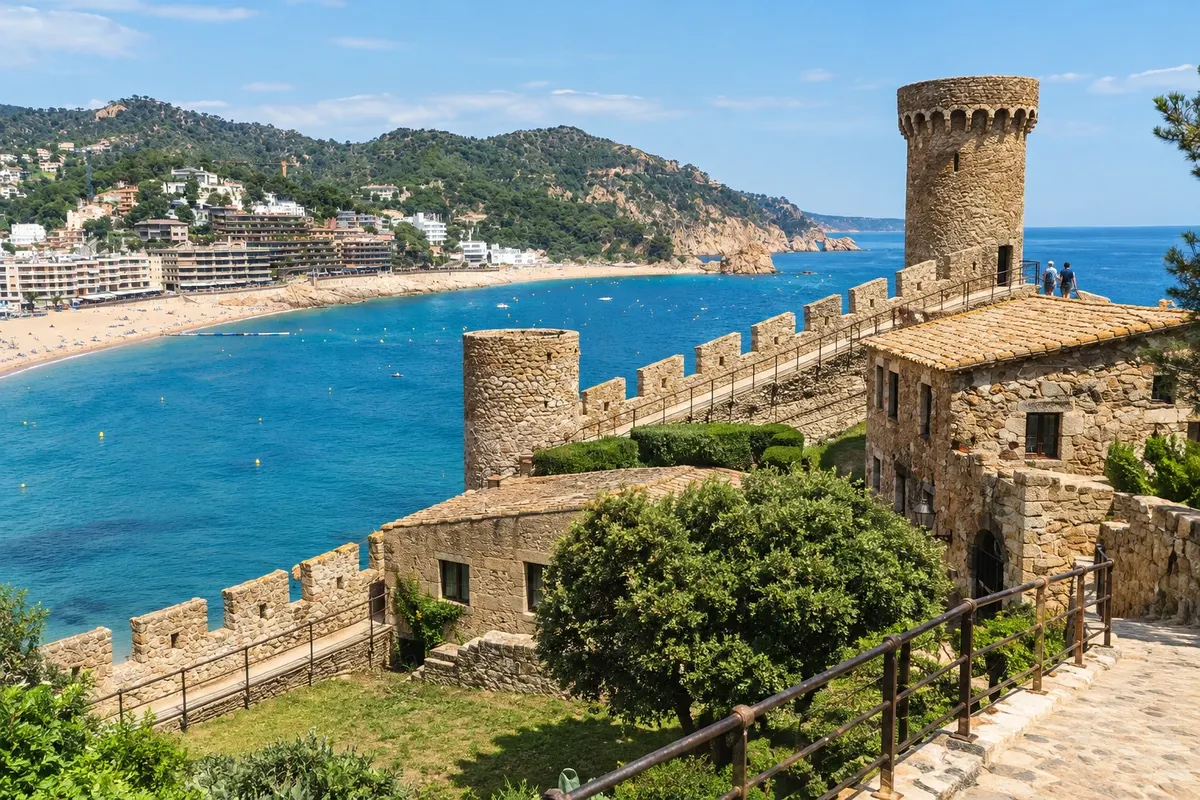
Wall · Tossa de Mar, Catalonia
Vila Vella de Tossa de Mar
Walled enclosure from the 12th to 14th centuries on the cabo de Tossa, the only fortified medieval settlement remaining on the Catalunha coast. It has about 300 meters of wall, seven round towers, stone lanes and, at the top, the Far de Tossa.
Illustrative images. The pictures in this guide are illustrations based on the real place, not photographs, and may differ from it.

Discover
About Vila Vella de Tossa de Mar
The castle of Tossa was erected in 1187 by order of the abbot of the monastery of Santa Maria de Ripoll, owner of the place since 966. In the same year the abbot granted a charter of settlement, which gave rise to the walled village. The wall was rebuilt in the 14th century, after attacks such as that of 1285, and served as defence against pirates. In 1931 the Vila Vella was declared a national historic-artistic monument.
The enclosure has a perimeter of about 300 meters and preserves almost the entire wall, with battlements and seven round towers. Three are taller: the Torre d'en Joanàs, over the sea rocks; the Torre de les Hores, or Clock Tower, next to the original gate; and the Torre des Codolar, to the west. On the highest part of the cape a wall was not needed because the cliff already provided defence.
Inside, the streets are narrow and steep, with houses from the 15th and 16th centuries. Remnants of the old Gothic church of Sant Vicenç remain. A staircase next to the entrance square leads to the path along the ramparts, inside the wall.
At the highest point of the cape, 60 meters above the sea, stands the Far de Tossa, a lighthouse inaugurated on 29 August 1917 in place of the old castle. It is still in operation and houses the Centre d'Interpretació dels Fars de la Mediterrània, about the history and technology of lighthouses. Around it there are viewpoints over the coast.
Before you go
Practical information
Cidade Turismo reviews its information regularly, but something may have changed. Check with the place before planning your trip.
How much time to set aside
From 1 hour to 1.5 hours for the lanes, the path along the ramparts and the lighthouse.
Best time
Early in the morning or late in the afternoon, when there are fewer people and less heat. The view of the walls from the beach is usually better with the morning sun, as the bay faces east. Check the opening hours of the lighthouse centre before going.
How to get there
On foot, from the Platja Gran or from the centre. The main gate is next to the Torre de les Hores. To the lighthouse there is an uphill route via the access road or through the enclosure's narrow streets.
Tip
Wear sturdy footwear: the paving is stone and the slopes are steep. The lighthouse interpretation centre usually charges an entrance fee and has its own opening hours; check before climbing. Bring water in summer.
Get your questions answered
Frequently asked questions about Vila Vella de Tossa de Mar
Why is the Vila Vella so well known?
It is the only example of a fortified medieval settlement that still exists on the Catalan coast, with the wall almost complete and seven towers.
What is in the lighthouse?
The Far de Tossa, dating from 1917, is still in operation and houses an interpretation center about the lighthouses of the Mediterranean. Check opening times before climbing.
Is the visit difficult?
There are slopes and stone steps. It is not suitable for strollers and requires care from those with mobility difficulties.
When was the wall built?
The first enclosure dates from the late 12th century. Most of what is seen today is from the 14th-century reconstruction.