

 Brazil
 Argentina
 Bolivia
 Chile
 Colombia
 Ecuador
 Guyana
 French Guiana
 Falkland Islands (Malvinas)
 Paraguay
 Peru
 Suriname
 Uruguay
 Venezuela
 Austria
 Belgium
 Croatia
 Denmark
 Spain
 Finland
 France
 Greece
 the Netherlands
 Hungary
 Ireland
 Iceland
 Italy
 Luxembourg
 Norway
 Poland
 Portugal
 the United Kingdom
 the Czech Republic
 Sweden
 Switzerland
 Turkey
 the United States
 Mexico
 the Dominican Republic
 South Africa
 Australia
 Fiji
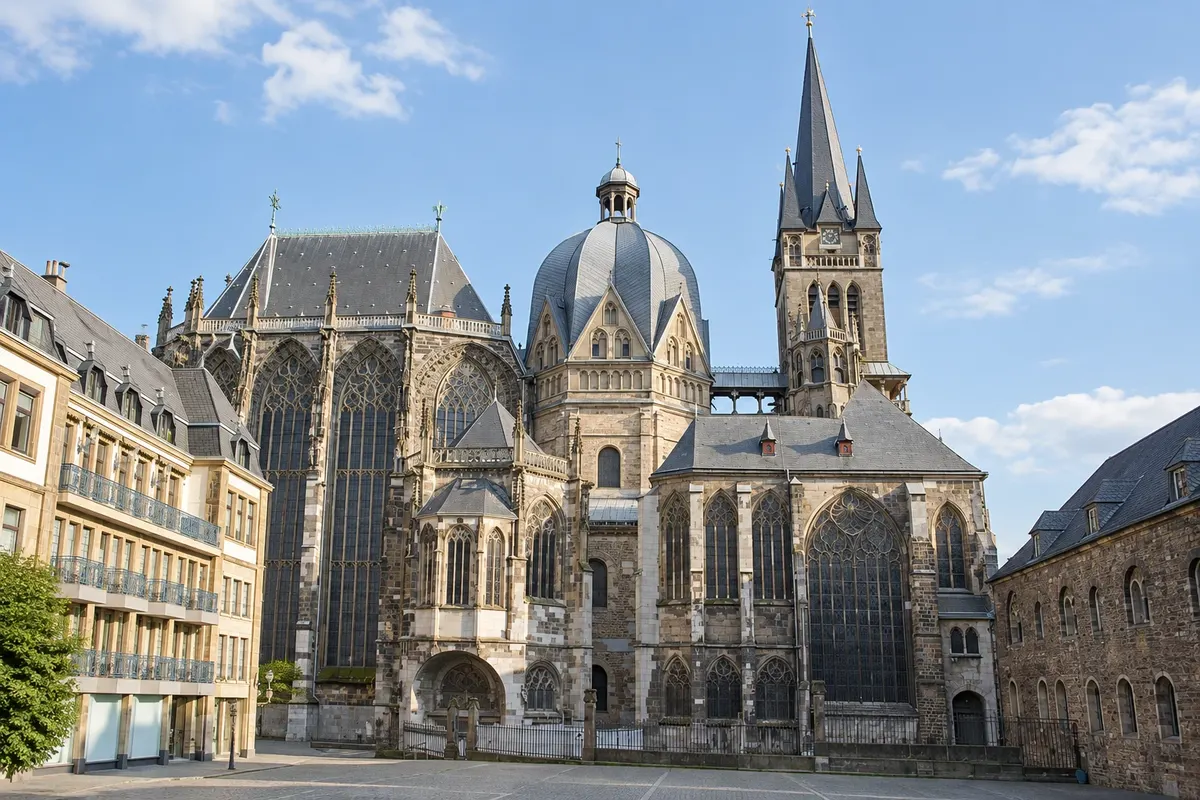
Cathedral · Aachen, Renânia do Norte-Vestfália
Aachen Cathedral
Cathedral built around Charlemagne’s octagonal palatine chapel from around 800, where he was buried and where the Holy Roman kings were crowned from 936 to 1531. First German monument inscribed as a UNESCO World Heritage Site, in 1978.
Illustrative images. The pictures in this guide are illustrations based on the real place, not photographs, and may differ from it.

Discover
About Aachen Cathedral
The Aachen Cathedral originated as the palace chapel of Charlemagne. The construction of the central part, the octagonal palatine chapel, took place between about 795 and about 803. Charlemagne died in 814 and was buried in the church; his remains are today in the Shrine of Charlemagne (Karlsschrein) in the choir.
Between 936 and 1531, the church was the coronation site of the Holy Roman kings. The marble throne, in the upper gallery, was used in the ceremony. Since the Middle Ages, the church has also been a major pilgrimage destination: every seven years the Heiligtumsfahrt displays the fabric relics kept in the Shrine of Mary (Marienschrein).
The cathedral grew around the octagon. Under the dome hangs the large bronze chandelier donated by Emperor Frederick I, Barbarossa. Between 1355 and 1414 the Gothic choir was built, with very tall stained glass windows, which locals call Aachen’s glass house. Side chapels were added in following centuries, and the west tower was completed at the end of the 19th century. The church has been the seat of the Diocese of Aachen since 1930.
In 1978 the cathedral was inscribed, together with the treasury, as the first German monument on the UNESCO World Heritage list.
Before you go
Practical information
Cidade Turismo reviews its information regularly, but something may have changed. Check with the place before planning your trip.
How much time to set aside
About 45 minutes on your own; the public guided tour lasts about 45 minutes.
Best time
Right at opening, before the groups. Outside Mass times visiting is free; on days with ceremonies the church may close briefly. Check times before you go.
How to get there
It is in the historic center, between the Münsterplatz and the Katschhof. From the central station it is about a 15-minute walk; city buses stop at the Elisenbrunnen, five minutes away.
Tip
To see Charlemagne’s throne you must enter with the guided tour. Tickets for public tours are sold the same day at the Dominformation, on Johannes-Paul-II.-Straße.
Official website
Get your questions answered
Frequently asked questions about Aachen Cathedral
Who is buried in Aachen Cathedral?
Charlemagne, who died in 814. His remains are in the Shrine of Charlemagne in the Gothic choir. Emperor Otto III was also buried in the church.
How can you see Charlemagne’s throne?
The throne is in the upper gallery and can only be seen on a guided tour. Tickets for public tours are sold on the day at the Dominformation, next to the cathedral.
Why is Aachen Cathedral a World Heritage Site?
Because of Charlemagne’s Palatine Chapel, one of the best-preserved buildings from the Carolingian period, and the church’s role as a coronation and pilgrimage site. It was inscribed in 1978, the first German site on the list.
What is Aachen’s Heiligtumsfahrt?
It is the pilgrimage held every seven years, since 1349, when the textile relics kept in Mary’s shrine are displayed. Check the year of the next event before planning your trip.