

 Brazil
 Argentina
 Bolivia
 Chile
 Colombia
 Ecuador
 Guyana
 French Guiana
 Falkland Islands (Malvinas)
 Paraguay
 Peru
 Suriname
 Uruguay
 Venezuela
 Germany
 Austria
 Belgium
 Croatia
 Denmark
 Spain
 Finland
 France
 Greece
 the Netherlands
 Hungary
 Ireland
 Iceland
 Italy
 Luxembourg
 Norway
 Poland
 Portugal
 the Czech Republic
 Sweden
 Switzerland
 Turkey
 the United States
 Mexico
 the Dominican Republic
 South Africa
 Australia
 Fiji
 New Zealand
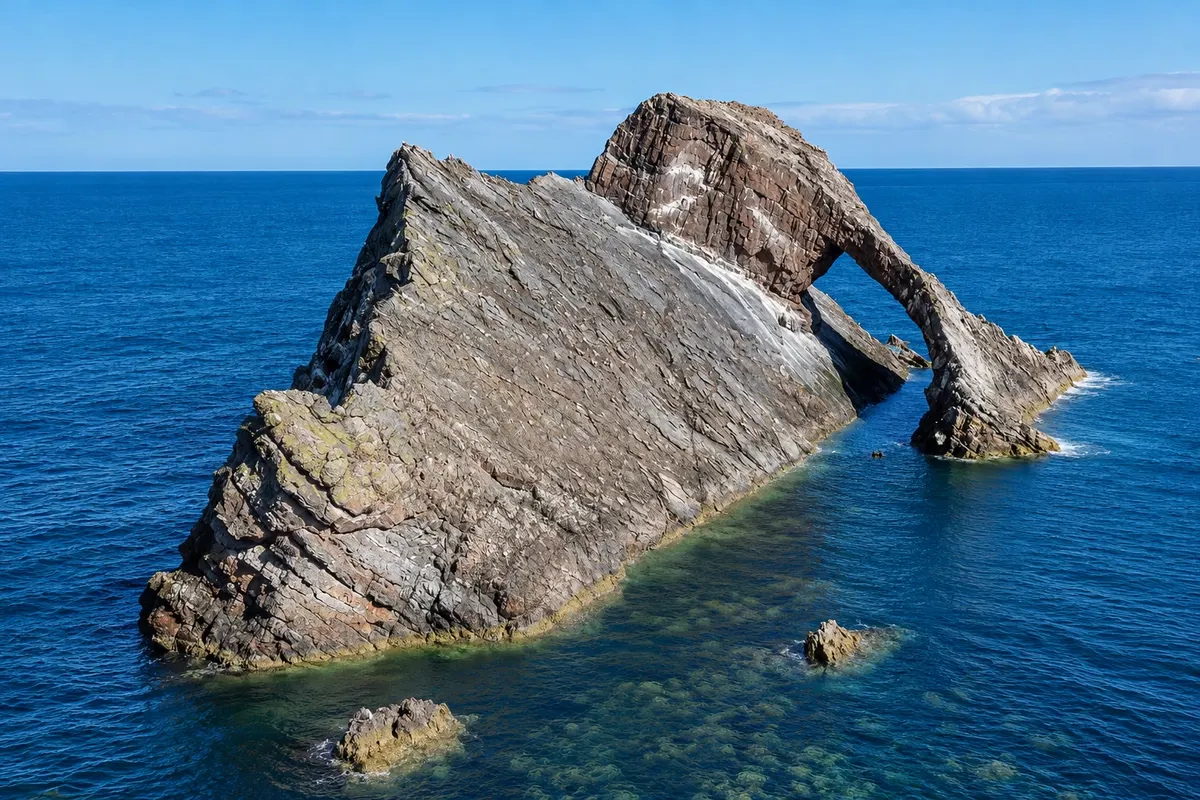
Rock formation · Cullen, Scotland
Bow Fiddle Rock
Quartzite sea rock in the shape of an arch, beside the village of Portknockie, about 3 km from Cullen. The name comes from its resemblance to the tip of a violin bow.
Illustrative images. The pictures in this guide are illustrations based on the real place, not photographs, and may differ from it.

Discover
About Bow Fiddle Rock
Bow Fiddle Rock is a sea rock beside the village of Portknockie, about 3 km west of Cullen. It is made of folded, tilted layers of quartzite that sea erosion has opened into a large arch. The name evokes the curved tip of the bow used to play the violin, which the rock resembles.
The rock lies a few metres from the shore and is clearly visible from the top of the cliff and from the rocky beach near the village. In spring and summer seabirds such as gulls and puffins often land and nest on its ledges.
The Moray coastal path links Cullen to Portknockie and passes close to the rock, the route alternating beaches, cliffs and coves.
Before you go
Practical information
Cidade Turismo reviews its information regularly, but something may have changed. Check with the place before planning your trip.
How much time to set aside
About half an hour on site; two hours return on foot from Cullen via the coastal path.
Best time
At late afternoon, when the sun sets west of the arch, or at low tide when you can get closer over the rocks.
How to get there
It's in Portknockie, about 3 km from Cullen. You can walk there via the Moray coastal trail or drive to the village, with parking near the viewpoint.
Tip
Be careful on the beach rocks: they become slippery, and the tide rises quickly.
Get your questions answered
Frequently asked questions about Bow Fiddle Rock
Why is it called Bow Fiddle Rock?
Because the arched rock resembles the tip of a violin bow.
How do you get to Bow Fiddle Rock from Cullen?
On foot via the Moray coastal trail, about 3 km, or by car to Portknockie, with parking near the viewpoint.
What's the best time to see Bow Fiddle Rock?
Late afternoon, with the sun in the west, or at low tide, when you can get closer across the rocks.