

 Brazil
 Argentina
 Bolivia
 Chile
 Colombia
 Ecuador
 Guyana
 French Guiana
 Falkland Islands (Malvinas)
 Paraguay
 Peru
 Suriname
 Uruguay
 Venezuela
 Germany
 Austria
 Belgium
 Croatia
 Denmark
 Spain
 Finland
 France
 Greece
 the Netherlands
 Hungary
 Ireland
 Iceland
 Italy
 Luxembourg
 Norway
 Poland
 Portugal
 the United Kingdom
 the Czech Republic
 Sweden
 Switzerland
 Turkey
 the United States
 Mexico
 the Dominican Republic
 South Africa
 Australia
 Fiji
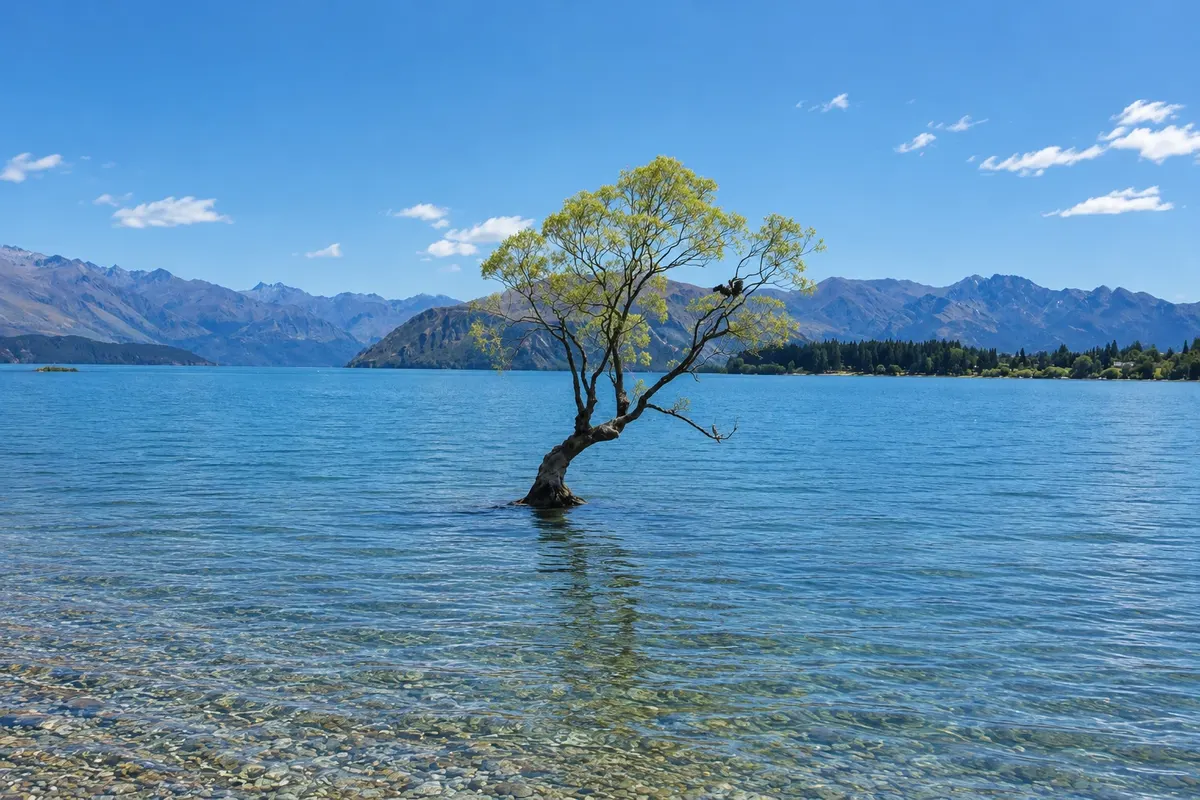
Landscape · Wanaka, Otago
That Wanaka Tree
Willow that grows in Lake Wānaka, near the shore adjacent to the town center, with the mountains in the background. It is one of New Zealand’s most photographed landscapes.
Illustrative images. The pictures in this guide are illustrations based on the real place, not photographs, and may differ from it.

Discover
About That Wanaka Tree
That Wānaka Tree is a willow that grows alone in Lake Wānaka, a few meters from the shore, beside the pebble beach near the town center. According to local lore, the tree began as a fence post that took root, and rising lake levels left it surrounded by water.
With the mountains and, in winter, snow in the background, the tree became one of the most photographed images in the country and one of the most shared on social media. In 2020 vandals cut some low branches, and since then the guidance has been not to climb on or touch it.
Before you go
Practical information
Cidade Turismo reviews its information regularly, but something may have changed. Check with the place before planning your trip.
How much time to set aside
About 15 to 30 minutes; longer if you walk along the shore.
Best time
Early morning, when the lake is calm and there are fewer people. In autumn the leaves change color; in winter the tree is leafless, with snow on the mountains in the background.
How to get there
It’s on the lakefront, about a 10-minute walk from central Wānaka, along the lakeside trail toward Roys Bay.
Tip
Do not climb the tree or enter the water near it: local guidance is to preserve it. For photography, arrive before sunrise when there are fewer people.
Get your questions answered
Frequently asked questions about That Wanaka Tree
Where is That Wānaka Tree?
On the shore of Lake Wānaka, about a 10-minute walk from the town centre.
Can you climb the Wānaka tree?
No. The guidance is not to climb or touch the tree, which was damaged by vandals in 2020.
What is the best time to photograph the Wānaka tree?
Early morning, when the lake is usually calm and there are fewer people.