

 Brazil
 Argentina
 Bolivia
 Chile
 Colombia
 Ecuador
 Guyana
 French Guiana
 Falkland Islands (Malvinas)
 Paraguay
 Peru
 Suriname
 Uruguay
 Venezuela
 Germany
 Austria
 Belgium
 Croatia
 Denmark
 Spain
 Finland
 France
 Greece
 the Netherlands
 Hungary
 Ireland
 Iceland
 Italy
 Norway
 Poland
 Portugal
 the United Kingdom
 the Czech Republic
 Sweden
 Switzerland
 Turkey
 the United States
 Mexico
 the Dominican Republic
 South Africa
 Australia
 Fiji
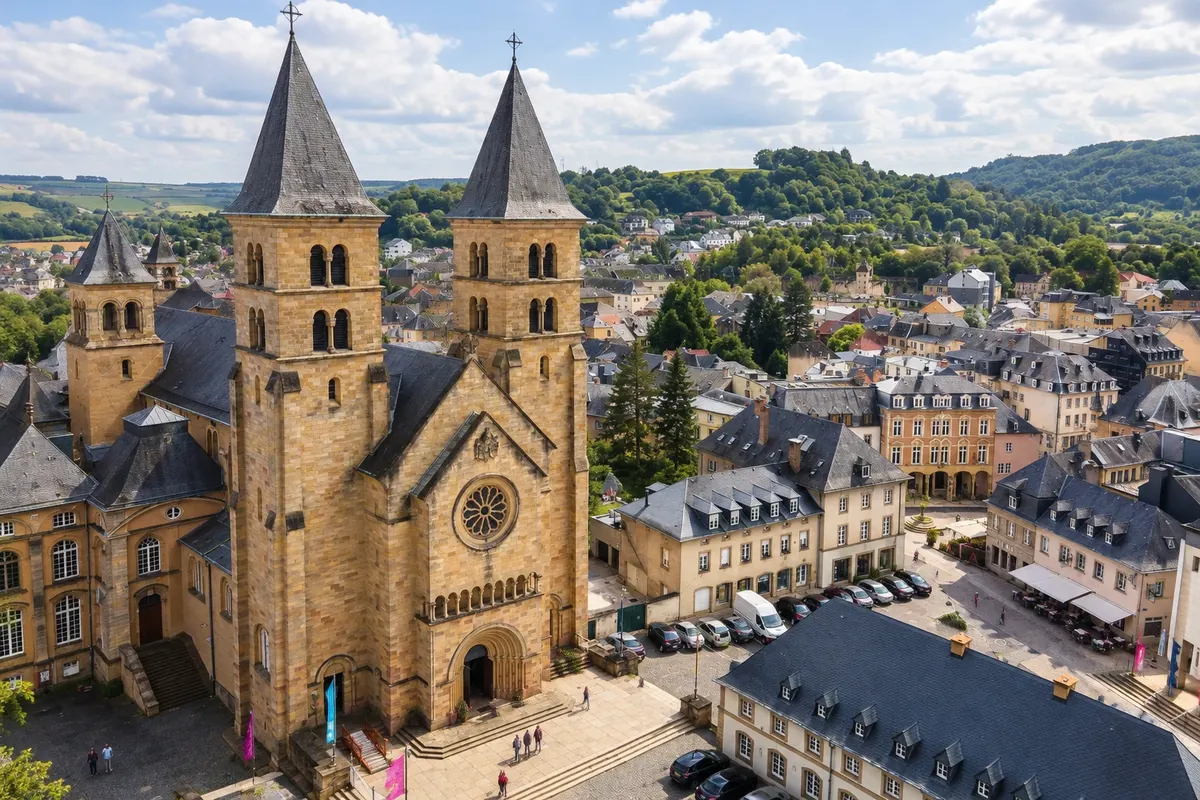
Church · Echternach, Echternach
Basilique Saint-Willibrord (Basílica de São Willibrord)
Romanesque basilica rebuilt after the Second World War, with the crypt where the tomb of São Willibrord is located, founder of the abadia de Echternach in 698. Beside it are the baroque abadia buildings and the abadia museum.
Illustrative images. The pictures in this guide are illustrations based on the real place, not photographs, and may differ from it.

Discover
About Basilique Saint-Willibrord (Basílica de São Willibrord)
The basílica de São Willibrord is at the heart of Echternach's history. Willibrord, a monk born in Northumbria, England, was the missionary who evangelized Frisia and the Low Countries and the first bishop of Utrecht. In 698 he founded the abadia de Echternach, where he died in 739 and was buried. The abadia became a center of pilgrimage and of manuscript illumination.
The present church follows the plan of the 11th-century Romanesque basilica, with two towers on the façade and three naves. In December 1944, during the Battle of the Bulge, it was almost completely destroyed by explosions and was rebuilt after the war, being reconsecrated in 1953. The stained glass and much of the decoration date from that reconstruction.
In the older crypt is the tomb of São Willibrord, in a white marble sarcophagus, and remains of medieval wall paintings. It is the destination of the dancing procession, which takes place every year on Whit Tuesday and is inscribed by UNESCO as intangible heritage.
Beside the basilica are the abadia buildings, rebuilt in Baroque style in the 18th century and today occupied by a school, with the courtyard and garden open. In the abadia's basement is the abadia museum, which tells the history of the monastery and shows reproductions of the illuminated manuscripts produced there, such as the Codex Aureus de Echternach.
Before you go
Practical information
Cidade Turismo reviews its information regularly, but something may have changed. Check with the place before planning your trip.
How much time to set aside
From 30 minutes to 1 hour including the crypt; add about 45 minutes for the abadia museum.
Best time
In the morning, outside mass times. On Whit Tuesday, the day of the dancing procession, the basilica and the town become very crowded. The abadia museum normally opens in season, from April to October; check before you go.
How to get there
It is on the Parvis de la Basilique, a 3-minute walk from Praça do mercado and 5 minutes from the bus station. By car, use the car parks at the town entrance.
Tip
Go down to the crypt to see the saint's tomb and the wall paintings. Then cross the abadia courtyard to the garden on the Sûre's bank. Those attending on Whit Tuesday should arrive early to see the procession.
Get your questions answered
Frequently asked questions about Basilique Saint-Willibrord (Basílica de São Willibrord)
Who was Saint Willibrord?
A monk born in Northumbria, England, who evangelized Frisia and the Low Countries, became the first bishop of Utrecht and founded Echternach Abbey in 698. He died in 739 and is buried in the basilica’s crypt.
Is the basilica original?
No. It was almost completely destroyed in December 1944 and rebuilt after the war following the 11th-century Romanesque design. The crypt is the oldest part.
What is the Codex Aureus of Echternach?
An illuminated Gospel book decorated with gold, produced at the abbey in the 11th century. The original is in Nuremberg, Germany; the abbey museum displays reproductions.
When is the dancing procession?
Every year on Whit Tuesday (the Tuesday after Pentecost), which falls between May and June. Participants cross the town taking small hops until they reach the basilica.