

 Brazil
 Argentina
 Bolivia
 Chile
 Colombia
 Ecuador
 Guyana
 French Guiana
 Falkland Islands (Malvinas)
 Paraguay
 Peru
 Suriname
 Uruguay
 Venezuela
 Germany
 Austria
 Belgium
 Croatia
 Denmark
 Spain
 Finland
 France
 Greece
 the Netherlands
 Hungary
 Ireland
 Iceland
 Italy
 Norway
 Poland
 Portugal
 the United Kingdom
 the Czech Republic
 Sweden
 Switzerland
 Turkey
 the United States
 Mexico
 the Dominican Republic
 South Africa
 Australia
 Fiji
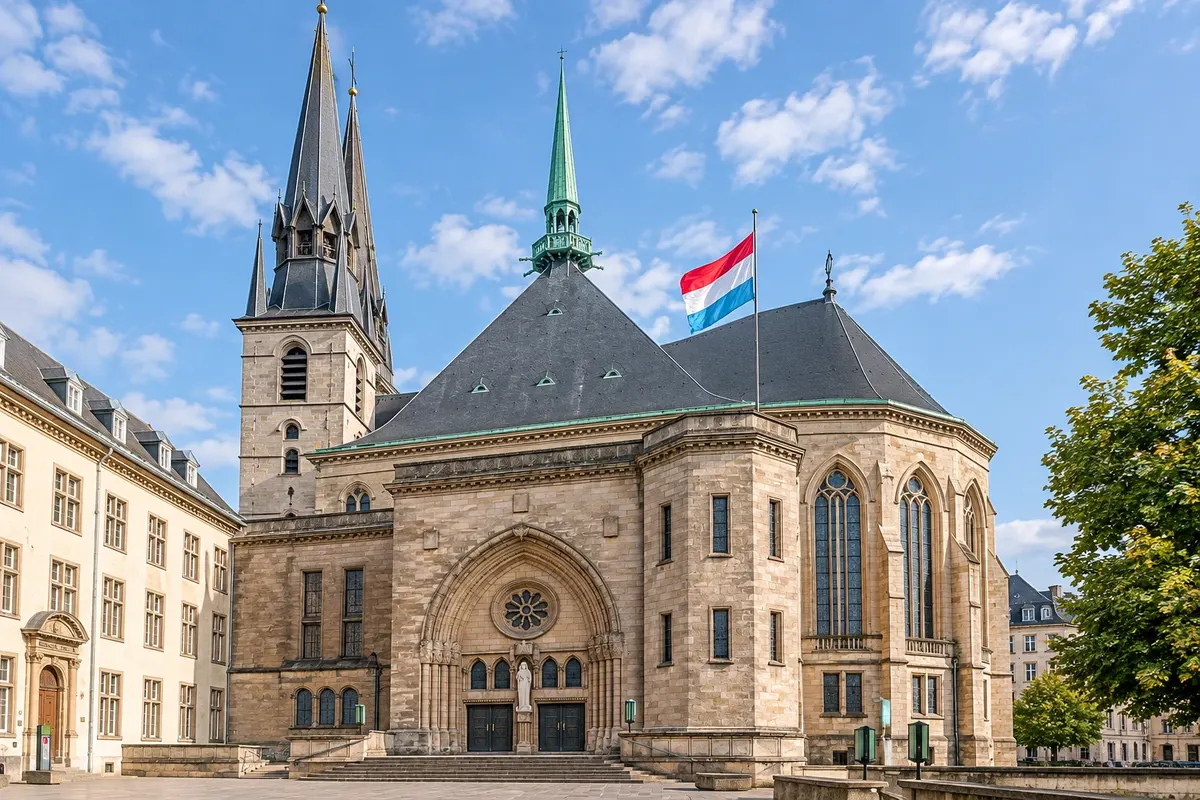
Church · Luxemburgo, Luxemburgo
Cathédrale Notre-Dame (Catedral de Notre-Dame)
The city’s cathedral, built by the Jesuits in the early 17th century, with a late Gothic façade, a Renaissance portal and the crypt that houses the tomb of John the Blind, Count of Luxembourg and King of Bohemia.
Illustrative images. The pictures in this guide are illustrations based on the real place, not photographs, and may differ from it.

Discover
About Cathédrale Notre-Dame (Catedral de Notre-Dame)
Notre-Dame Cathedral was built between 1613 and 1621 as the church of the Jesuit college, on the edge of the upper town. It blends late Gothic — in the vaults and windows — with Renaissance elements such as the north portal, and has three pointed towers visible from many parts of the city. In 1870 it became a cathedral, and in the 20th century it was extended toward the choir.
Inside, notable features include the stained glass, the organ gallery carved in stone and the image of Our Lady, Consoler of the Afflicted, patroness of the city and country. Each year, between the third and fifth week after Easter, the cathedral hosts the Octave, a pilgrimage in honour of this image that ends with a procession through the streets of the upper town and a small market around it.
The crypt contains the graves of the grand-ducal family and that of John the Blind, Count of Luxembourg and King of Bohemia, who died at the Battle of Crécy in 1346. The crypt is guarded by two bronze lions. It can generally be viewed when the cathedral is open to visitors, outside mass times.
The cathedral stands next to the National Library and Place de la Constitution. It is an active place of worship: visit in silence and avoid service times.
Before you go
Practical information
Cidade Turismo reviews its information regularly, but something may have changed. Check with the place before planning your trip.
How much time to set aside
Allow 20 to 40 minutes, including the crypt.
Best time
In the morning, outside mass times. During the Octave, between the third and fifth week after Easter, there are many ceremonies and the cathedral becomes very full. Check visiting hours before you go.
How to get there
It is on rue Notre-Dame in the upper town, a 3-minute walk from Place de la Constitution and 5 minutes from Place Guillaume II. From the station area, the tram stops nearby, after the Adolphe Bridge.
Tip
Go down to the crypt to see the bronze lions and the tomb of John the Blind. Exit through the door on the Place de la Constitution side and walk to the Gëlle Fra for the view of the Pétrusse valley.
Get your questions answered
Frequently asked questions about Cathédrale Notre-Dame (Catedral de Notre-Dame)
Who is buried in the cathedral crypt?
Members of the grand‑ducal family and John the Blind, Count of Luxembourg and King of Bohemia, who died in 1346 at the Battle of Crécy. The crypt entrance has two bronze lions.
What is the Oitava?
The annual pilgrimage to Our Lady Consoler of the Afflicted, the country's patroness, between the third and fifth week after Easter, with masses, a final procession through the upper town and a market around the cathedral.
Is the cathedral Gothic?
It’s a mix: it was built in the early 17th century by the Jesuits, with late Gothic vaults and windows and a Renaissance portal and decoration. The choir area was enlarged in the 20th century.