

 Brazil
 Argentina
 Bolivia
 Chile
 Colombia
 Ecuador
 Guyana
 French Guiana
 Falkland Islands (Malvinas)
 Paraguay
 Peru
 Suriname
 Uruguay
 Venezuela
 Germany
 Austria
 Belgium
 Croatia
 Denmark
 Spain
 Finland
 France
 Greece
 the Netherlands
 Hungary
 Ireland
 Iceland
 Luxembourg
 Norway
 Poland
 Portugal
 the United Kingdom
 the Czech Republic
 Sweden
 Switzerland
 Turkey
 the United States
 Mexico
 the Dominican Republic
 South Africa
 Australia
 Fiji
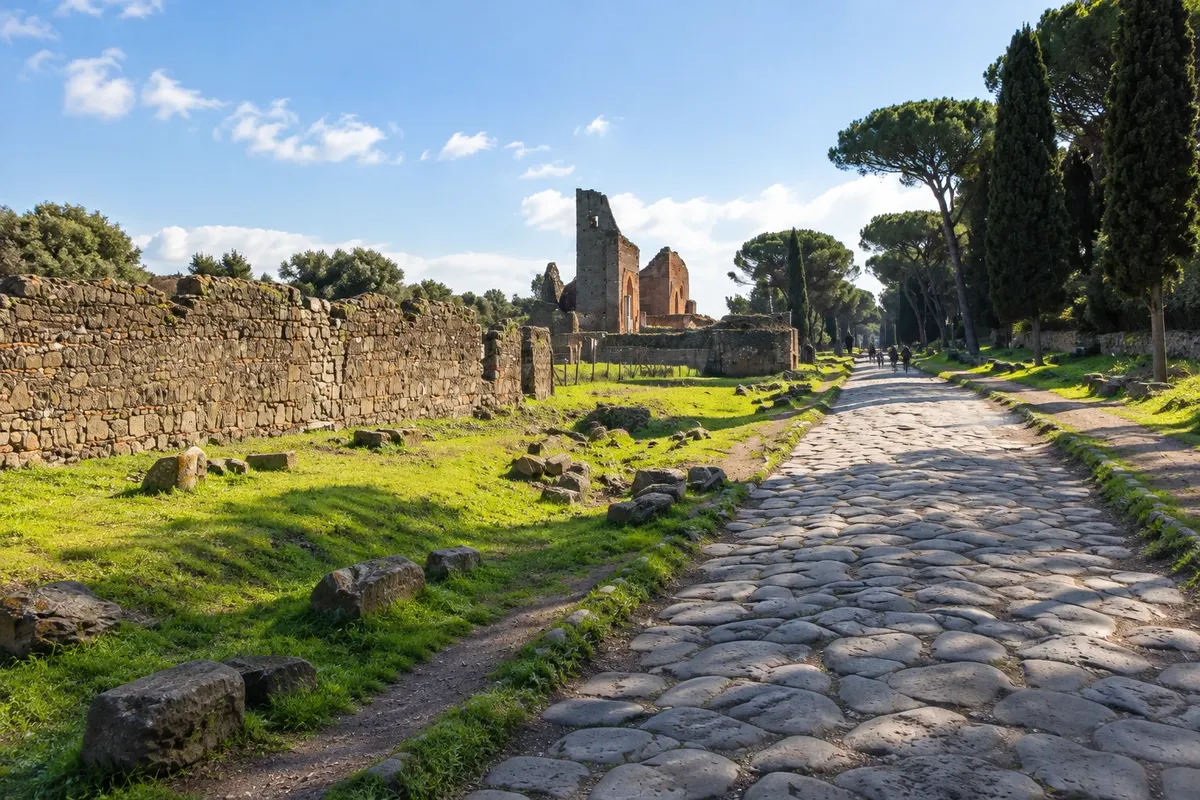
Historic site · Roma, Lazio
Via Appia Antica
The Roman road opened in 312 BC, still with stretches of original stone, lined with pine trees, tombs and catacombs. A good bike ride or walk outside the city center.
Illustrative images. The pictures in this guide are illustrations based on the real place, not photographs, and may differ from it.

Discover
About Via Appia Antica
The Via Appia Antica is the most famous of the Roman roads. It was opened in 312 BC by the censor Ápio Cláudio Cego to link Rome to Capua and later extended to Brindisi in southern Italy. The Romans called it Regina Viarum, the queen of roads. Today the stretch that leaves Rome is protected by the Parque Arqueológico da Via Appia Antica.
Because the Romans could not bury the dead inside the city, wealthy families built tombs along the road. That is why the landscape is made up of umbrella pines, cypresses, ruins of mausoleums and ancient walls. In several sections the large basalt blocks of the original paving still appear, showing wheel marks.
The best-known point is the Mausoleo di Cecilia Metella, a cylindrical tomb from the 1st century BC that became part of a castle in the Middle Ages. Nearby are the Circo di Massenzio and the Villa di Massenzio, and further on the Villa dei Quintili. Along the same road are the Christian catacombs of San Callisto and San Sebastiano.
The most common way to travel the road is by bicycle, rented at the park’s information points, or on foot. The ancient paving is uneven: wear sneakers. The section close to the city has car traffic and a narrow sidewalk in places, so it’s worth starting the walk from the catacombs.
Before you go
Practical information
Cidade Turismo reviews its information regularly, but something may have changed. Check with the place before planning your trip.
How much time to set aside
Half a day, combining a section of the road with a catacomb. A full day to cycle to the Villa dei Quintili.
Best time
In spring (March to May) and autumn (September to November), when temperatures are mild for cycling. In summer (June to August) set out early: there is little shade outside the pines. On Sundays there are many Romans cycling.
How to get there
Bus 118 from the Circo Massimo or Colosseo metro stations (line B), and bus 660 from Arco di Travertino station (line A), stop at the catacombs. Bus 218 departs from San Giovanni. By taxi, the journey from the center takes about 20 minutes.
Tip
Sites within the park, such as the Mausoleo di Cecilia Metella and the Villa dei Quintili, have their own opening times and tickets — check the official website. Bring water and a snack: there are few places to eat along the road.
Official website
Get your questions answered
Frequently asked questions about Via Appia Antica
How to explore Via Appia Antica?
The most common way is by bicycle, rented at the park's information points, or on foot. The Roman paving is uneven, so wear sneakers and prefer a bike with wide tires.
What to see on Via Appia Antica?
The original basalt paving, the Mausoleo di Cecilia Metella, the Circo di Massenzio, the Villa dei Quintili and the catacombs of San Callisto and San Sebastiano.
Can you combine Via Appia with the catacombs?
Yes. The catacombs of San Callisto and San Sebastiano are on the road itself. Book the catacomb and use the rest of the time to walk or cycle.
How to get to Via Appia Antica by public transport?
By buses 118 (from Circo Massimo or Colosseo metro, line B) and 660 (from Arco di Travertino metro, line A), which stop at the catacombs.