

 Brazil
 Argentina
 Bolivia
 Chile
 Colombia
 Ecuador
 Guyana
 French Guiana
 Falkland Islands (Malvinas)
 Paraguay
 Peru
 Suriname
 Uruguay
 Venezuela
 Germany
 Austria
 Belgium
 Croatia
 Denmark
 Spain
 Finland
 France
 Greece
 the Netherlands
 Hungary
 Ireland
 Iceland
 Luxembourg
 Norway
 Poland
 Portugal
 the United Kingdom
 the Czech Republic
 Sweden
 Switzerland
 Turkey
 the United States
 Mexico
 the Dominican Republic
 South Africa
 Australia
 Fiji
Historic neighborhood · Roma, Lazio
Trastevere
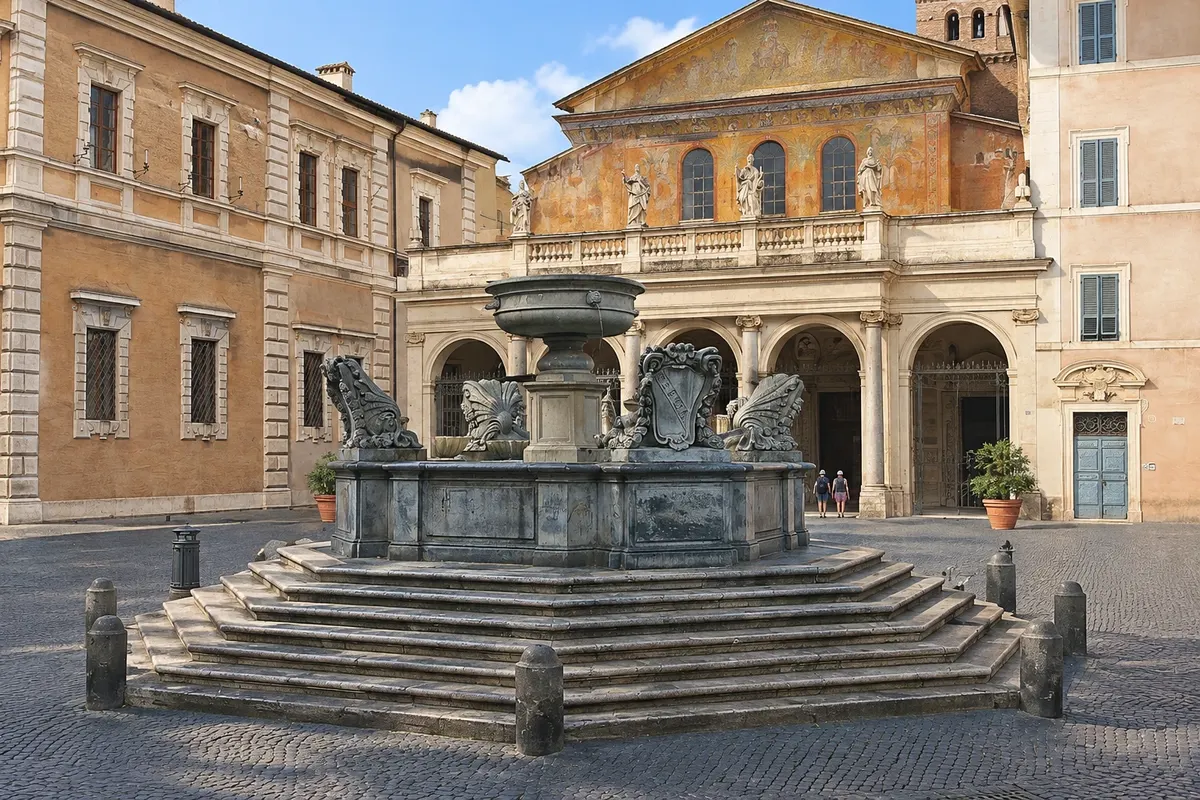
Neighborhood of cobbled alleys, ochre-colored houses and trattorias on the other side of the Tiber. At its center is the Piazza di Santa Maria in Trastevere, with the basilica of golden mosaics.
Illustrative images. The pictures in this guide are illustrations based on the real place, not photographs, and may differ from it.

Discover
About Trastevere
Trastevere means “beyond the Tiber”: it is the neighborhood on the west bank of the river, between the Ilha Tiberina and the Gianicolo hill. The narrow cobbled streets, façades covered in ivy and clothes hanging on lines form the best-known portrait of popular Rome. By day it is a residential neighborhood, with bakeries and small markets; at night it fills with people at outdoor tables.
The heart of the neighborhood is the Piazza di Santa Maria in Trastevere, with a fountain in the center and the Basilica di Santa Maria in Trastevere, one of Rome’s oldest churches dedicated to the Virgin. The façade has a mosaic frieze of Mary and the Child, and inside the apse are the twelfth-century golden mosaics and scenes of the Virgin’s life executed by Pietro Cavallini at the end of the thirteenth century. The church is active worship: shoulders and knees should be covered to enter.
It’s worth wandering without a plan along Via della Lungaretta, Via della Scala and the alleys around the Piazza di San Cosimato, where a neighborhood market runs in the morning. Further south is the Basilica di Santa Cecilia in Trastevere, built over the saint’s house, and on Sunday mornings the Porta Portese market occupies the streets near the river.
Trastevere is also the starting point for an uphill walk to the Gianicolo via Via Garibaldi. Roman cuisine is everywhere: cacio e pepe, carbonara, amatriciana, Jewish-style artichokes in season. Dinner begins around 20:00 and the most popular places fill up early.
Before you go
Practical information
Cidade Turismo reviews its information regularly, but something may have changed. Check with the place before planning your trip.
How much time to set aside
Two to three hours to walk and see the basilica; allow the whole evening if you plan to dine in the neighborhood.
Best time
Late afternoon, to see the streets in low light, and at night when the neighborhood becomes livelier. In the morning it’s quieter and good for photos. In spring and autumn the weather usually helps outdoor seating; in summer (June to August) it’s very hot during the day.
How to get there
On foot from the historic center, crossing the Tiber via Ponte Sisto (near Campo de' Fiori) or via Ilha Tiberina. Tram 8 departs from Largo di Torre Argentina and stops at Viale di Trastevere. There is no metro station in the neighborhood.
Tip
For dinner in Trastevere, make a reservation on Friday and Saturday or arrive before 20:00. Streets farther from the central square tend to have quieter restaurants. Keep an eye on your belongings on crowded streets at night.
Get your questions answered
Frequently asked questions about Trastevere
What is the best time to visit Trastevere?
Late afternoon and evening are the liveliest times, with the trattorias full. In the morning the neighborhood is calmer, good for walking around and entering the Basilica di Santa Maria in Trastevere.
Do you have to pay to enter the Basilica di Santa Maria in Trastevere?
Entrance is free. It's an active church: enter with shoulders and knees covered and avoid walking around during masses.
How to get from the center to Trastevere?
On foot, in 10 to 20 minutes from Campo de' Fiori or Piazza Navona, crossing Ponte Sisto. From Largo di Torre Argentina, tram 8 drops you off at Viale di Trastevere.
Can you walk up from Trastevere to the Gianicolo?
Yes. Via Garibaldi climbs from the neighborhood up to the Fontanone and Piazza Garibaldi, at the top of the hill. It's a climb of about 20 to 30 minutes, with stairways in some sections.