

 Brazil
 Argentina
 Bolivia
 Chile
 Colombia
 Ecuador
 Guyana
 French Guiana
 Falkland Islands (Malvinas)
 Paraguay
 Peru
 Suriname
 Uruguay
 Venezuela
 Germany
 Austria
 Belgium
 Croatia
 Denmark
 Spain
 Finland
 France
 Greece
 the Netherlands
 Hungary
 Ireland
 Iceland
 Luxembourg
 Norway
 Poland
 Portugal
 the United Kingdom
 the Czech Republic
 Sweden
 Switzerland
 Turkey
 the United States
 Mexico
 the Dominican Republic
 South Africa
 Australia
 Fiji
Archaeological site · Roma, Lazio
Circo Massimo
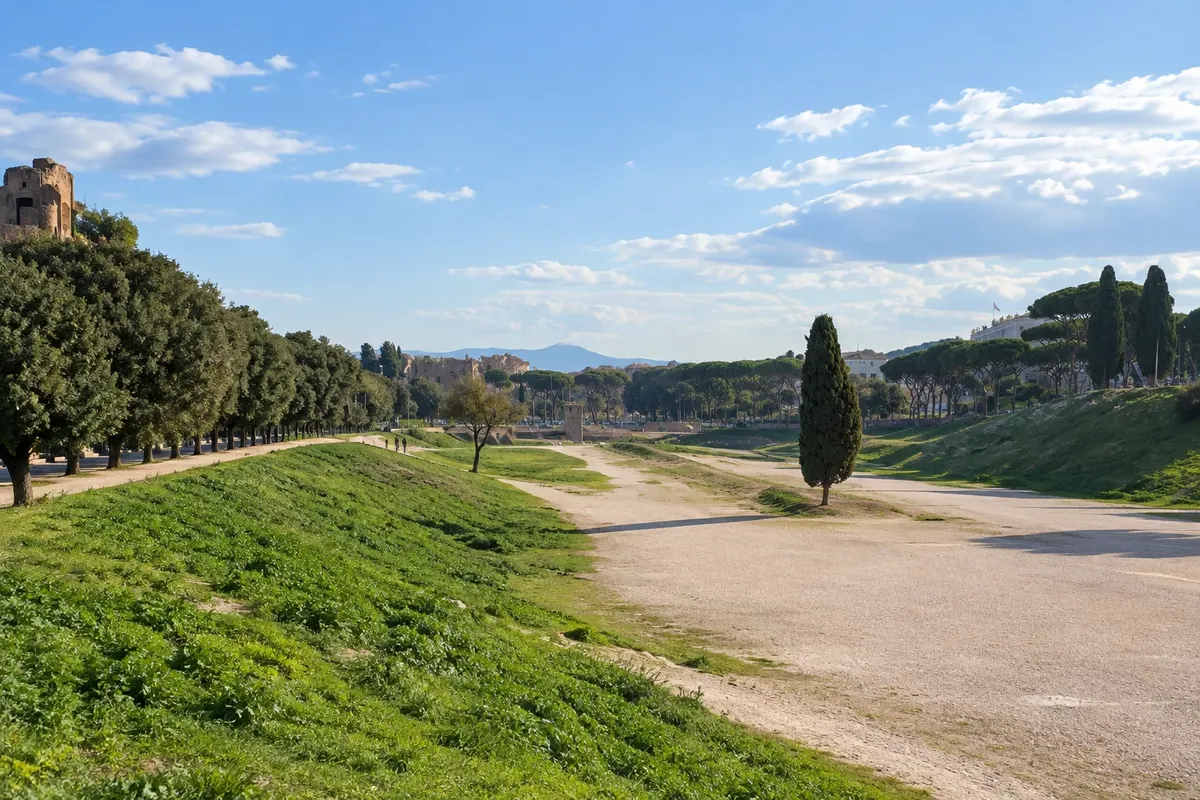
The large stadium for chariot races of ancient Rome, today a grassy valley 600 meters long between the Palatino and the Aventino. The eastern end preserves ruins and the Torre della Moletta.
Illustrative images. The pictures in this guide are illustrations based on the real place, not photographs, and may differ from it.

Discover
About Circo Massimo
The Circo Massimo was the largest venue for spectacles in ancient Rome. It occupied the valley between the Palatino and the Aventino hills, about 600 meters long and 140 meters wide, and hosted chariot races—the four‑horse carts that were the passion of the Roman people. It was also used for triumphal parades and processions.
The masonry structure began with Julius Caesar and was rebuilt several times after fires. Most of what is seen today dates to the reconstruction during the reign of Emperor Trajan in the 2nd century. Races continued until the 6th century. Afterwards the valley became agricultural land and later housed a gasometer and warehouses, until the 20th‑century excavations.
Today the track is a large open lawn, used by Romans for walking and running and sometimes for major shows and events. The elongated shape of the circus is still clearly visible, and from the Palatino side you can imagine the stands and the imperial palaces above.
At the eastern end is the archaeological area with remains of the stands, the shops and the triumphal arch, as well as the Torre della Moletta, a medieval tower of the Frangipane family. This section has opening hours and an entrance fee, and also offers the Circo Maximo Experience, an augmented reality route that shows the circus in its various phases.
Before you go
Practical information
Cidade Turismo reviews its information regularly, but something may have changed. Check with the place before planning your trip.
How much time to set aside
20 to 30 minutes to walk across the lawn; about 1 hour including the archaeological area and the augmented reality route.
Best time
In the late afternoon, when the light hits the ruins of the Palatino. In summer (June to August) avoid midday: the lawn has no shade. On days with concerts and events access may be restricted.
How to get there
Circo Massimo metro station (line B), at the eastern end of the circus. On foot from the Coliseu in about 10 minutes, or from the Bocca della Verità in 5 minutes.
Tip
The lawn is freely accessible; the archaeological area at the eastern end has its own opening hours and is closed on Mondays — check before you go. Combine the visit with the Aventino, which is just above, ascending via the Clivo dei Publicii.
Get your questions answered
Frequently asked questions about Circo Massimo
Is Circo Massimo ticketed?
The lawn is a public space with free access. The archaeological area at the eastern end, with the Torre della Moletta, has a paid entrance and its own opening hours.
What is the Circo Maximo Experience?
It's a route using augmented and virtual reality glasses that reconstructs the circus in various periods. It lasts about 40 minutes and offers versions in several languages. Check days and hours before you go.
Can you combine a visit to Circo Massimo with the Colosseum?
Yes. The Colosseum is about a 10-minute walk away, or one metro stop on line B. The Palatine, which is included in the same Colosseum ticket, is right next to the circus.