

 Brazil
 Argentina
 Bolivia
 Chile
 Colombia
 Ecuador
 Guyana
 French Guiana
 Falkland Islands (Malvinas)
 Paraguay
 Peru
 Suriname
 Uruguay
 Venezuela
 Germany
 Austria
 Belgium
 Croatia
 Denmark
 Finland
 France
 Greece
 the Netherlands
 Hungary
 Ireland
 Iceland
 Italy
 Luxembourg
 Norway
 Poland
 Portugal
 the United Kingdom
 the Czech Republic
 Sweden
 Switzerland
 Turkey
 the United States
 Mexico
 the Dominican Republic
 South Africa
 Australia
 Fiji
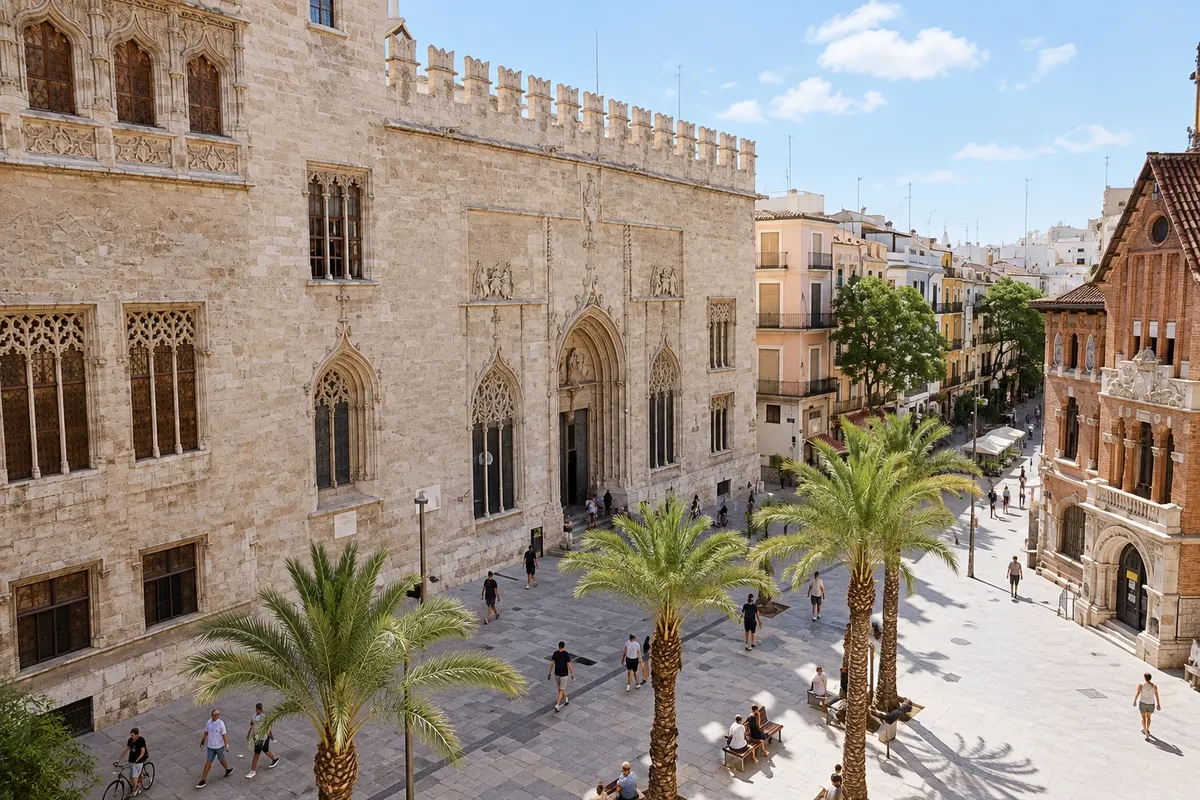
Monument · Valencia, Valencian Community
Silk Exchange (La Lonja)
Former silk exchange from the late 15th century, featuring the Hall of Columns with twisted trunks, the Orange Courtyard and gargoyles on the façade. UNESCO World Heritage.
Illustrative images. The pictures in this guide are illustrations based on the real place, not photographs, and may differ from it.

Discover
About Silk Exchange (La Lonja)
The Llotja de la Seda, or Lonja de la Seda, was built between 1482 and 1533 to house the businesses of silk merchants and other trades, at a time when València was one of the Mediterranean's wealthiest ports. The initial design is by master builder Pere Compte, and the building was added to the UNESCO World Heritage list in 1996.
The main hall, the Hall of Columns, has eight helical columns that rise like twisted trunks and spread into ribs in the vault, at 17 meters high. Letters engraved in the floor recall the rules of honest trade. Contracts were closed there.
The central tower contained a prison for merchants who did not pay their debts. On the other side is the Consolat de Mar, an old maritime court, with a gilded wooden ceiling on the upper floor. The Orange Courtyard links the wings.
On the façade, gargoyles and carved figures show animals, monsters and profane scenes, some quite daring for the time. The building faces the Mercado Central.
Before you go
Practical information
Cidade Turismo reviews its information regularly, but something may have changed. Check with the place before planning your trip.
How much time to set aside
30 to 45 minutes.
Best time
In the morning, combined with the Mercado Central opposite, which is open until early afternoon. On Sundays ticketing is often handled differently; check at the box office.
How to get there
It is located on the Plaza del Mercado, in Ciutat Vella, about 500 meters from the cathedral and a 10-minute walk from the Plaza del Ayuntamiento.
Tip
Notice the gargoyles on the façade facing Calle de la Lonja before entering. Inside, look at the floor of the Hall of Columns and go up to the Consolat de Mar to see the ceiling. Visit it together with the Mercado Central.
Get your questions answered
Frequently asked questions about Silk Exchange (La Lonja)
Why is La Lonja a World Heritage Site?
UNESCO included it in 1996 as an example of civic Gothic architecture and of the power of Mediterranean merchant cities in the 15th century, with the Hall of Columns as the main feature.
What was La Lonja used for?
It was the commerce exchange, where silk and other goods were traded. It also housed a maritime court, the Consolat de Mar, and a debtors' prison in the tower.
Is La Lonja close to the Central Market?
It stands opposite it, on the same square. You can see both in the same morning.