

 Brazil
 Argentina
 Bolivia
 Chile
 Colombia
 Ecuador
 Guyana
 French Guiana
 Falkland Islands (Malvinas)
 Paraguay
 Peru
 Suriname
 Uruguay
 Venezuela
 Germany
 Austria
 Belgium
 Croatia
 Denmark
 Finland
 France
 Greece
 the Netherlands
 Hungary
 Ireland
 Iceland
 Italy
 Luxembourg
 Norway
 Poland
 Portugal
 the United Kingdom
 the Czech Republic
 Sweden
 Switzerland
 Turkey
 the United States
 Mexico
 the Dominican Republic
 South Africa
 Australia
 Fiji
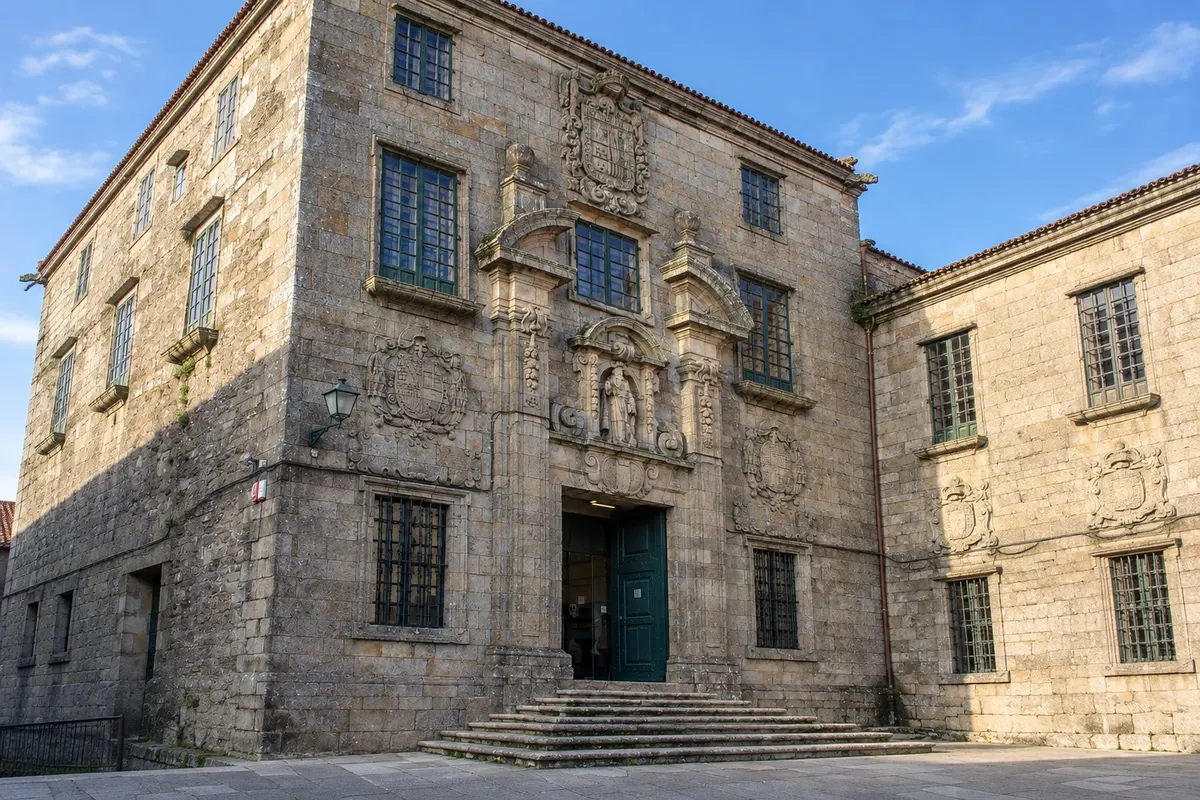
Museum · Santiago de Compostela, Galicia
Museo do Pobo Galego
Museum of Galician culture in the former convent of San Domingos de Bonaval, featuring Domingo de Andrade’s triple helical staircase and the Panteón de Galegos Ilustres, where Rosalía de Castro is buried.
Illustrative images. The pictures in this guide are illustrations based on the real place, not photographs, and may differ from it.

Discover
About Museo do Pobo Galego
The Museo do Pobo Galego occupies the former Dominican convent of San Domingos de Bonaval, founded in the 13th century near one of the medieval city‑wall gates, outside the old town. The museum was created in 1976 and displays Galicia’s traditional culture.
The rooms cover the sea and fishing, the countryside, crafts such as basketry, ceramics and goldsmithing, music and instruments like the gaita gallega, traditional clothing and village architecture, with models of hórreos, the elevated stone granaries.
The building houses the late 17th‑century triple helical staircase by architect Domingo de Andrade: three independent stone ramps wind together around the same axis and lead to different floors without crossing one another. In the convent’s former Gothic church is the Panteón de Galegos Ilustres, containing the tombs of the poet Rosalía de Castro, Alfonso Daniel Rodríguez Castelao and other figures of Galician culture.
Next door are the Parque de Bonaval, designed by Álvaro Siza on the convent’s old cemetery, and the CGAC, Centro Galego de Arte Contemporánea, also by Siza.
Before you go
Practical information
Cidade Turismo reviews its information regularly, but something may have changed. Check with the place before planning your trip.
How much time to set aside
From 1 hour to 1.5 hours.
Best time
On a rainy day or in the mid-afternoon. It is closed on Mondays; confirm the opening hours.
How to get there
It is on Rúa San Domingos de Bonaval, a 10-minute walk from the cathedral, passing the Porta do Camiño, where pilgrims on the Camino Francés enter.
Tip
Go up and down the triple staircase, trying the three ramps. Afterwards, walk through the Parque de Bonaval, by Álvaro Siza, with views of the old town roofs. Entrance is often free at certain times; check the conditions.
Official website
Get your questions answered
Frequently asked questions about Museo do Pobo Galego
What is the museum’s triple staircase?
A 17th-century helical staircase with three independent ramps that wind around the same axis, the work of Domingo de Andrade.
Who is in the Pantheon of Illustrious Galicians?
The poet Rosalía de Castro, the writer and artist Castelao, and other figures of Galician culture.
What is next to the museum?
Bonaval Park and the CGAC, Galician Center for Contemporary Art, both designed by Álvaro Siza.