

 Brazil
 Argentina
 Bolivia
 Chile
 Colombia
 Ecuador
 Guyana
 French Guiana
 Falkland Islands (Malvinas)
 Paraguay
 Peru
 Suriname
 Uruguay
 Venezuela
 Germany
 Austria
 Belgium
 Croatia
 Denmark
 Finland
 France
 Greece
 the Netherlands
 Hungary
 Ireland
 Iceland
 Italy
 Luxembourg
 Norway
 Poland
 Portugal
 the United Kingdom
 the Czech Republic
 Sweden
 Switzerland
 Turkey
 the United States
 Mexico
 the Dominican Republic
 South Africa
 Australia
 Fiji
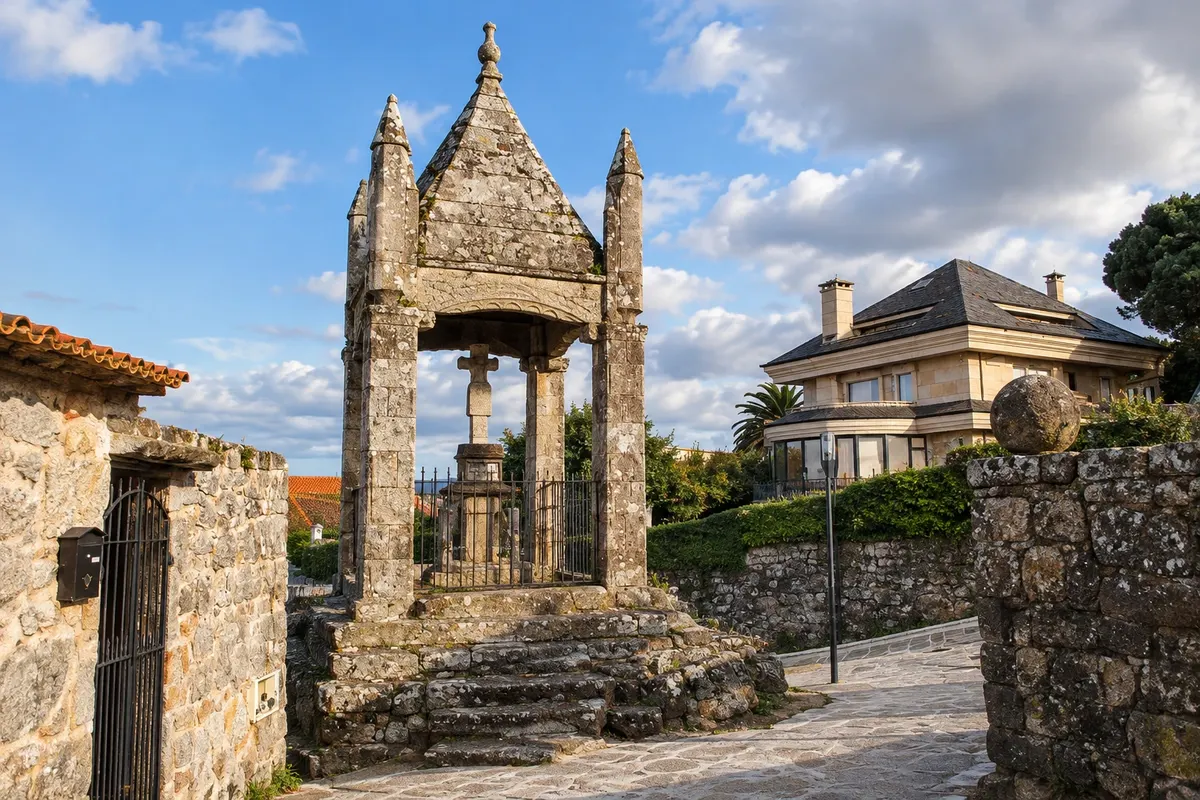
Monument · Baiona, Galicia
Cruzeiro da Santíssima Trindade
15th-century Gothic cruzeiro on the rocks, protected by a Renaissance canopy in the shape of a pyramid, one of the few covered cruzeiros in Galicia.
Illustrative images. The pictures in this guide are illustrations based on the real place, not photographs, and may differ from it.

Discover
About Cruzeiro da Santíssima Trindade
The cruzeiro da Santíssima Trindade stands on a rock outcrop at the entrance to Baiona, on the old line of the Roman road later called the royal road. It dates from the 15th century and is one of the few cruzeiros in Galicia protected by a stone canopy.
The Gothic cross shows Christ crucified and, at his feet, the Virgin Mary, Mary Magdalene and the apostle James. The Renaissance canopy has the shape of a pyramid and rests on columns topped by cylindrical pinnacles with conical crowns.
Next to the cruzeiro is a large granite slab, about one metre above the ground, which served as an altar for celebrating Mass outdoors in times of plague, for the inhabitants of Val Miñor and for the crews of ships anchored in the bay, who could not enter the town.
Stone cruzeiros are part of the Galician landscape, on paths, at crossroads and in churchyards. This is one of the best known.
Before you go
Practical information
Cidade Turismo reviews its information regularly, but something may have changed. Check with the place before planning your trip.
How much time to set aside
About 10 to 15 minutes.
Best time
At any time of day; late-afternoon light brings out the texture of the stone.
How to get there
It's on Rua do Mariñeiro, at the entrance to Baiona for those coming from Vigo, about a 10-minute walk from the port.
Tip
Pass by the cruzeiro on the way to Praia da Ribeira and the port: it's on the route for those arriving on foot along the seafront.
Get your questions answered
Frequently asked questions about Cruzeiro da Santíssima Trindade
What is special about the cruzeiro da Santíssima Trindade?
It is one of the few cruzeiros in Galicia protected by a baldaquin, a stone canopy in the shape of a pyramid.
What was the slab next to the cruzeiro used for?
It was used as an altar for outdoor Masses in times of plague.
From what period is the cruzeiro?
From the 15th century, with the Renaissance baldaquin.