

 Brazil
 Argentina
 Bolivia
 Chile
 Colombia
 Ecuador
 Guyana
 French Guiana
 Falkland Islands (Malvinas)
 Paraguay
 Peru
 Suriname
 Uruguay
 Venezuela
 Germany
 Austria
 Belgium
 Croatia
 Denmark
 Finland
 France
 Greece
 the Netherlands
 Hungary
 Ireland
 Iceland
 Italy
 Luxembourg
 Norway
 Poland
 Portugal
 the United Kingdom
 the Czech Republic
 Sweden
 Switzerland
 Turkey
 the United States
 Mexico
 the Dominican Republic
 South Africa
 Australia
 Fiji
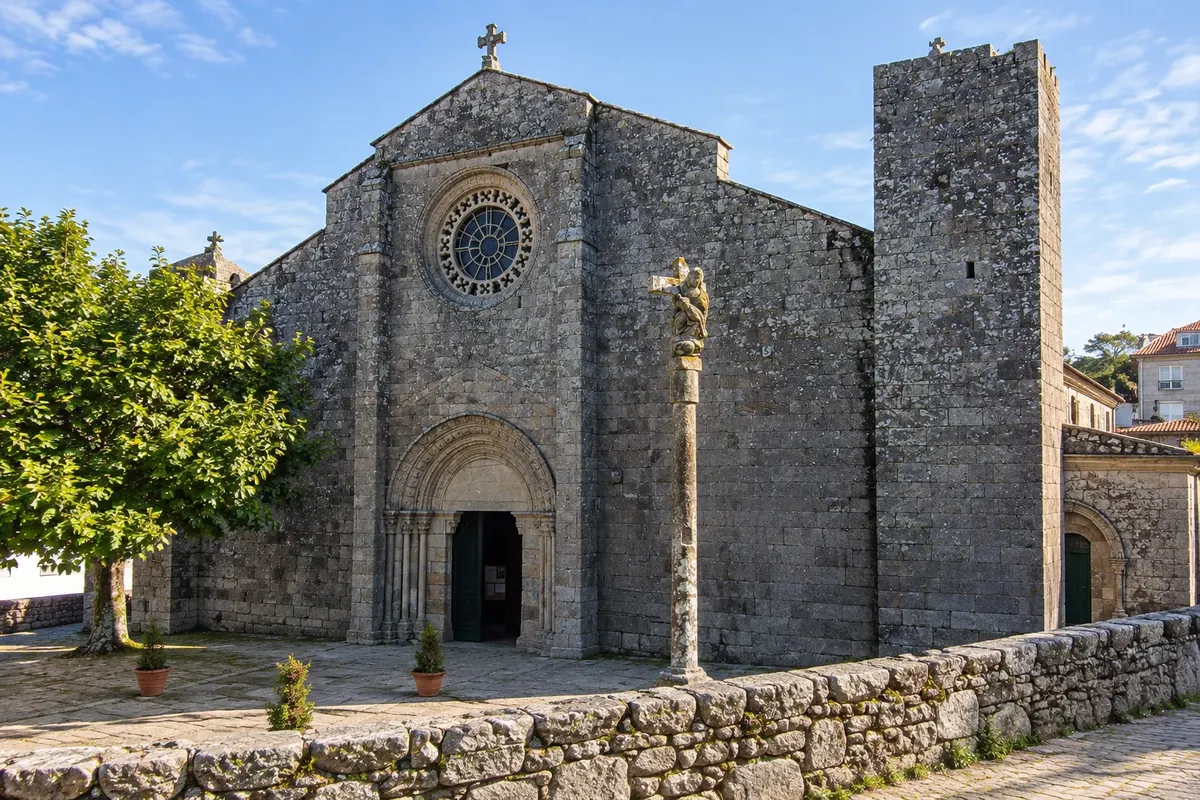
Church · Baiona, Galicia
Colegiata de Santa María de Baiona
Romanesque church with a fortified appearance, dating to 1278, which was a colegiata between 1482 and 1840, with a rose window on the façade, a Baroque altar and stone cruzeiros in the churchyard.
Illustrative images. The pictures in this guide are illustrations based on the real place, not photographs, and may differ from it.

Discover
About Colegiata de Santa María de Baiona
The former colegiata of Santa María is the main church of Baiona's historic centre. It was built in the 13th century in the Romanesque style, and the year 1278 is associated with the work. It has the appearance of a fortress, with thick granite walls and few openings.
In 1482, Bishop Diego de Muros elevated the church to a colegiata, with a chapter of canons, a status that lasted until 1840, when it returned to being a parish. For this reason locals still call it the colegiata.
Inside it has three naves and a rectangular apse. The central nave recalls the Cistercian style of the nearby monastery of Santa María de Oia. The façade has a Romanesque rose window and windows from the same period. The side chapels were added at the end of the 17th century, and the Baroque altarpiece was made between 1726 and 1732.
In the churchyard there are several stone cruzeiros of different styles, moved there from streets of the town in 1841.
Before you go
Practical information
Cidade Turismo reviews its information regularly, but something may have changed. Check with the place before planning your trip.
How much time to set aside
15 to 30 minutes.
Best time
In the morning or late afternoon, outside Mass times.
How to get there
It's in the upper part of the historic centre, a few minutes' walk from the port.
Tip
Look at the cruzeiros in the churchyard before entering: each one is from a different period and style.
Get your questions answered
Frequently asked questions about Colegiata de Santa María de Baiona
Why is the church called a colegiata?
Because it was a colegiata, with a chapter of canons, between 1482 and 1840. Afterwards it returned to being a parish church.
From what period is the church?
From the 13th century, in Romanesque style, with 17th-century chapels and an 18th-century Baroque altarpiece.
What is in the churchyard?
Several stone cruzeiros of different styles, moved there in 1841.