

 Brazil
 Argentina
 Bolivia
 Chile
 Colombia
 Ecuador
 Guyana
 French Guiana
 Falkland Islands (Malvinas)
 Paraguay
 Peru
 Suriname
 Uruguay
 Venezuela
 Germany
 Austria
 Belgium
 Croatia
 Denmark
 Finland
 France
 Greece
 the Netherlands
 Hungary
 Ireland
 Iceland
 Italy
 Luxembourg
 Norway
 Poland
 Portugal
 the United Kingdom
 the Czech Republic
 Sweden
 Switzerland
 Turkey
 the United States
 Mexico
 the Dominican Republic
 South Africa
 Australia
 Fiji
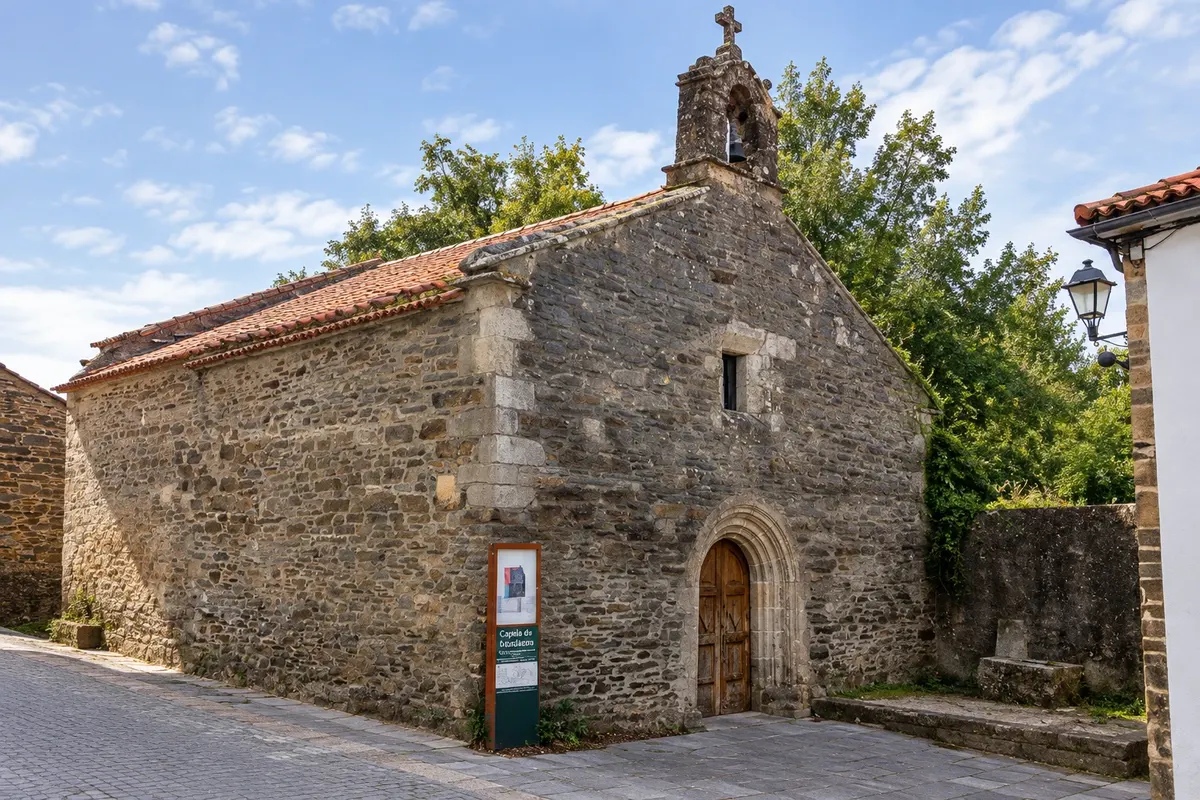
Church · Arzúa, Galicia
Capela da Madalena
Gothic chapel from the 14th century in the center of Arzúa, a remnant of an Augustinian convent that functioned as a pilgrims' hospital, now used for exhibitions and cultural activities.
Illustrative images. The pictures in this guide are illustrations based on the real place, not photographs, and may differ from it.

Discover
About Capela da Madalena
The capela da Madalena is the oldest building in the center of Arzúa. It is what remains of a convent and pilgrims' hospital run by Augustinian friars, founded in the 14th century to welcome those following the Camino de Santiago. Medieval hospitals on the Camino provided shelter, food and care to pilgrims, and Arzúa, as the last major stop before Santiago, played an important role in that network.
The chapel is Gothic, built of granite, with a single nave and simple arches, without much decoration. The rest of the convent disappeared over the centuries, but the chapel was preserved and restored.
Today it is used as a cultural space, with exhibitions and activities linked to the village's and the Camino's history. It is a few steps from the igreja de Santiago, in the upper part of the village.
Before you go
Practical information
Cidade Turismo reviews its information regularly, but something may have changed. Check with the place before planning your trip.
How much time to set aside
About 10 to 20 minutes.
Best time
During the day, at exhibition times; check before you go.
How to get there
It is in the center of Arzúa, near the igreja de Santiago, on the rua do Caminho.
Tip
Combine a visit to the chapel with the igreja de Santiago: the two are side by side and tell the story of Arzúa on the Camino.
Get your questions answered
Frequently asked questions about Capela da Madalena
What was the chapel of Madalena?
The chapel of a 14th-century Augustinian convent that functioned as a pilgrims' hospital.
Is the chapel open?
It is used as a cultural space with exhibitions; opening hours vary.
Where is the chapel?
In the center of Arzúa, near the church of Santiago.