

 Brazil
 Argentina
 Bolivia
 Chile
 Colombia
 Ecuador
 Guyana
 French Guiana
 Falkland Islands (Malvinas)
 Paraguay
 Peru
 Suriname
 Uruguay
 Venezuela
 Germany
 Austria
 Belgium
 Croatia
 Denmark
 Finland
 France
 Greece
 the Netherlands
 Hungary
 Ireland
 Iceland
 Italy
 Luxembourg
 Norway
 Poland
 Portugal
 the United Kingdom
 the Czech Republic
 Sweden
 Switzerland
 Turkey
 the United States
 Mexico
 the Dominican Republic
 South Africa
 Australia
 Fiji
Monument · Mérida, Extremadura
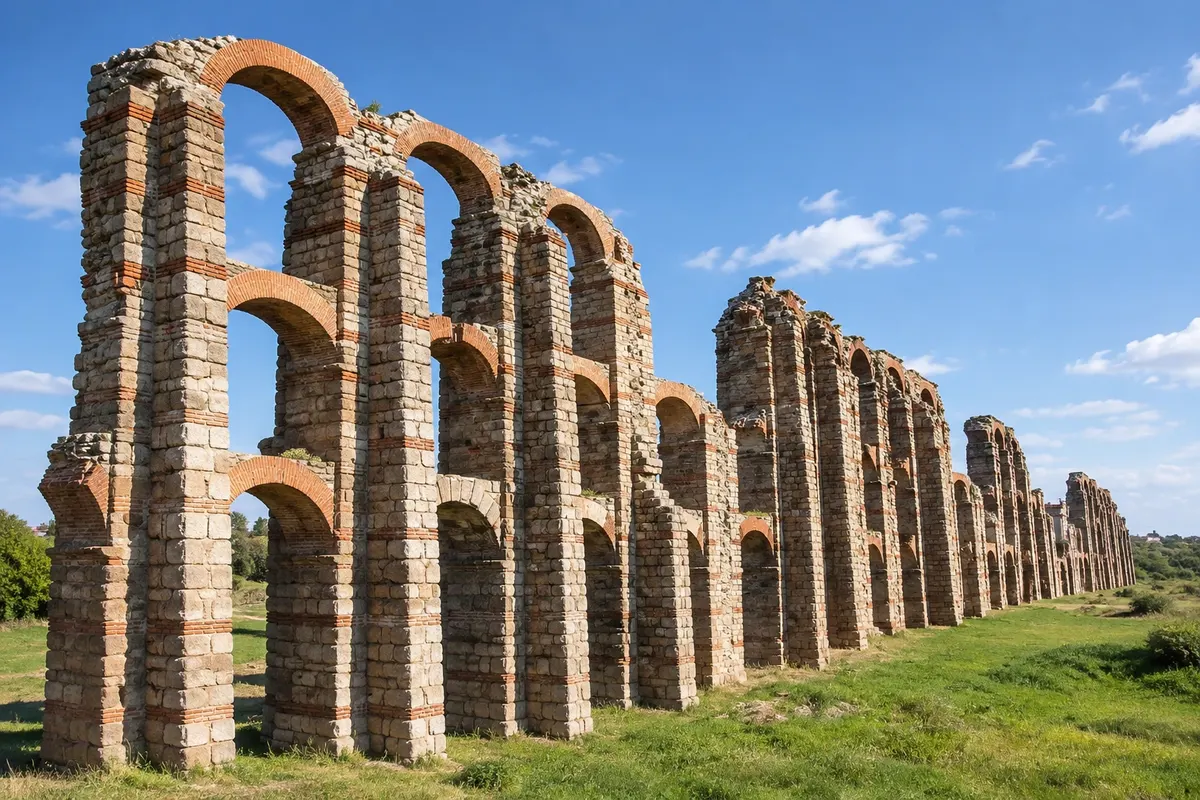
Acueducto de los Milagros
Remains of the Roman aqueduct that brought water from the Proserpina reservoir, with granite and brick arches up to 25 metres high, where storks nest.
Illustrative images. The pictures in this guide are illustrations based on the real place, not photographs, and may differ from it.

Discover
About Acueducto de los Milagros
The Acueducto de los Milagros is the best-preserved stretch of one of the aqueducts that supplied Augusta Emerita. It carried water from the Proserpina reservoir, about 5 km to the north, built by the Romans and still used as a lake. The aqueduct was erected in the 1st century and remodeled in the 3rd or 4th century.
What remains is a series of pillars and arches about 830 metres long and up to 25 metres high, which crossed the valley of the Albarregas river. The construction alternates bands of granite and red brick, giving the pillars a striped appearance.
The name, aqueduct of the Miracles, was given by locals impressed that it still stood after so many centuries. On top of the pillars storks build large nests, which are part of the landscape, especially in spring.
A park has been created around it along the Albarregas, with paths and benches. Nearby are another aqueduct, that of San Lázaro, and a small Roman bridge over the same river.
Before you go
Practical information
Cidade Turismo reviews its information regularly, but something may have changed. Check with the place before planning your trip.
How much time to set aside
20 to 40 minutes.
Best time
In the late afternoon, with the low sun on the arches, or at night with lighting. In spring the stork nests are often occupied. There is no charge or fixed opening hours.
How to get there
It is located in the north of the city, next to the Albarregas river, about 1 km from the Plaza de España and a 10-minute walk from the train station.
Tip
Walk through the park along the arches to see the storks up close. Combine this visit with the small Roman bridge over the Albarregas, a few minutes away.
Get your questions answered
Frequently asked questions about Acueducto de los Milagros
Where did the aqueduct’s water come from?
From the Roman reservoir of Proserpina, about 5 km to the north, still in use as a lake.
Why is it called "de los Milagros"?
Because the locals were impressed that it remained standing after so many centuries.
Do you have to pay to see the aqueduct?
No. It is in a public park, with no opening hours or charge.