

 Brazil
 Argentina
 Bolivia
 Chile
 Colombia
 Ecuador
 Guyana
 French Guiana
 Falkland Islands (Malvinas)
 Paraguay
 Peru
 Suriname
 Uruguay
 Venezuela
 Germany
 Austria
 Belgium
 Croatia
 Denmark
 Finland
 France
 Greece
 the Netherlands
 Hungary
 Ireland
 Iceland
 Italy
 Luxembourg
 Norway
 Poland
 Portugal
 the United Kingdom
 the Czech Republic
 Sweden
 Switzerland
 Turkey
 the United States
 Mexico
 the Dominican Republic
 South Africa
 Australia
 Fiji
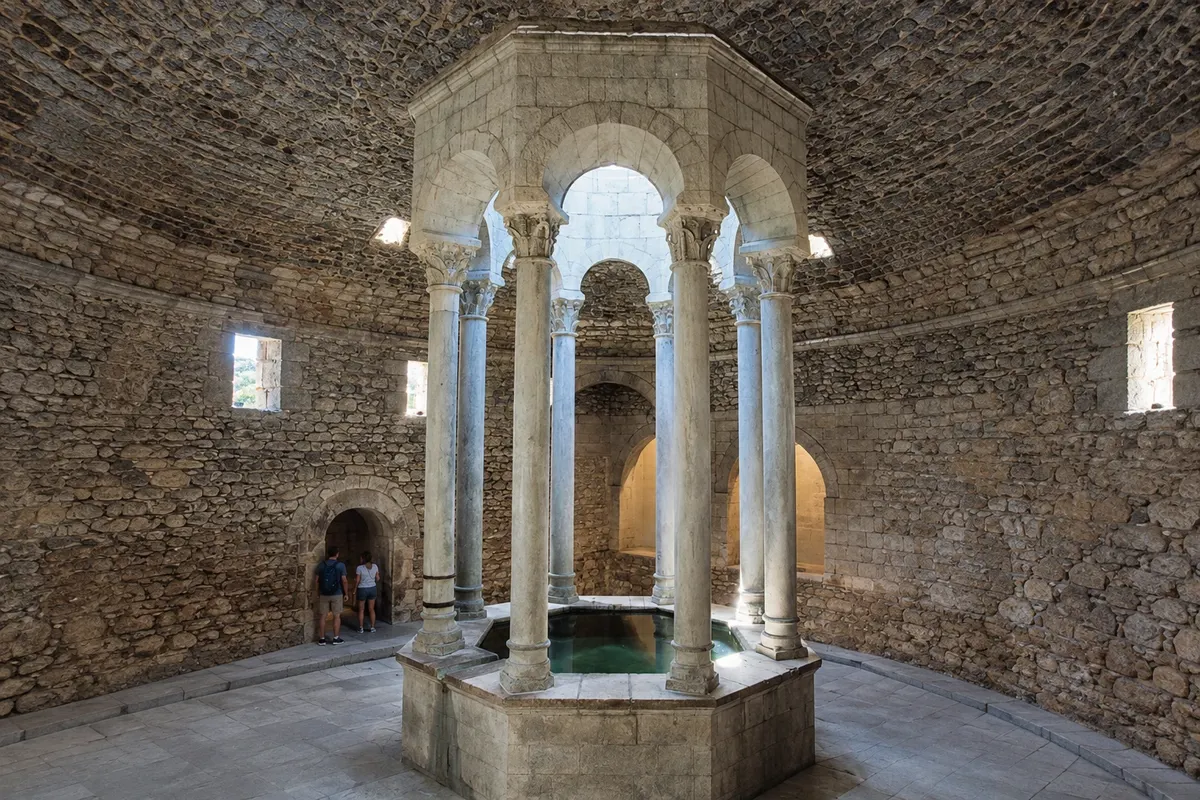
Monument · Girona, Catalonia
Banys Àrabs
Medieval public baths from the late 12th century, Romanesque in style but inspired by North African baths. The highlight is the cold room, with an octagonal basin surrounded by eight columns and a lantern in the ceiling.
Illustrative images. The pictures in this guide are illustrations based on the real place, not photographs, and may differ from it.

Discover
About Banys Àrabs
Despite the name, the Banys Àrabs de Girona were not built by Muslims. They are Christian public baths, first mentioned in 1194, when King Alfons the Chaste granted the building's income to the cathedral. The plan follows the model of North African baths and Roman thermae, but the architectural elements are Romanesque: semicircular arches, barrel vaults and capitals.
The building was damaged during the French siege of 1285. In 1294 King Jaume II granted it to Ramon de Toïlà to be rebuilt. The baths appear to have ceased operating in the 16th century, and in 1618 the building passed to the Capuchin nuns, who established a convent there.
The visit follows the rooms in the order of the bath: the changing room (apodyterium), the cold room (frigidarium), the warm room (tepidarium) and the hot room (caldarium), with the furnace at the rear. In the cold room, an octagonal tank is surrounded by eight slender columns that support an open lantern for light.
Restoration began in 1929, led by architects Rafael Masó and Emili Blanch. The baths are a cultural asset of national interest of the Catalunha.
Before you go
Practical information
Cidade Turismo reviews its information regularly, but something may have changed. Check with the place before planning your trip.
How much time to set aside
About 30 minutes.
Best time
Mid-morning, when light enters through the lantern of the cold room. It's a small space and gets crowded with groups in summer; early or late in the afternoon is usually quieter.
How to get there
On foot. It's on Carrer de Ferran el Catòlic, between the cathedral and Sant Pere de Galligants, in the north of the Barri Vell.
Tip
Entrance is usually paid and opening hours vary by season; check before you go. Combine the visit with Sant Pere de Galligants, which is on the same street a few metres further down.
Get your questions answered
Frequently asked questions about Banys Àrabs
Are the baths really Arabic?
No. They are 12th-century Christian public baths in the Romanesque style, modeled after the baths of North Africa. The popular name stuck.
What is there to see inside?
The medieval bath rooms in sequence: changing room, cold room with the octagonal pool, warm room, hot room, and the furnace.
Is it worth it for someone with little time?
The visit is short, about half an hour, and it's on the route between the cathedral and Sant Pere de Galligants, so it fits well into a one-day itinerary.