

 Brazil
 Argentina
 Bolivia
 Chile
 Colombia
 Ecuador
 Guyana
 French Guiana
 Falkland Islands (Malvinas)
 Paraguay
 Peru
 Suriname
 Uruguay
 Venezuela
 Germany
 Austria
 Belgium
 Croatia
 Denmark
 Spain
 Finland
 France
 Greece
 the Netherlands
 Hungary
 Ireland
 Iceland
 Italy
 Luxembourg
 Norway
 Poland
 Portugal
 the United Kingdom
 the Czech Republic
 Sweden
 Switzerland
 Turkey
 Mexico
 the Dominican Republic
 South Africa
 Fiji
State · Grandes Planícies (Monte Rushmore)
Oklahoma
Oklahoma, in the Great Plains: the cowboy museum in Oklahoma City, Tulsa’s art deco, stretches of Route 66 and the bison of the Wichita Mountains.
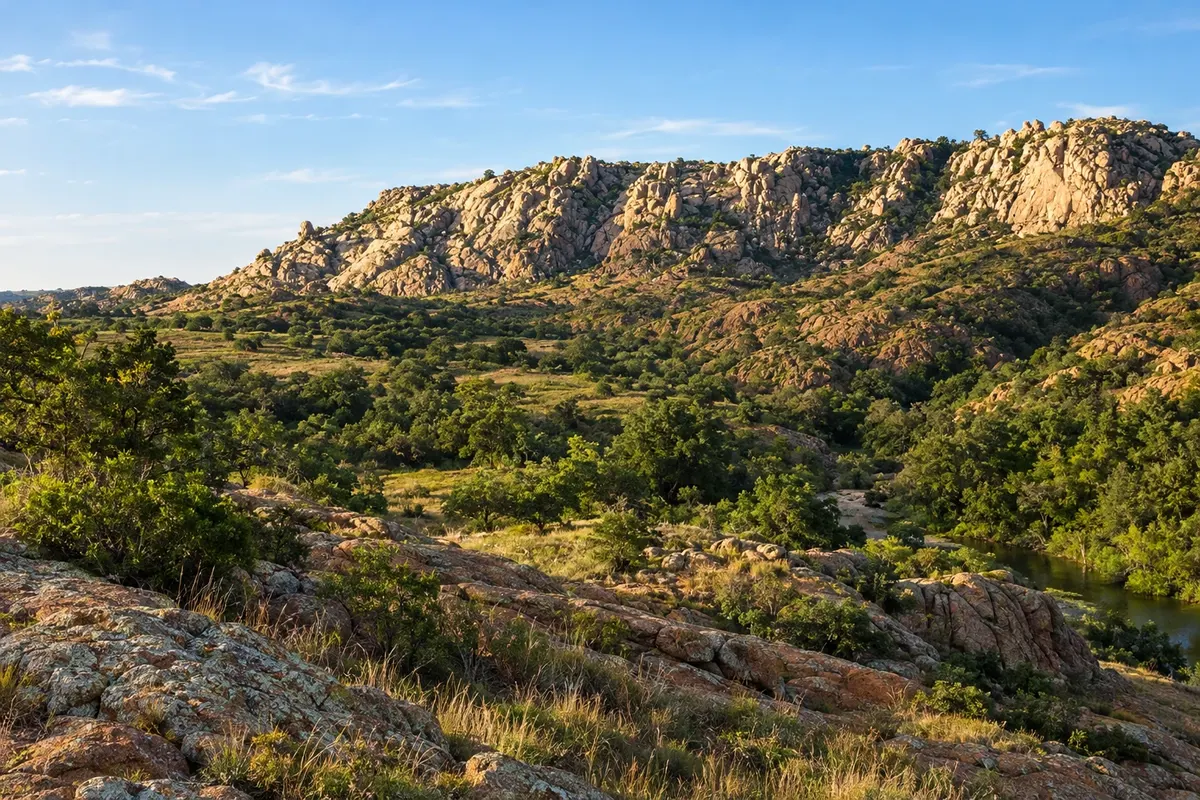
In the photo: Wichita Mountains
Illustrative images. The pictures in this guide are illustrations based on the real place, not photographs, and may differ from it.

The state
Get to know Oklahoma
Oklahoma is in the southern Great Plains, just north of Texas. The name comes from the Choctaw language and means red people, and the state is home to 39 federally recognized Indigenous nations, including Cherokee, Choctaw and Osage. The landscape ranges from western prairies to forested hills in the east.
Oklahoma City, the capital, has the National Cowboy & Western Heritage Museum, with Western art and history, the Bricktown neighborhood of old warehouses along a canal, and the First Americans Museum, dedicated to the state’s Indigenous nations. Route 66 crosses the state from northeast to southwest, with the round barn in Arcadia, the Blue Whale of Catoosa and the road museum in Clinton.
Tulsa, in the northeast, prospered from oil in the 1920s and retains art deco buildings downtown, the Philbrook, an art museum in a mansion with gardens, and the Woody Guthrie Center, about the folk singer born in the state. The Gathering Place, on the banks of the Arkansas River, is a large urban park.
In the southwest, the Wichita Mountains Wildlife Refuge has free-roaming bison and longhorn cattle among granite hills, with a road to the top of Mount Scott. In the northeast, Tahlequah is the capital of the Cherokee Nation, with museums about the people’s history, and the east has lakes and the Ouachita Mountains. On the plate, chicken fried steak (breaded steak with white gravy), barbecue and the grilled onion burger — born in El Reno.
When to go
Spring (April and May) and autumn (September to November) usually have mild days. Storms on the plains are more common in spring, so it’s wise to monitor forecasts. Summers tend to be hot, with highs above 33 °C (91 °F), and winters are short, with occasional cold and snow. Oklahoma is 3 hours behind Brasília (2 hours during daylight saving time).
Getting there
Oklahoma City (OKC) and Tulsa (TUL) airports have domestic flights. From Brazil, trips usually connect through Dallas or Houston; confirm before booking. Oklahoma City is about a 3-hour drive from Dallas and about 1.5 hours from Tulsa. Route 66 and I-44 link the two cities.
Your questions
Frequently asked questions about Oklahoma
Can you do Route 66 in Oklahoma?
Yes. The state preserves long stretches of the original highway, with old gas stations, neon-sign motels, the round barn in Arcadia, the Blue Whale of Catoosa and the museums in Clinton and Elk City. One or two days by car between Tulsa and the Texas border cover the essentials.
What to see in Oklahoma City?
The National Cowboy & Western Heritage Museum, the First Americans Museum and the Bricktown neighborhood, with a boat ride on the canal. One or two days are enough for all three.
Where to experience Indigenous culture in Oklahoma?
At the First Americans Museum in Oklahoma City and in Tahlequah, the capital of the Cherokee Nation, with the Cherokee National History Museum. Several Nations hold dance gatherings (powwows) open to the public, especially in summer; check each Nation’s calendar.
How to see the bison in the Wichita Mountains?
The refuge, near Lawton, has roads and trails where bison and longhorn cattle commonly roam. Do not leave your vehicle near the animals. The road to the top of Mount Scott offers views over the plains.