

 Brazil
 Argentina
 Bolivia
 Chile
 Colombia
 Ecuador
 Guyana
 French Guiana
 Falkland Islands (Malvinas)
 Paraguay
 Peru
 Suriname
 Uruguay
 Venezuela
 Germany
 Austria
 Belgium
 Croatia
 Denmark
 Spain
 Finland
 France
 Greece
 the Netherlands
 Hungary
 Ireland
 Iceland
 Italy
 Luxembourg
 Norway
 Poland
 Portugal
 the United Kingdom
 the Czech Republic
 Sweden
 Switzerland
 Turkey
 Mexico
 the Dominican Republic
 South Africa
 Fiji
State · Grandes Planícies (Monte Rushmore)
Nebraska
Nebraska, in the Great Plains: the migration of cranes on the Platte River, Chimney Rock on the Oregon Trail, the Omaha Zoo and the sand hills of the west.
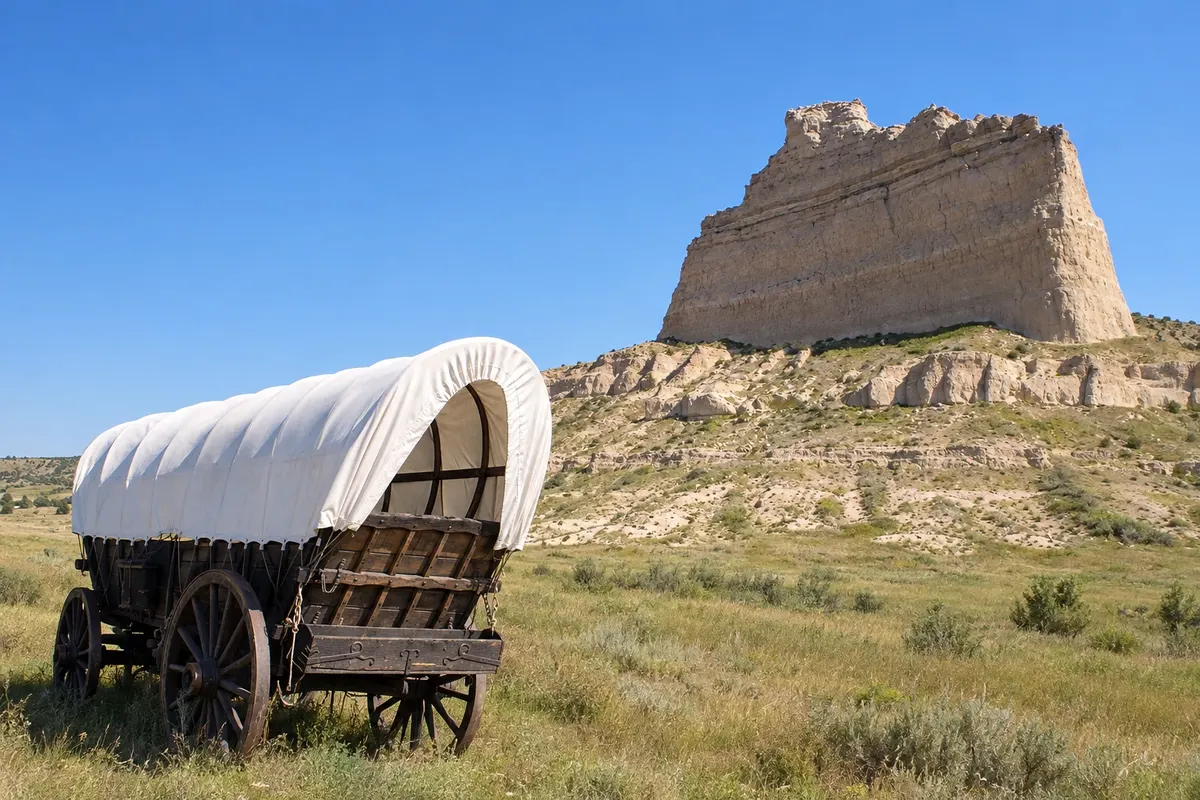
In the photo: Scotts Bluff
Illustrative images. The pictures in this guide are illustrations based on the real place, not photographs, and may differ from it.

The state
Get to know Nebraska
Nebraska lies in the center of the Great Plains, between the Missouri River to the east and the Rocky Mountains to the west. Through the Platte River valley in the 19th century passed the Oregon, California and Mormon trails. The state is farmland of corn and cattle, and in the north it holds the Sandhills, one of the largest grass-covered dune regions in the world.
Omaha, the largest city, has the Henry Doorly Zoo, with a dome-covered desert and an indoor rainforest, the Old Market with brick streets and old warehouses, and the stadium that hosts the College World Series, the university baseball finals, in June. Lincoln, the capital, has a tower-shaped capitol.
In the center of the state, from late February to early April, hundreds of thousands of sandhill cranes typically stop on the Platte River between Kearney and Grand Island, forming the largest congregation of cranes in the world; centers like Rowe Sanctuary organize viewing from riverside blinds at dawn and dusk. Kearney also has the Archway, an arched museum over I-80 that tells the story of the trails.
In the west, Chimney Rock, a rock tower that served as a landmark for pioneers, and Scotts Bluff National Monument, with a road up to the top of the cliff, recall the Oregon Trail. Near Alliance, Carhenge reproduces Stonehenge with old cars painted gray. On the table, plains steak and runza, a bread filled with meat and cabbage.
When to go
March is the month of the cranes on the Platte River, with nights still cold. From May to September days are usually pleasant to hot, with highs above 30 °C in July, a good time for trails and western monuments. Winters are cold and windy, with snowstorms. Most of Nebraska is 3 hours behind Brasília (2 hours during daylight saving); the west, including Scotts Bluff, is 4 hours behind (3 in summer).
Getting there
Omaha airport (OMA) is the main one, with domestic flights; Lincoln and Kearney have smaller flights. From Brazil, trips usually connect in Chicago, Dallas or Denver; confirm before purchasing. Interstate 80 crosses the state east–west: from Omaha to Kearney is about 2.5 hours by car, and to Scotts Bluff about 7 hours. Denver is roughly 3 hours from Scotts Bluff.
Your questions
Frequently asked questions about Nebraska
When to see the crane migration in Nebraska?
Sandhill cranes typically arrive at the Platte River in mid-February and leave in mid-April, with peak numbers from mid- to late March. Viewing is done at dawn and dusk from riverside blinds; guided blinds require reservations.
What to see in Omaha?
The Henry Doorly Zoo, which takes a full day, the Old Market with galleries and restaurants in old warehouses, the Joslyn Art Museum and the Bob Kerrey pedestrian bridge, which crosses the Missouri River into Iowa.
What is Chimney Rock?
A rock tower about 100 meters above the plain, in the North Platte River valley, which pioneers on the Oregon Trail used as a landmark. A visitor center tells the story of the trails; the rock is viewed from a distance, there is no climb.
Can you cross Nebraska en route to Colorado or Mount Rushmore?
Yes. Via I-80, Omaha is about 8 hours from Denver, with stops in Kearney and North Platte. For Mount Rushmore, the western route passes Scotts Bluff and Chimney Rock before heading up into South Dakota.