

 Brazil
 Argentina
 Bolivia
 Chile
 Colombia
 Ecuador
 Guyana
 French Guiana
 Falkland Islands (Malvinas)
 Paraguay
 Peru
 Suriname
 Uruguay
 Venezuela
 Germany
 Austria
 Belgium
 Croatia
 Denmark
 Spain
 Finland
 France
 Greece
 the Netherlands
 Hungary
 Ireland
 Iceland
 Italy
 Luxembourg
 Norway
 Poland
 Portugal
 the United Kingdom
 the Czech Republic
 Sweden
 Switzerland
 Turkey
 Mexico
 the Dominican Republic
 South Africa
 Fiji
State · Grandes Lagos e Meio-Oeste (Chicago)
Minnesota
Minnesota, land of lakes: Minneapolis and Saint Paul, the source of the Mississippi River at Itasca, the Lake Superior shore and the Boundary Waters canoes on the border with Canada.
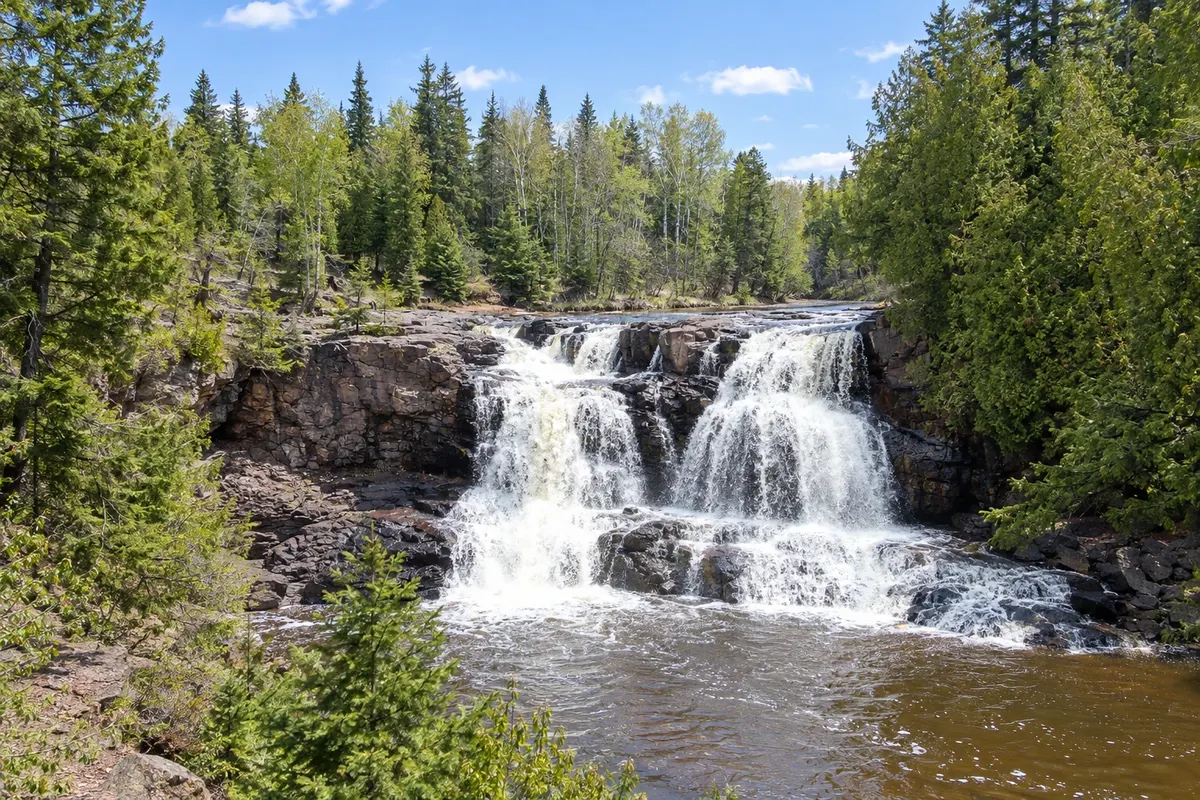
In the photo: Gooseberry Falls
Illustrative images. The pictures in this guide are illustrations based on the real place, not photographs, and may differ from it.

The state
Get to know Minnesota
Minnesota lies in the northern Midwest, on the border with Canada, and bills itself as the land of 10,000 lakes; by the official count there are more than 11,000. The south is farmland, the north is pine forest, and the east reaches Lake Superior. It is in Itasca State Park that the Mississippi River begins, as a shallow stream you can cross by stepping on rocks.
Minneapolis and Saint Paul, the Twin Cities, sit on either side of the Mississippi. Minneapolis has the Walker Art Center and its sculpture garden, the Stone Arch bridge over Saint Anthony Falls, and a chain of lakes inside the city with bike paths. Saint Paul, the capital, has the cathedral and Summit Avenue with Victorian mansions. In Bloomington, the Mall of America has an indoor amusement park.
To the north, Duluth is the port on Lake Superior, and the North Shore drive follows the coast up to Canada, passing the Split Rock Lighthouse and waterfalls in state parks. At the border, the Boundary Waters Canoe Area contains more than a thousand lakes linked by portage trails, and Voyageurs National Park is explored by boat.
Scandinavian and German heritage shows up in festivals and food: hotdish, a baked stew topped with potatoes, and lutefisk, a dried Scandinavian fish, at year-end celebrations. In winter the lakes freeze and become ice-fishing fields, and Saint Paul holds the Winter Carnival, with ice and snow sculptures, between January and February.
When to go
From June to September days are usually long and pleasant, with highs near 27 °C; it’s the lakes and paddling season. Fall colors run from late September to mid-October, starting in the north. Winter runs from December to March, with snow, frozen lakes and lows that in January are often well below zero; it’s the time for ice fishing and Saint Paul’s carnival. Minnesota is 3 hours behind Brasília (2 hours during daylight saving time).
Getting there
Minneapolis–Saint Paul Airport (MSP) is one of the country’s major hubs, with domestic and international flights. From Brazil expect at least one connection; check before you buy. The light rail links the airport, the Mall of America and downtown for both cities. Duluth is about a 2.5-hour drive, and Itasca State Park about 4 hours.
Your questions
Frequently asked questions about Minnesota
What to do in Minneapolis and Saint Paul?
Visit the Walker Art Center and the Minneapolis Institute of Art, walk or cycle along the Mississippi riverfront and the city lakes, see Summit Avenue in Saint Paul and shop at the Mall of America. Two or three days cover both cities.
Where does the Mississippi River start?
In Lake Itasca, inside the state park of the same name in northern Minnesota. There the river is a shallow stream you can cross by stepping on rocks, marked by a post showing the distance to the Gulf of Mexico. The park has trails and lakes for canoeing.
When to go canoeing in the Boundary Waters?
The season runs from late May to September, when the lakes are ice-free. Permits are required to enter the area, and slots are often competitive; book in advance. Ely is the gateway town, with outfitters that rent canoes and gear.
What is winter like in Minnesota?
Very cold, from December to March, with snow and frozen lakes. Locals make the most of it with ice fishing, cross-country skiing and skating; downtown Minneapolis buildings are connected by covered walkways, the Skyway, so you can move around without going outside.