

 Brazil
 Argentina
 Bolivia
 Chile
 Colombia
 Ecuador
 Guyana
 French Guiana
 Falkland Islands (Malvinas)
 Paraguay
 Peru
 Suriname
 Uruguay
 Venezuela
 Germany
 Austria
 Belgium
 Croatia
 Denmark
 Spain
 Finland
 France
 Greece
 the Netherlands
 Hungary
 Ireland
 Iceland
 Italy
 Luxembourg
 Norway
 Poland
 Portugal
 the United Kingdom
 the Czech Republic
 Sweden
 Switzerland
 Turkey
 Mexico
 the Dominican Republic
 Fiji
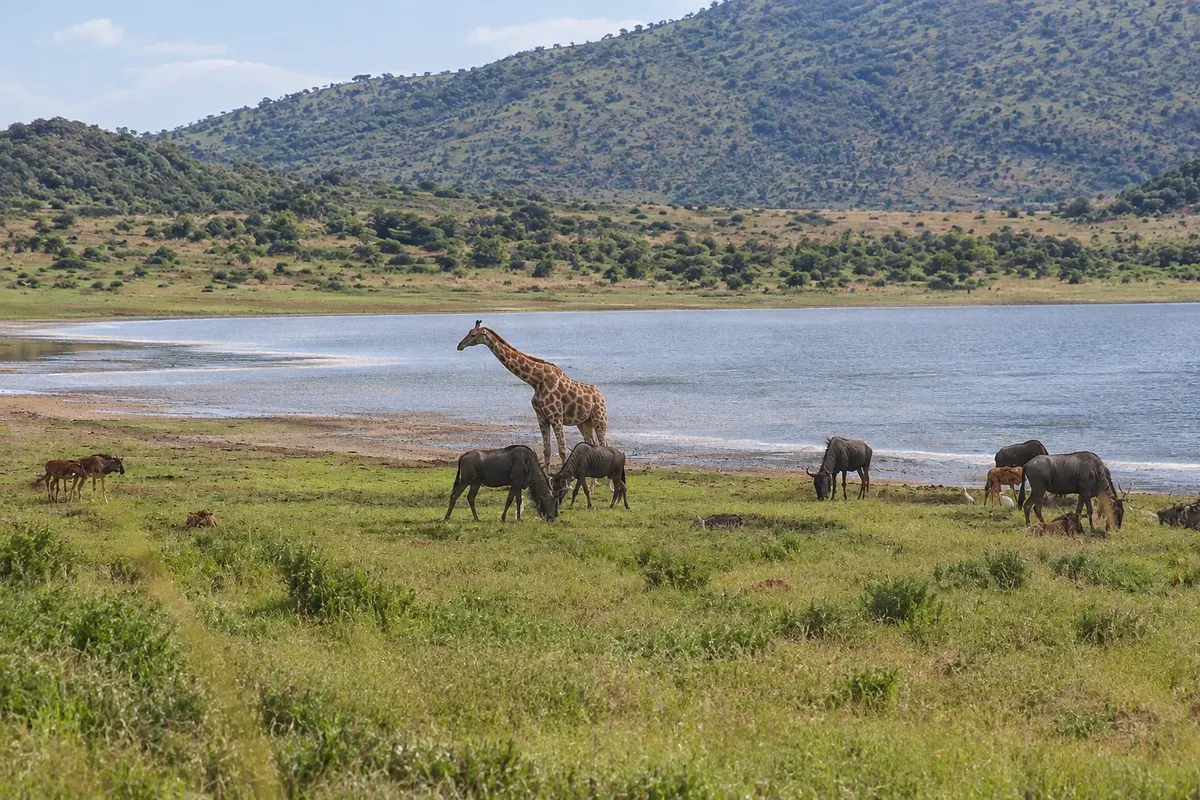
National park · Sun City, Noroeste
Parque Nacional de Pilanesberg
A roughly 55,000-hectare park inside the crater of an extinct volcano, with the Big Five, about 200 km of roads and safari by self-drive or with a guide.
Illustrative images. The pictures in this guide are illustrations based on the real place, not photographs, and may differ from it.

Discover
About Parque Nacional de Pilanesberg
Pilanesberg National Park was created in 1979 on farmland inside an ancient volcanic structure, one of the largest complexes of its kind in the world, about 1.2 billion years old. The rings of hills surrounding the park are what remains of the volcano, and in the center lies the Mankwe dam valley.
Animals were reintroduced during Operation Genesis in the 1980s: elephants, white and black rhinos, buffalo, giraffes, zebras, hippos and many antelopes. Lions arrived later. The park lies in a transition zone between the Kalahari and the eastern savanna, which allows sightings of species from both environments, such as springbok and impala.
There are about 200 km of roads, partly paved and partly dirt. You can do the safari in your own car, or in open vehicles with a guide, in the morning, at dusk and at night. There are also hot-air balloon rides at sunrise.
The rules are the same as in other parks: do not leave your vehicle outside designated areas, respect the speed limit and exit before the gates close, which varies by month.
Before you go
Practical information
Cidade Turismo reviews its information regularly, but something may have changed. Check with the place before planning your trip.
How much time to set aside
From half a day to two days.
Best time
Right after the gates open and in the late afternoon, when animals move more. The dry season, from May to September, usually makes viewing easier.
How to get there
The gates are Bakubung, near Sun City, Kwa Maritane, Manyane to the east, and Bakgatla to the north. From Johannesburg it's about a 2½-hour drive. Entrance is paid per person and per vehicle.
Tip
Pick up the map at the gate and check the sightings board at the visitor centre in the middle of the park.
Official website
Get your questions answered
Frequently asked questions about Parque Nacional de Pilanesberg
How large is Pilanesberg?
About 55,000 hectares, inside an ancient volcanic structure.
Which animals are seen in Pilanesberg?
Elephants, rhinos, giraffes, zebras, hippos and antelopes are commonly seen; lions and leopards are more difficult to spot.
What are the gates of Pilanesberg?
Bakubung, Kwa Maritane, Manyane and Bakgatla.
When was Pilanesberg created?
In 1979, on farmland, with animals reintroduced in the 1980s.