

 Brazil
 Argentina
 Bolivia
 Chile
 Colombia
 Ecuador
 Guyana
 French Guiana
 Falkland Islands (Malvinas)
 Paraguay
 Peru
 Suriname
 Uruguay
 Venezuela
 Germany
 Austria
 Belgium
 Croatia
 Denmark
 Spain
 Finland
 France
 Greece
 the Netherlands
 Ireland
 Iceland
 Italy
 Luxembourg
 Norway
 Poland
 Portugal
 the United Kingdom
 the Czech Republic
 Sweden
 Switzerland
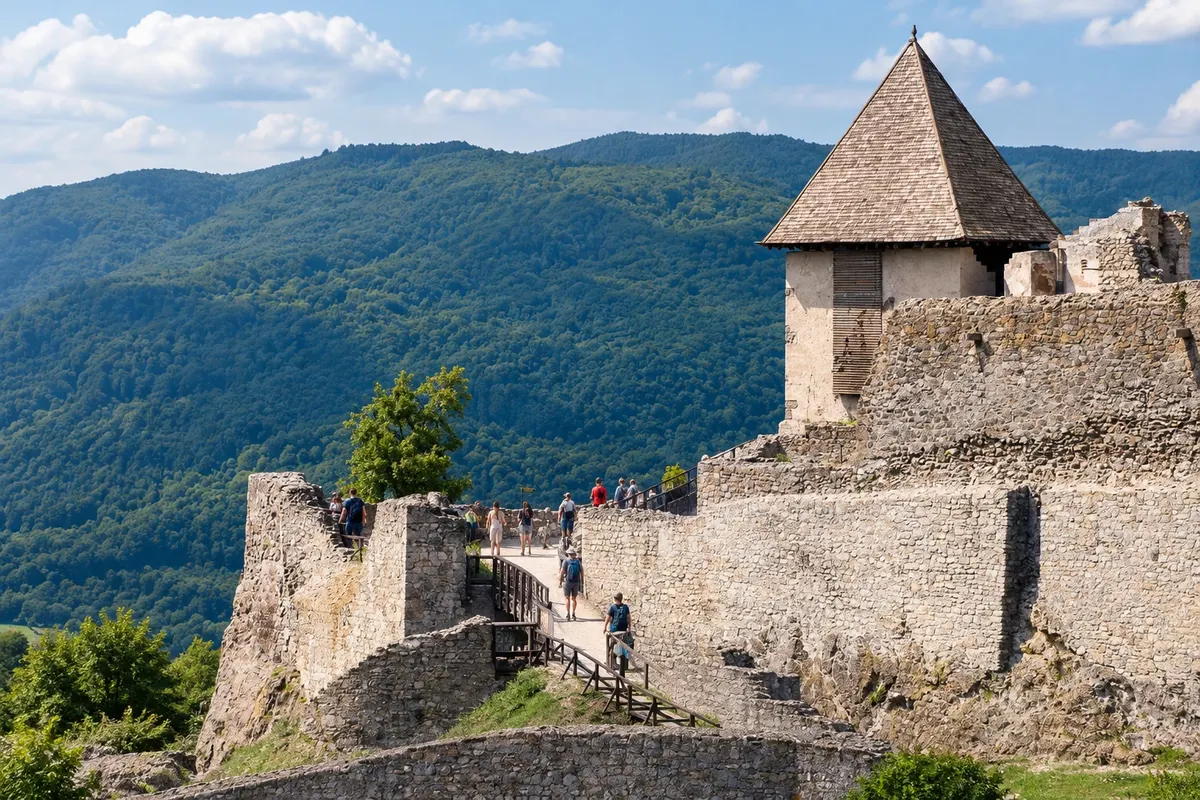
Castle · Visegrád, Pest
Visegrádi fellegvár
Ruins of the citadel atop Visegrád’s hill, with views over the Danube bend and the wooded slopes.
Illustrative images. The pictures in this guide are illustrations based on the real place, not photographs, and may differ from it.

Discover
About Visegrádi fellegvár
The Visegrádi fellegvár occupies the top of a hill above the Danube. Walls and courtyards retain the sense of a medieval fortification, though parts of the complex are in ruins. The elevated position explains both its defensive role and the appeal of the viewpoint.
The route alternates exhibition spaces with outdoor sections between stone walls. From the openings you can see the river’s change of direction and the relationship between the lower town and the slopes. The landscape should be understood as a wide valley with forested hills, not a canyon.
The citadel is set apart from the riverside and requires arranging the climb. Those going on foot need to allow time and energy for the elevation; taxi or car reduce part of the effort but do not eliminate internal stairways. On cold days, the wind at the top is usually more noticeable.
Before you go
Practical information
Cidade Turismo reviews its information regularly, but something may have changed. Check with the place before planning your trip.
How much time to set aside
One and a half to two hours, not counting the climb from the riverside.
Best time
May, June, September and October are usually suitable for the outdoor route.
How to get there
From Visegrád’s lower town, climb via the road or the marked paths; check the access you choose.
Tip
Treat the citadel and the lower‑town palace as visits at separate locations.
Official website
Get your questions answered
Frequently asked questions about Visegrádi fellegvár
Is the citadel next to the river landing?
It sits atop the hill, requiring an additional walk up from the lower town.
Is the castle intact?
The complex includes ruins, walls and areas prepared for exhibition.
What can you see from the viewpoint?
The Danube bend, the lower town and the wooded hills on both banks.