Eurostar Paris–Amsterdam
By train through the centers of Paris, Brussels, Antwerp, Rotterdam and Amsterdam: three countries in just over three hours, from central station to central station.
Antarctica
Trips that cross borders by train, car, boat and on foot, with the map, the cities in each country, the itineraries and what changes from one side to the other.
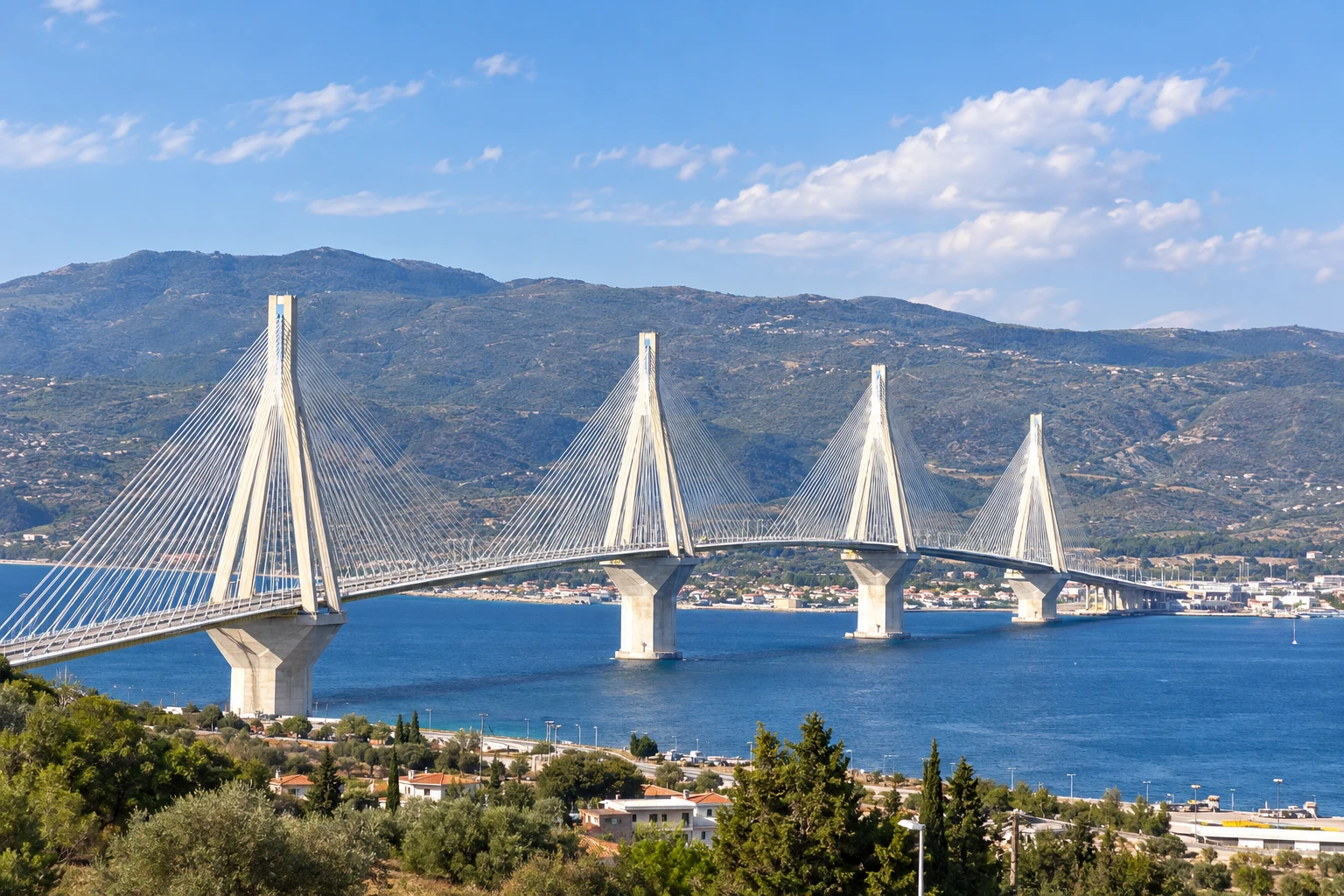
In the photo: Rio–Antirrio Bridge — Italy–Greece ferry across the Adriatic →
The routes
By train through the centers of Paris, Brussels, Antwerp, Rotterdam and Amsterdam: three countries in just over three hours, from central station to central station.
By train from Paris to Munich via Frankfurt and Nuremberg: TGV and ICE connect France with southern Germany from central station to central station.
By train from Paris to Zurich in about four hours, without changing: from Gare de Lyon to the center of Switzerland’s largest city, passing through Alsace and Basel.
By train from Paris to Barcelona, crossing southern France and the Pyrenees, with stops in Figueres and Girona: from central station to central station in about six and a half hours.
By train from Switzerland to Italy through the Alps: from Zurich to Milan via the Gotthard base tunnel, with Lucerne, Lake Como and, if you have time, the old panoramic mountain line.
By car on both sides of the Rhine: the Alsace Wine Route, with half-timbered villages among vineyards, and the mountain roads of the Black Forest, between Strasbourg, Colmar, Freiburg and Baden-Baden.
By train from Italy to France through the Alps: Milan, Turin, the Maurienne valley, Lyon and Paris in about seven hours, without changing trains.
By train from the Netherlands to Berlin: about six hours nonstop, through the Dutch interior and northern Germany, from central station to central station.
By train from Belgium to Germany: Brussels, Liège, Cologne and Frankfurt in about three hours, from central station to central station.
The three Benelux countries by train: from Amsterdam to Brussels in about two hours, and from Brussels to Luxembourg via the Ardennes, with Rotterdam, Antwerp and Namur along the way.
On foot from Portugal to Santiago de Compostela: the pilgrimage route that starts in Lisbon or Porto, follows yellow arrows and ends at Obradoiro Square.
By car between the two capitals of the peninsula: the Alentejo around Évora, Roman Mérida and medieval Cáceres on the route from Lisbon to Madrid.
From Porto to Galicia by train: the Celta crosses the Minho to Vigo, and a regional train takes you to Santiago de Compostela in about an hour.
Along the Moselle River, from Luxembourg to Germany: vineyards on slopes, half-timbered villages, Roman Trier, Cochem Castle, and the confluence with the Rhine in Koblenz.
From Puglia to Greece by sea: overnight ferries depart Bari and Brindisi and arrive in the morning at Igoumenitsa, in Epirus, or continue to Patras, the gateway to the Peloponnese.
The red train that crosses the Alps from Switzerland to Italy: viaducts, spiral tunnels, glaciers and Lake Bianco, from Chur to Tirano in about four hours, with a bus onward to Lugano.
The most travelled pilgrimage route to Santiago de Compostela: from the French Pyrenees to Galicia, on foot, via Pamplona, Burgos and León, following the yellow arrows.
The ancient pilgrims’ route to Rome: from Canterbury Cathedral, through France and Switzerland, over the Alps via the Great St Bernard Pass and through Tuscany to St. Peter’s Square.
The Camino de Santiago along the Atlantic: from Porto to Galicia via the coast, through Vila do Conde, Viana do Castelo, A Guarda, Baiona and Vigo, ending at Santiago Cathedral.
Two capitals on the island of Ireland in about two hours by train, along the Irish Sea coast, with no border control on the way.
By train under the English Channel: from St Pancras in central London to central Paris or Brussels in a little over two hours.
From Ljubljana to Trieste along the Karst railway, with stops at Postojna, Divača and Sežana and arrival by the Adriatic.