

 Brazil
 Antarctica
 Argentina
 Bolivia
 Chile
 Colombia
 Ecuador
 Falkland Islands (Malvinas)
 French Guiana
 Guyana
 Paraguay
 Peru
 Suriname
 Uruguay
 Venezuela
 Austria
 Belgium
 Croatia
 Denmark
 Finland
 France
 Greece
 Hungary
 Iceland
 Ireland
 Italy
 Luxembourg
 Norway
 Poland
 Portugal
 Slovakia
 Slovenia
 Spain
 Sweden
 Switzerland
 the Czech Republic
 the United Kingdom
 Turkey
 Bermuda
 Canada
 Greenland
 Mexico
 Saint Pierre and Miquelon
 the United States
 the Dominican Republic
 Japan
 Egypt
 South Africa
 Australia
 Fiji
 New Zealand
 Papua New Guinea
Route · the Netherlands · Germany
Amsterdam–Berlin by train
By train from the Netherlands to Berlin: about six hours nonstop, through the Dutch interior and northern Germany, from central station to central station.
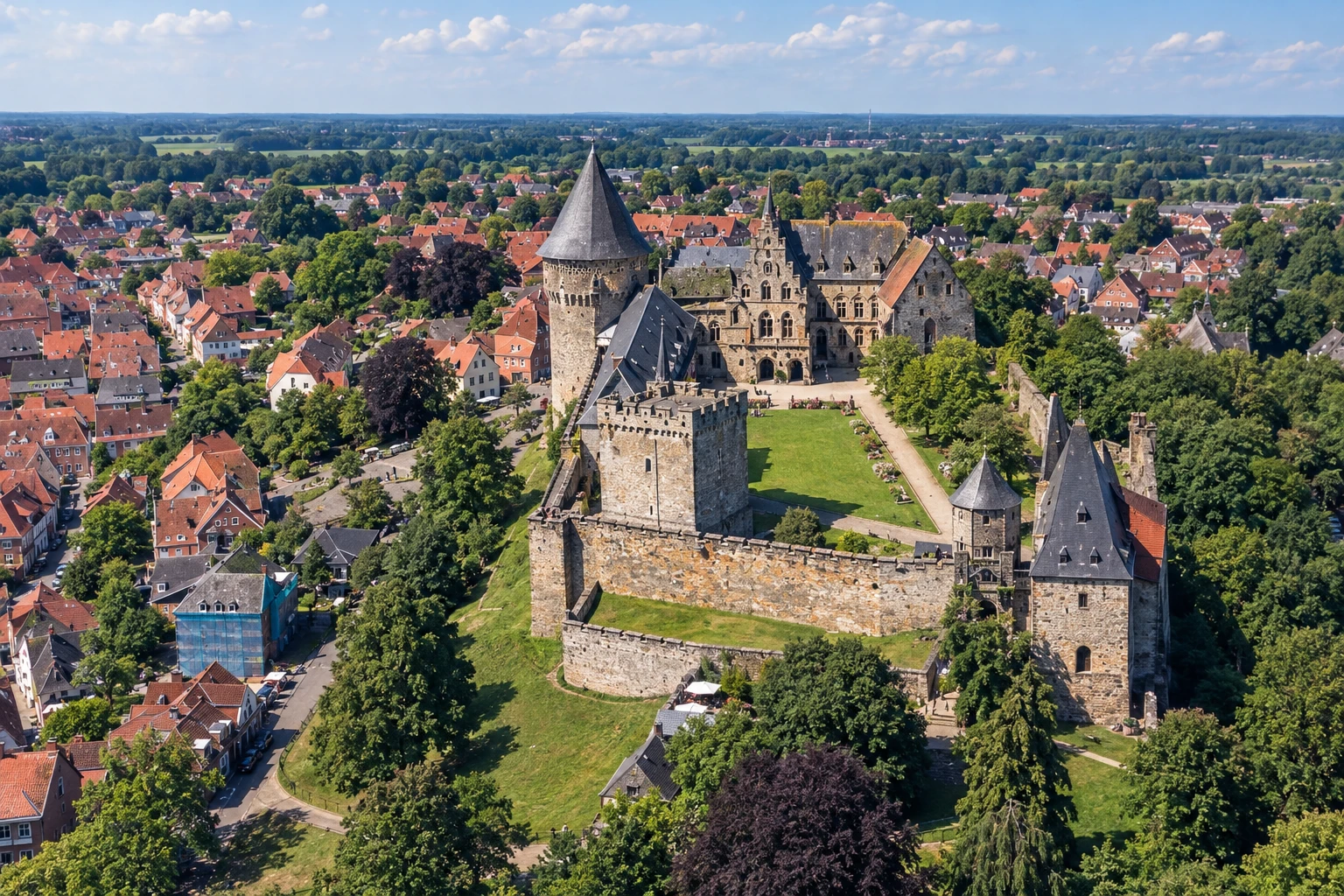
In the photo: Bad Bentheim Castle (Burg Bentheim)
The route
What the Amsterdam–Berlin by train is
The direct train between Amsterdam and Berlin covers the route in about 5 hours 50 minutes, without transfers. It departs from Amsterdam Centraal, crosses eastern Netherlands via Hilversum, Amersfoort, Apeldoorn, Deventer and Hengelo, crosses the border at Bad Bentheim and continues through Osnabrück and Hanover to Berlin, where it stops at Spandau, the central station (Hauptbahnhof) and Südkreuz.
The line, which for many years was served by the Intercity Berlin, is now operated by Deutsche Bahn’s ICE, with about five direct trains per day. The Netherlands and Germany are in the Schengen area and use the euro: there is no passport control on the train.
It’s a one-day journey, with flat polder landscapes, forests and small towns out the window. The most common plan is to spend a few days in Amsterdam, take the morning train and arrive in Berlin in the afternoon, with time for initial sightseeing.
The map
Amsterdam–Berlin by train
The journey
City by city
Distances and times are approximate: check before you set off.
-
 1 ·
 the Netherlands · North Holland
Amsterdam
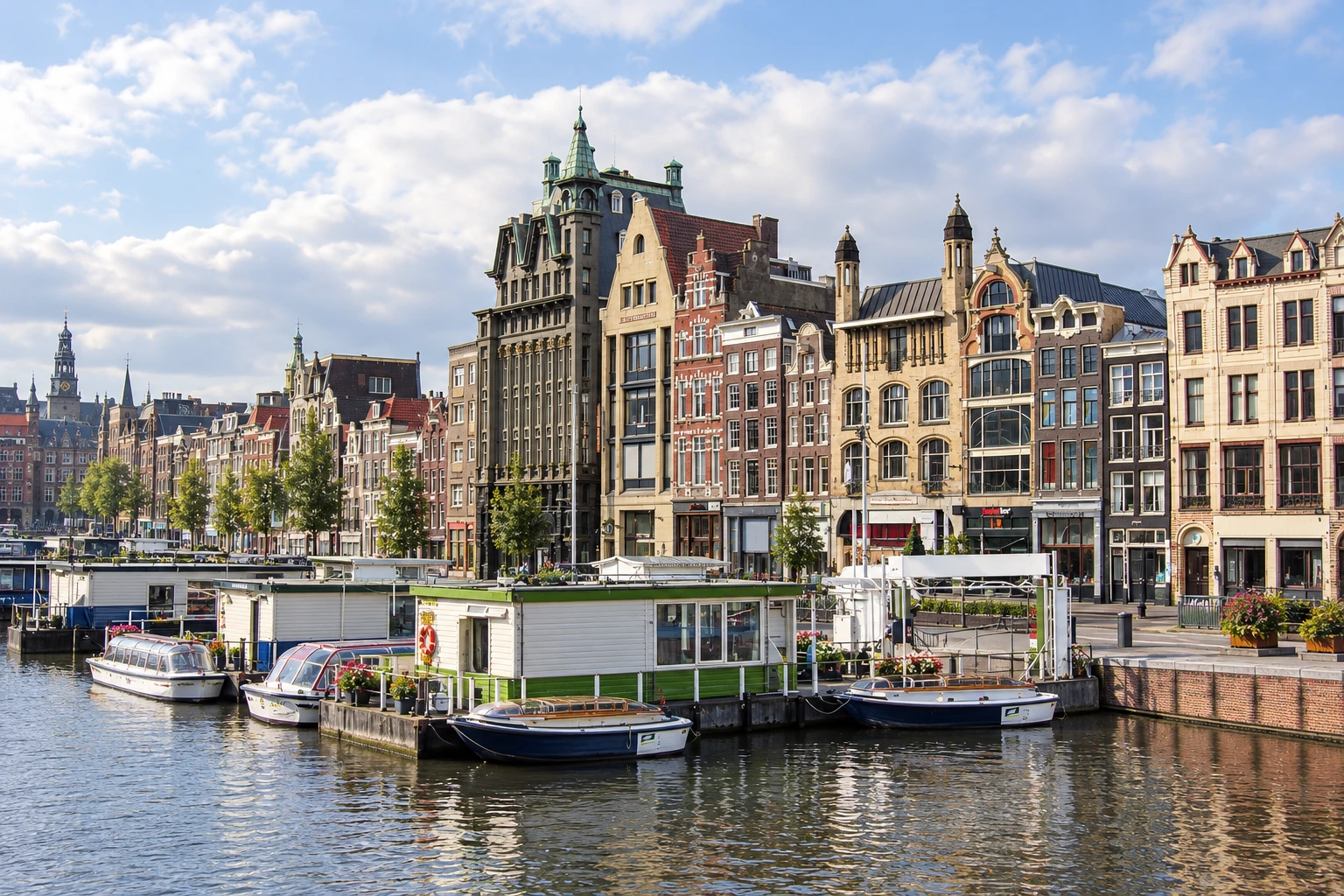
The route starts at Amsterdam Centraal, on the IJ waterfront and a few minutes’ walk from the canals. Amsterdam needs at least two days: the canals, the Jordaan, the Rijksmuseum, the Van Gogh Museum and Anne Frank’s house. Along the way, in eastern Netherlands the train stops at Hilversum, Amersfoort, Apeldoorn, Deventer and Hengelo; in Germany it stops at Bad Bentheim, Rheine, Osnabrück, Bünde and Hanover.
→ Berlin about 5h50 Direct ICE from Deutsche Bahn, stopping at Hilversum, Amersfoort, Apeldoorn, Deventer, Hengelo, Bad Bentheim, Rheine, Osnabrück, Bünde, Hanover and Spandau.
-
 2 ·
 Germany · Berlin
Berlin
The train reaches Berlin via Spandau and stops at the central station (Hauptbahnhof), near the Reichstag and the Brandenburg Gate, then continues to Südkreuz. Berlin needs at least two days: the Brandenburg Gate, Museum Island, the Holocaust Memorial, what remains of the Wall at the East Side Gallery and the Kreuzberg neighborhood. Potsdam is about a 30-minute regional train ride away.
How many days
The train journey takes about 5 hours 50 minutes. To see both cities at a relaxed pace, allow 6 to 8 days; with 4 days, two in each.
Best time to go
From May to September, with long days and mild temperatures. The tulip season in the Netherlands usually runs from mid-March to mid-May. In December there are Berlin Christmas markets.
The seasons shown are the most usual ones; nature doesn't always follow the calendar.
How to travel it
On a direct train, with a ticket purchased in advance. Seat reservation is not mandatory but is recommended because trains are often full. There is no check-in: just find the train on the departure board and board.
Who it's for
For travelers who want to combine the Netherlands and Germany without flying, who enjoy watching the landscape from the window, and who prefer to travel with their luggage from city center to city center.
Your questions
Frequently asked questions about Amsterdam–Berlin by train
How long is the train from Amsterdam to Berlin?
About 5 hours 50 minutes on the direct train, from Amsterdam Centraal to Berlin central station. Some schedules include extra stops and travel time may vary.
How many direct trains are there per day?
About five direct trains per day each way. Outside those times you can travel with a transfer in Germany; the Deutsche Bahn app shows the options.
Do you need to reserve a seat?
It is not mandatory but is recommended: trains are often full, especially on Fridays, Sundays and during holidays. In some summer periods reservation may become mandatory; check when purchasing your ticket.
Do you have to show your passport between the Netherlands and Germany?
Both countries are in the Schengen area and there is no fixed border control on the train. Still, carry your passport: police checks can occur, and it is the document Brazilians use in Europe.
Is there food on the train?
The ICE usually has a restaurant car or bistro. On a six-hour journey it’s wise to bring water and a snack in case the service is closed.
Can you stop along the way?
Yes, with separate tickets. Hanover and Osnabrück are the larger cities on the German section of the line, and Deventer in the Netherlands has an old town on the banks of the IJssel river.