Piran on foot: Tartini Square, the Venetian house and the Punta lighthouse
From Tartini Square, in the center of Piran Walk through the historic center about 3 hours morning or afternoon easy (stone streets)
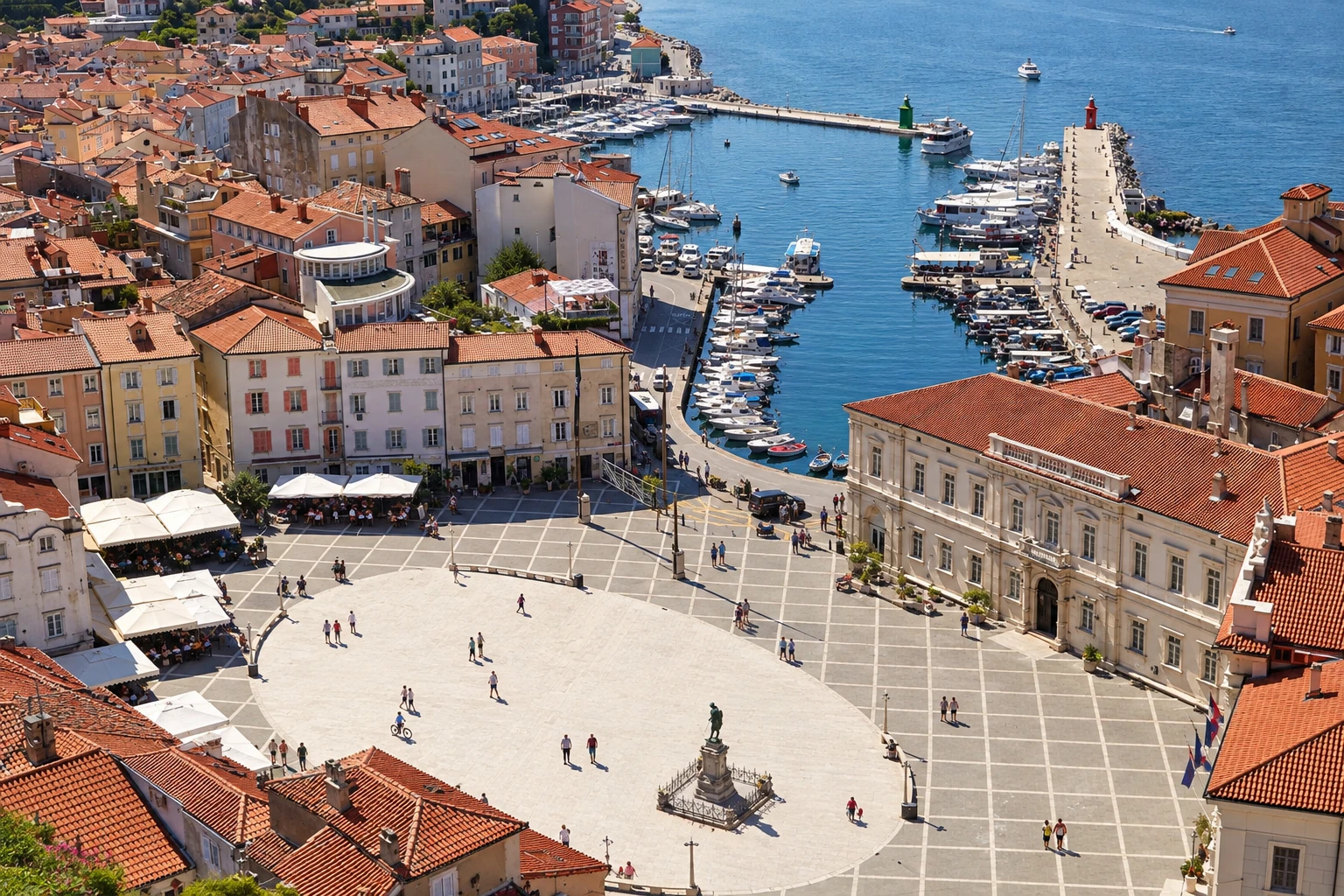
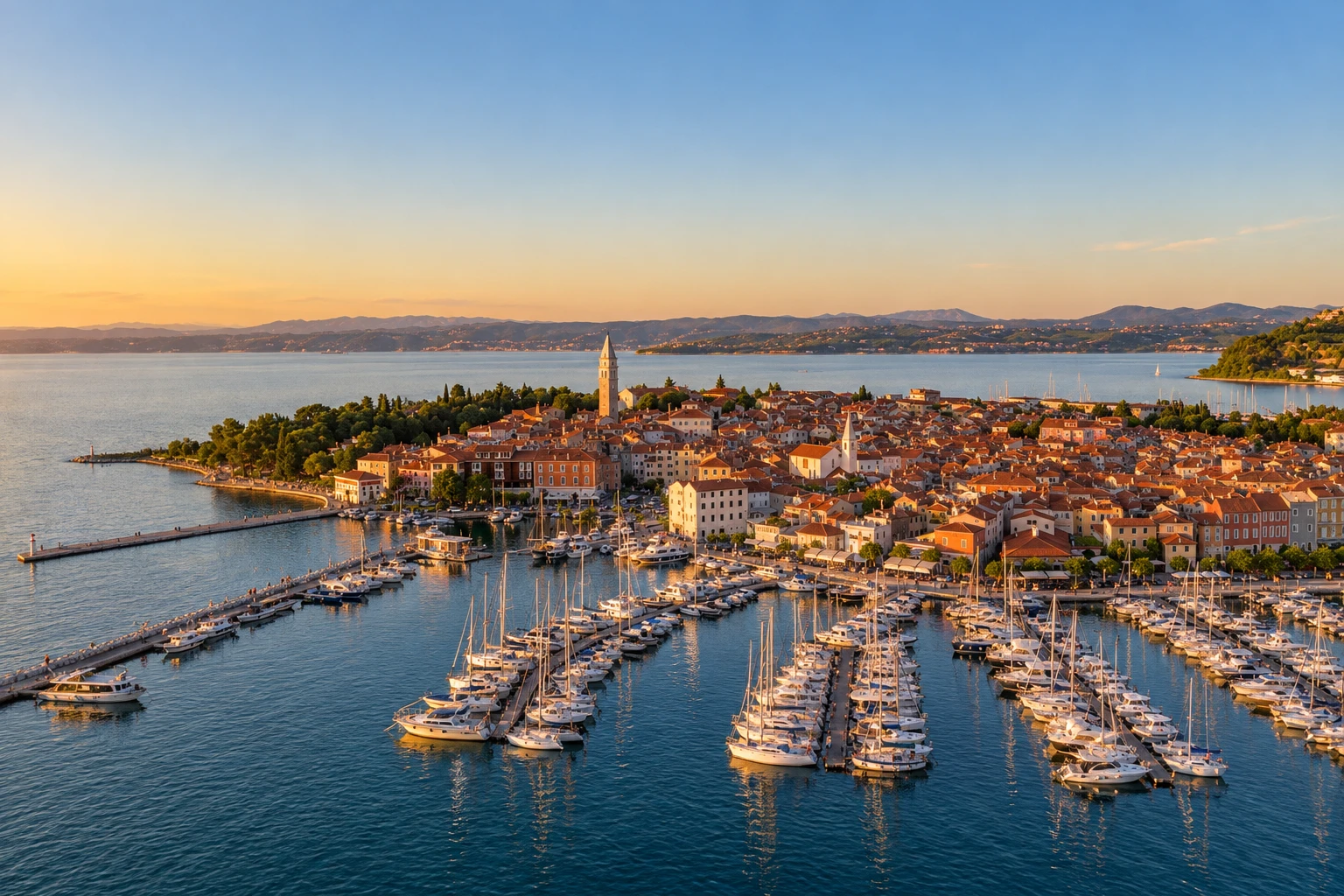
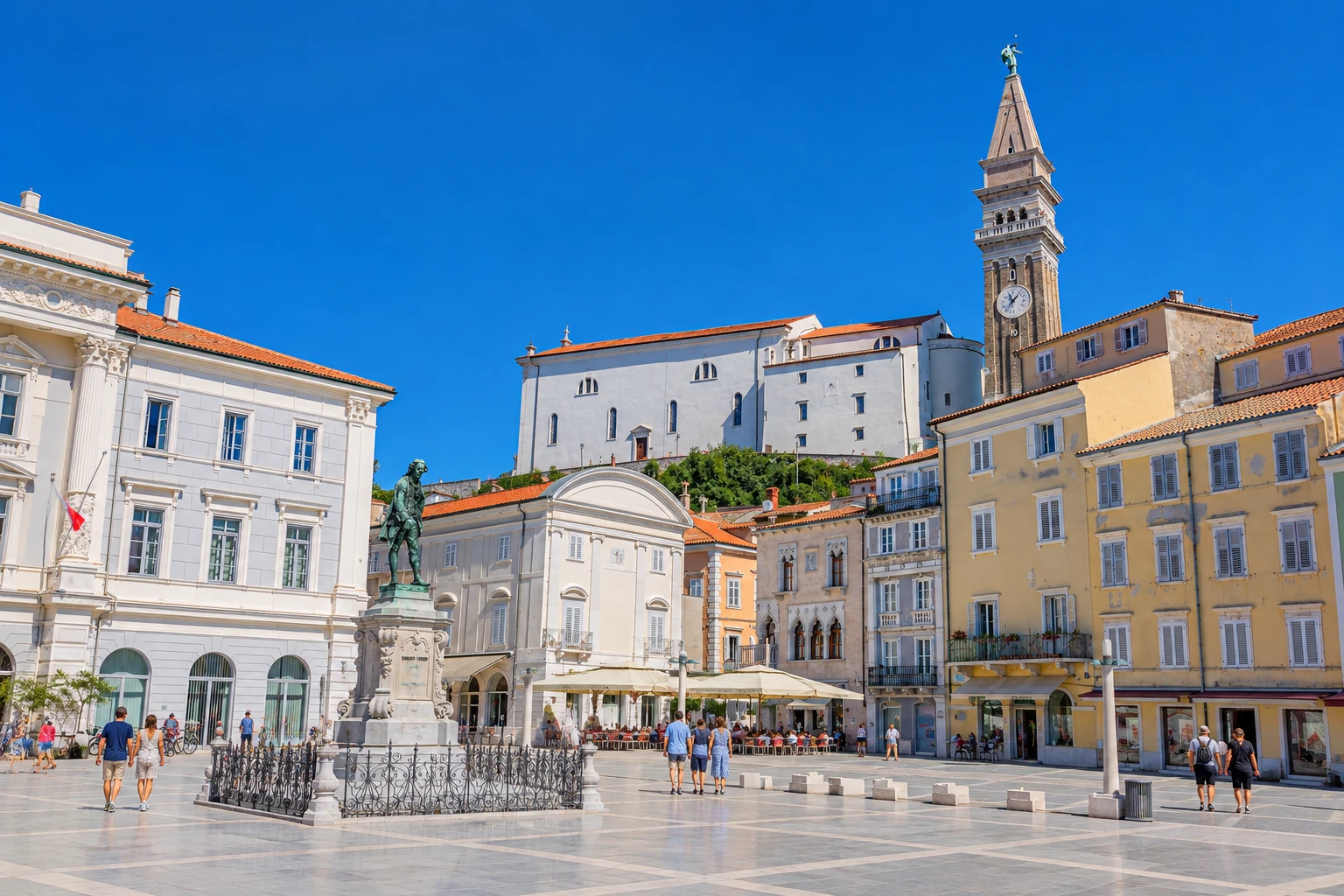
Piran sits on a narrow peninsula, and the medieval center can be explored entirely on foot. The starting point is Tartini Square, the oval plaza that used to be an inner fishermen’s harbor, the mandrač, filled in 1894. It is named after the violinist and composer Giuseppe Tartini, born in 1692 in a house on the square that is now open to visitors; his bronze statue by Venetian sculptor Antonio Dal Zotto was installed in 1896. On the corner stands the Benečanka, the 15th-century Venetian house in Venetian Gothic style, with a corner balcony and the inscription “Lasa pur dir” (let them talk), linked by legend to a Venetian merchant’s love for a local girl. The square is completed by the town hall and the courthouse palace. From there, the alleyways lead to the Minorite friary of St. Francis, founded before 1301, with a 1735 cloister used for concerts, and to the seafront, which continues to the Punta, the tip of the peninsula where the lighthouse and the Church of Our Lady of Health stand. The town also has the Pomorski muzej Sergej Mašera maritime museum, the Piran Aquarium with about 140 species from the northern Adriatic in 25 tanks, and a shell museum with more than 4,000 items.
Stops: Tartini Square, Benečanka, Punta, Minorite Friary of St. Francis, Piran Aquarium.
Includes: Self-guided walk. Tartini House, museums, the aquarium and the lighthouse have separate entrance fees. Check the current rates.
Tip: Car access to the center is restricted: leave your car in a garage at the entrance and walk down or use the local shuttle. The lighthouse is open to visitors only in the warm months; check before you go.
Best time: Year-round; May to October to find the lighthouse open.
Church of Saint George and the walls: Piran seen from above
From Tartinijev trg, in Piran Walk uphill through the streets of the centre about 2 hours morning or late afternoon easy to moderate (slopes and steps)
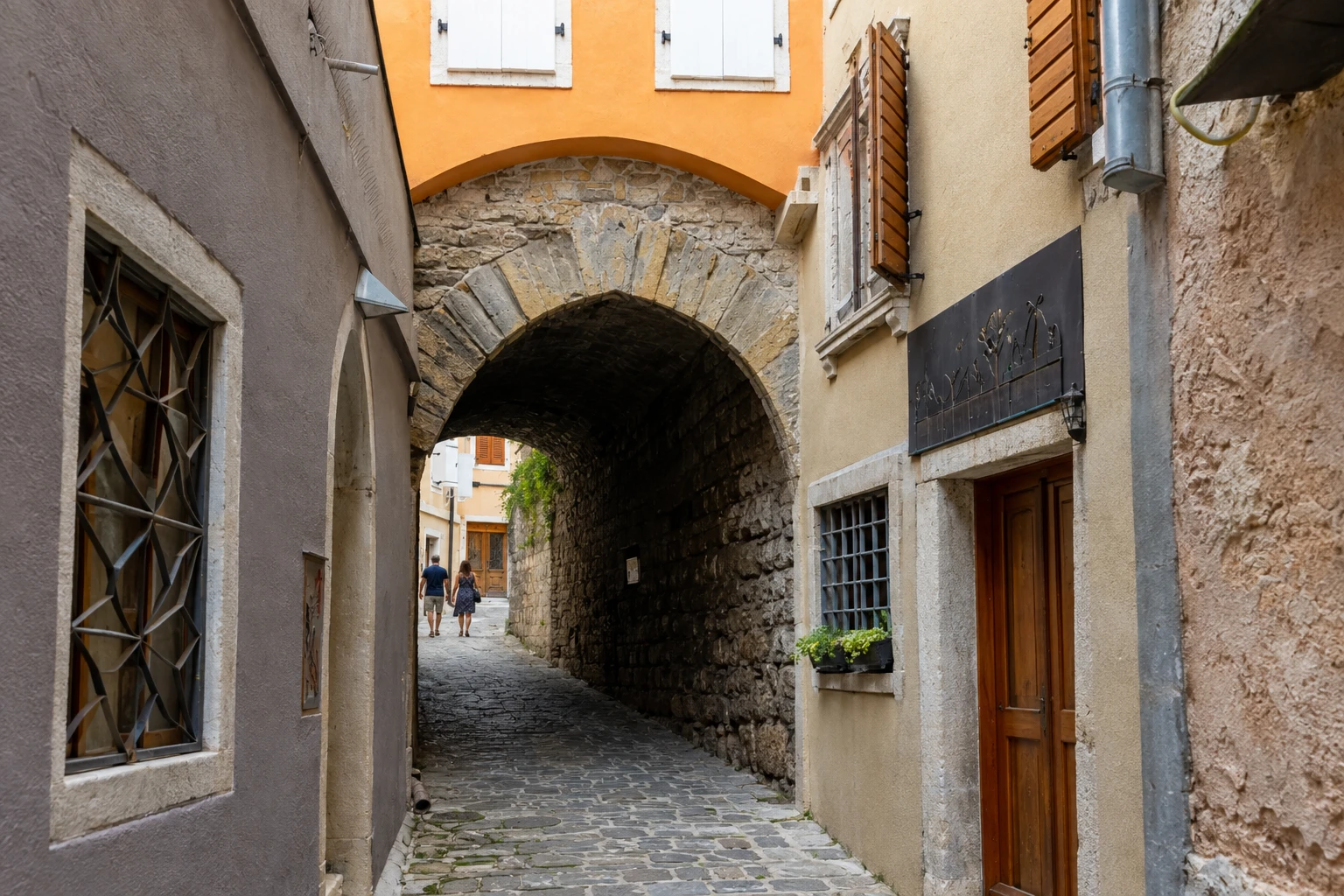
The two most open viewpoints in Piran are on the hill behind the town center. Cerkev sv. Jurija, the Church of St. George, the city’s patron saint, occupies the highest point of the peninsula; there was a church here as early as the 6th or 7th century, the current building dates from the 14th century and gained its Baroque appearance in the 17th century. Inside are seven altars, a painted wooden ceiling, canvases of the Venetian school and The Martyrdom of St. George (1841), cited as the largest oil on canvas in Slovenia; the parish museum keeps the treasury and a 16th-century wooden model of the church. The 46 m tower is a smaller replica of St. Mark’s bell tower in Venice and is topped by the statue of the archangel Michael, which turns with the wind. From the top, on a clear day, you can see the coasts of Slovenia, Italy and Croatia. From the square, about a 10-minute climb brings you to the walls (Mestno obzidje Piran). The town was fortified in three phases; the visitable section belongs to the third phase, built between 1470 and 1533, with towers that offer views of the whole peninsula. Seven city gates still stand in the lower streets, including the Dolfin Gate, from 1483.
Stops: Cerkev sv. Jurija, Mestno obzidje Piran, Baptistery of St. John the Baptist.
Includes: The tower, the parish museum and the walls have separate paid entries. There is a pass that covers all three. Check the current price list.
Tip: Climb the tower or the walls on a clear sky day, early in the morning or late in the afternoon, when the light is lower.
Best time: All year round; in summer, avoid the hours of strongest sun.
From Piran to Fiesa along the seafront: the beach and the two lakes
From Piran, via the coastal promenade Walk along the coastal promenade about 1 h 30 (round trip) morning or afternoon easy (flat)
A coastal walking path links Piran to the Fiesa cove, toward Strunjan. It’s a short stretch with the sea beside it. In Fiesa there is a pebble beach with concrete platforms, lawns and pine shade, with shallow water popular with families and snorkelers. Beside it are the two Fiesa lakes, formed in the clay pits of an old pottery and protected as a natural monument: the larger one, up to 9 m deep, lies a few meters from the sea and connects to it underground; the smaller, fresh-water lake hides among the bushes. Both provide habitat for plants and animals, and the visit is along marked paths.
Stops: Fiesa, Fiesa Lakes, Piran.
Includes: Free walk, no charge. On the beach, sunbed and umbrella rentals from May to September, paid separately.
Tip: The beach has no lifeguards. Those coming by car find a small paid parking lot in Fiesa, which fills early in summer; on foot from Piran there’s no such concern.
Best time: Year-round for the walk; June to September for swimming.
Sečovlje Salina Nature Park: Lera, Fontanigge and the salt museum
From Lera entrance, on the heights of Seča (Portorož) On foot or by bicycle within the park about 3 hours morning or late afternoon easy (flat, without shade)
The Sečoveljske soline, the Sečovlje salinas, lie at the back of Piran bay, by the border with Croatia, and are first mentioned in 804. Salt is still harvested by hand, with traditional tools, using a method more than 700 years old that the salt workers of Piran learned from those on the island of Pag. The nature park has two parts, separated by the Drnica stream. Lera is the active area: the concentration and crystallization basins, the petola (a layer of cultivated microorganisms on the bottom that keeps the salt clean), maintained paths, information panels, a visitor center with a viewpoint and the salt shop. The guided Lera visit covers about 2 km between the entrance and the visitor center. Fontanigge is the abandoned salina area, where halophytic plants have taken over the basins and the salt workers’ houses remain among the channels; it houses the salt museum in restored houses, with a field where the medieval method is demonstrated. More than 300 bird species have been recorded in the park. By tradition, salt-worker families moved to the salinas on Saint George’s Day, April 23, and stayed there until the end of October.
Stops: Sečoveljske soline, Lera, Fontanigge, Salt museum.
Includes: Park entrance fee charged separately, required of all visitors; guided tour and salt museum also have fees. Check the current price list.
Tip: The two parts have different land entrances: Lera, from the heights of Seča; Fontanigge and the salt museum via a dirt road by the Dragonja river, near the border. In Fontanigge you can only walk or go with a guide. Bring water and a hat; dogs are not allowed in Lera. Check opening hours before you go.
Best time: In summer, to see the salt harvest; the park welcomes visitors year-round.
Strunjan Park: the cliff, the Stjuža lagoon and the Moon Bay
From Strunjan (local bus from Piran and Portorož) Cliff-edge walking trail about 3 hours morning or afternoon easy to moderate (steep descent)
The Strunjan Landscape Park (Krajinski park Strunjan) protects the longest stretch of natural coast on the Gulf of Trieste, between Piran and Izola. Its centerpiece is the flysch cliff, soft rock layers formed about 40 million years ago and shaped by wind, rain and waves: it reaches 80 m in height, extends for about 4 km and is the highest flysch cliff in the Adriatic. With the 200 m-wide strip of sea at its base, it forms a nature reserve. A trail runs along the edge, through pine trees and Mediterranean vegetation, passes the Strunjan cross with views over the gulf, and provides access to Moon Bay (Mesečev zaliv), a natural pebble beach reachable only on foot with no facilities. At the foot of the slope lies the Stjuža, Slovenia’s only marine lagoon, separated from the sea by a causeway for more than 400 years, averaging about half a meter deep, with wooden viewpoints for birdwatching. The small Strunjan salt pans next door keep the traditional salt harvest. Around them, terraces with dry stone walls and vineyards form the park’s cultivated landscape.
Stops: Krajinski park Strunjan, Strunjan Cliff, Stjuža Lagoon, Moon Bay, Strunjan Cross.
Includes: Free trails, no entrance fee. Paid parking near the villages of Strunjan and Pacug. Guided tours require separate payment.
Tip: Wear trail shoes, sunscreen and bring water. At the Moon Bay, choose a spot away from the cliff face, which occasionally sheds rocks, and take your trash back with you: the beach has no facilities.
Best time: From April to October; in summer, start early because of the heat.
Portorož: the central beach, the rose garden and the Forma viva sculptures
From Portorož promenade, next to the central beach Seafront walk; bus or bicycle to Seča about 4 hours morning or afternoon easy
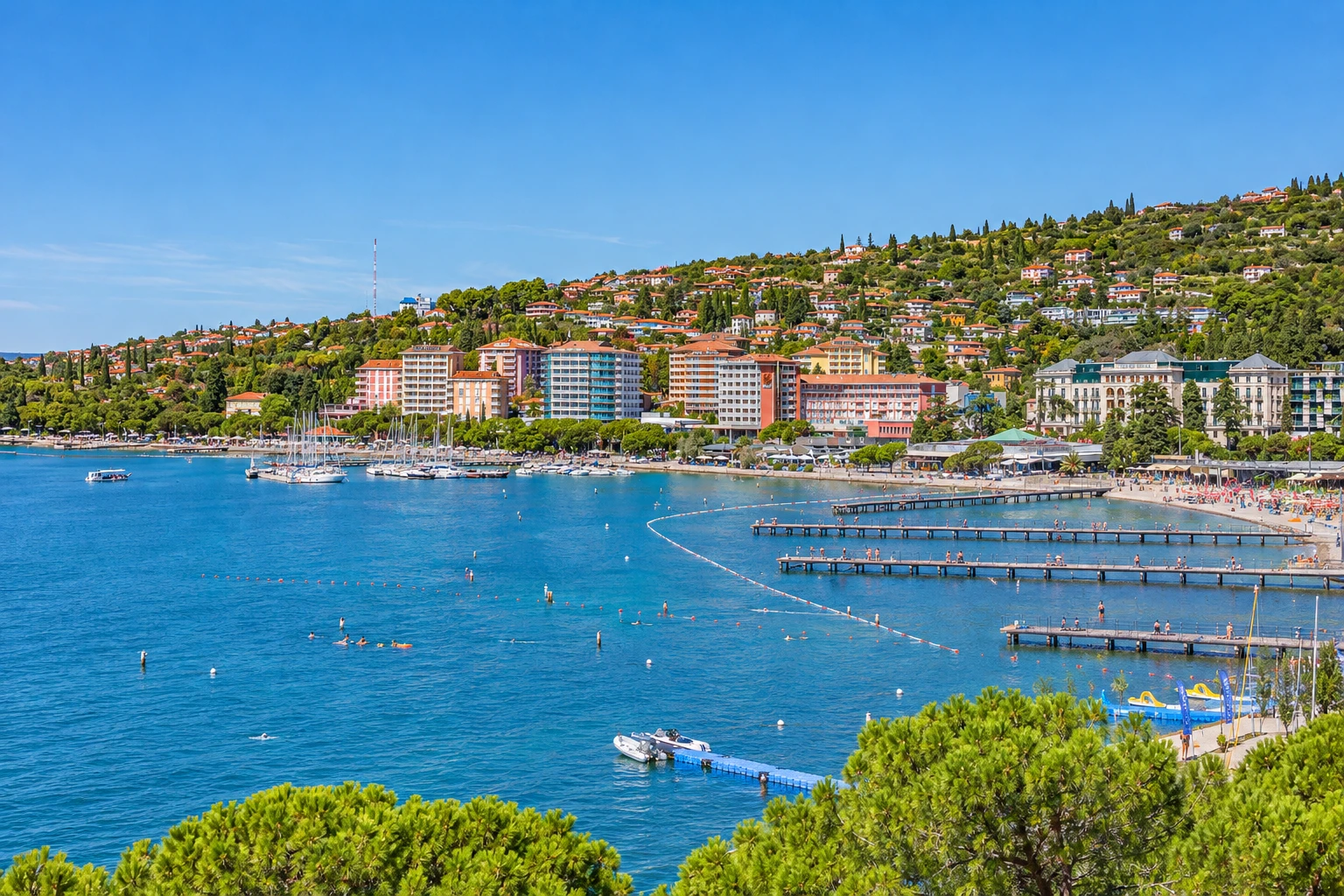
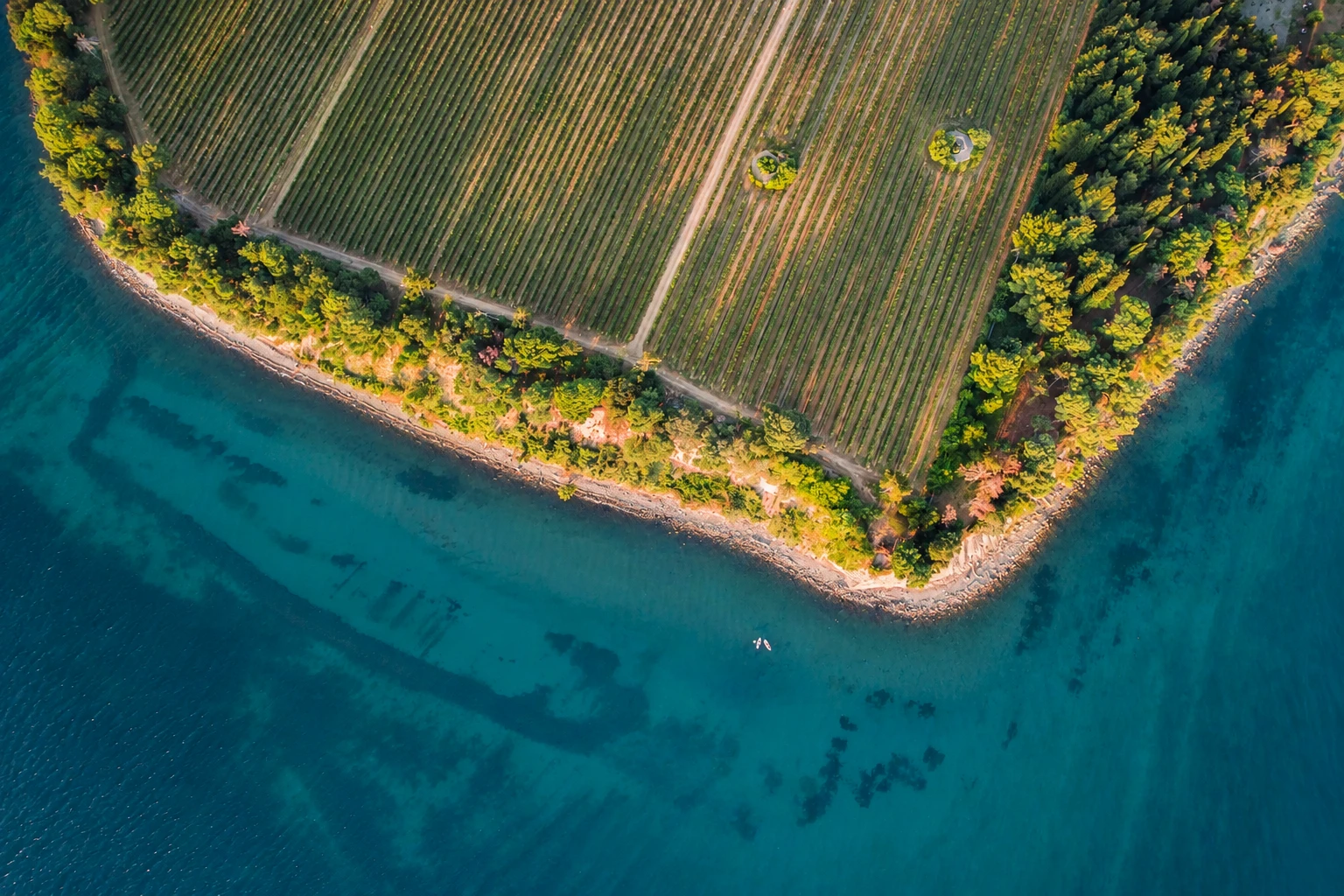
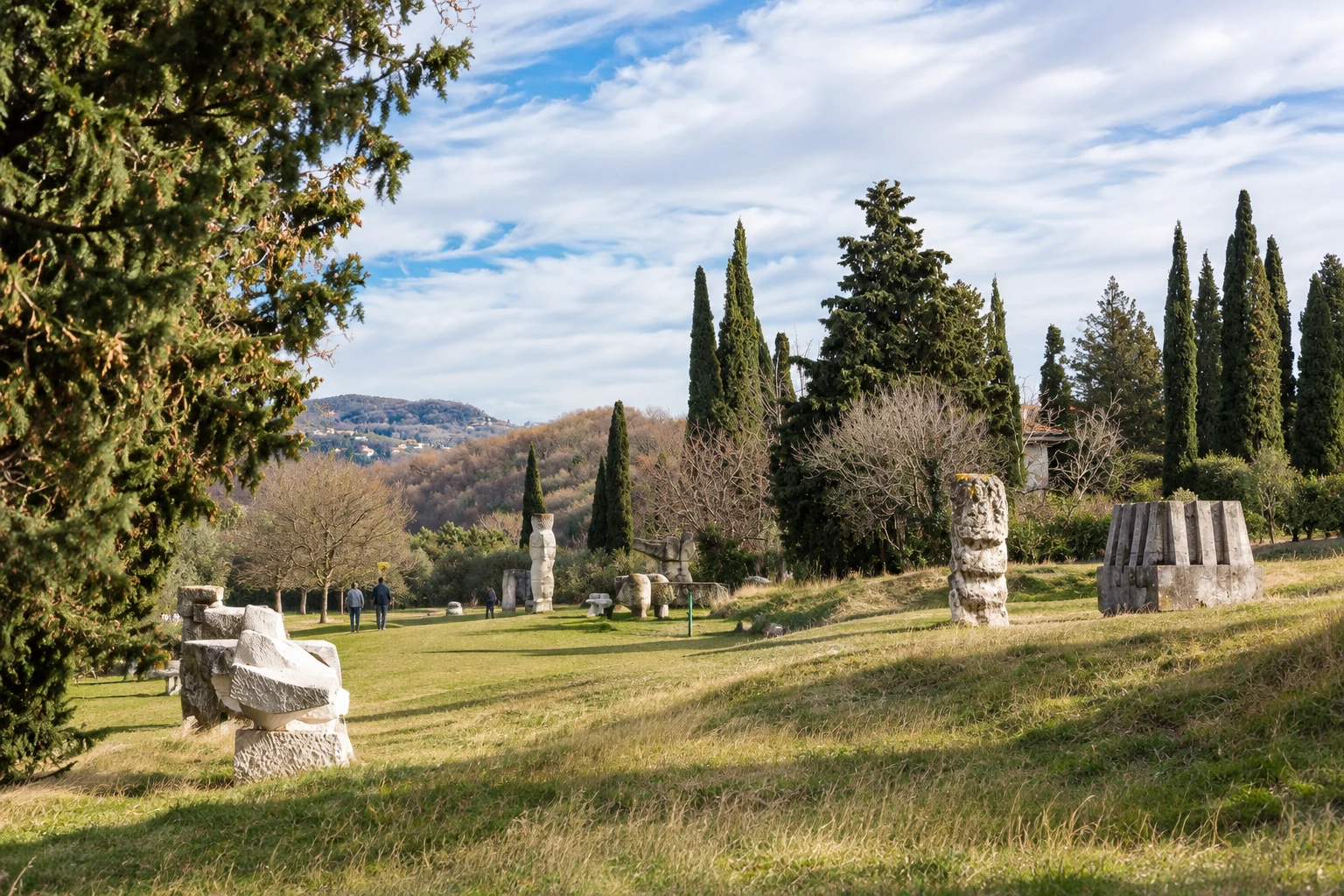
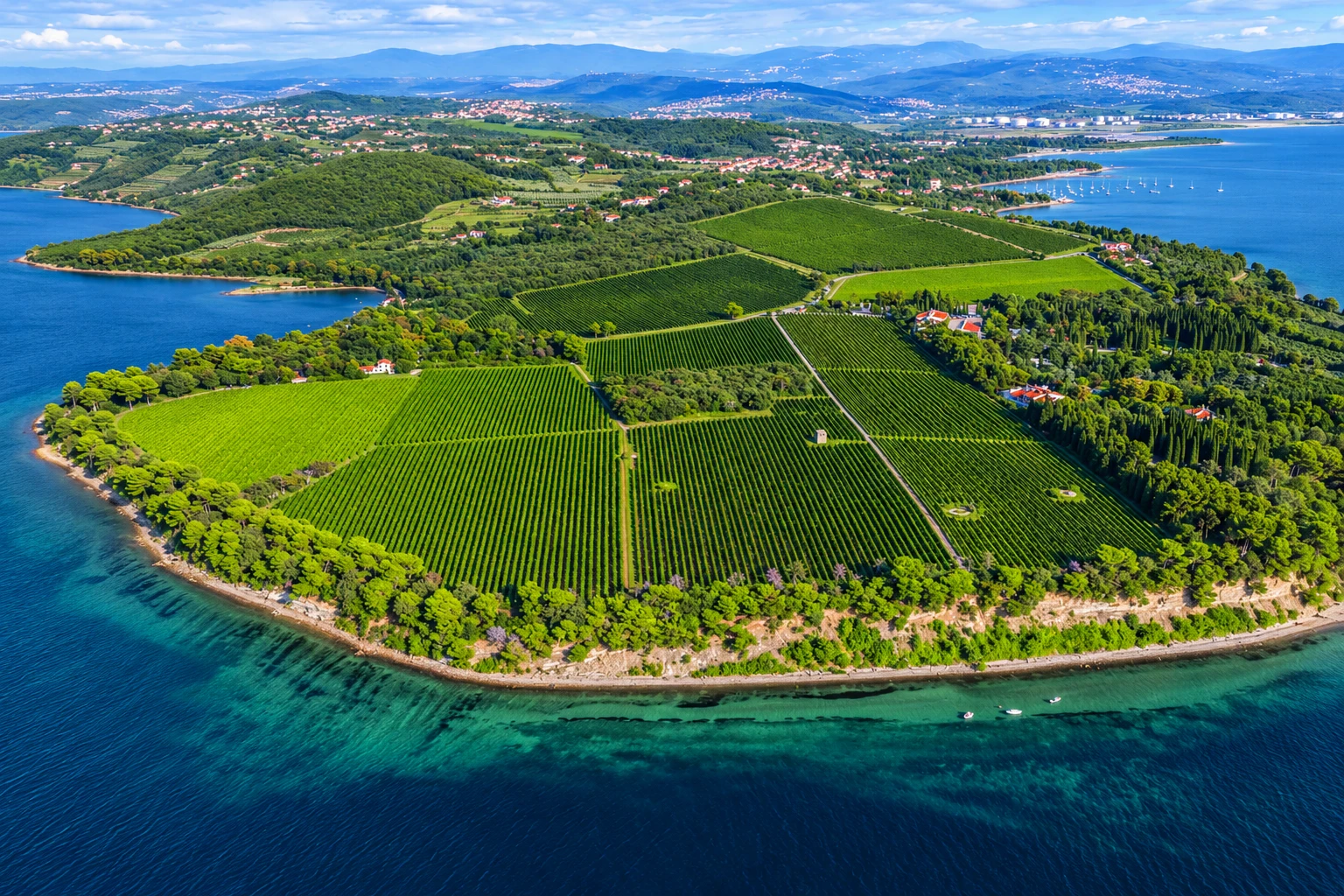
Portorož is the seaside resort of the Slovenian coast, a few kilometers from Piran. The name comes from Portus Sanctae Mariae de Rosae — the port of Saint Mary of the Rosary — because of a church that stood above the bay in the 13th century. The first modern spa, with a park, dates from 1887, and by 1911 the town already had 20 hotels and boarding houses and 47 villas; some still stand, in styles ranging from Art Nouveau to modernism. The Centralna plaža Portorož, the central beach, is about 25,000 m², with a stretch of sand, lawns and an area of pebbles along the promenade, a ramp and equipment for sea access for people with reduced mobility. On the promenade is the rose garden, with more than 120 varieties of roses. On the Seča peninsula, the Forma viva Portorož park displays outdoor stone sculptures: the collection began in 1961, initiated by artists Jakob Savinšek and Janez Lenassi, and now includes more than 130 works by sculptors from over 30 countries, among olive trees and with views over Portorož bay.
Stops: Centralna plaža Portorož, Portorož rose garden, Forma viva Portorož, Seča.
Includes: Beach with free access; sunbeds, umbrellas and restrooms are paid separately. No admission fee is charged to enter Forma viva.
Tip: A local bus runs all day between Piran, Portorož and Lucija; you cannot pay cash on board — only with the city card, the app, or contactless bank card.
Best time: June to September for swimming; in May the roses are in bloom.


 Brazil
 Antarctica
 Argentina
 Bolivia
 Chile
 Colombia
 Ecuador
 Falkland Islands (Malvinas)
 French Guiana
 Guyana
 Paraguay
 Peru
 Suriname
 Uruguay
 Venezuela
 Austria
 Belgium
 Croatia
 Denmark
 Finland
 France
 Germany
 Greece
 Hungary
 Iceland
 Ireland
 Italy
 Luxembourg
 Norway
 Poland
 Portugal
 Slovakia
 Spain
 Sweden
 Switzerland
 the Czech Republic
 the Netherlands
 the United Kingdom
 Turkey
 Bermuda
 Canada
 Greenland
 Mexico
 Saint Pierre and Miquelon
 the United States
 the Dominican Republic
 Japan
 Egypt
 South Africa
 Australia
 Fiji
 New Zealand
 Papua New Guinea