Tartinijev trg, Tartini’s birthplace and the Benečanka
From Tartinijev trg, central Piran Walk around the square and surrounding streets About 2 hours Morning or afternoon Easy
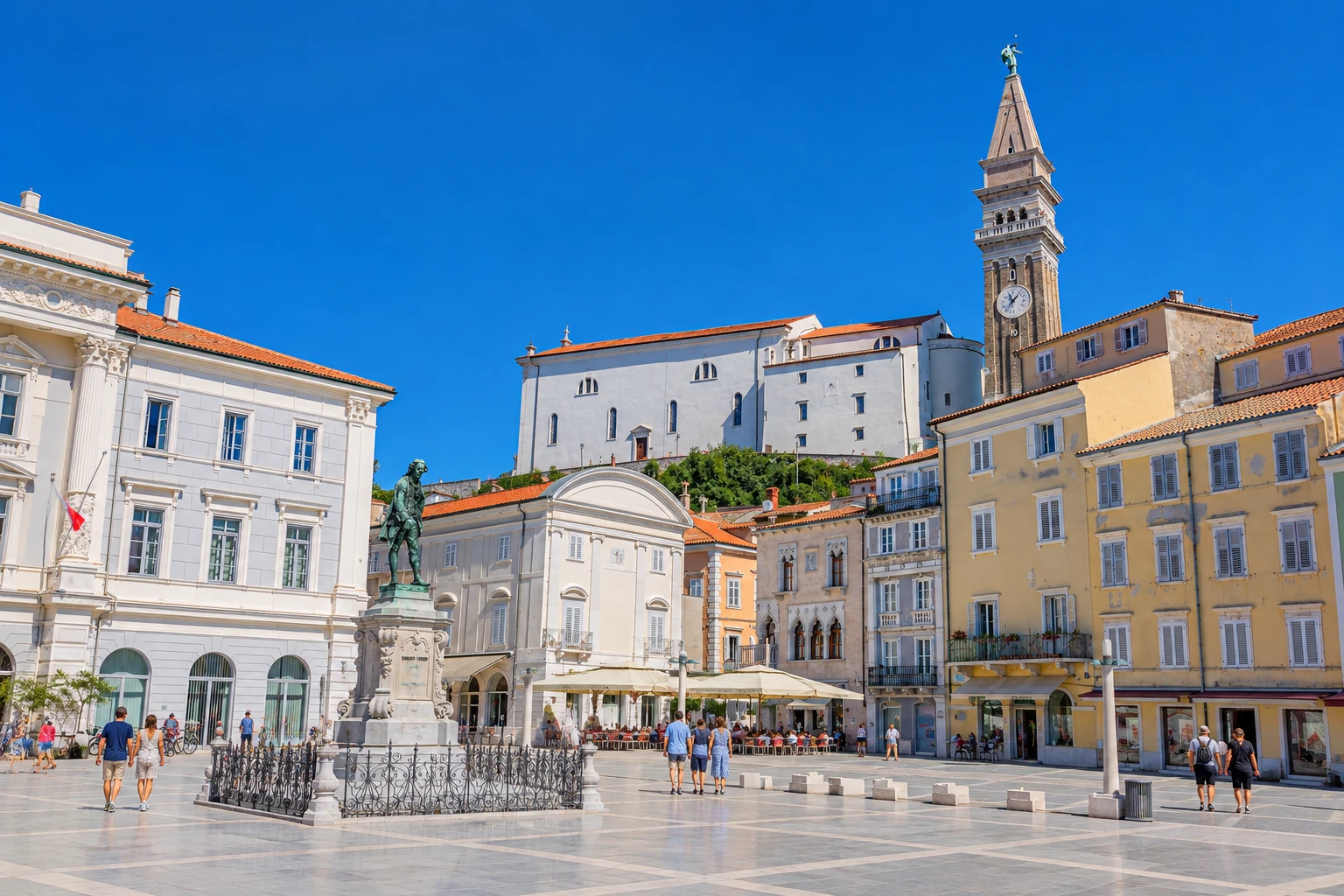
Tartinijev trg is Piran’s main square and the starting point for walks in every direction. Until the late 19th century, water filled this space. It was the mandrač, the inner harbor where boats unloaded fish, salt, olives, grapes and wine. The harbor was filled in in 1894 to improve sanitation and give the town a public space. Its present design dates from 1992. Architect Boris Podrecca kept the old harbor’s oval outline and paved it with white Istrian stone. The square is now closed to traffic.
At its center is a bronze statue of Giuseppe Tartini by Venetian sculptor Antonio Dal Zotto, installed in 1896 with funds raised in Trieste, Istria and the Kingdom of Italy. The violinist and composer was born on the square in 1692, the son of a Florentine merchant. In 1708 he left Piran to study in Padua, where he later led the orchestra of the Basilica of St. Anthony for more than forty years. His 14th-century birthplace, with a 19th-century neoclassical facade, is now a small museum. It holds one of his violins, made around 1720, portraits and his death mask. Landscapes decorate the walls.
On the corner stands the Benečanka, or Venetian House, the oldest building on the square. Built in the 15th century in the Venetian Gothic style, it has a corner balcony and the inscription “Lasa pur dir,” or “Let them talk.” Legend says a Venetian merchant, Del Bello, had the house built for a young woman from Piran, and the words were their answer to local gossip. Around the square are the neo-Renaissance town hall, the courthouse and, one floor above street level, the shell museum, with more than 4,000 specimens from seas, rivers and caves.
Stops: Tartinijev trg, Tartini Monument, Tartini’s birthplace, Benečanka, Piran Town Hall, Courthouse, Shell museum.
Includes: Explore the square freely. Tartini’s birthplace and the shell museum charge separate admission. Check current rates.
Tip: Tartini’s birthplace closes on Mondays and opens for only part of the day. In winter, the shell museum opens only on weekends. Check before you go. The tourist information center is on the square.
Best time: Year-round. In December the square hosts the holiday market.
St. George’s Church, bell tower, baptistery and parish museum
From Tartinijev trg, uphill through the town center Walk uphill on slopes and stairs About 1 hour 30 minutes Morning or late afternoon Easy to moderate (slope and stairs)
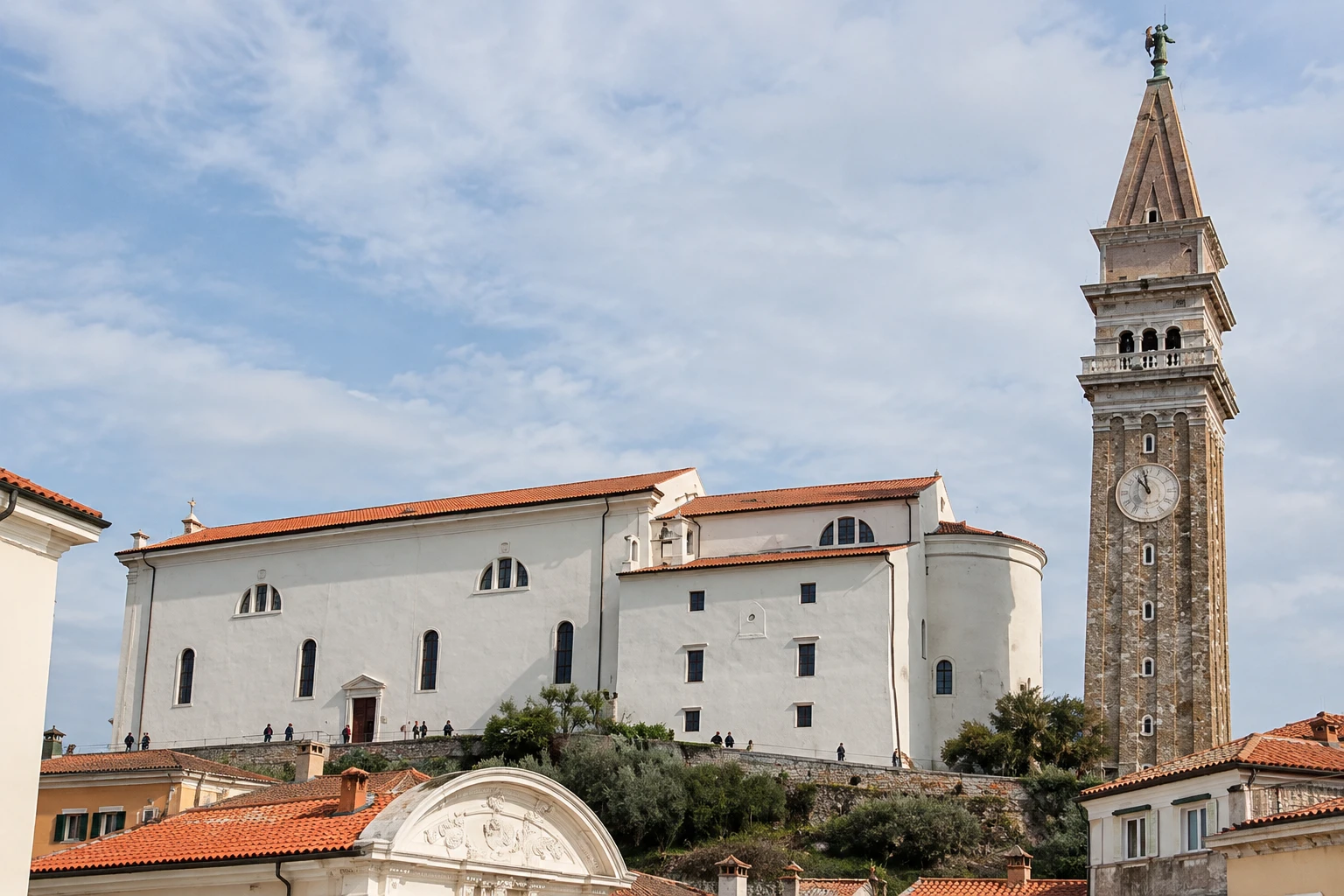
Cerkev sv. Jurija, or St. George’s Church, rises above the rooftops and is the largest church in Piran. A church already stood on this hill in the 6th or 7th century and doubled as a lookout over the bay. The present church dates from the 14th century. Consecrated in 1344, it took on its Baroque appearance during 17th-century renovations. St. George is Piran’s patron saint. Legend says he appeared to fishermen at sea and calmed a storm that threatened the town.
Inside are seven altars, a painted wooden ceiling, canvases of the Venetian school and Giovanni Pagliarini’s 1841 Martyrdom of St. George, said to be Slovenia’s largest oil painting on canvas. The church also holds the country’s oldest baptismal register, kept continuously since the early 16th century.
The tower stands about 46 m tall, has four bells and was modeled on St. Mark’s Campanile in Venice. The Venetian tower collapsed in 1902 and was rebuilt, making Piran’s smaller replica older than the current version of its model. At the top, a statue of the Archangel Michael, protector of sailors, turns in the wind. Tradition says the sea will be calm when the angel faces Trieste. On a clear day you can see the coasts of Slovenia, Italy and Croatia.
Alongside stands the domed, octagonal Baptistery of St. John the Baptist, built in 1650. Its font is a 1st-century Roman tombstone carved with a winged boy riding a dolphin. Giuseppe Tartini was baptized here on April 8, 1692. The parish museum displays liturgical objects, a treasury with a silver statue of St. George on horseback, an archaeological crypt with Roman and medieval remains, and a 16th-century wooden model of the former Gothic church.
Stops: Cerkev sv. Jurija, St. George’s bell tower, Baptistery of St. John the Baptist, St. George’s Parish Museum.
Includes: The tower and parish museum each charge admission. A combined pass covers the tower, museum and town walls. Check current rates.
Tip: Wear sturdy shoes for the uphill walk to the church and the stairs inside the tower. The parish museum opens daily in summer. At other times, check before visiting.
Best time: Year-round. For the views, choose a clear day and go early or late in the afternoon.
Piran’s town walls and seven gates
From Tartinijev trg (about a 10-minute climb) Uphill walk with stairs in the towers About 1 hour 30 minutes Morning or late afternoon Easy to moderate (slope and stairs)
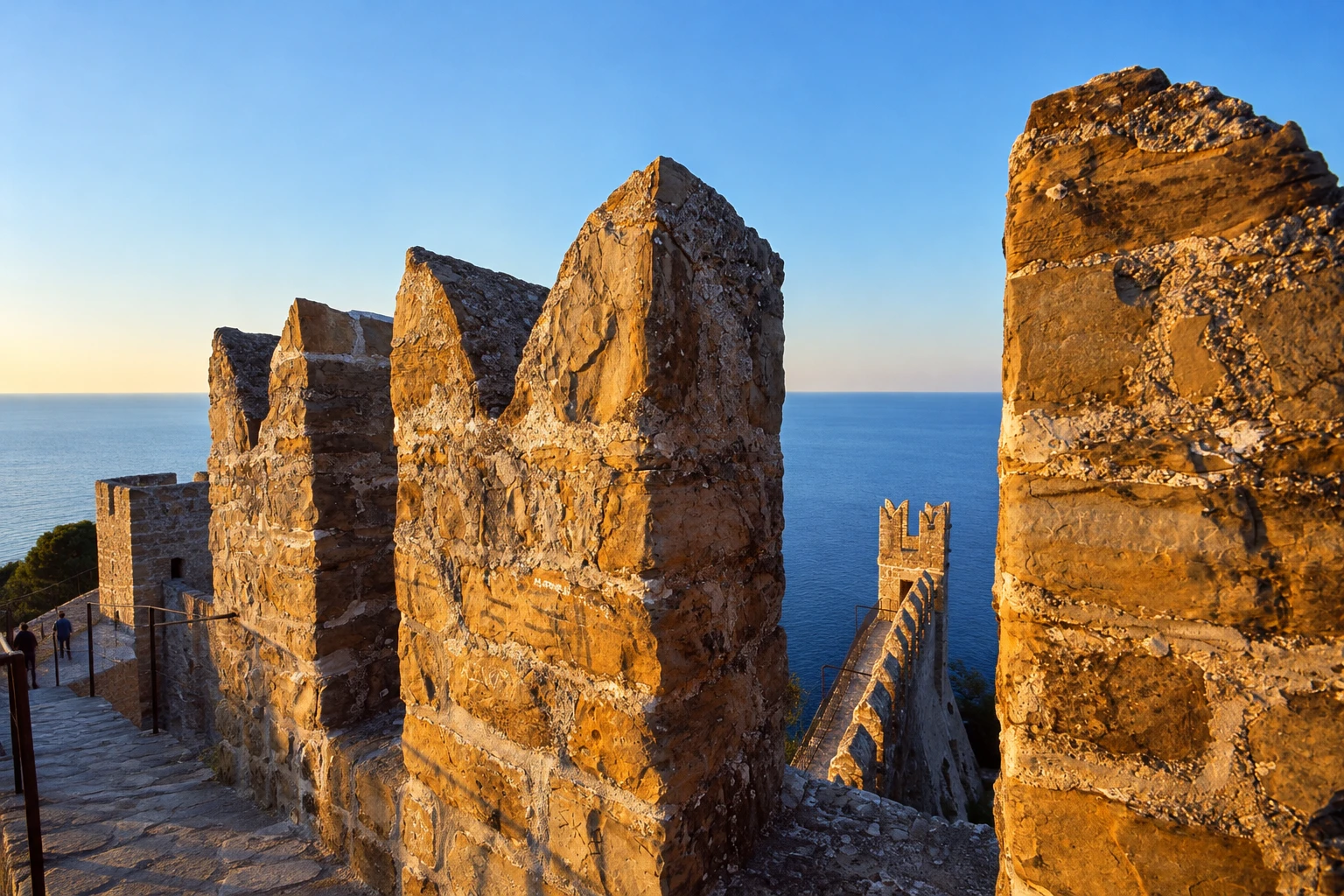
As Piran grew, it enclosed itself in three successive sets of walls. The first, from the 7th century, protected only the oldest part of Punta. Its four neighborhoods took their names from the gates: Miljska, Stolna, Osrednja and Poljska. The second set followed the town’s expansion southeast to include Marčana. The third, built between 1470 and 1533, climbed the hill to enclose the entire peninsula. This is the best-preserved stretch, on the slope of Mogoron, and the one you can visit. With the arrival of gunpowder, the walls were adapted to new forms of defense.
The section open to visitors is about a 10-minute climb from Tartinijev trg. You can enter some of the defensive towers for views over the whole town, the peninsula and the open sea.
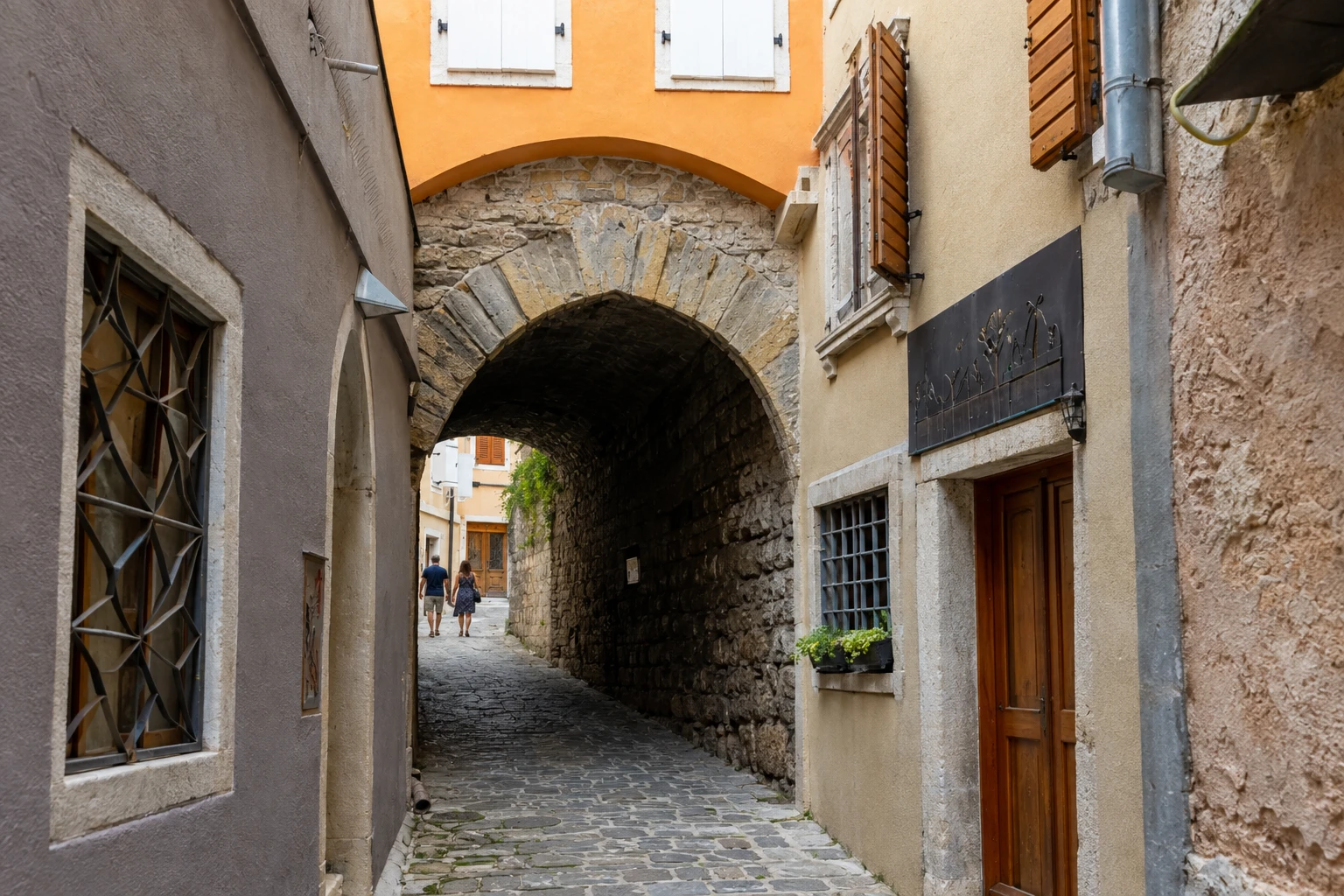
On the way down, look for the seven surviving gates in the streets below. The first Rašpor Gate, on Rozmanova ulica, is Gothic. The second, built in 1470, has a pointed arch. Marčana Gate, from 1534, is Renaissance in style. The 13th-century Miljska Gate is one of the oldest. Dolfin Gate, built in 1483, bears a coat of arms with three dolphins. Poljska Gate dates from the 15th century, and the Baroque St. George’s Gate was rebuilt in 1660.
Stops: Mestno obzidje Piran, Dolfin Gate, Marčana Gate, Rašpor Gates, St. George’s Gate.
Includes: The walls charge admission. A combined pass covers the walls, St. George’s bell tower and the parish museum. Check current rates.
Tip: In summer, go early or late in the afternoon to avoid the strongest sun. You can combine the climb with St. George’s Church on the same side of the hill.
Best time: Year-round. In summer, avoid the hours of strongest sun.
Punta, from Prvomajski trg and the Minorite cloister to the lighthouse
From Tartinijev trg, along the lanes toward the tip of the peninsula Walk through the lanes and along the waterfront About 2 hours Morning or late afternoon Easy (stone streets)
Punta is Piran’s oldest quarter, on the part of the peninsula that reaches into the open sea. At its heart is Prvomajski trg, or May 1 Square, once called Old Square. In the Middle Ages it was the administrative center, home to the old town hall. A stone cistern in the middle of the square dates from after the great drought of 1775. Rainwater ran from nearby roofs through stone, sand and gravel into the reservoir. Two statues of boys, one holding a fish and the other a vase, decorate it. The small 14th-century Church of St. Donatus is now an art gallery, and in summer the square hosts music, dance and theater. Several Slovenian films were shot here, and the European Film Academy named it one of its Treasures of European Film Culture.
Near the center is the Minorite Monastery of St. Francis, founded before 1301 and expanded in the 17th and 18th centuries. Its cloister, completed in 1735, has fine acoustics and hosts classical concerts, including performances at the Tartini Festival.
Follow the Prešernovo nabrežje waterfront to the tip of the peninsula. Here you’ll find the lighthouse and the Church of Our Lady of Health. Originally dedicated to St. Clement, patron saint of sailors, the church was renamed in 1632 during the plague epidemics. The rotunda at the back dates from 1506. Legend traces the name Piran to the Greek pyr, or fire, because fires burned here to guide ships. The lighthouse opens in the warmer months with temporary exhibitions. The waters around Cape Madona are protected as a natural monument for their rich marine life and are popular with divers.
Stops: Punta, Prvomajski trg, Minorite Monastery of St. Francis, Piran Lighthouse, Church of Our Lady of Health, Prešernovo nabrežje, Cape Madona.
Includes: Explore on your own. Lighthouse admission is charged separately. Check current rates.
Tip: The lighthouse usually opens from May to October, Friday through Sunday only early in the season. Access to the churches in Punta is restricted and they aren’t always open. Late afternoon is the most popular time to stroll along the waterfront.
Best time: Year-round. Visit from May to October to see inside the lighthouse.
Piran’s maritime museum, aquarium and diving collections
From Cankarjevo nabrežje, beside Piran harbor On foot between the harbor and nearby streets About 3 hours Morning or afternoon Easy
Four places near the harbor tell the story of Piran’s relationship with the sea. They make good stops on a rainy day or during the strongest midday sun.
Pomorski muzej Sergej Mašera, the maritime museum, is Slovenia’s leading institution devoted to maritime heritage. Founded in 1954, it occupies Gabrielli Palace on Cankarjevo nabrežje, facing the harbor. Collections cover maritime archaeology and fishing life, with ship models, navigational instruments, uniforms and maps, including a 16th-century world map. A glass floor reveals Roman amphorae. The museum also looks after Tartini’s birthplace, the lighthouse and the salt museum at the Sečovlje salt pans.
Piran Aquarium occupies Villa Piranesi beside Fishermen’s Square. Around 140 northern Adriatic species live in 25 tanks, including sea bass, sea bream, moray eels, conger eels, groupers, seahorses, small sharks, lobsters, starfish and sea urchins. Through the glass floor you can see the remains of the 11th-century Church of St. Nicholas.
The Museum of Underwater Activities on Župančičeva ulica explores diving on the Slovenian coast and in the Adriatic. Exhibits include old diving suits, hand pumps, 19th-century regulators, equipment from the Austro-Hungarian, Italian and Yugoslav navies, and divers’ personal belongings.
On the waterfront, the Herman Pečarič Gallery occupies a former tailor’s shop dating from around the turn of the 20th century. Local artist Herman Pečarič (1908–1981) donated its collection of more than 150 paintings, drawings and prints of Istrian subjects. Admission is free.
Stops: Pomorski muzej Sergej Mašera, Piran Aquarium, Museum of Underwater Activities, Herman Pečarič Gallery.
Includes: The maritime museum, aquarium and Museum of Underwater Activities charge separate admission. Check current rates.
Tip: The maritime museum and aquarium close on Mondays. In July and August the maritime museum opens in the morning and early evening, with an afternoon break. From October to May the Museum of Underwater Activities opens only Friday through Sunday and on holidays.
Best time: Year-round.
Walking from Piran to Fiesa along the coast to the pebble beach and lakes
From Piran’s northern waterfront, below St. George’s Church Walk along the seaside promenade About 1 hour 30 minutes round trip, excluding swimming Morning or afternoon Easy (flat)
On the north side of the peninsula, at the foot of the church hill, a pedestrian path follows the water to Fiesa cove in the direction of Strunjan. It’s the easiest way to leave the lanes behind and reach a beach without taking a bus.
Fiesa’s pebble beach has concrete platforms, lawns and pine shade. The shallow sea attracts families with children, and the clear water draws snorkelers. There are showers and restrooms, and from May to September you can rent lounge chairs and umbrellas. There are no lifeguards, and dogs aren’t allowed.
Behind the beach are the two Fiesa lakes, formed in the clay pits of a former brickworks and protected as a natural monument. The larger lake, up to 9 m deep, lies just meters from the sea. An underground connection makes its water brackish. The smaller freshwater lake is tucked among the shrubs. Both support plants and wildlife. Stay on the marked paths to explore.
For a longer walk, follow the marked Piran circular trail, a 9 km route taking about 2 hours 30 minutes. It loops around town, mostly along the coast, with just a few uphill sections. The coastal path also continues beyond Fiesa to Strunjan, Izola and Koper, an 18 km walk of about four hours for energetic hikers.
Stops: Fiesa, Fiesa beach, Fiesa lakes, Piran circular trail.
Includes: Free, self-guided walk. Lounge chairs and umbrellas at the beach cost extra.
Tip: Bring water shoes for the rocky seabed. Fiesa’s paid parking lot has few spaces and fills up early in summer. Walking from Piran saves you the search for a spot.
Best time: Year-round for the walk. June to September for swimming.


 Brazil
 Antarctica
 Argentina
 Bolivia
 Chile
 Colombia
 Ecuador
 Falkland Islands (Malvinas)
 French Guiana
 Guyana
 Paraguay
 Peru
 Suriname
 Uruguay
 Venezuela
 Austria
 Belgium
 Croatia
 Denmark
 Finland
 France
 Germany
 Greece
 Hungary
 Iceland
 Ireland
 Italy
 Luxembourg
 Norway
 Poland
 Portugal
 Slovakia
 Spain
 Sweden
 Switzerland
 the Czech Republic
 the Netherlands
 the United Kingdom
 Turkey
 Bermuda
 Canada
 Greenland
 Mexico
 Saint Pierre and Miquelon
 the United States
 the Dominican Republic
 Japan
 Egypt
 South Africa
 Australia
 Fiji
 New Zealand
 Papua New Guinea