Portorož · Slovenia · Park
Forma Viva Portorož
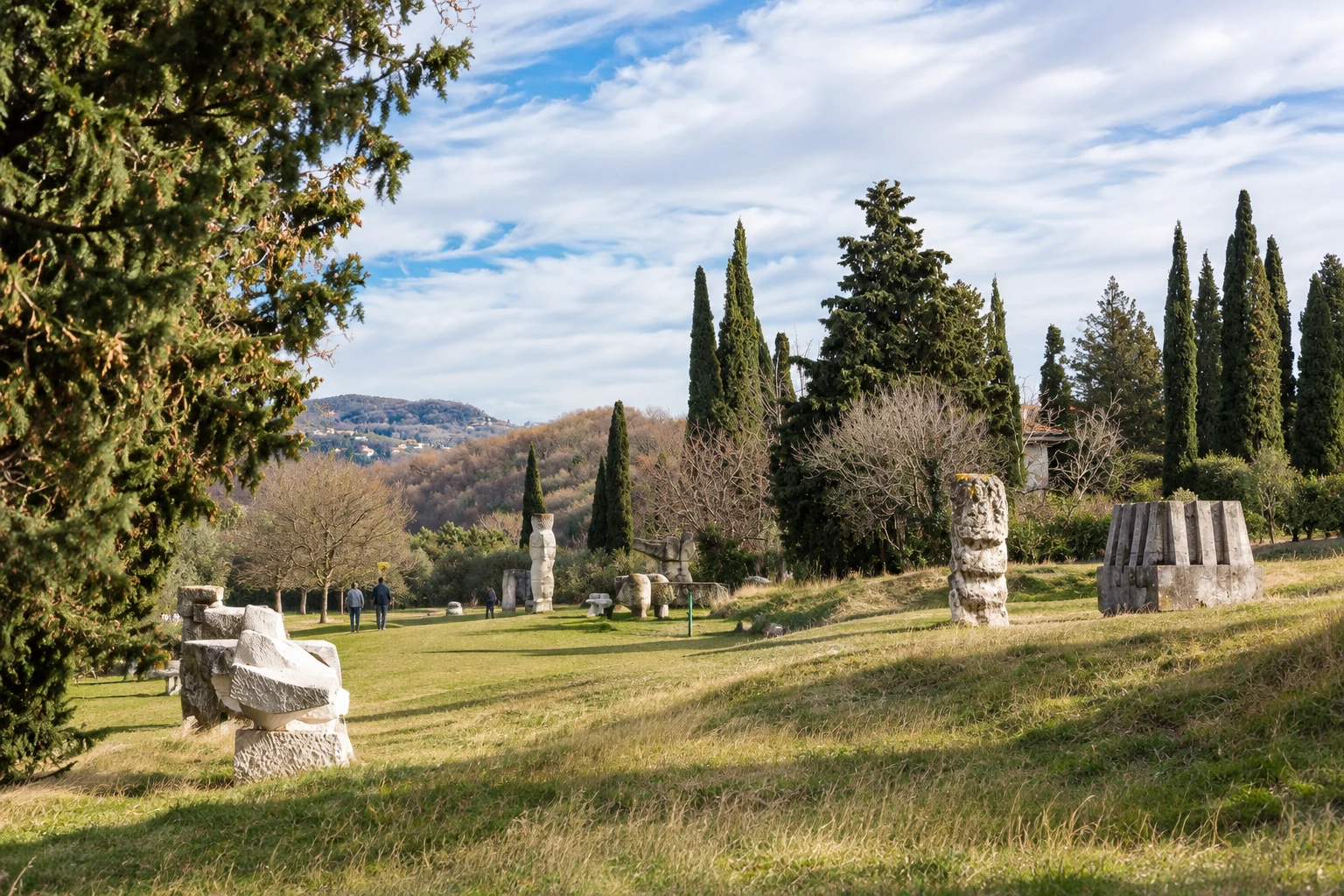
The open-air stone sculpture park on the Seča peninsula in Portorož, with more than 130 works by artists from dozens of countries, among olive trees and with views over the gulf.

 Search
 Brazil
 Antarctica
 Argentina
 Bolivia
 Chile
 Colombia
 Ecuador
 Falkland Islands (Malvinas)
 French Guiana
 Guyana
 Paraguay
 Peru
 Suriname
 Uruguay
 Venezuela
 Austria
 Belgium
 Croatia
 Denmark
 Finland
 France
 Germany
 Greece
 Hungary
 Iceland
 Ireland
 Italy
 Luxembourg
 Norway
 Poland
 Portugal
 SlovakiaSlovenia
 Spain
 Sweden
 Switzerland
 the Czech Republic
 the Netherlands
 the United Kingdom
 Turkey
 Bermuda
 Canada
 Greenland
 Mexico
 Saint Pierre and Miquelon
 the United States
 the Dominican Republic
 JapanTurkey
 Egypt
 South Africa
 Australia
 Fiji
 New Zealand
 Papua New Guinea
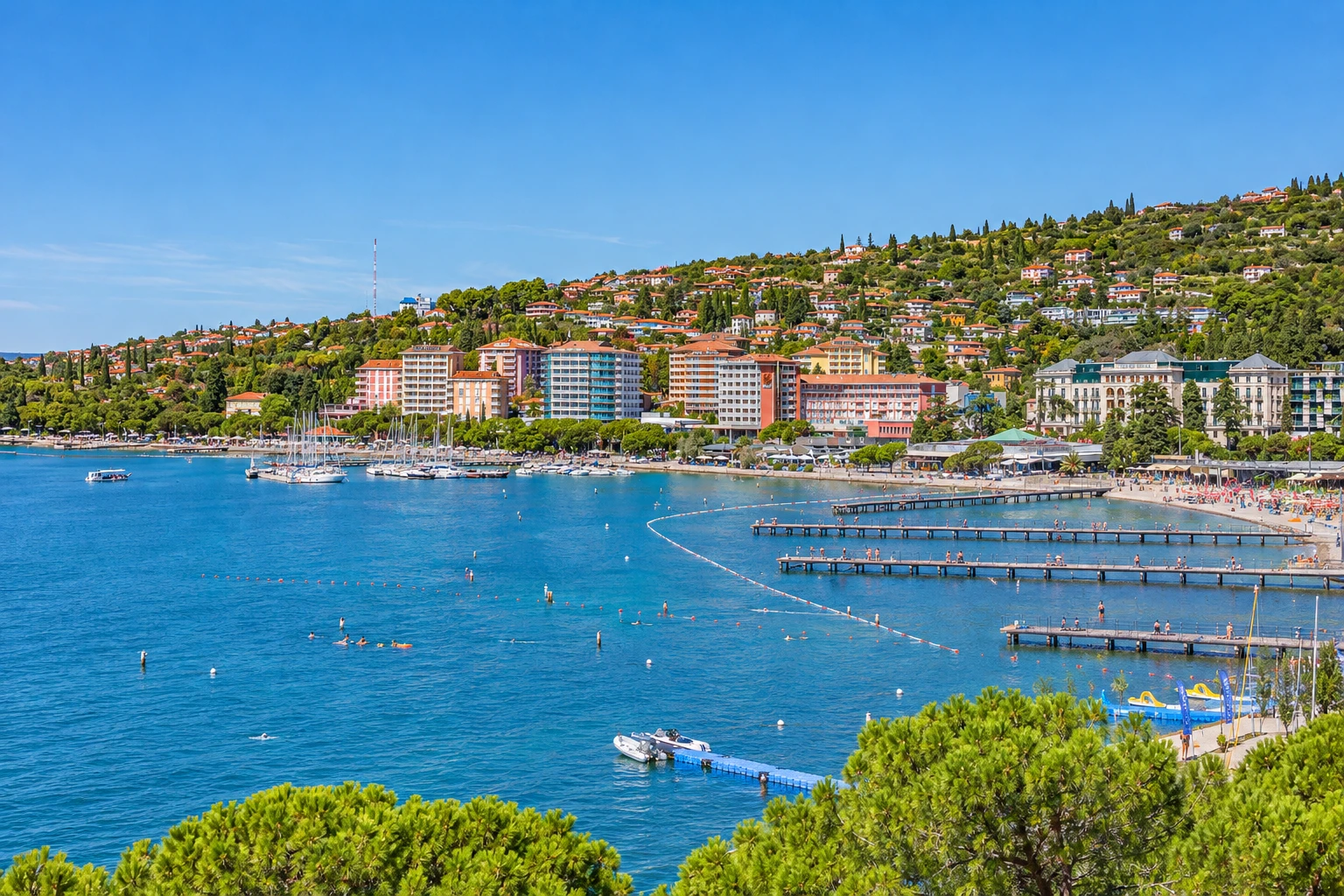
In the photo: Portorož beach and bay.
Illustrative images. The pictures in this guide are illustrations based on the real place, not photographs, and may differ from it.

The city
Seaside locality with a spa tradition in the bay next to Piran, in the same municipality. It has the main urban beach on the coast, a long promenade, the Lucija marina and, on the Seča peninsula, the Forma Viva sculpture park. The Sečovlje salt pans lie just to the south.
Portorož is the Slovenian coast’s beach and spa resort, stretched along a sheltered bay about 3 km from Piran. Part of the municipality of Piran, it has a resort life of its own. Piran has stone lanes and a bell tower, while Portorož has a promenade, beaches, gardens and seafront hotels. Road signs carry its Italian name, Portorose, alongside the Slovenian name.
The resort grew out of the practice of sea bathing for health. As early as the 13th century, Benedictine monks recommended concentrated brine and mud from the nearby salt pans. The first modern bathing establishment, complete with a park, opened in 1887. Managed beaches followed in 1891, and by 1911 the resort had 20 hotels and guesthouses and 47 summer villas catering to the aristocracy of the Austro-Hungarian Empire. Some of these buildings survive in styles ranging from Art Nouveau to modernism. The grand historic hotel on the promenade, with its park out front, still marks the center. Today’s spas continue the tradition with salt, mud and concentrated brine from the Sečovlje salt pans.
The center follows Obala, the waterfront avenue. On one side are the main beach, the largest in Portorož, with sand, lawns and pebbles, the rose garden and wooden piers. On the other are hotels, cafés and shops. The coastal path toward Piran passes through Bernardin, where the bell tower and chancel of a 15th-century church survive, and continues to Piran. In the opposite direction are the marina, neighboring Lucija and the Seča peninsula with its olive trees and Forma viva stone sculptures. Just beyond is the entrance to the Sečovlje salt pans.
Portorož is the handiest coastal base if you want a beach with accessible facilities, lounge chair rentals, water sports and frequent buses to Piran, Lucija and Strunjan. Long-distance buses from abroad also stop here. For a historic center, Piran is only minutes away. In Portorož, you come for the sea, walking, cycling the former Parenzana railway and spa treatments.
The climate is mild year-round. Summers are hot and sunny, with average highs of 29°C in July and August. The swimming season generally runs from June to September, and the resort is busiest in August. May, June and September bring long days and fewer visitors. The roses bloom in May. Rainfall increases from September to November. Winter highs are around 10°C. This is the season for spas, sunny walks and holiday events, including a seaside ice rink.
Highlights include the main beach and rose garden, the coastal walk to Piran, the Forma viva sculptures, the Sečovlje salt pans via the Lera entrance and a bike ride through the old railway’s Valeta Tunnel.
38 places to stay in Portorož.
7 places to eat in Portorož.
25 places on the map: where to stay and where to eat, by neighborhood.
The local experience
The open-air stone sculpture park on the Seča peninsula in Portorož, with more than 130 works by artists from dozens of countries, among olive trees and with views over the gulf.
The main urban beach of Portorož and of the Slovenian coast, with a strip of sand, lawns and piers, along the promenade in front of the centre. Calm sea, sheltered by the bay.
To choose before you go
Where each tour starts, how long it takes, how it is done, what is included and the price range.
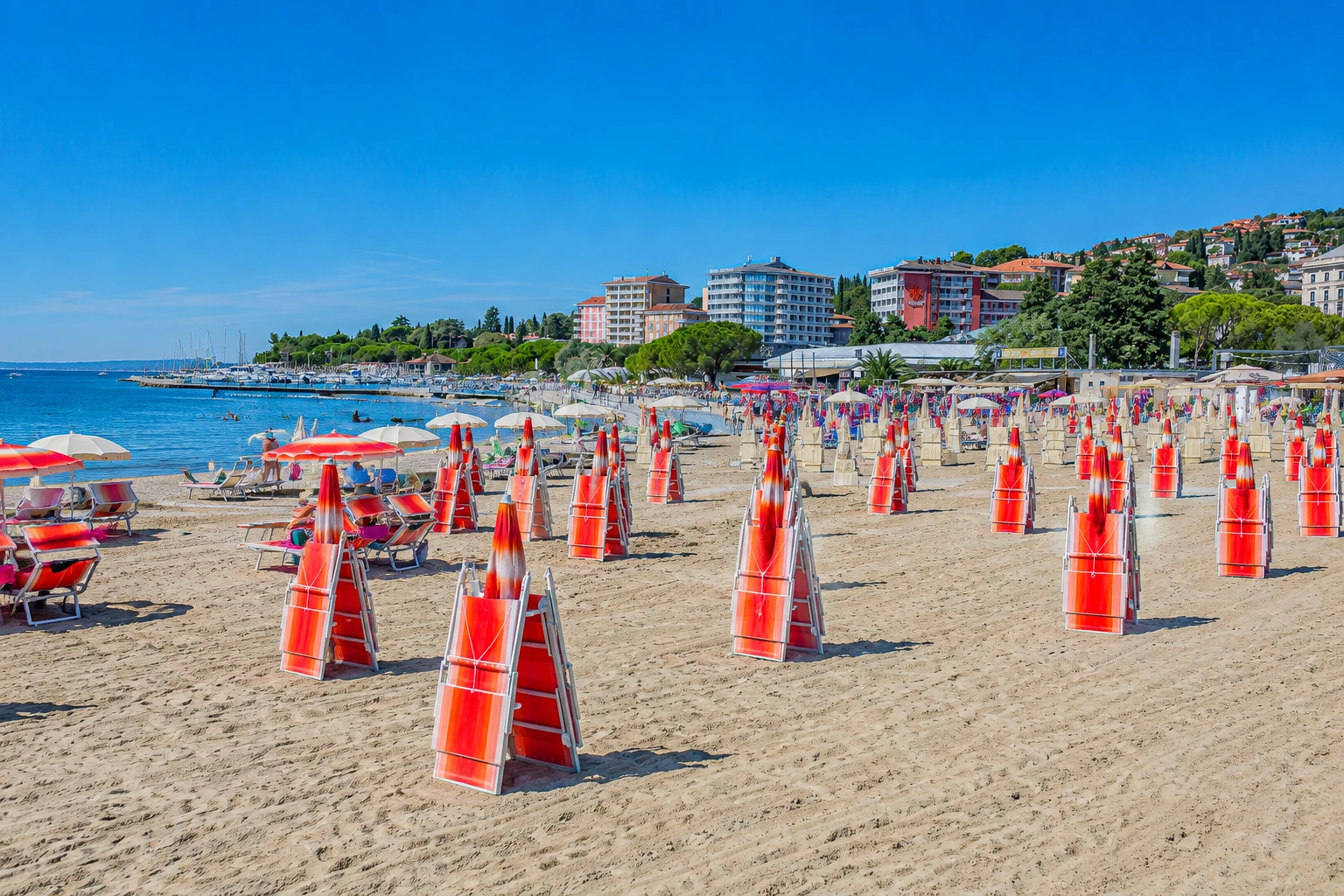
Centralna plaža Portorož is the resort’s largest and busiest beach, covering about 25,000 m² beside the promenade in the center of town. With sand, lawns and a pebbly section, it’s a good choice if you want plenty of facilities. There are showers, restrooms, lounge chair and umbrella rentals, beach volleyball courts, playgrounds and water sports, including paddleboarding, pedal boats and kayaking. A ramp leads down to the sand and sea, and special equipment helps people with limited mobility enter the water. The beach holds the Blue Flag, an international award for water quality and facilities. Elsewhere on the waterfront there’s a dog beach with showers for pets, concrete platforms attached to hotels and a designated swimming area opposite Turistica. The promenade’s rose garden has more than 120 varieties. Roses have grown here since the first bathing resort opened in 1887. One is the Portorož rose, introduced in 2010 and planted around town, with orange blooms that fade to yellow and pale pink. From the wooden piers you can see the marina to one side and Bernardin to the other. One of the simplest pleasures in Portorož is spending the end of the day on the promenade between the cafés and the sea.
Stops: Centralna plaža Portorož, Portorož promenade, Portorož rose garden, Wooden piers.
Includes: Free beach access. Lounge chairs, umbrellas, restrooms and water sports cost extra. Check current rates.
Tip: Dogs aren’t allowed on the main beach, but they have their own beach along the waterfront. In summer, parking near the beach costs money and fills up quickly. If you drive, you can park in Lucija and walk from there.
Best time: June to September for swimming. The roses bloom in May.
Around the turn of the 20th century, sea air and a mild climate drew the elite of the Austro-Hungarian Empire to Portorož. A themed waterfront walk of about an hour takes you past the surviving landmarks of that time. Start at the grand historic hotel on the promenade, with its Art Nouveau facade. When it opened, it was the largest and most elegant hotel on the Adriatic coast. Emperor Franz Joseph I and European aristocrats stayed in the hotels and villas of Portorož, followed after World War II by film stars. The hotel’s front garden, with a pond and benches, hosts events. Nearby stands Our Lady of the Rosary, the parish church of Portorož. Consecrated in 1984 when tourism outgrew the old chapel, this modern church has a polygonal nave, a concrete cross resembling a ship’s mast, stained glass and a terracotta altar sculpture. It also hosts concerts. Its name recalls the origins of Portorož. In the 13th century, a church of St. Mary of the Rosary stood above the bay, and the port became known as Portus Sanctae Mariae de Rosae. The main square has a fountain commemorating sailors. On the road toward Piran, you’ll see the two-story neoclassical Villa Maria, with a columned porch and balustrades. Built in the late 19th century as the summer home of Austro-Hungarian General Wilhelm von Reinländer, it remains privately owned and can be seen only from outside. The walk ends at the former Grando and Monfort salt warehouses, now contemporary art galleries and event venues.
Stops: Obala, Church of Our Lady of the Rosary, Sailors’ Fountain, Villa Maria, Grando and Monfort salt warehouses.
Includes: Free, self-guided walk. Exhibitions in the salt warehouses may charge admission.
Tip: You can download a brochure with a map of this route and five other themed walks from the local tourism website. In winter, the Grando warehouse houses the ice rink.
Best time: Year-round.
A footpath of about 3 km links Portorož and Piran, following the sea almost all the way, away from road traffic. It’s an easy walk with sea views at every turn and a different perspective on both towns. Halfway along is Bernardin. Its name comes from the Franciscan monastery founded here in 1452 by St. John of Capistrano, a disciple of St. Bernardino of Siena. The friars chose a quiet site overlooking the sea outside Piran’s walls. Around 1490, they added a chapel dedicated to Our Lady of Grace. The monastery closed in 1806 and became a military fort. Much of its art was lost. The Gothic chancel survives, with a ribbed vault and capitals carved with flowers, animals and human figures, as do the Venetian-style bell tower with its single bell and the foundations of the nave. A hotel complex built in the 1970s surrounds the remains. Nearby swimming areas have concrete platforms and lawns. From Bernardin the path continues along the waterfront to Piran. The town has its own guide. You can return on the frequent local bus.
Stops: Portorož promenade, Bernardin, Church of St. Bernardino, Piran.
Includes: Free, self-guided walk. Pay separately for the local bus if you take it back.
Tip: Local buses are cashless. Use the city card, the app or a contactless bank card. Late afternoon, when the sun is low over the water, is the most popular time for the walk.
Best time: Year-round. In summer, go early or late in the afternoon.
The Seča peninsula encloses Portorož Bay to the south and belongs to the municipality of Piran. It’s an easy escape from the busy promenade. Walk past the Lucija campground to the tip of the peninsula, then, before reaching St. Bartholomew’s Canal, climb the steps to the sculpture park. Forma viva Portorož is an open-air collection of stone sculptures, started in 1961 by Slovenian artists Jakob Savinšek and Janez Lenassi. Over more than 60 years, artists from more than 30 countries have created over 130 sculptures. They stand among olive trees overlooking the whole bay. Admission is free and an online audio and video guide introduces 21 selected works. At the tip of the peninsula, about 2 km from Portorož, a private garden holds more than 1,500 cactus species. Ring the bell at the gate to visit. The family that owns the garden also sells young plants. The beach at Cape Seča is part rock, part pebbles, with a section set up for families with children. It’s also a popular kitesurfing and windsurfing spot, with lessons and equipment rentals. For a longer walk, follow the marked 9 km Seča loop. In about 2 hours 30 minutes it takes you past Forma viva, the walkway over St. Bartholomew’s Canal and the edge of the salt pans, with a different view of Portorož.
Stops: Seča, Forma viva Portorož, Seča cactus garden, Cape Seča, St. Bartholomew’s Canal.
Includes: Free, self-guided route. Forma viva has free admission. Kitesurfing lessons and equipment rentals cost extra.
Tip: Bring water for the walk. At the cactus garden, visits depend on someone being home.
Best time: Year-round, with milder temperatures in spring and fall.
From Portorož the Sečovlje salt pans lie just beyond Seča. This is the closest town to the nature park and you can cycle to the Lera entrance. Take the road between Lucija and the Sečovlje border crossing. At the top of Seča hill follow the stone-paved descent to the canal. The entrance and parking lot are across the bridge. Lera is the working saltworks. Separate ponds concentrate the seawater and crystallize the salt. Workers harvest it by hand with traditional tools over the petola, a living layer cultivated on the pond floors to keep the salt clean. Walk or cycle about 2 km from the entrance to the visitor center. A short film and a model show how the water moves through the saltworks. There’s also a lookout over the whole area, a café and a salt shop. More than 300 bird species have been recorded here, so binoculars are worth bringing in any season. From May to September, the northern part of the park houses the country’s only open-air spa. Treatments use salt pan mud, the mineral-rich concentrated brine left over from salt production, and the salt itself for wraps, baths and scrubs. The spa admits just a few people at a time by reservation and provides its own transportation from the park entrance. Visits depend on the weather. Fontanigge, the other section of the park, contains the abandoned salt pans and salt museum. It has a separate entrance on a dirt road beside the Dragonja River beyond the border post. The museum opens from April to October.
Stops: Sečoveljske soline, Lera, Salt pans visitor center, Fontanigge, Salt museum.
Includes: All visitors must pay park admission. The guided visit, salt museum and spa treatments cost extra. Check current rates.
Tip: There’s no shade between the ponds, so go early or late in the afternoon and bring water and a hat. Dogs aren’t allowed in Lera. Book guided visits ahead and check opening hours with park reception before you go.
Best time: Summer to see the salt harvest. May to September for the open-air spa.
In the early 20th century the Parenzana narrow-gauge railway linked Trieste to Poreč in Croatian Istria, carrying produce and passengers from villages along the way. After closing in the 1930s, it became the Route of Health and Friendship, a trail for cyclists, runners and walkers. The section through Portorož is paved and has little climbing, making it a good choice for families. The most unusual feature lies between Portorož and Strunjan. The 550 m stone Valeta Tunnel, built between 1900 and 1902, curves gently and passes almost directly below the Valeta traffic circle. When the trains stopped in 1935, the tunnel closed for years. After World War II it served as a storage space and even a place to grow mushrooms. Renovations in 2000 cleaned the walls and added pavement, lighting and barriers at both ends to keep out motor vehicles. It’s open and lit year-round, with signs at both entrances. Beyond the tunnel lies the Strunjan Valley, with its small salt pans, Stjuža Lagoon and landscape park, all within the municipality of Piran. For a longer ride, continue on the same paved route to Izola and Koper. In the other direction, the Parenzana heads from Portorož toward Sečovlje by the salt pans and border. Shops along the Portorož waterfront rent regular and electric bikes. Guided e-bike tours also explore the salt pans and inland villages.
Stops: Parenzana, Valeta Tunnel, Strunjan, Strunjan salt pans.
Includes: Free, self-guided route. Bike rentals and guided tours cost extra.
Tip: Keep right and slow down in the tunnel. Walkers and runners share the path. Bring water in summer.
Best time: Year-round. In summer, go early or late in the afternoon.
Portorož began as a health resort, and spa treatments remain a reason to visit, especially outside summer. Seawater, salt pan mud and salt have been used here for over 700 years. As early as the 13th century, Benedictine monks recommended saltwater baths and mud applications. Under Austrian rule in the 19th century, the bay became a health resort for Europe’s elite. Its first modern bathing establishment dates from 1887, and the opening of the town’s thermal baths in 1968 began the current chapter. The characteristic treatments use products from the Sečovlje salt pans. Warm salt mud, called fango, is used in body wraps. Concentrated, mineral-rich brine left after salt crystallizes is used in warm baths, while salt itself goes into scrubs and baths. Slovenia’s Ministry of Health recognizes the mud and concentrated brine as natural therapeutic agents. Thalassotherapy, which uses seawater and sea air, is also available. Several spas operate in town, most of them in hotels, offering pools, saunas, massages and beauty treatments. In summer there’s also an open-air spa among the salt pans. Strunjan, on the other side of the Parenzana tunnel, has its own thalassotherapy centers. A spa visit suits any weather and makes a good option for a rainy day or a winter afternoon.
Stops: Portorož, Portorož spas, Sečovlje salt pans.
Includes: Pay each spa directly for pool and sauna entry and for treatments. Check current rates.
Tip: Book treatments ahead, especially on weekends and holidays. If you have a health condition, let the spa know before booking mud treatments or hot baths.
Best time: Year-round, particularly from October to April when the beach is out of season.
Sightseeing boats leave from the main pier in Portorož for trips around the bay and along the coast. The shortest scenic cruise takes about an hour and a half and shows you the coast from the water. One boat runs a morning round trip from Portorož to Izola, with about two hours to explore the neighboring old town before returning. Another takes groups by reservation along the Sečovlje salt pans canal and includes a visit to the salt museum. The same boat offers picnics at sea and swimming trips to undeveloped beaches. A different outing starts at the small harbor in Seča, where you can visit a family-run sea bass and mussel farm in Piran Bay. The boat takes you out to the sea pens to watch the fish being fed, then past the mussel beds. The visit ends with a tasting of raw and smoked sea bass, fleur de sel, olive oil and wine from local producers. In summer, full-day trips to Venice and services to Trieste and Croatian Istria also depart from Piran. Piran Bay is shallow, reaching a maximum depth of 35 m.
Stops: Portorož Bay, Piran Bay, Izola, Sečovlje salt pans.
Includes: Pay each boat operator directly for the trip. Check current fares.
Tip: Departures depend on the weather, sea conditions and passenger numbers, and are rare outside the main season. Book ahead and confirm before going to the pier. For Venice, Trieste or Croatia, bring your ID card or passport.
Best time: May to September.
Day by day
Suggestions to plan the trip. Change the order of the days according to the weather and tour availability.
Start on the promenade with the rose garden, the wooden piers and the garden of the grand historic hotel. Follow the Austro-Hungarian Riviera walk along the waterfront, passing the Church of Our Lady of the Rosary, the Sailors’ Fountain and the former salt warehouses. In summer, spend the late morning and early afternoon at the main beach, with a swim and lunch at a waterfront restaurant. Outside swimming season, spend a few hours at a spa with pools and saunas instead. In the late afternoon walk along the coast to Piran via Bernardin, where the bell tower and chancel of the 15th-century church survive. It’s about 3 km. See Tartinijev trg lit up for the evening and return by local bus.
Spend the morning on the promenade, visiting the rose garden and following the Austro-Hungarian Riviera walk to the salt warehouses. Head to the main beach around midday. In the late afternoon, walk about 3 km along the coast via Bernardin to Piran. Have dinner there and return by local bus.
Rent a bike on the waterfront. Ride through Lucija to the Seča peninsula and head up to Forma viva to see the stone sculptures among olive trees overlooking the bay. If you enjoy plants, ring the bell at the cactus garden at the tip of the peninsula. Continue to the Lera entrance of the Sečovlje salt pans. Allow about two hours for the path between the ponds, visitor center and lookout. From May to September, you can also book a treatment at the outdoor spa in the salt pans. Back in Portorož, finish on the promenade or, on a windy day, watch the kitesurfers at Cape Seča.
Spend the morning on the promenade, at the rose garden and on the main beach. In the afternoon, follow the Austro-Hungarian Riviera walk, then continue along the coast via Bernardin to Piran. Return by local bus after dinner.
Cycle or walk to the Seča peninsula for the Forma viva sculptures. Continue to the Sečovlje salt pans via the Lera entrance, arriving early to avoid the heat. Spend the afternoon at the beach or on a boat trip around the bay. One option visits a sea bass and mussel farm and includes a tasting.
In the morning, cycle the Parenzana through the 550 m Valeta Tunnel to the Strunjan Valley, with its small salt pans and Stjuža Lagoon. You can leave your bike and follow the cliff trail to the Strunjan Cross. Back in Portorož, finish your trip at a spa with pools, saunas or a treatment using salt pan mud and concentrated brine. In summer, another afternoon at the beach is an alternative.
Best time to go
The seasons shown are the most usual ones; nature doesn't always follow the calendar.
Winter · ice rink until early in the month · spas
Winter highs average 9°C and lows hover near 1°C, with about 60 mm of rain. Snow is rare along the sea. Holiday events, including the ice rink in the Grando warehouse, continue into the first few days of the month. The resort then quiets down. It’s a season for spas and sunny walks on the promenade. Beach services and the salt pan spa are closed.
Winter · longer days · spas
Winter highs average 10°C and lows are close to 0°C. With about 54 mm of rain, this is the driest month of the year. With more sunshine, the coastal path to Piran makes a good afternoon walk. Spas are the main attraction. Many public parking spaces are free at this time of year.
Late winter · cycling the Parenzana
Late winter highs average 13°C and lows 3°C, with about 62 mm of rain. Longer days suit cycling the Parenzana and walking in Seča. The sea is still cold for swimming. Parking fees resume throughout the resort in midmonth.
Spring · walking and cycling
Spring highs average 17°C and lows 7°C, with about 66 mm of rain. Comfortable temperatures suit walks and bike rides to Forma viva, the salt pans and the Valeta Tunnel. The salt museum at Fontanigge opens early in the month. Around the 23rd, nearby Piran holds its Salt Workers’ Festival.
Spring · roses in bloom · Roses & Rosé in the rose garden
Spring highs average 22°C and lows 11°C, with about 75 mm of rain. The rose garden is in bloom. One day this month celebrates roses and rosé wines with tastings, music and the planting of a Portorož rose. Beach services begin opening and the open-air spa at the salt pans starts its season.
Early summer · swimming season
Early summer highs average 26°C and lows 15°C, with about 86 mm of rain, usually in brief showers. The sea is warm enough for swimming and all facilities are open at the main beach. These are the longest days of the year, before the August crowds.
Summer · high season · street food evening on the promenade
Summer highs average 29°C and lows 17°C, with about 56 mm of rain and the most sunshine hours of the year. It’s high season, with a busy beach and competition for parking. On one Saturday the main square hosts Kulinarična promenada, featuring Istrian cooks and winemakers. Save the salt pans and bike rides for early morning or late afternoon.
Summer · Portorož Nights in midmonth
Summer highs average 29°C and lows 17°C, with about 86 mm of rain, much of it in late-afternoon thunderstorms. This is the busiest month. In mid-August, Portorož Nights fills the promenade with concerts, street performers, Istrian food and wine, and lights in the sky. Book accommodation well ahead.
Late summer · sea still warm
Late summer highs average 24°C and lows 13°C. Rainfall rises to about 118 mm, the highest total of the year. Despite the rain, the water is usually still warm enough for swimming and crowds thin after the summer holidays. This is the last month of the season for the outdoor spa at the salt pans. It’s a good time for beaches, cycling and boat trips.
Fall · end of beach season · olive harvest
Fall highs average 19°C and lows 10°C, with about 112 mm of rain. Beach services end for the season and the salt museum closes at the end of the month. The olive harvest begins on the hills of Seča and farther inland. Many public parking spaces become free in the middle of the month. Bring a raincoat.
Fall · spas · holiday lights at the end of the month
Fall highs average 14°C and lows 6°C, with about 106 mm of rain. The resort is quiet in low season and the spas are in full swing. At the end of the month, holiday lights come on in the main square and the ice rink opens.
Winter · ice rink and holiday market · sparkling wine festival on the 26th
Winter highs average 10°C and lows 2°C, with about 88 mm of rain. The main square hosts a holiday market, concerts and children’s activities, and the Grando warehouse houses the covered ice rink. On the 26th, Slovenian and international producers come to Portorož for the sparkling wine festival.
Plan the journey
Portorož has its own small airport 7 km away in Sečovlje, beside the salt pans. It handles light aircraft. If you’re interested in aviation, you can book a guided visit.
Commercial flights use the region’s other airports. Road distances to Portorož are 80 km from Trieste (Ronchi dei Legionari) in Italy, 90 km from Pula in Croatia, 140 km from Ljubljana (Jože Pučnik), 180 km from Treviso, 190 km from Venice (Marco Polo), 200 km from Klagenfurt in Austria, 250 km from Maribor and 260 km from Zagreb. From Ljubljana, Trieste, Venice, Treviso and Zagreb, you can book a shared transfer to your accommodation or arrange a private transfer. Check routes and schedules before booking.
Regular services connect Ljubljana, Maribor, Bled and Postojna directly to Portorož and Piran. Another operator links Koper with Nova Gorica, Celje, Postojna and Novo mesto. From Koper, take a coastal bus via Izola. Pay cash on the main regional operator’s services.
International coaches call at Portorož bus station. Routes from Italy, Austria, Germany, Croatia and Hungary serve cities such as Trieste, Venice, Vienna, Bratislava, Rovinj and Umag. Buy your ticket online in advance and show it on your phone. A regular international service also connects Trieste with Koper, where you can change for Portorož. Check schedules before traveling.
Portorož has no train service. The nearest station is 15 km away in Koper, with trains from Ljubljana, Maribor, Celje, Jesenice and Postojna. The adjoining bus station has regular services to Portorož. Taxis and rental cars are alternatives. If you arrive by train from abroad, get off in Koper, Sežana or Trieste and continue by bus, taxi or car. Check the Slovenian Railways website for schedules before traveling.
From Ljubljana, follow the A1 motorway to Koper, then the expressway and coastal road. It’s about 140 km and takes roughly an hour and a half. Koper is 15 km away. Cars, motorcycles and light vans need an electronic vignette for Slovenian motorways and expressways. Buy it online or at a service station and register it to your license plate. In summer and on holidays, plan to arrive outside peak traffic hours.
Portorož has street parking and parking lots, mostly charged by the hour with a daily rate after ten hours. From mid-October to mid-March, many public spaces are free, though some waterfront sections and lots charge year-round. The marina lot is open day and night and accepts cards only. In neighboring Lucija, the first hour in public spaces is free and subsequent hours cost less than in central Portorož, making it a good choice for the day. There are electric car charging points and a motorhome area beside the marina.
If you’re traveling in your own boat, Portorož has a modern marina with fuel, maintenance and other services, as well as smaller moorings around the bay.
International passenger boats dock in nearby Piran, about 3 km away. In summer a scheduled fast boat from Trieste continues to Poreč, Rovinj and Mali Lošinj in Croatia. Seasonal services from Venice take about two and a half hours. Bring an ID card or passport for the crossing. Dates and schedules change each season, so check before making plans.
Central Portorož is flat and easy to explore on foot along the promenade. Two frequent local bus routes pass through. One links Piran, Beli Križ, Portorož and Lucija. The other links Piran, Portorož and Strunjan. Buses are cashless. Use a city card from the green machines in Portorož, Lucija and Piran or from Lucija bus station, the operator’s app, or a contactless bank card. Several people can share a city card. Tell the driver how many fares to deduct.
Piran is about 3 km away along the coastal walking path. Regional buses continue to Izola and Koper. By bike, the paved Parenzana leads through the Valeta Tunnel to Strunjan, or toward Sečovlje in the opposite direction. Several waterfront shops rent regular and electric bikes, and car and boat rentals are available. There’s also a taxi service.
Your questions
Yes, about 3 km, with frequent buses and a seaside promenade you can walk in about 30 minutes.
Port of the roses, from the Italian name Portorose, linked to an old church of Saint Mary of the Roses.
Yes. Since the late 19th century local health centres have used concentrated brine and mud from the Sečovlje salt pans.
Portorož has more beach and leisure infrastructure; Piran has the historic centre. The two are a few minutes apart.
One day gives you time for the promenade, the main beach and the walk to Piran. With two, add Seča, the Forma viva sculptures and the Sečovlje salt pans. Stay three days or longer for a beach vacation, cycling on the Parenzana and spa treatments, using the resort as a base for Piran, Strunjan, Izola and Koper.
Yes. The main beach in the center covers about 25,000 m², with a strip of sand, lawns and a pebbly section. There are showers, restrooms, lounge chair rentals, playgrounds and access for people with limited mobility. Most other swimming spots along the waterfront have concrete platforms and lawns.
No. Like Lucija, Seča, Sečovlje and Strunjan, Portorož is part of the municipality of Piran. Its administrative center is the town of Piran, about 3 km away. The area is bilingual, and signs show the Italian name, Portorose, alongside the Slovenian one.
There’s a small airport for light aircraft 7 km away in Sečovlje. For commercial flights, the most common options are Trieste in Italy, 80 km away, Ljubljana, 140 km away, and Venice, 190 km away. You can book a shared transfer to Portorož.
There’s street parking and there are lots that charge by the hour along the waterfront. The marina lot is open day and night. In summer, spaces near the beach fill up early. In neighboring Lucija, the first hour in public spaces is free and subsequent hours cost less. From there, walk or take a local bus to the beach. Many public spaces in Portorož are free from mid-October to mid-March.
Local buses are cashless. Use a city card from the green machines in Portorož, Lucija or Piran, the operator’s app, or a contactless bank card, which costs more per ride. Several people can share one city card. On regional buses to Izola and Koper, pay the fare in cash.
Lera, the main entrance, has parking and is at the top of Seča hill on the road between Lucija and the Sečovlje border crossing. You can get there from Portorož by bike, taxi or car. The salt museum at Fontanigge has a separate entrance along a dirt road beside the Dragonja River, beyond the border post. The park charges admission.
It’s an outdoor stone sculpture park on the Seča peninsula. Started in 1961, the collection has more than 130 works by sculptors from over 30 countries, set among olive trees overlooking Portorož Bay. Admission is free. You can walk or cycle there from the center, with a short climb up steps.
Yes. The former railway runs through town, and the Slovenian section is paved. Heading north, the 550 m illuminated Valeta Tunnel leads to Strunjan, and the route continues to Izola and Koper. To the south it heads toward Sečovlje. Waterfront shops rent regular and electric bikes.
Yes, if you’re looking for a restful break. The spas stay open year-round, with pools, saunas and treatments using mud and concentrated brine from the salt pans. From late November to early January, the waterfront has lights, a market and a covered ice rink. A sparkling wine festival takes place on December 26. The sea is cold and beach services close for the season.
The main beach has sand, lawns, playgrounds and pedal boats. You can also take a boat trip around the bay, cycle the flat, paved Parenzana through the Valeta Tunnel, or book a guided tour of the small airport. In winter, there’s an ice rink. Piran’s aquarium and shell museum are just a few minutes away.
Yes, at Cape Seča on the southern tip of the bay. A club there offers lessons and equipment rentals for kitesurfing, windsurfing and stand-up paddleboarding. Winds such as the bora, jugo and maestral reach the bay in every season. In the center, you can rent paddleboards, pedal boats and kayaks.