Parenzana
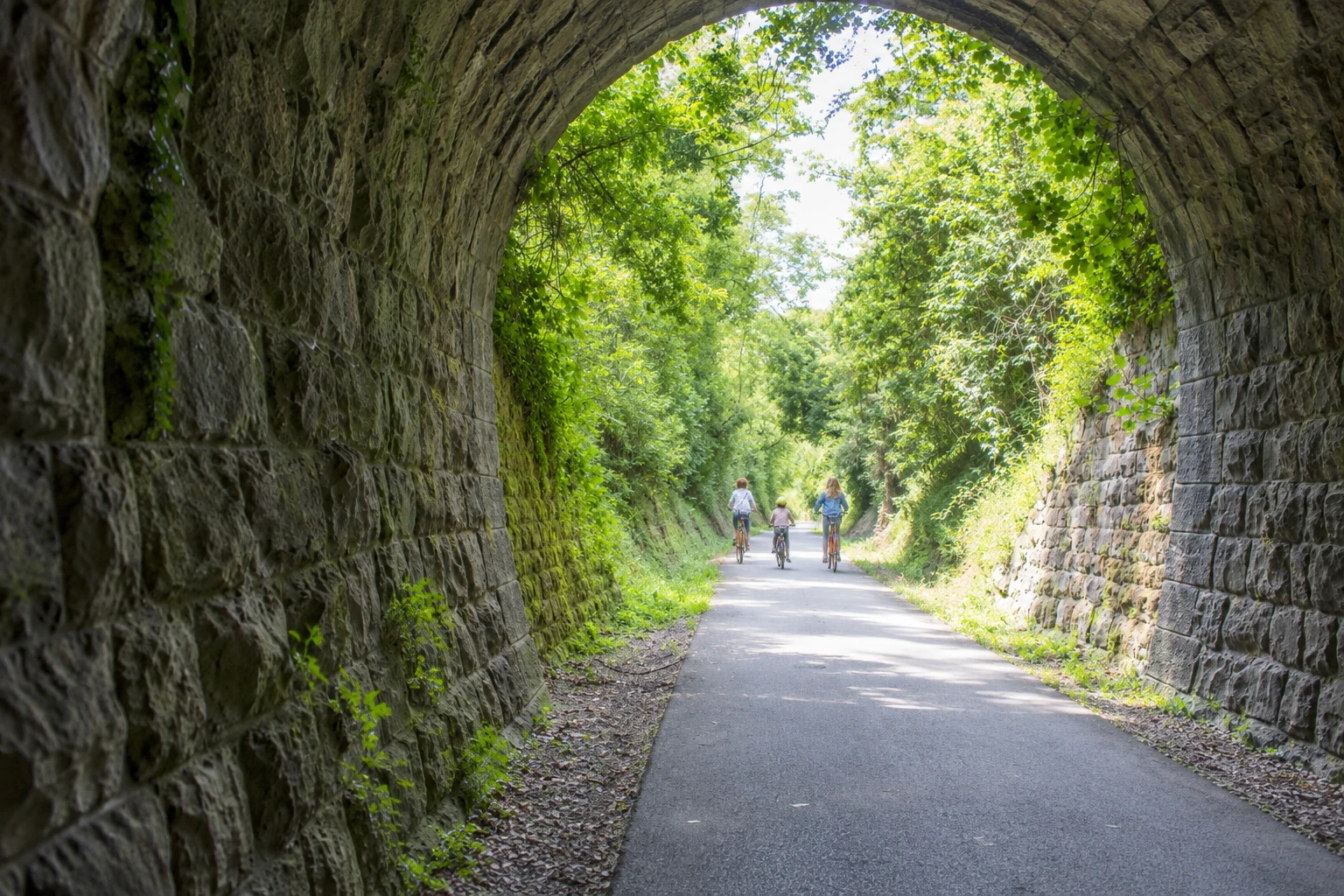
The former narrow-gauge railway between Trieste and Poreč, decommissioned in 1935 and converted into a cycling and walking route. On the Slovenian coast it passes through Izola and tunnels all the way to Portorož.
Antarctica
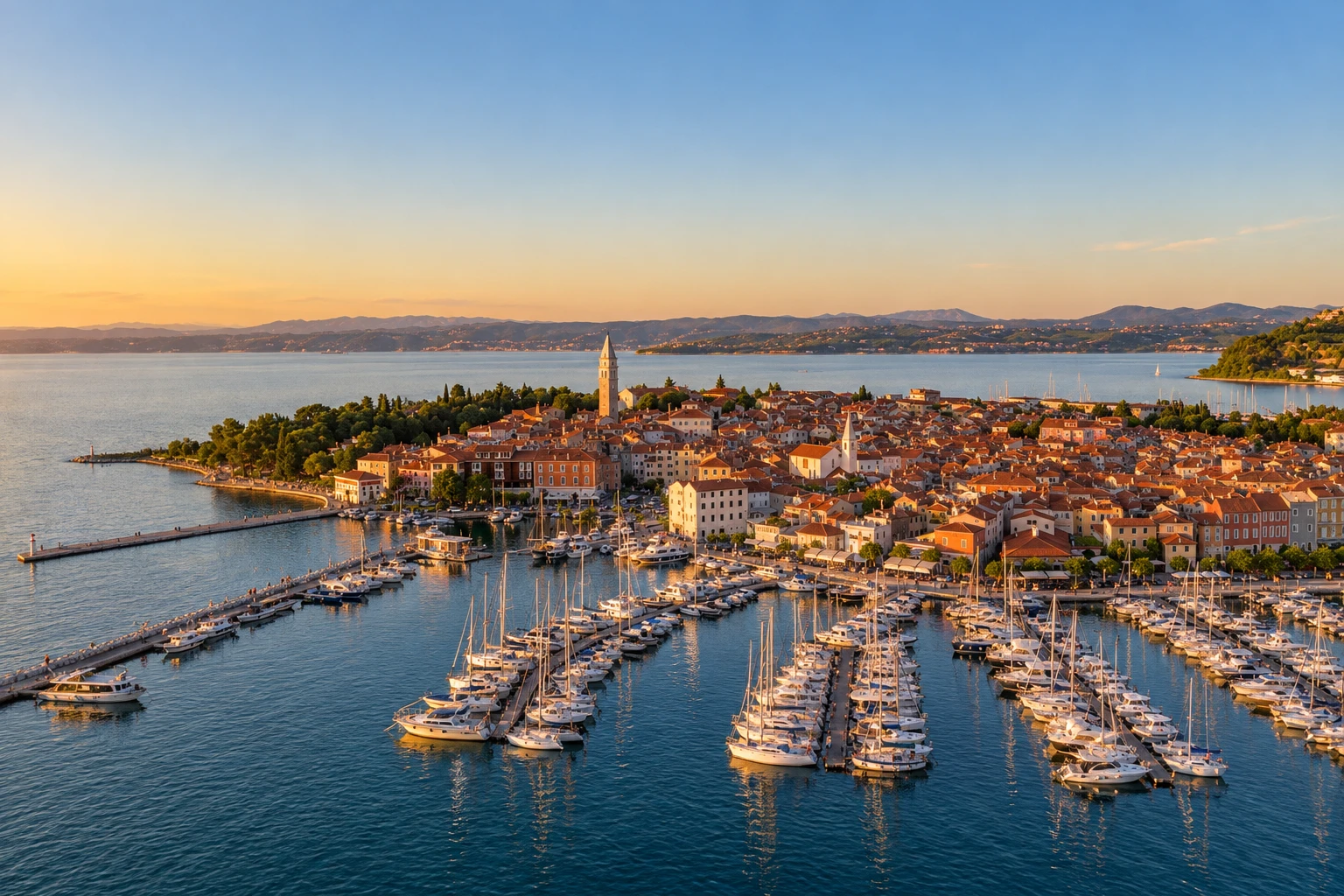
In the photo: Izola’s harbor and center.
Illustrative images. The pictures in this guide are illustrations based on the real place, not photographs, and may differ from it.
The city
A fishing town between Koper and Piran that used to be an island until it was connected to the mainland in the early 19th century. It has narrow streets, a fishing port, seafood restaurants on the waterfront, the bay of St. Simon with remains of a Roman harbor, and a section of the old Parenzana railway that is now a cycling path.
Izola is the fishing town of the Slovenian coast. It sits between Koper and Piran, facing the Gulf of Trieste, and its name tells you what it once was: an island. Uninhabited until the early Middle Ages, it gained a harbor and palaces under the Republic of Venice. The channel to the mainland was finally filled in under Austrian rule, as the fish-canning industry grew. The town is officially bilingual, and signs carry its Italian name, Isola, alongside the Slovenian one.
You can explore the old town, which occupies the former island, in an hour or two. At its heart is the mandrač, the inner harbor where fishing boats and traditional craft moor, surrounded by fish restaurants. Narrow streets climb from there to St. Maurus Church at the highest point. Its 39 m tower doubles as a lookout. Along the way are Manzioli Square and its namesake palace, and the late 18th-century Besenghi degli Ughi Palace. The Izolana House of the Sea tells the story of fishing, canneries and shipyards. The chimney of a former fish factory still stands as a town landmark.
Beyond the center, Izola stretches along the waterfront, with eight beaches on 5 km of coast. Svetilnik, the lighthouse beach, is next to the center and has a lawn and pine trees. To the west, the cove of Simonov zaliv, or San Simon, has the town’s most popular family beach and an archaeological park with the remains of a Roman villa and harbor. Farther on, below Belvedere hill, the undeveloped beaches of Strunjan Landscape Park begin. In the other direction, the old coast road offers a car-free walk or bike ride to Koper.
The municipality’s small, green hinterland is about 40% farmland, with olive groves and vineyards. Around the villages of Korte, Šared, Cetore and Malija you’ll find Malvazija and Refošk wine cellars, trails to old springs and the prehistoric Kaštelir hillfort overlooking the Sečovlje salt pans.
Izola is quieter than Piran and less urban than Koper. Its streets are busy with residents, boat owners from the marina and families on vacation. Many visitors come for the food. Festivals throughout the year feature fresh fish, brodet fish stew with polenta, olive oil and Istrian wines.
The climate is mild and you can cycle year-round. Summers are hot and sunny, with average highs of 29°C in July and August. The sea is usually warm enough for swimming from June to September. Spring and early fall temperatures range from 17°C to 24°C. Rainfall increases from September to November. In winter, highs hover around 10°C, snow is rare, and a seaside ice rink opens in town.
Coastal buses connect Izola with Koper, about 7 km away, and Piran, about 10 km away. Portorož and Strunjan are on the way to Piran. These towns have their own guides.
24 places to stay in Izola.
9 places to eat in Izola.
10 places on the map: where to stay and where to eat, by neighborhood.
The local experience
The former narrow-gauge railway between Trieste and Poreč, decommissioned in 1935 and converted into a cycling and walking route. On the Slovenian coast it passes through Izola and tunnels all the way to Portorož.
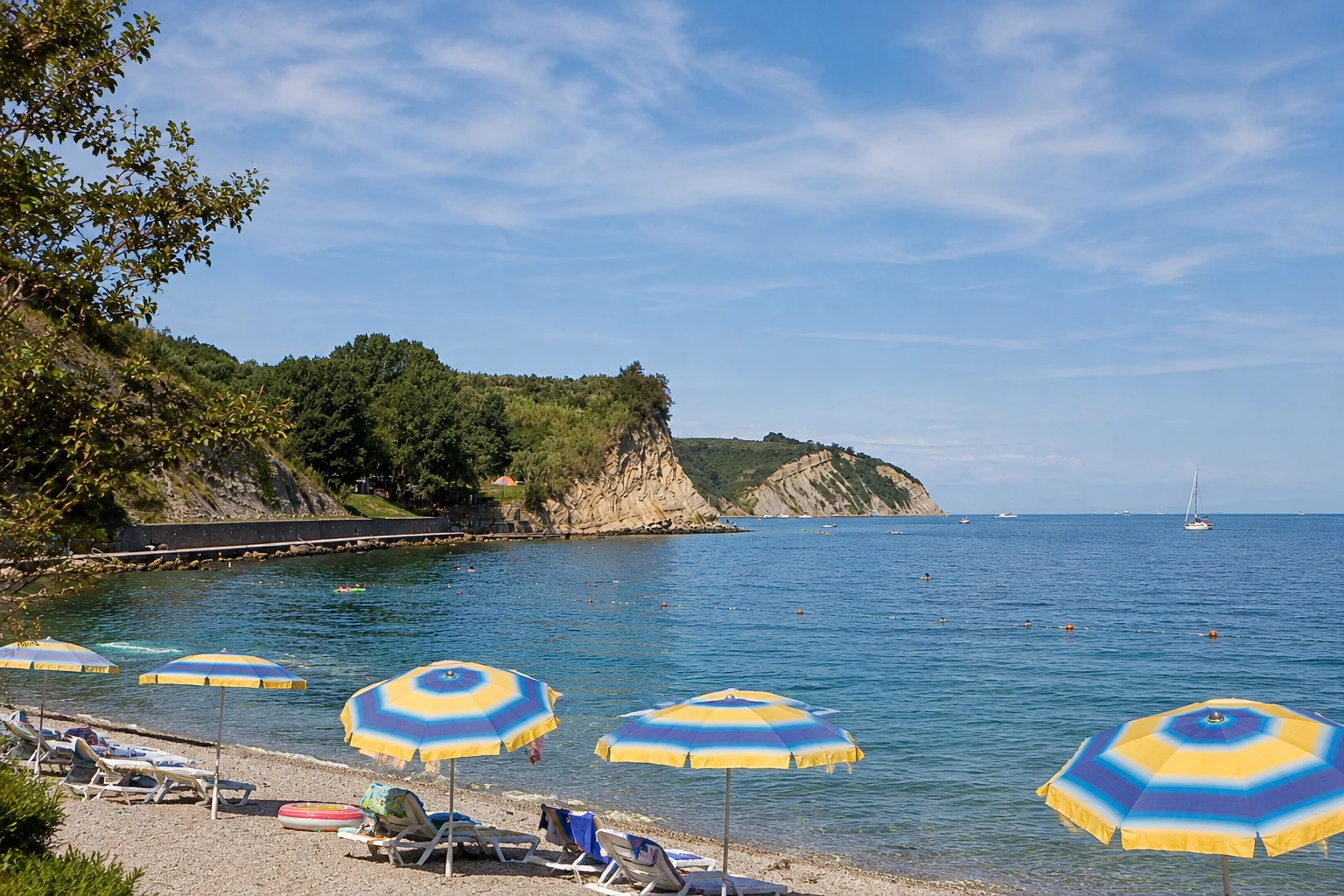
The cove west of Izola, with a bathing area, lawns and, nearby, the remains of the Roman port of Haliaetum. One of the most popular bathing spots on the Slovenian coast.
To choose before you go
Where each tour starts, how long it takes, how it is done, what is included and the price range.
Izola’s old town fits within the bounds of the island it once was. Start on Sončno nabrežje, the sunny quay, where the town is reflected in the harbor. Beside it is the mandrač, the inner harbor where fishing boats and traditional vessels tie up. The smell of grilled fish drifts from the restaurants around it. Fishing was already one of Izola’s main livelihoods in the Middle Ages. Later, canneries helped the town grow, and one factory chimney survives as a landmark. From the harbor, narrow lanes lead to Manziolijev trg, or Manzioli Square, where the palace of the same name hosts an annual festival of wines made from the Refošk grape. Farther on stands Besenghi degli Ughi Palace, built between 1775 and 1781 by architect Filippo Donghetti for a wealthy local family. This three-story example of late Venetian Baroque architecture has a central hall decorated with Rococo paintings and stucco. The 13th-century stone lion on the corner is thought to come from an older building. The palace houses the music school and opens only on special occasions or for guided visits by arrangement. The climb ends at St. Maurus Church, on the highest point of the old island. Its 39 m bell tower has 99 steps, with views over the old town rooftops and marina to the distant cliffs of Strunjan. Local legend says St. Maurus hid Izola in a cloud of mist from a Genoese fleet in 1380. The dove with an olive branch that supposedly led the ships away appears on the municipal coat of arms. On the way down, look for the blue house in the old town that houses Izolana, the House of the Sea. Inside are more than 35 model boats, a restored fishing boat, a model of the town with a projection about its history and a room devoted to cartographer Pietro Coppo, who did much of his work in Izola.
Stops: Izola’s mandrač, Sončno nabrežje, Manziolijev trg, Besenghi degli Ughi Palace, St. Maurus Church, Izolana.
Includes: Explore on your own. The church tower and the Izolana museum each charge admission. Check current rates.
Tip: The Izolana museum opens on fewer days outside summer, so check before you go. The tourist information center on the quay has town maps and arranges walks of about an hour with a local guide.
Best time: Year-round. In summer, go early in the morning or late in the afternoon.
Simonov zaliv, a cove locals also call San Simon, lies west of the center, a short walk along the waterfront promenade. On the way, Delfinček beach has easy access to the water and lifeguards, making it popular with older swimmers and families. The Romans began settling in Istria in the 2nd century BC. Here on the bay they built a seaside villa with its own harbor, the largest in northern Istria. An aristocrat’s home, the villa had about 3,000 m² of living space and 600 m² of mosaic floors. The site preserves the largest area of Roman mosaics in Slovenia. You can see some in the archaeological park, on the spot where they were laid 2,000 years ago. The park is a cultural monument of national importance. Two visitor center pavilions explore villa life and Roman dining customs, including the triclinium, the dining room where guests ate reclining. The harbor was large for a private home. A quay 55 m long and over 5 m wide and a 110 m breakwater, both made of large stone blocks, sheltered ships up to 30 m long. As the Gulf of Trieste coast slowly sank and the sea rose, the harbor slipped underwater. You can see it on a guided visit or by snorkeling. The restored fishing boat Biser is on display near the park. Next door is San Simon, Izola’s most popular family beach. The sandy cove has a volleyball court, a water slide, and kayaks, pedal boats and paddleboards for rent. A beach library operates in July and August.
Stops: Simonov zaliv, Simonov zaliv Archaeological Park, San Simon beach, Delfinček beach.
Includes: Free beach access. The archaeological park, guided tours and equipment rentals charge separately. Check current rates.
Tip: The archaeological park keeps its own hours and closes earlier outside summer. Check before visiting. In peak summer, the town’s tourist road train stops at Simonov zaliv.
Best time: June to September to combine the visit with a swim. You can also visit the park in spring and fall.
Izola has eight beaches along 5 km of coast between the old road to Koper and Strunjan Landscape Park. Each has its own following. Svetilnik, the lighthouse beach beside the center, is the locals’ favorite. It has a lawn, pine shade, a playground and small pebbles underfoot as you enter the water. In July and August you can borrow books from an outdoor library. From the beach you can see Koper and Cape Debeli rtič, and on clear days Trieste and the snowcapped Alps. Walk here along the promenade from the center. Heading west, you reach Delfinček beach, which has lifeguards, then the sandy cove of San Simon, popular with families for its water sports. A few hundred meters farther on, the beach below Belvedere hill, Pod Belvederjem, draws a young crowd with a bar and live music on some evenings. The last beach is Bele skale, the “white rocks,” an undeveloped stretch inside Strunjan Landscape Park where you can escape the crowds. The trail passes a viewpoint overlooking the coast and town. This is a protected area, so carry out your trash and avoid lighting fires or pitching tents. On the other side of town, the old coast road between Izola and Koper now offers nearly 4 km of walking, cycling and access to the sea. There’s also a dog beach and a beach accessible to people with limited mobility.
Stops: Svetilnik beach, Delfinček beach, San Simon beach, Pod Belvederjem beach, Bele skale beach.
Includes: Free beach access. Equipment rentals and refreshments at the bars cost extra.
Tip: Bele skale has no lifeguard, beach shelters or place to buy drinking water. Bring what you need and wear sturdy shoes for the trail. In peak summer, the tourist road train connects the parking lots at the entrance to town with the beaches.
Best time: June to September for swimming. The beaches are good for walks year-round.
The Riva Lunga, the seafront road linking Izola and Koper, opened in 1837. After many changes, it closed to cars and became a route for walkers, runners and cyclists. For almost 4 km it hugs the sea without a building in sight. Locals treat it as a park between the two towns. From the tourist information center, the cycle path follows tree-lined Cankarjev drevored to Ruda, where the car-free section begins. The path is flat, well maintained and lit, with benches, bike racks, drinking water, restrooms and, in summer, showers for anyone who stops for a swim. It suits strollers, children on small bikes and visitors with limited mobility. One of Izola’s viewpoints, Obalna višta, is along this stretch, with the old town as a backdrop. This coast also has a wartime story. The Rex, the largest and fastest Italian ocean liner of its day, sank just offshore. It had 12 decks and room for more than 2,000 passengers. After it ran aground near Izola during World War II, Allied aircraft bombed it and it caught fire. The wreck was later cut up for scrap. From one town center to the other, the walk covers about 6.5 km. By bike it takes just over half an hour. The route is part of the Parenzana, the cycle trail on the former railway between Trieste and Poreč. From Koper, it continues through Škocjanski zatok Nature Reserve toward the Italian border.
Stops: Izola–Koper coast road, Ruda, Coastal viewpoint (Obalna višta), Koper.
Includes: Free, self-guided route. Bike or electric scooter rentals cost extra.
Tip: Bike rentals are available in central Izola, and the tourist information center rents electric scooters for a few hours at a time. Return the same way or take a coastal bus. There’s very little shade along the route, so in summer, go early or in the late afternoon.
Best time: Year-round. In summer, avoid the hours of strongest sun.
This loop leaves central Izola, climbs along the former railway and returns by the waterfront. Locals called the Parenzana narrow-gauge line between Trieste and Poreč the “wine railway” for the cargo it carried from the interior to the coastal towns. Restored as a walking and cycling trail, it became the Route of Health and Friendship. From the center, head to Jagodje to join the old track. After about a kilometer, houses give way to vegetable gardens, orchards and vineyards. The Parenzana viewpoint looks out over Izola surrounded by fields. In summer the air smells of ripe figs. Just ahead is the Šalet Tunnel, one of eight tunnels on the line. At its exit the whole Strunjan Valley comes into view, with the silhouette of St. George’s Church in Piran beyond. From the valley the trail climbs through olive groves to the top of Ronek hill. On the ridge between Ronek and Belvedere you can see the sea and, on clear days, the Julian Alps. The Belvedere viewpoint stands 100 m above sea level, overlooking the town and the Gulf of Trieste. A winding scenic road descends to the beach below the hill and the promenade leading to Simonov zaliv and back to the center. If you’re cycling, you can stay on the Parenzana instead of climbing. The paved route crosses the Strunjan Valley and passes through the Valeta Tunnel to Portorož.
Stops: Parenzana, Jagodje, Parenzana viewpoint, Šalet Tunnel, Strunjan Valley, Belvedere, Simonov zaliv.
Includes: Free, self-guided route.
Tip: Bring water and comfortable shoes. In peak summer, the tourist road train goes up to Belvedere, so you can walk just the downhill section.
Best time: Year-round, except on very hot or stormy days. The vines change color in fall.
About a 15-minute drive from the center, the village of Korte shows you another side of Izola, with stone houses, olive groves and vineyards on the hills, and the sea in the distance. On the hill above the village, the Histri built a fortified settlement about 5,000 years ago. Korte’s hillfort, Kaštelir, is the largest of its kind in Slovenian Istria. Today it’s an archaeological park where the remains lie among the trees. Leave your car in the village center and follow the signs toward the school. The trail climbs gently for about 15 minutes and is suitable for young children. Just before the summit, look among the trees for a kažeta, the stone shelter typical of the Istrian countryside. At the top, a clearing with an open-air amphitheater looks out over the Sečovlje salt pans and the surrounding hills. Villagers organize guided tours with stories of prehistoric life and an archaeology sandbox for children. On the way back, stop in central Korte to see the bell tower and explore the nearby villages. A path connects Šared with Korte via Cetore, passing an old spring, olive groves, vineyards and small woods. For many years these springs were the only source of water inland. Cellars in Šared and Korte offer tastings of Istria’s Malvazija and Refošk wines. One is the region’s largest certified biodynamic winery. For a longer hike, a 17 km hill trail leaves town, passes Baredi and Šared and returns via Jagodje in four to five hours.
Stops: Korte, Kaštelir Archaeological Park, Šared, Cetore.
Includes: Free access to the archaeological park. Guided visits, tastings and meals cost extra.
Tip: Choose a designated driver if you plan to taste wine. Cellar tastings usually require advance notice. The path between Šared and Korte has a firm surface and is walkable even on rainy days.
Best time: Year-round. In fall, the vines change color and the olive harvest begins.

Day by day
Suggestions to plan the trip. Change the order of the days according to the weather and tour availability.
Start at Sončno nabrežje and the mandrač to see the fishing boats. Climb through the old town to Manzioli Square, Besenghi degli Ughi Palace and St. Maurus Church. The 99 steps of the bell tower give you a bird’s-eye view of the former island. On the way down, stop at the Izolana museum to learn about local fishing and the canneries. Have fish for lunch by the harbor. Brodet fish stew with polenta is the town fishermen’s dish. In the afternoon, follow the promenade to the lighthouse beach and continue along the waterfront to Simonov zaliv. Visit the archaeological park to see the Roman villa mosaics, then spend the rest of the day at San Simon beach. From June to September you can go for a swim. If it’s too cool for the beach, spend the afternoon walking the old coast road toward Koper.
Spend the morning at the mandrač, Manzioli Square, Besenghi degli Ughi Palace, St. Maurus bell tower and the Izolana museum. After lunch, follow the promenade to Simonov zaliv for the archaeological park and San Simon beach. Return via the lighthouse beach in the late afternoon.
Rent a bike and follow the old coast road to Koper. It’s just over half an hour of cycling, with places to stop at the viewpoint and along the shore. See Titov trg and the city tower in central Koper, then return for lunch. In the afternoon, walk the circular trail via Jagodje, the former Parenzana railway, the Šalet Tunnel and the Strunjan Valley. Climb to Belvedere and descend via the beach below the hill. If you prefer an undeveloped beach, continue to Bele skale.
Spend the morning at the mandrač, Manzioli Square, Besenghi degli Ughi Palace and the Izolana museum, with a climb up St. Maurus bell tower. In the afternoon, visit the lighthouse beach and follow the promenade to Simonov zaliv for the archaeological park and San Simon beach.
Spend the day cycling. In the morning, follow the old coast road to Koper and back. In the afternoon, head the other way through Jagodje to the Parenzana viewpoint and Šalet Tunnel, overlooking the Strunjan Valley. For a longer ride, continue through the Valeta Tunnel to Portorož and return by bike or bus. The route is paved and easy.
Drive or cycle up to Korte, about 15 minutes by car. Walk to Kaštelir hillfort for views of the Sečovlje salt pans, then explore the village center. Have lunch at an inland restaurant serving Istrian food. Book ahead to visit a Malvazija and Refošk cellar in Korte or Šared. Choose a designated driver for tastings. Without a car, spend the day in Piran, about 10 km away by coastal bus.
Best time to go
The seasons shown are the most usual ones; nature doesn't always follow the calendar.
Winter · seaside ice rink until early in the month · new olive oil days
Winter highs average 9°C and lows hover near 1°C, with about 60 mm of rain. Snow is rare along the sea. The ice rink in Pietro Coppo Park usually stays open into the beginning of the month. In the second half, restaurants across Slovenian Istria celebrate new olive oil days, with menus built around oil from the latest harvest. The town is quiet and some beach services are closed.
Winter · driest month · walks on the coast road
Winter highs average 10°C and lows are close to 0°C. With about 54 mm of rain, this is the driest month of the year. On sunny days, walkers fill the old coast road and promenade. The Izolana museum opens on fewer days, so check before visiting.
Late winter · wild asparagus days · cycling the Parenzana
Late winter highs average 13°C and lows 3°C, with about 62 mm of rain. Wild asparagus days begin late in the month, when the region’s restaurants serve the first produce of spring. Longer days suit cycling the Parenzana and walking the hill trails. The sea is still cold.
Spring · Orange Wine Festival · Istrian Marathon
Spring highs average 17°C and lows 7°C, with about 66 mm of rain. On the last Friday of the month, Izola hosts the Orange Wine Festival, where producers present white wines made with extended skin contact. The Istrian Marathon passes through the coastal towns, and wild asparagus days continue until midmonth.
Spring · squid days · start of beach season
Spring highs average 22°C and lows 11°C, with about 75 mm of rain. Days are long and summer crowds have yet to arrive. It’s a good month for the circular trail, Korte and cycling. Local restaurants begin squid days late in the month, and beach services start opening.
Early summer · olive, wine and fish festival · swimming season
Early summer highs average 26°C and lows 15°C, with about 86 mm of rain, usually in brief showers. The sea is warm enough for swimming. At midmonth the olive, wine and fish festival fills old town streets with producers’ stalls. Shortly before peak season, Izola also hosts the Kino Otok international film festival. Check the dates.
Summer · beach library · tourist road train · street music
Summer highs average 29°C and lows 17°C, with about 56 mm of rain and the most sunshine hours of the year. It’s high season, with busy beaches, music in the streets and squares, and the smell of grilled fish around town. The libraries at the lighthouse and San Simon beaches are open, and the tourist road train is running. Leave your car in the lots at the entrance to town.
Summer · busiest beaches · late-afternoon thunderstorms
Summer highs average 29°C and lows 17°C, with about 86 mm of rain, much of it in late-afternoon thunderstorms. The beaches are at their busiest, with music and sports events continuing. Walk or cycle early in the morning. For a quieter beach, try Bele skale.
Late summer · sea still warm · Istrian Cycling Marathon
Late summer highs average 24°C and lows 13°C. Rainfall rises to about 118 mm, the highest total of the year. The water is usually still warm enough for swimming, and beaches empty after the summer holidays. At the end of the month the Istrian Cycling Marathon takes place, the region’s biggest recreational cycling event.
Fall · Legend of Izola festival · white fish days · fall colors in the vineyards
Fall highs average 19°C and lows 10°C, with about 112 mm of rain. The Legend of Izola festival commemorates October 23, 1380, with games and rowing regattas between former Venetian towns. The inland vineyards change color, and local restaurants begin their white fish days late in the month. Bring a raincoat.
Fall · white fish days · low season
Fall highs average 14°C and lows 6°C, with about 106 mm of rain. White fish days continue until midmonth. It’s low season. The Izolana museum opens only a few days a week and beach services are closed. The firm trails between Šared and Korte are still good for walking, even after rain.
Winter · Ledeni otok ice rink · holiday events
Winter highs average 10°C and lows 2°C, with about 88 mm of rain. Ledeni otok, or Ice Island, opens early in the month. The seaside ice rink in Pietro Coppo Park has stalls, Friday and Saturday evening concerts and children’s activities. Ring in the New Year outdoors with music in the Lonka area.
Plan the journey
Izola has no airport. The nearest commercial airport is Trieste (Ronchi dei Legionari) in Italy, about 70 km or an hour’s drive away. The closest Slovenian airport is Portorož, a few kilometers away, but it handles only light aircraft. Ljubljana’s Jože Pučnik International Airport in Brnik is 130 km away. Venice Marco Polo, 180 km away, and Treviso, 175 km away, usually have more connections.
From the airports, continue by bus, rental car or a shared transfer booked in advance.
If you’re flying from Brazil, the trip to Slovenia requires a connection in a European city. Check routes and schedules before buying tickets.
Izola has no train station. The nearest is Koper, at the end of the Slovenian line. Trains from Ljubljana to Koper leave several times a day and take about two and a half hours. From Koper, a bus or taxi to Izola takes 10 to 15 minutes. Koper bus station is beside the railway station.
Trieste in Italy is another nearby station and has a bus connection to Izola. Check the Slovenian or Italian railway website for schedules before traveling.
Buses connect Izola with the rest of Slovenia and with Trieste in Italy. Regular services run from Ljubljana and other Slovenian cities to the coast. Throughout the day, regional buses connect Izola with Koper, about 7 km away, and Piran, about 10 km away. Long-distance operators serve the region from several European cities, with advance booking online.
In summer, the town’s tourist road train stops at the bus station. Check schedules before traveling.
From Ljubljana, follow the A1 motorway to Koper, then the expressway to Izola, about 7 km farther on. Slovenian motorways and expressways require a vignette, an electronic toll linked to your license plate. A section of the expressway between Koper and Izola is exempt. Trieste is about 20 km from Koper.
In summer the coastal roads fill up and parking takes planning. The town recommends leaving your car in a lot on the outskirts and continuing on foot. Everything is close together. The official tourist map shows all lots and their parking rules, including motorhome areas. In peak summer, a tourist road train calls at the larger lots and runs from one end of town to the other.
If you arrive in your own boat, Izola has a marina beside the old town and a municipal harbor. In summer, a passenger boat calls at Izola on a circuit between Ankaran, Koper, Izola and Piran and carries bikes. It generally runs on certain days of the week in July and August. Sailing trips also follow the coast to Bele skale, and licensed boaters can rent motorboats. Dates and schedules change each season, so check before making plans.
Izola is small and easy to explore on foot. The promenade takes you from the harbor to the beaches at Simonov zaliv. For longer trips, cycling is the local way to get around. Rental shops are in the center, where two car-free routes begin: the old coast road to Koper and the Parenzana to Strunjan and Portorož. The tourist information center on the quay rents electric scooters for a few hours at a time.
In the warmer months, a tourist road train leaves hourly from outside the information center, passes Simonov zaliv, climbs to Belvedere and returns via the Ruda parking lots, bus station and lighthouse beach. The same ticket lets you get off and reboard on the next loop. The train does not run in bad weather.
For Korte and the inland villages, driving is easiest. Fit cyclists can ride up.
Your questions
Yes — for the fishing port, the old streets, the bay of St. Simon and the Parenzana, which is less crowded than Piran.
Yes, about 7 km from Koper and 10 km from Piran along the coastal road.
Yes. Like the other coastal towns, Izola has Slovene and Italian as official languages.
At the restaurants along the fishing port and waterfront, which serve fish and seafood from the Adriatic.
One day gives you time for the old town, the Izolana museum, Simonov zaliv Archaeological Park and a swim in the sea. With two days, you can cycle the old coast road and walk the Belvedere trail. With three, you can head up to Korte and the Kaštelir hillfort, or use Izola as a base for Koper and Piran.
Yes. The old town stands on a former island that was uninhabited until the early Middle Ages. The channel that separated it from the mainland was finally filled in under Austrian rule, as the fish-canning industry grew. That island gave the town its name. Isola means “island” in Italian.
There are eight along 5 km of coast. Svetilnik, the lighthouse beach in town, has a lawn, pine trees and a playground. Delfinček has lifeguards. San Simon, a sandy cove with water sports, is the family favorite. Pod Belvederjem draws a younger crowd. The Bele skale beaches in Strunjan park have no facilities. Other options include the shore along the old road to Koper, a dog beach and a beach accessible to people with limited mobility.
No. The nearest station is in Koper, at the end of the line from Ljubljana. The train journey takes about two and a half hours. From Koper, Izola is 10 to 15 minutes away by bus or taxi. There is also a bus connection to Izola from Trieste train station in Italy.
Locals recommend leaving your car in one of the lots outside the old town and walking from there. Everything is close together. The official tourist map shows each lot and its parking rules. In peak summer, a tourist road train links the larger lots with the center and the beaches.
Yes. The 39 m bell tower stands at the highest point of the former island. Climb its 99 steps for views across the old town rooftops and marina to the Strunjan cliffs. The tower has a separate admission fee. Opening times vary by season, so check with the tourist information center.
Izolana, Izola’s House of the Sea, is a small interactive museum about the town’s fishing, fish canneries and shipyards. Exhibits include more than 35 model boats, a restored fishing boat, a model of the town with a projected display and a room devoted to the Parenzana railway. Outside summer it opens only a few days a week, so check before you go.
You can see the remains of a seaside Roman villa built around 2,000 years ago, with some of its mosaic floors on display where they were laid. The villa covered about 3,000 m² and had its own harbor, now underwater, which you can see on a guided tour. Two pavilions explore life at the villa. The park is next to San Simon beach and charges admission.
Yes. The old coast road is closed to cars. From one town center to the other, it’s about 6.5 km on a flat, paved route with benches, drinking water and restrooms along the way. Allow just over an hour to walk or about half an hour by bike. You can take the bus back.
San Simon beach has sand, a water slide and pedal boats, while the lighthouse beach has a playground and shade. At the Izolana museum, kids can learn to tie fishing knots and try a digital fishing game. The tourist road train runs in the warmer months, the coast road suits small bikes, and in December there’s a seaside ice rink. You can also arrange a visit to the Kaštelir hillfort in Korte for children’s archaeology activities.
It takes place on the last Friday in April. The festival showcases white wines made using extended skin contact, a traditional method in which white grapes are left on their skins as they would be for red wine. The producers are there to talk about their work in the vineyards and cellars. Check the date and ticket availability before making plans.
Try the wineries in the inland villages, especially Šared and Korte, about 15 minutes away by car. They serve Malvazija and Refošk with Istrian snacks, usually by prior arrangement. In town, a local sommelier leads a walking tour with a tasting. Tastings carry a separate charge.