Flandres Ocidental

Province · Flandres

Flandres Ocidental

The only Belgian province on the coast: 67 km of beaches and dunes, Bruges with its canals and, inland, the fields where the First World War was fought.

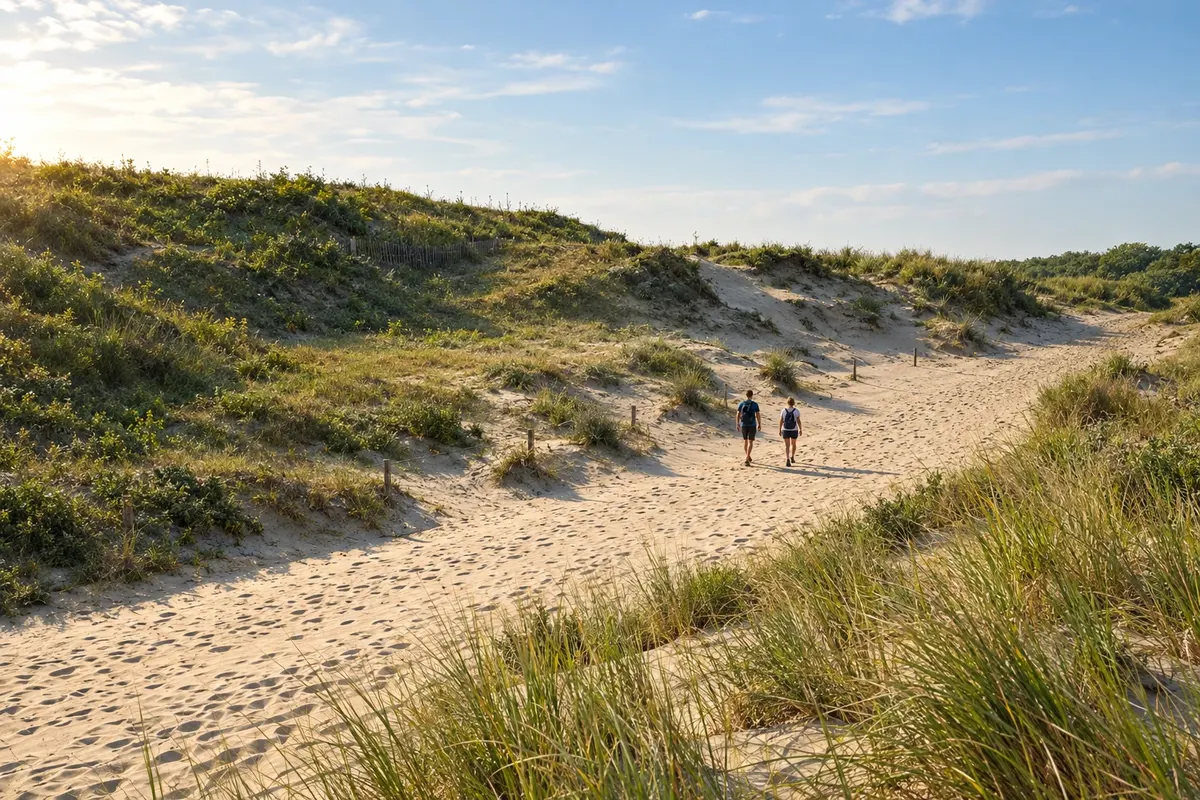
In the photo: Westhoekreservaat, De Panne

Illustrative images. The pictures in this guide are illustrations based on the real place, not photographs, and may differ from it.

Get it on Google Play

The province

Get to know Flandres Ocidental

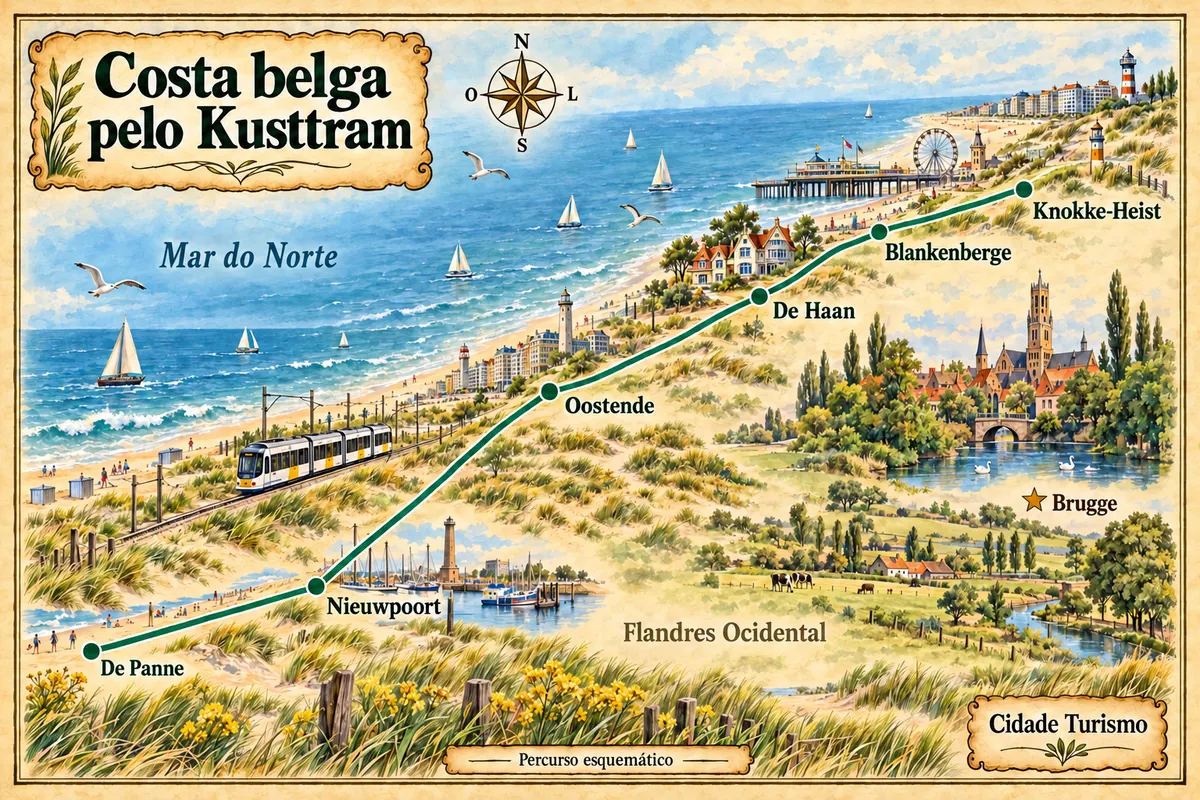
Flandres Ocidental is the corner of Belgium that borders the North Sea. The entire coast lies here, from De Panne, near the border with France, to Knokke-Heist, nearly at the Netherlands. The Kusttram, the coastal tram, runs the length of this shoreline and passes through Nieuwpoort, Ostende, De Haan and Blankenberge. Behind the beach are the polders, flat land reclaimed from the sea, cut by canals and lined with poplars.

Bruges is the capital and the calling card. The medieval centre, with the Belfort, the Markt and the canals, has been a UNESCO World Heritage Site since 2000. The city grew wealthy on the cloth trade in the Middle Ages, when the Zwin sea arm reached its gates. When the channel silted up, the port died and the centre froze in time. Damme, a few kilometres away, was Bruges’s former outport and today is a village beside a tree‑lined canal.

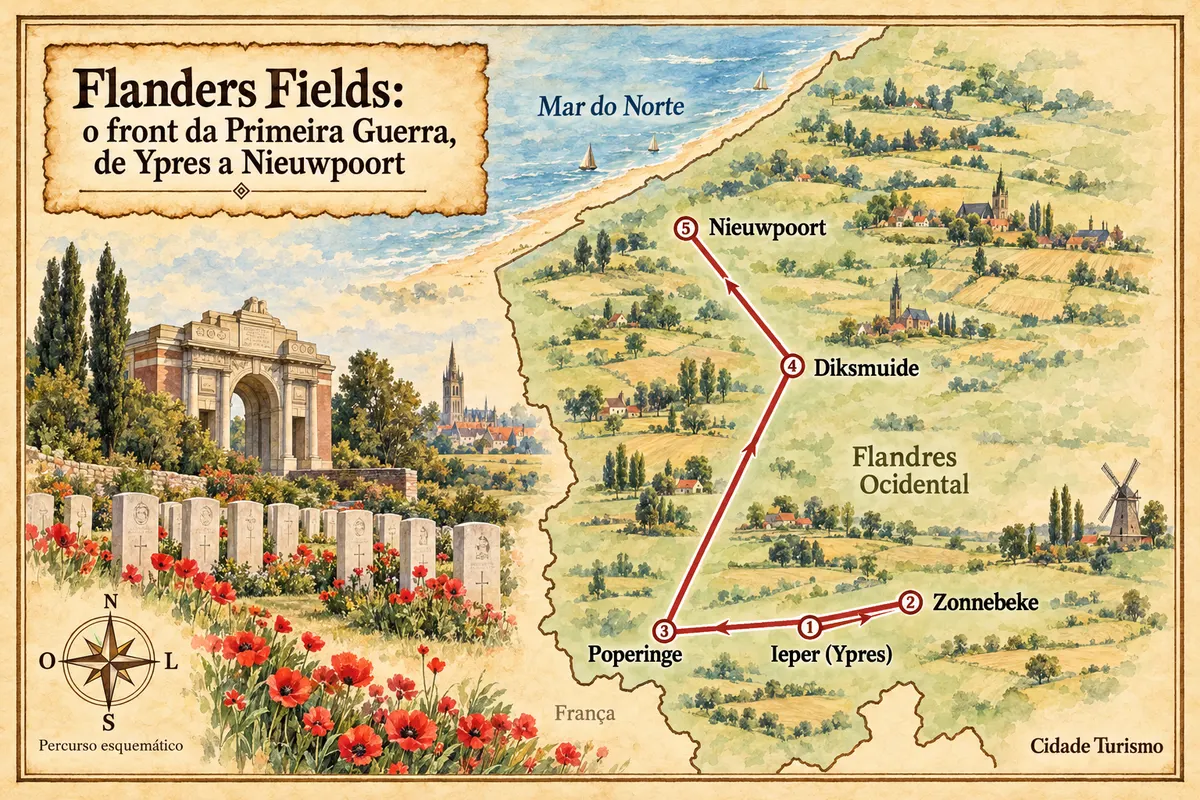
The southwest of the province is the Westhoek, and the story there is different. Between 1914 and 1918 the First World War front line cut across these fields. Ypres was destroyed and rebuilt stone by stone; at the Porta de Menin the Last Post is sounded every night since 1928, interrupted only during the German occupation in the Second World War. Around it are Zonnebeke, with the Tyne Cot cemetery, Poperinge, which was the rear area for British soldiers, and Diksmuide, where the Belgian front stopped behind the waters of the IJzer.

People speak Dutch, in a western dialect called West-Vlaams, which even other Flemings sometimes find hard to understand. On the table, the sea dominates: grey shrimp croquettes, mussels with fries and the catch of the day at the ports of Nieuwpoort and Ostende. Inland you find stoverij, a beef stew made with beer, and abbey and hop‑field beers from Poperinge. In Oostduinkerke fishermen still catch shrimp on horseback, a tradition recognised by UNESCO.


Routes

Routes through Flandres Ocidental

When to go

The climate is maritime: mild summers, cold and wet winters, and wind for much of the year. The beach season runs from June to August, when the sea is usually around 18–19 °C; July and August fill the coast. April, May and September are good for Bruges and the Westhoek, with fewer people. November is usually the rainiest month. In Bruges, the Procession of the Holy Blood takes place on Ascension Day, in May or June. In Ypres, the Kattenstoet, the parade of the cats, happens every three years, in May. In December and January it gets dark in the mid‑afternoon.

Getting there

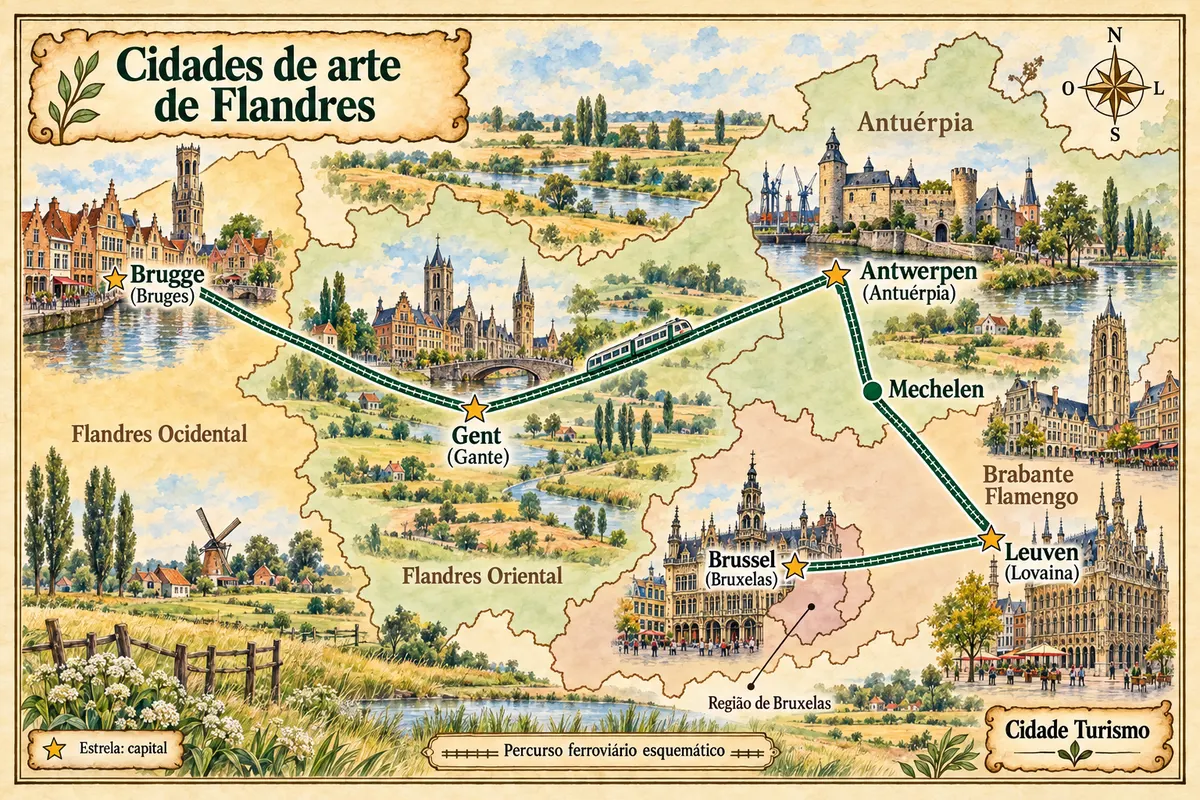
The gateway is Brussels Airport, in Zaventem, near Bruxelas. Flights from Brazil usually involve a connection in another city. Check before you buy. From the airport and Bruxelas stations, SNCB trains run to Bruges and Ostende; many call at Gante en route. On the coast there are stations at De Panne (Adinkerke), Ostende, Blankenberge and Knokke, and from there the Kusttram links the seaside resorts. For Ypres and Poperinge, the train comes via Kortrijk. By car, the E40 connects Bruxelas to Gante, Bruges and the coast and continues to France; the E403 runs from Bruges down to Kortrijk.

Your questions

Frequently asked questions about Flandres Ocidental

Can you visit Bruges on a day trip from Bruxelas?

Yes. The direct train takes about an hour and the centre is walkable. But the city empties in the late afternoon when tour groups leave, and many people think it's worth staying a night to see the canals at a more relaxed pace.

Do I need a car to visit the First World War battlefields?

It helps a lot. Ypres and Poperinge have train stations, but Tyne Cot, Passchendaele and the smaller cemeteries are scattered across the countryside. Without a car your options are cycling, taxi or a guided tour from Ypres. The waymarked bike routes are flat.

Is the sea on the Belgian coast good for swimming?

It's cold by Brazilian standards: even in August the water is usually around 19 °C. The beach is wide, with fine sand, and there are lifeguard posts in summer. Belgians go to the coast a lot to walk the promenade, cycle and eat seafood, more than to swim.

What language is spoken in the province?

Dutch, with the West Flemish accent. In tourist towns almost everyone speaks English, and many understand French. Signs and menus are in Dutch; in Bruges and on the coast they often have translations.

What is the Last Post in Ypres?

It is the bugle call in memory of Commonwealth soldiers who died on the Ypres salient. It takes place every night under the arch of the Porta de Menin, bringing residents and visitors together in silence. Check the time before you go and arrive early in summer.

Where to eat the shrimp croquettes?

In any coastal town and in Bruges. They are made with grey shrimp from the North Sea, small and strongly flavored. In Ostende and Nieuwpoort there are stalls and restaurants by the fishing harbour.

Bruxelas Antuérpia Limburgo Flandres Oriental Flandres Ocidental Brabante Flamengo Brabante Valão Hainaut Liège Luxemburgo Namur Bruxelas Bruxelas
Tap a province to see its destinations. Contornos: © NGI-IGN, AdminVector, CC BY 4.0. Adaptação do Cidade Turismo.
Back