Art cities of Flandres
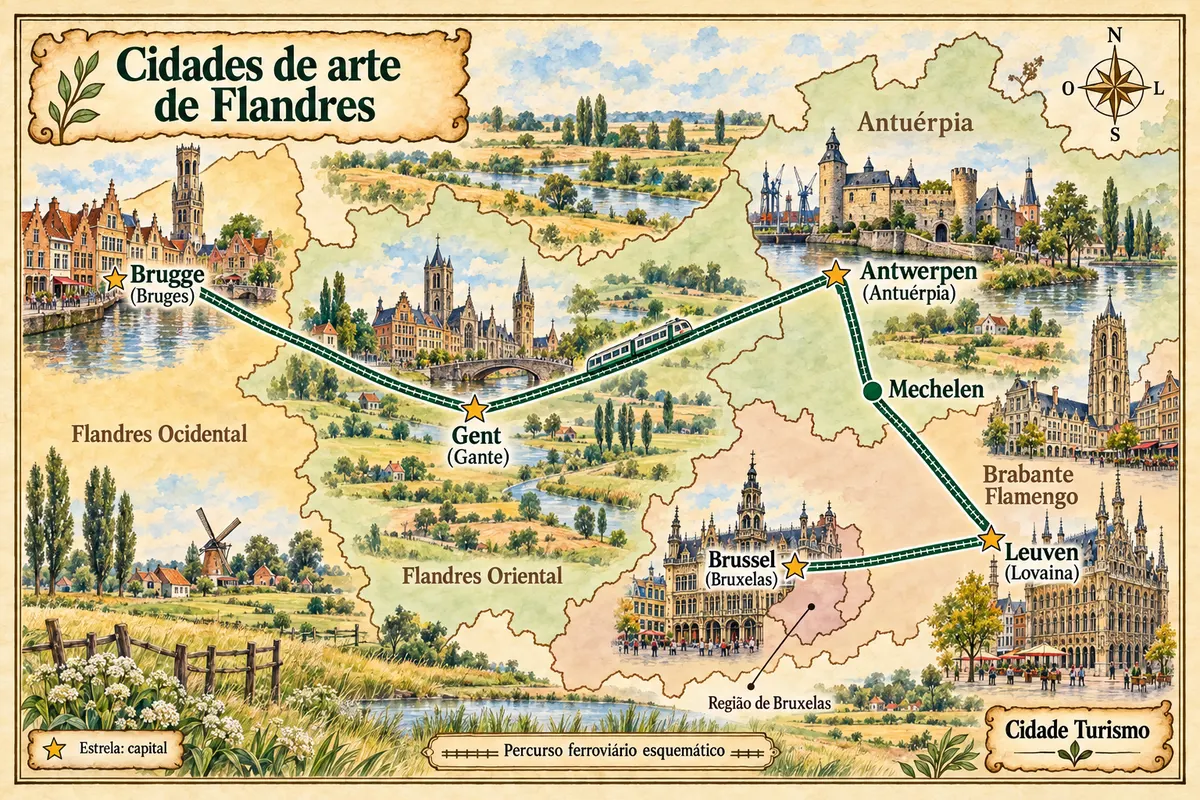
Six historic cities connected by train: Bruxelas, Lovaina, Mechelen, Antuérpia, Gante and Bruges, with Flemish painting, cathedrals and medieval centres less than an hour from each other.
Province · Bruxelas
Capital of Belgium and seat of the institutions of the European Union, Brussels brings together the Grand-Place, Art Nouveau, comics and lambic beer across 19 bilingual municipalities.
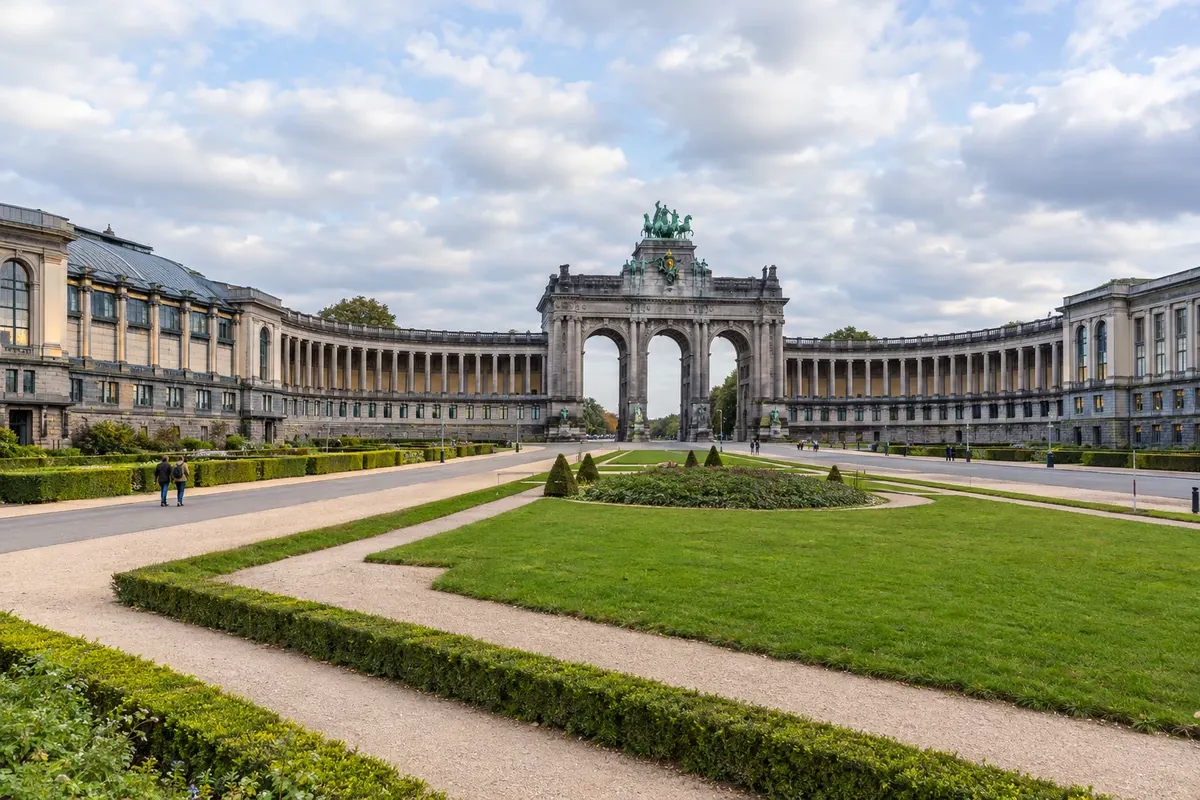
In the photo: Parc du Cinquantenaire
Illustrative images. The pictures in this guide are illustrations based on the real place, not photographs, and may differ from it.
The province
Brussels is the capital of Belgium and alone constitutes one of the country's three regions: the Brussels-Capital Region. It does not belong to any province. It comprises 19 municipalities, each with its own town hall. The municipality called the City of Brussels is only one of them and covers the historic center, part of the European Quarter and Laeken to the north. Ixelles, Saint-Gilles, Anderlecht and Schaerbeek are neighboring municipalities, not neighborhoods of it.
The region is officially bilingual. Signs carry the names in French and Dutch (Grand-Place and Grote Markt, Gare du Midi and Zuidstation), but French predominates in everyday life. English is widely spoken too, because of the European institutions and NATO, which has its headquarters in Evere.
The center revolves around the Grand-Place, a Unesco World Heritage site, the Galeries Royales Saint-Hubert and the Manneken Pis. On the upper part of the city are the Mont des Arts and the Royal Museums of Fine Arts, which include the Magritte Museum. Victor Horta’s Art Nouveau appears in Saint-Gilles and Ixelles, where the architect’s house became the Musée Horta. Comics are taken seriously: there is the Centre Belge de la Bande Dessinée, the comic museum, and dozens of character murals around the streets. To the north, in Laeken, the Atomium recalls the 1958 World Expo.
On the table you’ll find moules-frites, stoemp (mashed potatoes with vegetables), carbonade flamande, Brussels waffles and chocolate, including the pralines that were born in the city. The local beer is lambic, produced by spontaneous fermentation, and gueuze, made by blending lambics of different ages; the Brasserie Cantillon in Anderlecht still brews this way.
The calendar includes the Ommegang, a Renaissance pageant on the Grand-Place in early July, the National Day on 21 July and, in even-numbered years, the Flower Carpet in August. At the end of the year, the winter market fills the center.

Routes
The climate is oceanic: it rains in any month and the weather changes quickly. From May to September the days are long and mild, with afternoons usually between 18 °C and 23 °C. July concentrates the Ommegang and the National Day (21 July); in even years the Flower Carpet usually occupies the Grand-Place in mid-August. From November to February it gets cold, near zero on some days, and it gets dark early, but the winter market livens up the center from late November to early January. Bring a waterproof jacket year-round.
Brussels Airport (BRU) is in Zaventem, in Flemish Brabant, just outside the region, and has an underground train station with direct links to Bruxelles-Nord, Central and Midi stations. Brussels South Charleroi (CRL), used by low-cost carriers, is in Charleroi, in Hainaut, and the connection to the center is by bus. Connections to Brazil may be direct flights or with a stopover, depending on the season and carrier; confirm before buying. Travelers from other European countries generally arrive at Bruxelles-Midi, the station for Eurostar (London), TGV (Paris) and ICE (Germany). SNCB trains connect Brussels to the whole country. By road, the R0 ring road circles the region and feeds the motorways E40, E19 and E411. Within the city, STIB metro, tram and bus services handle most journeys.
Your questions
No. The Brussels-Capital Region is one of Belgium’s three regions, alongside Flanders and Wallonia, and is not part of any province. It is made up of 19 municipalities with their own administrations, and the City of Brussels, where the Grand-Place is located, is just one of them.
The region is officially bilingual, French and Dutch, and all signs show both names. On the street, French is the most commonly heard language. English generally works well in hotels, restaurants and museums. A few French words, like bonjour and merci, help in everyday interactions.
Brussels is four hours ahead of Brasília in the European winter (from late October to late March) and five hours ahead in the European summer, when Belgium moves the clock forward.
The simplest way is the train that leaves the underground station at Brussels Airport in Zaventem for Bruxelles-Nord, Central and Midi. There are also STIB and De Lijn buses. Those arriving via Charleroi use the shuttle bus that links that airport with Bruxelles-Midi station.
Yes. Belgium is small and SNCB trains run frequently from the three central stations. Leuven, Ghent, Bruges, Antwerp, Mechelen and Namur are within reach for a day trip by train, and Waterloo is just a few kilometers to the south.
The Flower Carpet is laid out on the Grand-Place in even-numbered years, in mid-August, for only a few days. It is made with begonias and other flowers and can be viewed from the square and from the town hall balcony. Check the event dates before you go.
Moules-frites (mussels with fries), stoemp, carbonade flamande (beef stew in beer), Brussels waffles and chocolate pralines. For beer drinkers, gueuze and kriek (lambic with cherry) are regional specialties.