Brazil
 Argentina
 Chile
Chile Colombia
 Peru
Peru Uruguay
 Germany
 Spain
Spain France
 Greece
 the Netherlands
 Ireland
 Italy
Italy Portugal
 the United Kingdom
 Switzerland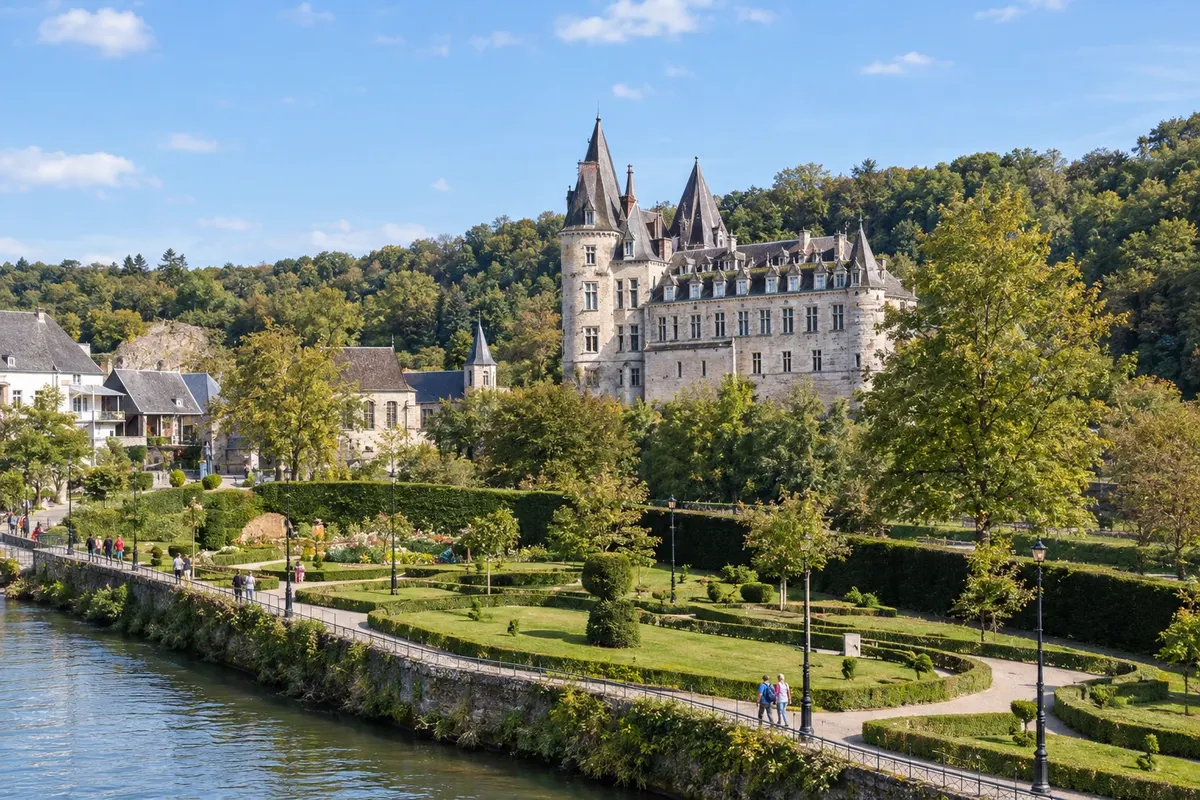
1 city
Province · Valônia
Where the Sambre meets the Mosa: citadels above the river, limestone cliffs, the Lesse caves and the valley's castles, in the south-central part of Valônia.
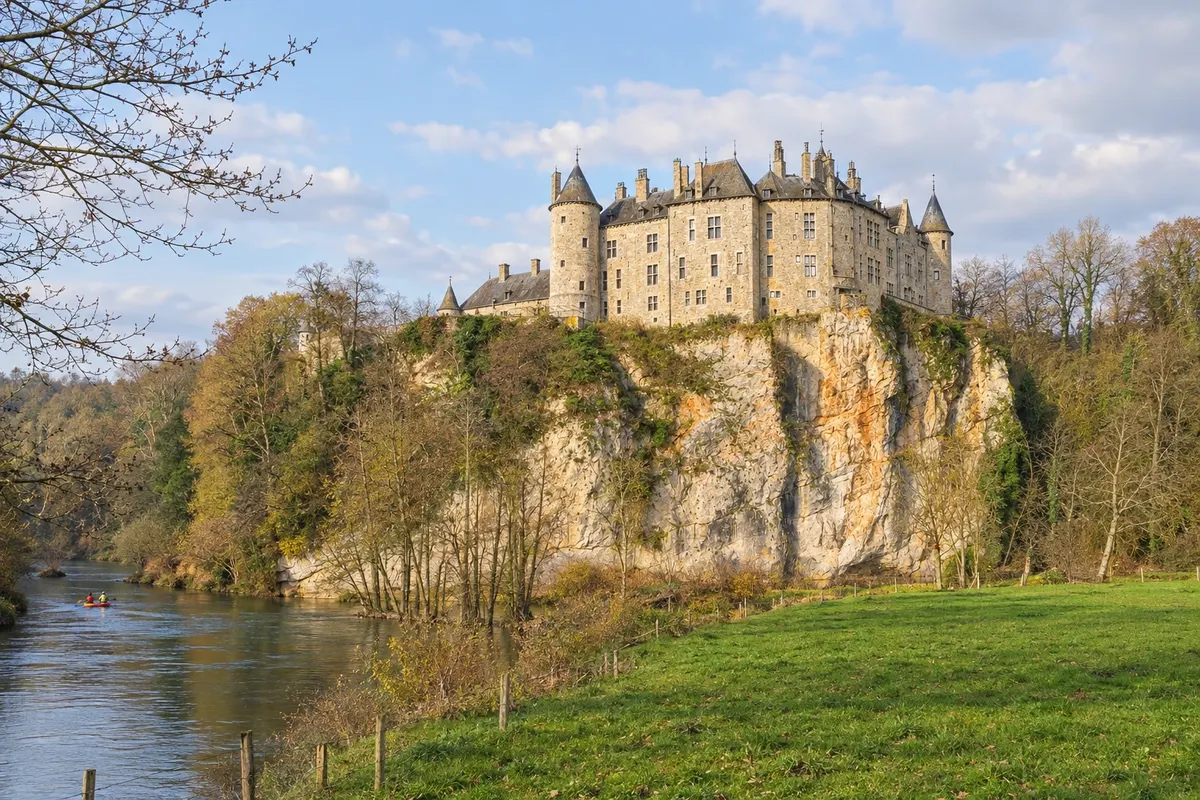
In the photo: Château de Walzin
Illustrative images. The pictures in this guide are illustrations based on the real place, not photographs, and may differ from it.

The province
The province of Namur occupies the south-central part of Valônia, the French-speaking half of Belgium. The capital, Namur, is also the capital of Valônia and grew at the confluence of the Sambre and the Mosa, at the foot of a citadel that watches over both rivers. From there to the south, the Mosa runs between limestone rocks to Dinant, the town where Adolphe Sax, the inventor of the saxophone, was born, and continues to Hastière, near the border with France.
Further south the landscape changes. Between the Famenne and the start of the Ardennes, the Lesse cuts through the limestone massif and forms the caves of Han-sur-Lesse, in the municipality of Rochefort. In the same valley, the Château de Walzin stands on top of a cliff above the water. It is a private residence and is viewed from the outside, preferably by kayak, on the Lesse descent to Anseremme.
The Mosa valley preserves centuries of castles, abbeys and gardens. The Château de Freÿr sits on the riverbank, with formal French gardens. The Jardins d'Annevoie are known for fountains powered only by the force of water. The Abadia de Maredsous, run by Benedictines, lends its name to a cheese and a beer, and the monks of the Abadia de Saint-Remy, in Rochefort, produce one of Belgium's Trappist beers.
The language is French, and Walloon still appears in songs and popular festivals. In September, Namur celebrates the Fêtes de Wallonie, featuring the échasseurs, men on stilts who try to knock down their rivals. On the table, the couque de Dinant, a hard honey biscuit molded in carved wooden forms, shares space with river trout and abbey cheeses.
Destinations
Routes
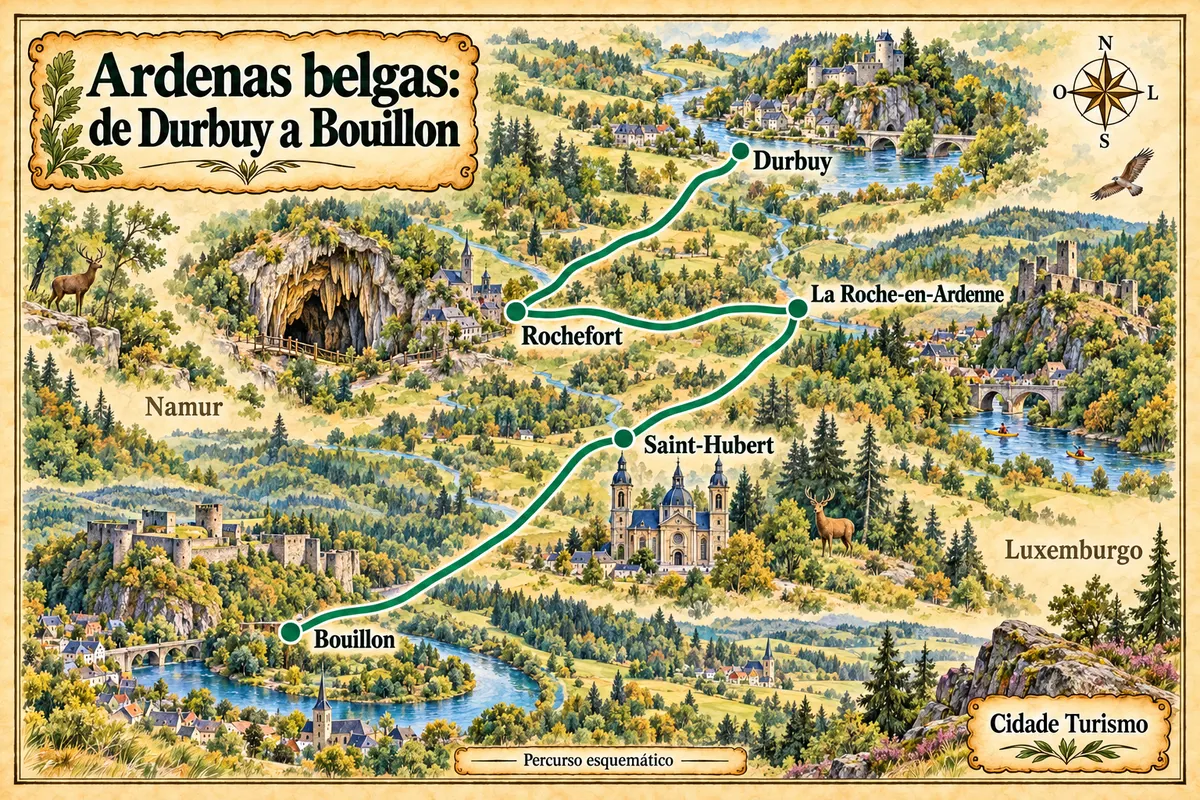
Five stops through the Belgian Ardennes, from the Ourthe valley to the Semois: Durbuy, the Han caves in Rochefort, La Roche-en-Ardenne, Saint-Hubert and Bouillon Castle, linked by forest roads.
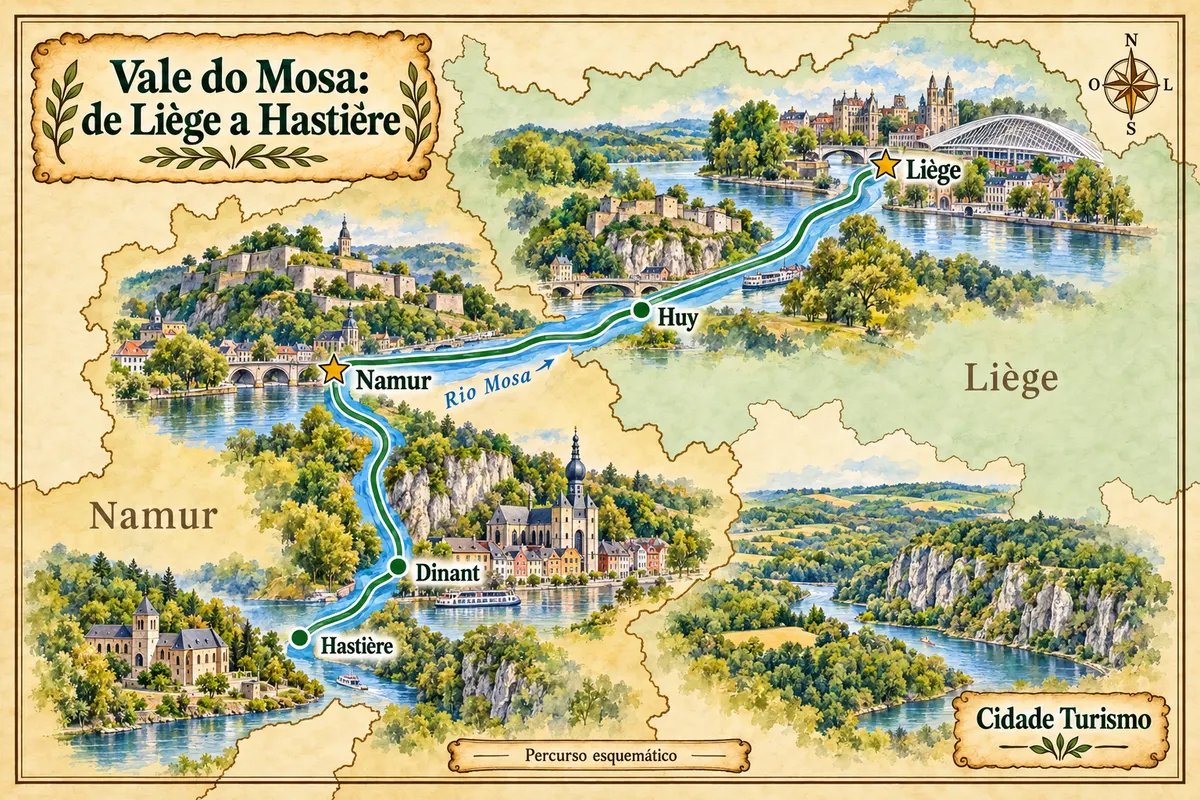
The river Mosa cuts through Wallonia from south to north. The route follows the valley from Liège to Hastière, passing Huy, Namur and Dinant, with fortresses atop the cliffs and the train running along the water.
The climate is temperate and humid, with seasons reversed compared to Brazil. From June to August the days are long and it is the busiest time for kayaking on the Lesse and boat trips on the Mosa in Dinant, which usually run from April to early November. April, May, September and October are quieter, and in October the valley woods often turn red. From December to February it is cold and it gets dark early; the Han caves often close for a break at the start of the year. The Fêtes de Wallonie in Namur take place in September.
The gateway is Brussels Airport, in Zaventem. Flights from Brazil usually involve a connection in another city. Check before buying. From the airport, SNCB trains go to Namur and continue along the valley to Dinant. South of Dinant there is no passenger train: Hastière is a short trip along the N96 road, on the banks of the Mosa. For Han-sur-Lesse, trains go to Jemelle station in Rochefort, and from there TEC buses run to the caves. By car, the E411 links Bruxelas to Namur and continues south, and the E42 crosses the province from west to east. Charleroi airport is in the neighboring province of Hainaut.
Your questions
Yes. The train links Bruxelas with Namur and continues to Dinant on the same line, so it's possible to see both towns in a single day, starting in Dinant and returning via Namur. To climb the Namur citadel and still stroll through Dinant’s center, set off early. Check train schedules before you go.
There are three ways: on foot, via trails and staircases starting from the center; by car, using the road that circles the hill; and by cable car that departs from the Mosa riverside near the confluence with the Sambre. Up there are the ramparts, the underground passages and the viewpoint over both rivers.
Yes. Local companies rent kayaks for sections between Houyet and Anseremme, where the Lesse flows into the Mosa, with a bus return to the starting point. The route passes beneath the Château de Walzin. The season generally runs from spring to early autumn and depends on river levels. Book in advance, especially in July and August.
No. Trains go to Jemelle station in Rochefort, and TEC buses run to Han-sur-Lesse. The caves tour begins with a tram that takes the group to the entrance. Having a car makes it easier to combine Rochefort, Dinant and the valley castles in the same day.
It is a biscuit made of flour and honey, without fat or yeast, baked in carved wooden molds with designs of animals, landscapes and coats of arms. It becomes very hard. The custom is to break it into small pieces and let it melt in the mouth rather than bite it. Dinant confectioneries sell it in various sizes.
The province's language is French. In hotels, museums and at the larger attractions—like the Namur citadel and the Han caves—English service is often available. In villages and small restaurants, a few words of French are very helpful.