

 Brazil
 Argentina
 Chile
Chile Colombia
 Peru
Peru Uruguay
 Germany
 Spain
Spain France
 Greece
 the Netherlands
 Ireland
 Italy
Italy Portugal
 the United Kingdom
 Switzerland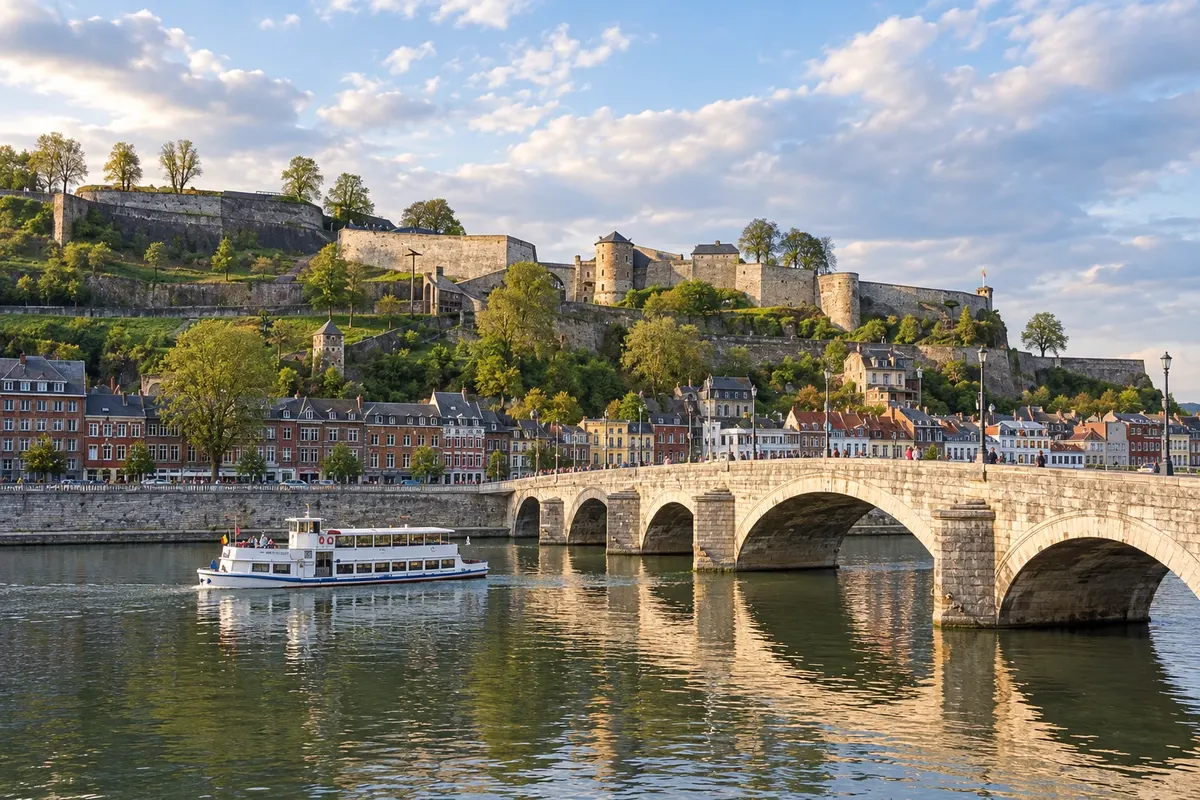
Route · Liège · Namur
Mosa Valley: from Liège to Hastière
The river Mosa cuts through Wallonia from south to north. The route follows the valley from Liège to Hastière, passing Huy, Namur and Dinant, with fortresses atop the cliffs and the train running along the water.
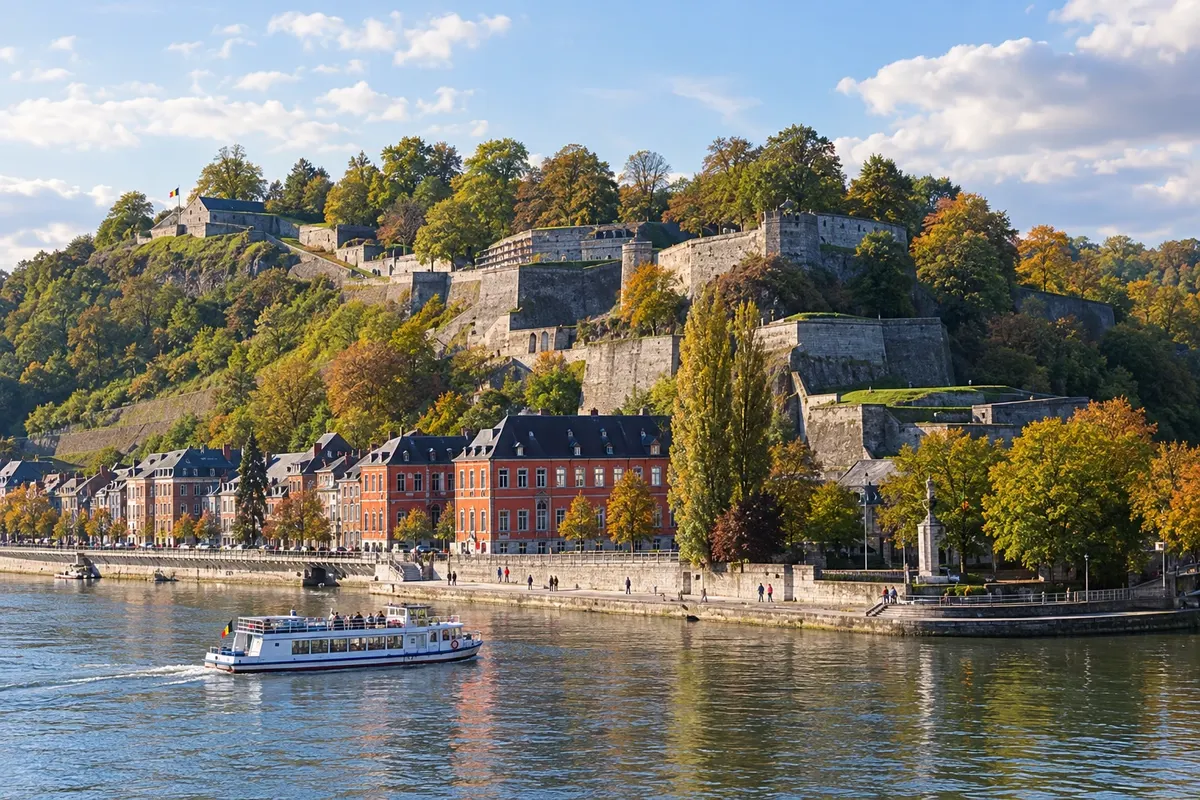
In the photo: Citadelle de Namur and Jambes bridge over the Mosa
Illustrative images. The pictures in this guide are illustrations based on the real place, not photographs, and may differ from it.

The route
What the Mosa Valley: from Liège to Hastière is
The Mosa rises in France, crosses Wallonia and continues to the Netherlands. In the Belgian section, the river runs in a narrow valley between rocks, and the towns grew stuck to the bank, each with its fortress above.
The route runs from Liège, the large industrial city in the north, to Hastière, almost on the French border. In between are Huy, with its 19th-century fort and Gothic collegiate church, Namur, the capital of Wallonia, at the confluence with the Sambre, and Dinant, with the onion‑domed church tower at the foot of the cliff.
This whole part of Belgium is French-speaking. Signs, menus and station names are in French, and Liège appears as Luik on Dutch-language signs in the north of the country.
The train follows the river from Liège to Namur and from Namur to Dinant, with short stops between towns. To reach Hastière the way is by car or by bike, along the cycle path that runs with the water from the French border to Liège.
The map
5 cities along the way
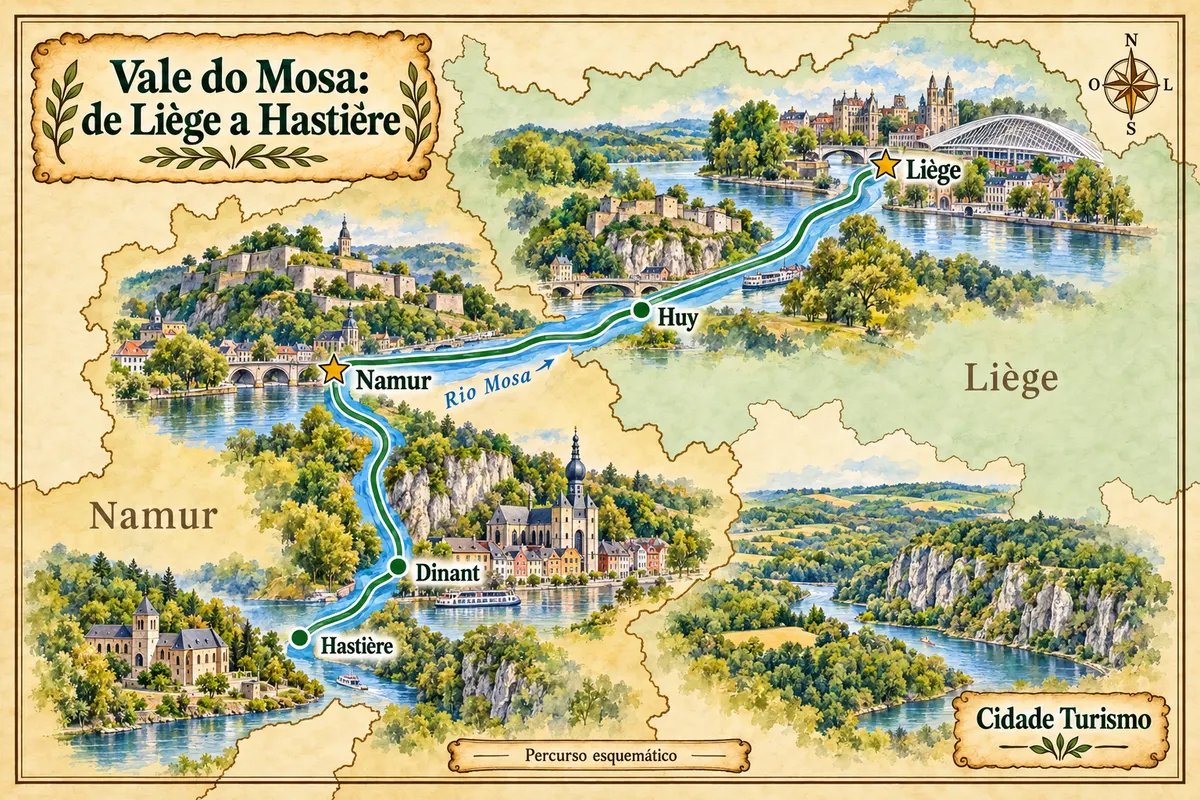
Contornos: © NGI-IGN, AdminVector, CC BY 4.0. Adaptação do Cidade Turismo.
The journey
City by city
Distances and times are approximate: check before you set off.
-
 1 · Liège
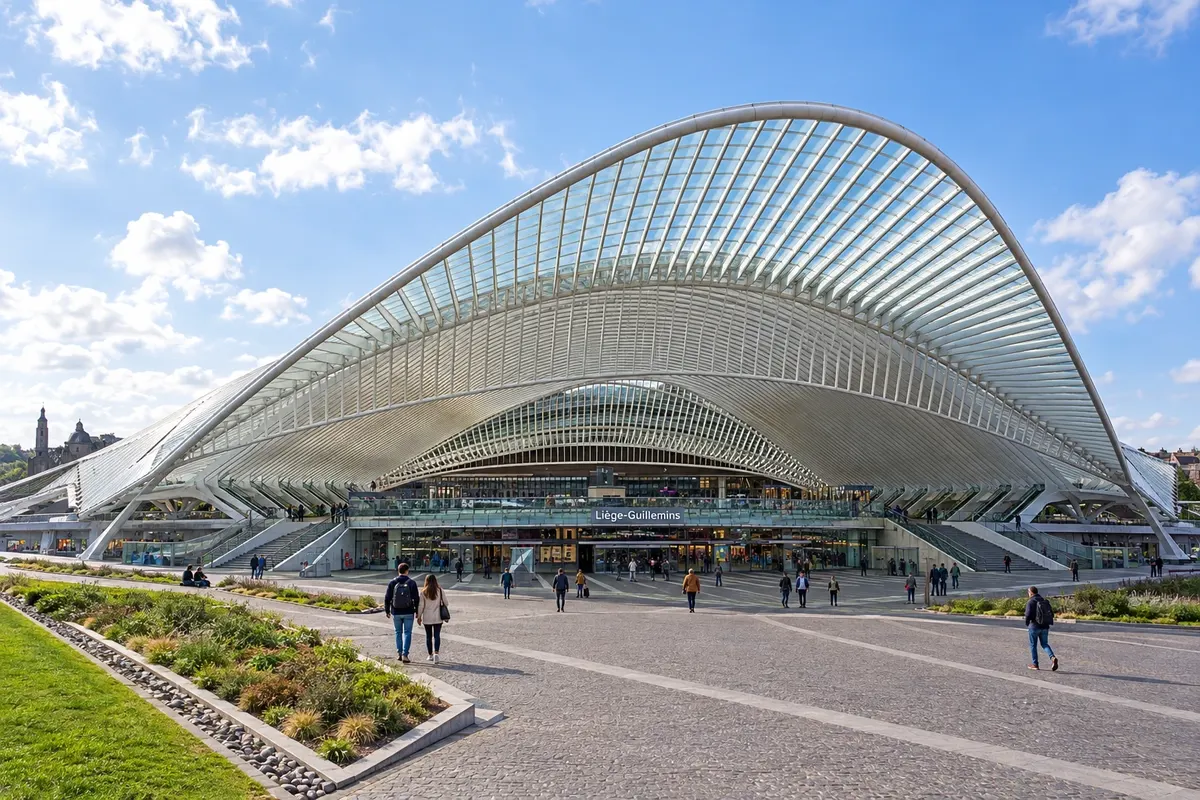
Liège
Starting point, the largest city of Wallonia. The Liège-Guillemins station, by architect Santiago Calatrava, is a sight in itself. In the center are the Montagne de Bueren stairway, with 374 steps, and the La Boverie museum, in a park between the Mosa and the canal. Heading south, the road passes the old Val-Saint-Lambert glassworks and the steelworks of Seraing.
→ Huy Train on the Liège–Namur line, which runs along the left bank and stops at Huy. By car, the N90 follows the river, passing Seraing, Flémalle and the cooling towers of the Tihange power station.
-
 2 · Liège
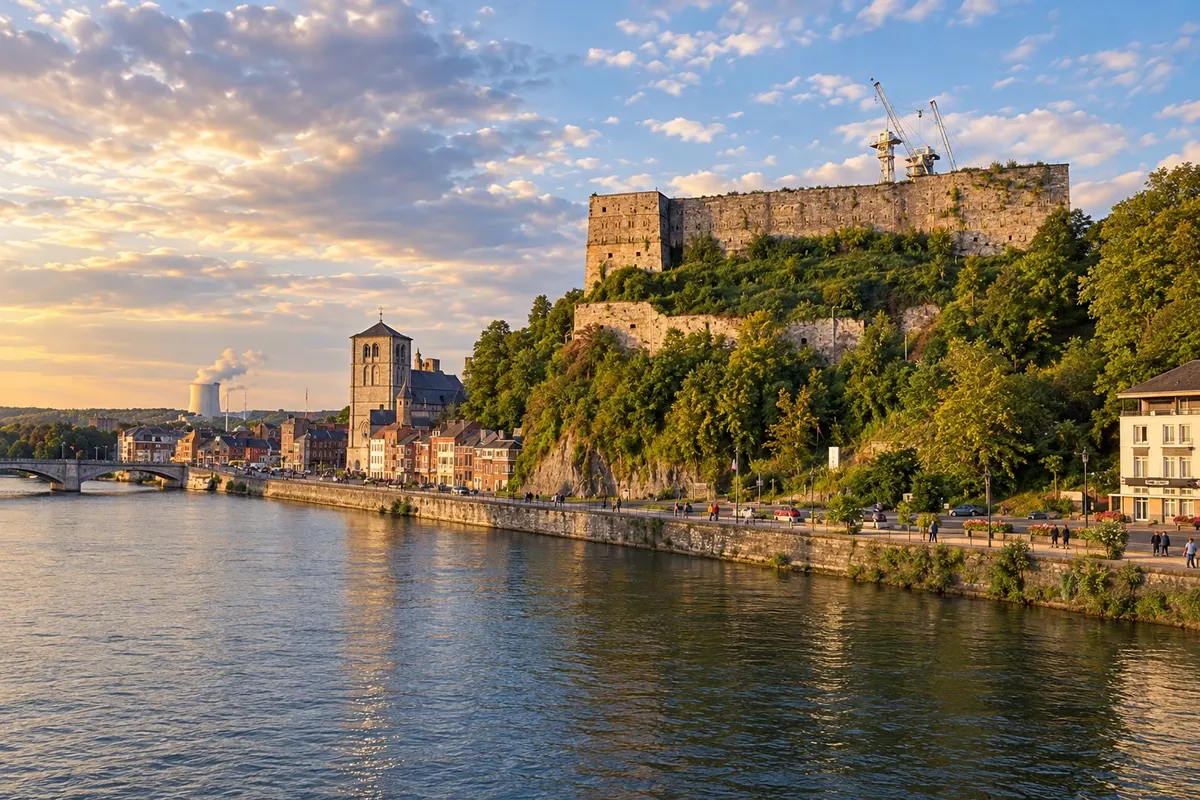
Huy
It lies halfway between Liège and Namur. The 19th‑century fort dominates the town from the hilltop, and a cable car climbs from the riverbank. Below are the collegiate church Notre-Dame, with the Li Rondia rose window, and the Grand-Place, with the Li Bassinia fountain. The Mur de Huy hill is the finish of the Flèche Wallonne cycling race.
→ Namur Same train line, without change, to Namur. Along the N90 the road passes Andenne and the quarries of Namêche. On the opposite bank, the cycle path goes by the mills of Beez.
-
 3 · Namur
Namur
Capital of Wallonia, where the Sambre flows into the Mosa. The citadel occupies the promontory between the two rivers, and the regional parliament operates in the former Saint-Gilles hospice at the tip of the Grognon. It's the most practical base for the route: trains to Liège, Dinant and Brussels depart from there.
→ Dinant Train on the Namur–Dinant line, which climbs the valley along the riverbank. By car, the N92 leaves Namur on the left bank to Profondeville and crosses to the right bank to Dinant. Along the way are the Annevoie gardens and the ruins of Poilvache.
-
 4 · Namur
Dinant
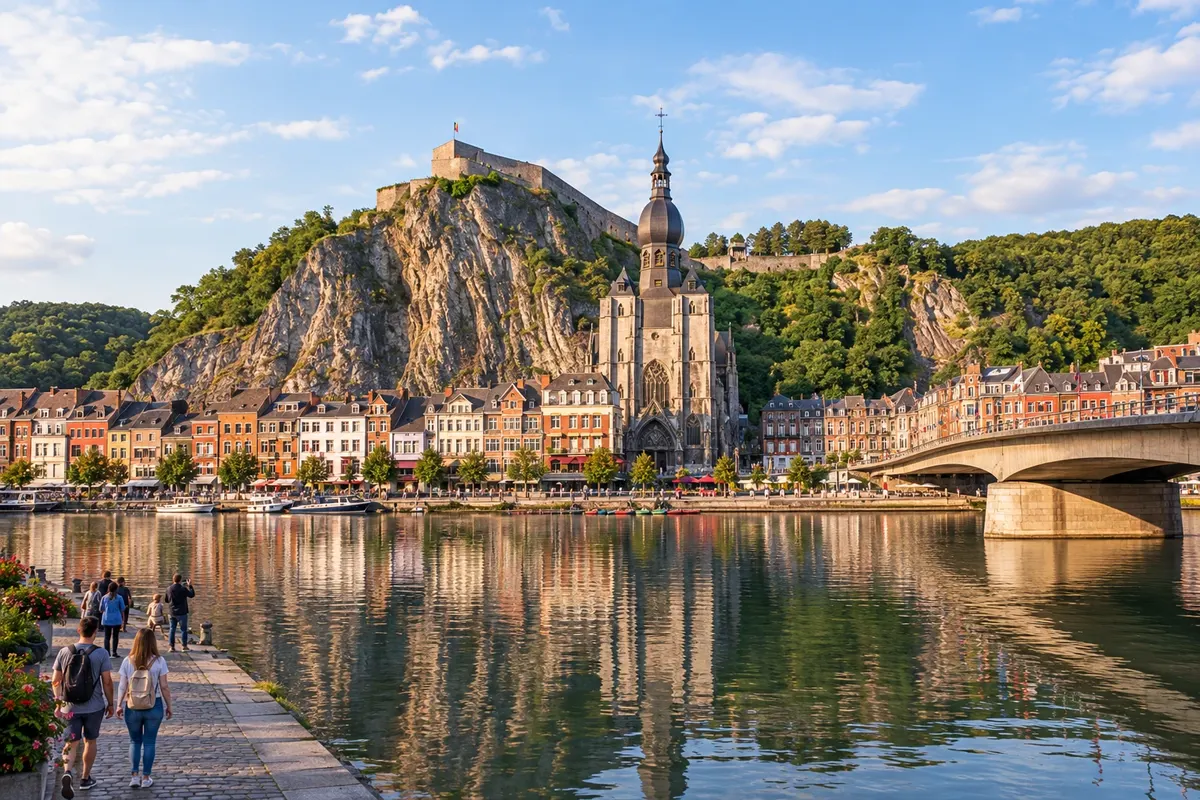
The town is a narrow strip between the river and a rock face. The collegiate church Notre-Dame, with its onion tower, sits just below the citadel, which is reached by stairs or cable car. Adolphe Sax, inventor of the saxophone, was born here. South of the center, the Rocher Bayard is a stone needle by the road, and sightseeing boats leave from the quay.
→ Hastière There is no passenger train on this stretch. By car, the N96 follows the river from Dinant to Hastière, passing Anseremme and near Freÿr. The sightseeing boat that departs from Dinant usually goes to Freÿr in July and August, round trip, without reaching Hastière.
-
 5 · Namur
Hastière
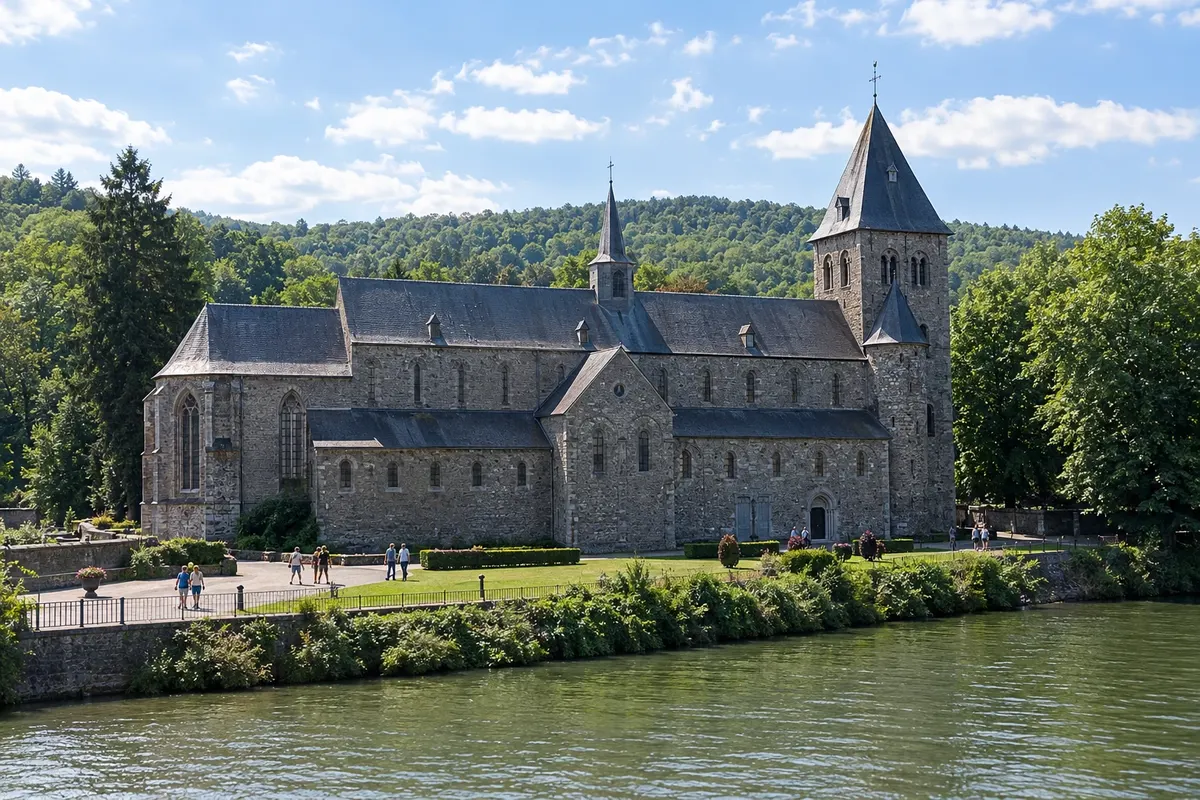
The last Belgian stop before France. The municipality groups riverside villages along the Mosa, such as Hastière-Lavaux, Hastière-par-delà and Waulsort, where the river makes a bend in front of a castle. On the way from Dinant are Freÿr castle and gardens and climbing cliffs. The 11th‑century Romanesque church once belonged to an old Benedictine monastery.
How many days
Two days is enough to see Huy, Namur and Dinant at a relaxed pace, staying overnight in Namur. With three or four days you can include all of Liège and the stretch south of Dinant, with Freÿr castle and Hastière. By bike, the Mosa cycle path is usually done in three to five days.
Best time to go
From May to September the days are long and the weather is generally more stable. Sightseeing boats in Dinant usually run from April to October, and the trip to Freÿr typically operates only in July and August. From November to February it gets dark early, it often rains, and some attractions open only on weekends.
The seasons shown are the most usual ones; nature doesn't always follow the calendar.
How to travel it
By train: the Liège–Namur line stops at Huy, and from Namur a line goes to Dinant. From Brussels there are direct trains to Namur and to Dinant. By car: the N90 links Liège to Namur through the valley, the N92 runs from Namur to Dinant, and the N96 goes from Dinant to Hastière. South of Dinant there is no passenger train.
Who it's for
For those who like small riverside towns, fortresses and old churches, and watching the landscape from a train window. It's also good for cyclists, since the cycle path is flat, and for anyone wanting to leave Brussels without flying.
Your questions
Frequently asked questions about the Mosa Valley: from Liège to Hastière
Can you do the route without a car?
Yes, from Liège to Dinant. The train stops at Huy on the way to Namur, and from Namur there is another line to Dinant, with a change in Namur. South of Dinant there is no passenger train: to reach Hastière and Freÿr you need a car, bicycle or regional bus. Check routes and timetables before you go.
Can you do a day trip from Brussels?
You can see one or two towns in a day. From Brussels there are direct trains to Namur and to Dinant; Huy and Liège are on the line that departs Namur. For the whole route, it's most practical to spend one or two nights in Namur.
What language do people speak in the Mosa valley?
In French. The valley is in Wallonia, the French‑speaking part of Belgium. In larger stations and museums there is usually information in English and Dutch. Some towns have different names in Dutch, such as Luik for Liège and Hoei for Huy.
What is the best time to do the route?
From May to September, when the days are long and the sightseeing boats operate. In July and August Dinant is busier. In winter, from December to February, it gets dark in the late afternoon, it often rains and some attractions reduce their opening days.
Can you cycle along the valley?
Yes. A waymarked cycle path follows the Mosa from Givet, on the French border, to Liège; it's almost entirely flat and paved, and for much of the route it is separated from cars. It is part of the European route EuroVelo 19.
Is there a regular boat service between the cities?
There is no regular boat linking Namur, Dinant and Hastière. In Dinant, boats run round-trip excursions: the short one, to Anseremme, usually operates from April to October, and the longer one, to Freÿr, usually runs in July and August. Check the dates before you go.