Toledo, Segovia, and Ávila

Castilla-La Mancha · Castile and León

Toledo, Segovia, and Ávila

Three historic World Heritage cities near Madri: Toledo above the Tejo, the Roman Aqueduct of Segóvia and the medieval walls of Ávila.

Central

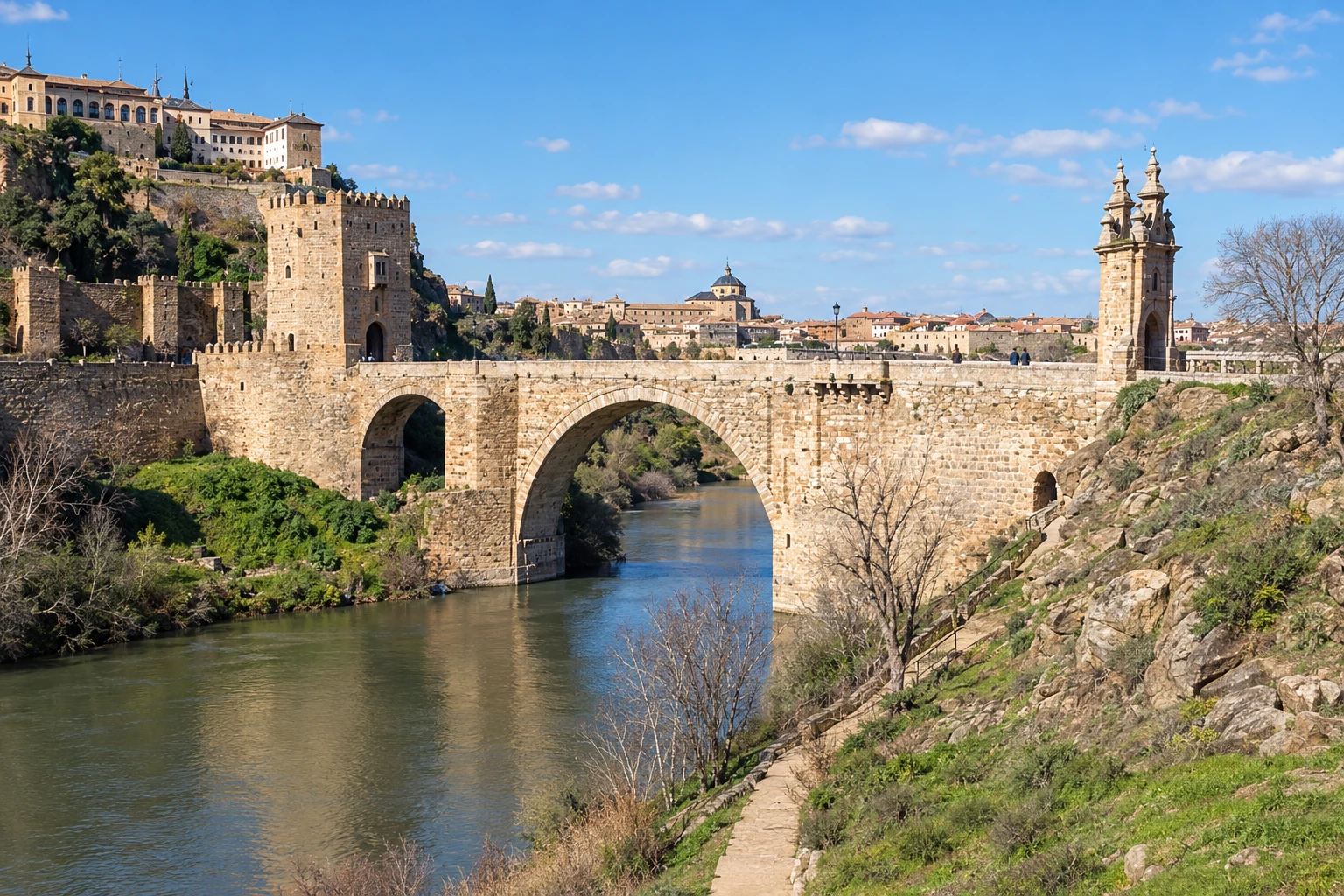
In the photo: Puente de Alcántara in Toledo

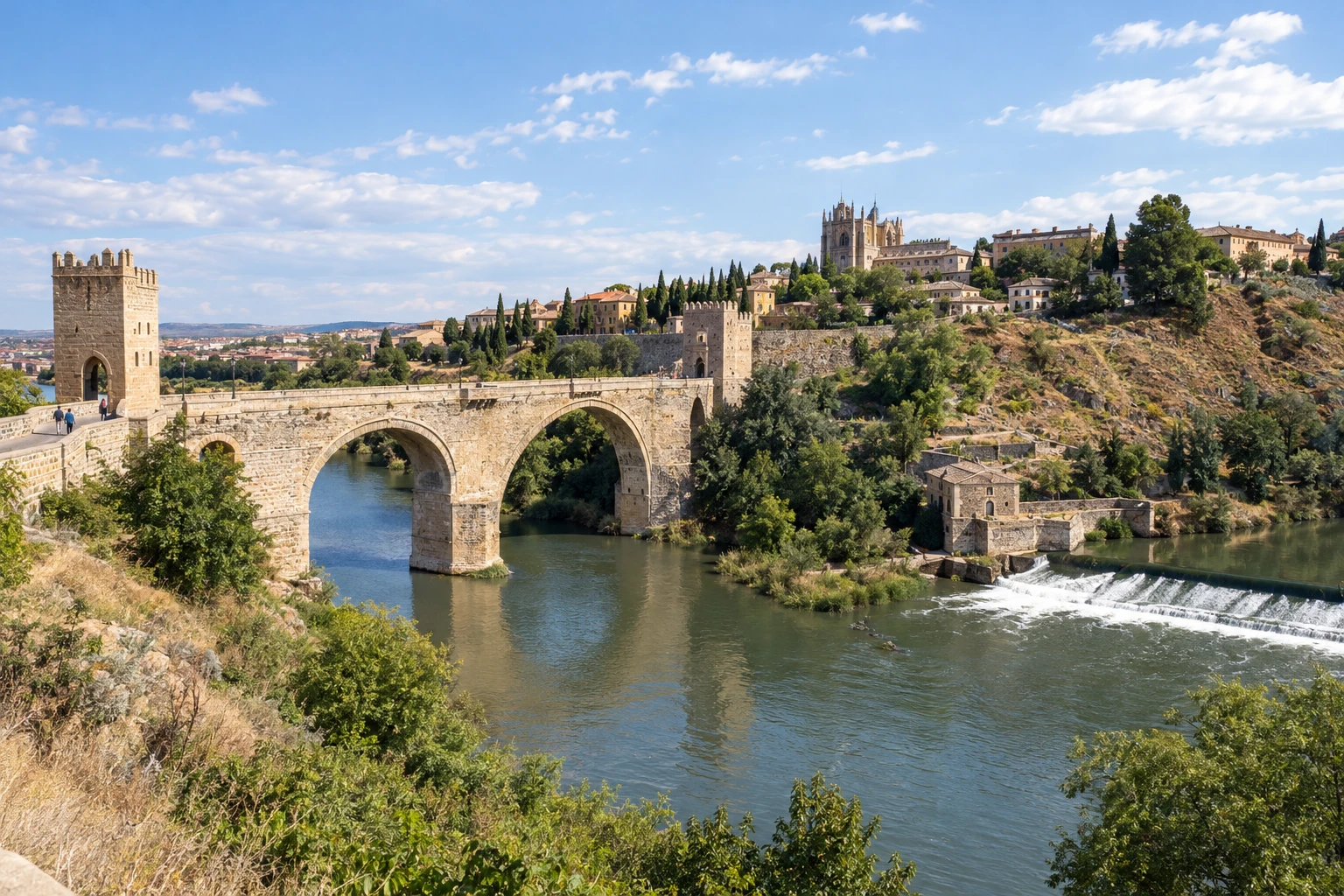
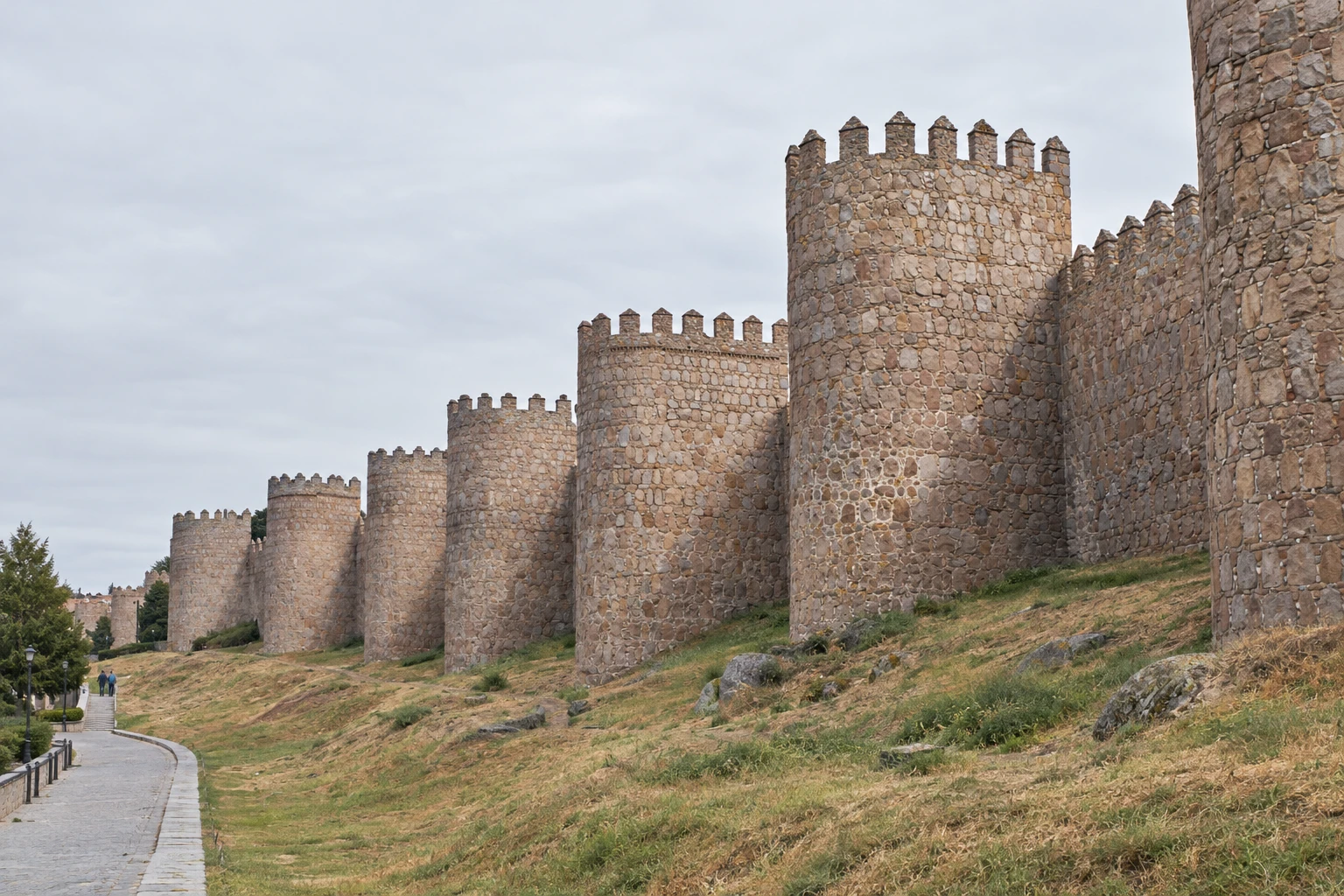
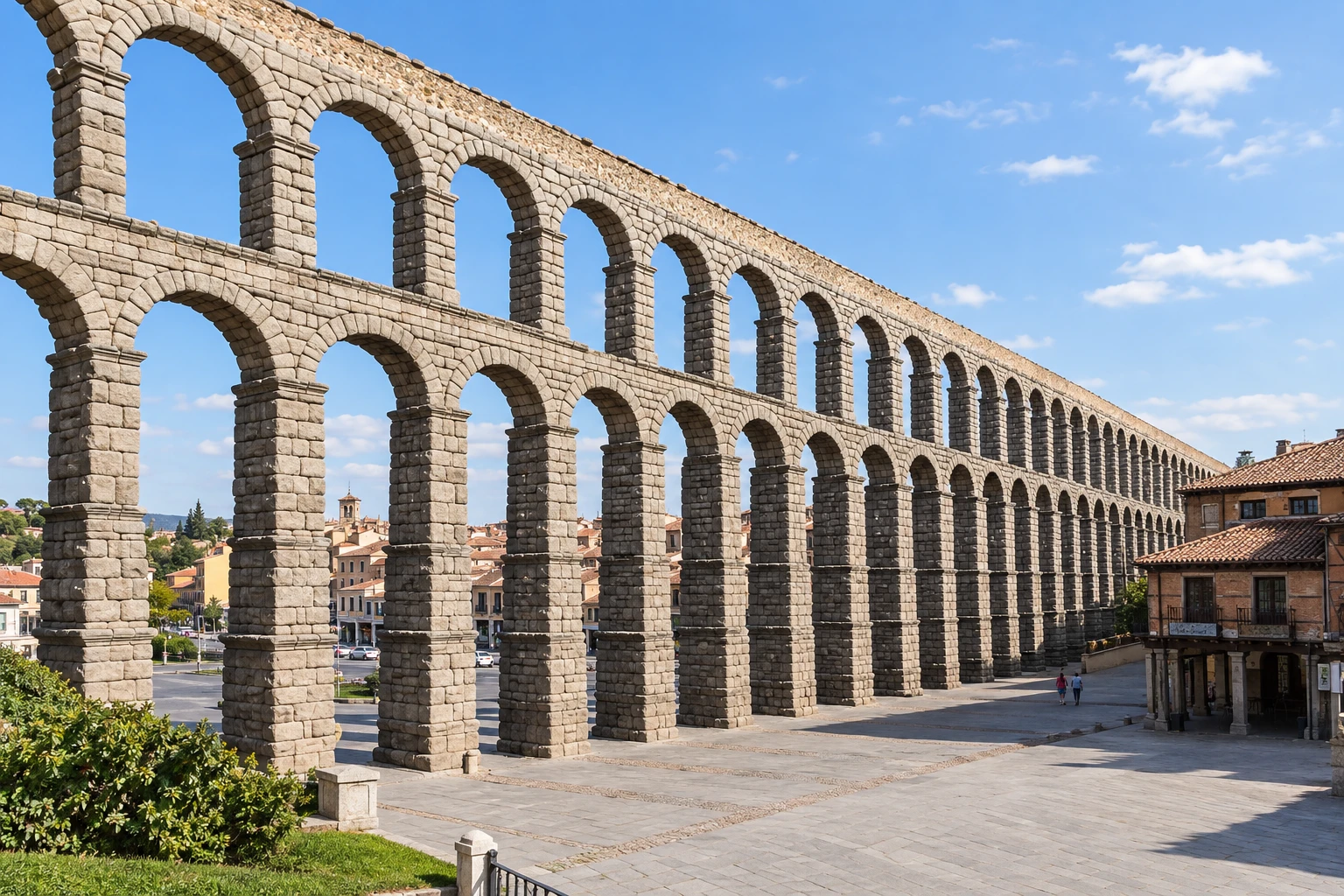
Illustrative images. The pictures in this guide are illustrations based on the real place, not photographs, and may differ from it.

Get it on Google Play

Get to know the place

A region to enjoy
at your own pace.

Toledo, Segóvia and Ávila are in central Spain, around Madri, and all three have historic centres inscribed by UNESCO as World Heritage. Each can be visited in a day from the capital, by train or car, and many people combine two or all three on the same trip. The language in all three is Spanish (Castilian).

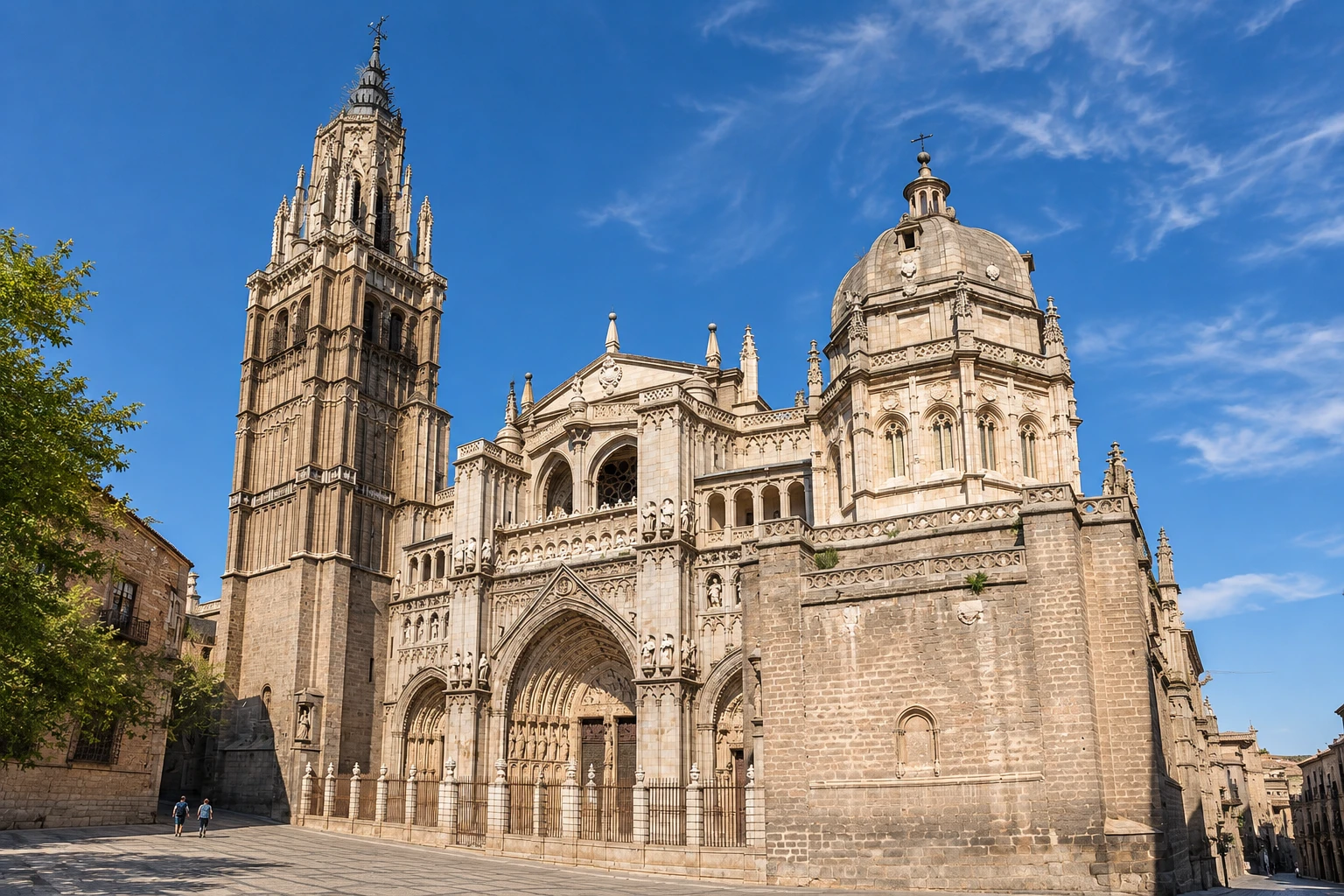
Toledo sits on a hill surrounded on three sides by a bend of the river Tejo. It was a Visigothic capital, a Muslim city and the seat of the Castile court, and it preserves the Catedral Primada, the Alcázar, two medieval synagogues, a small mosque from the year 999 and works by El Greco, who lived and painted in the city. It is the capital of Castela-Mancha.

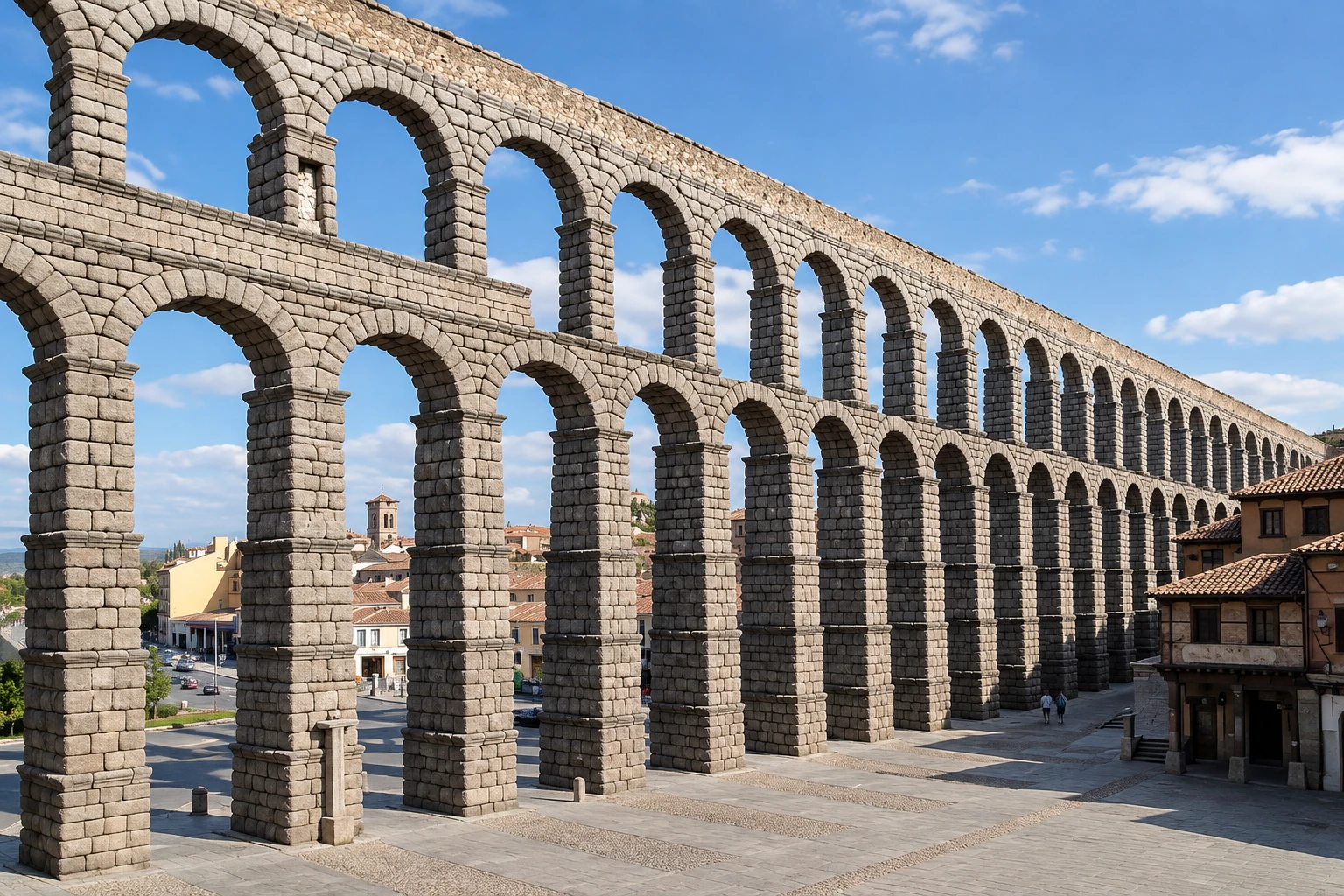
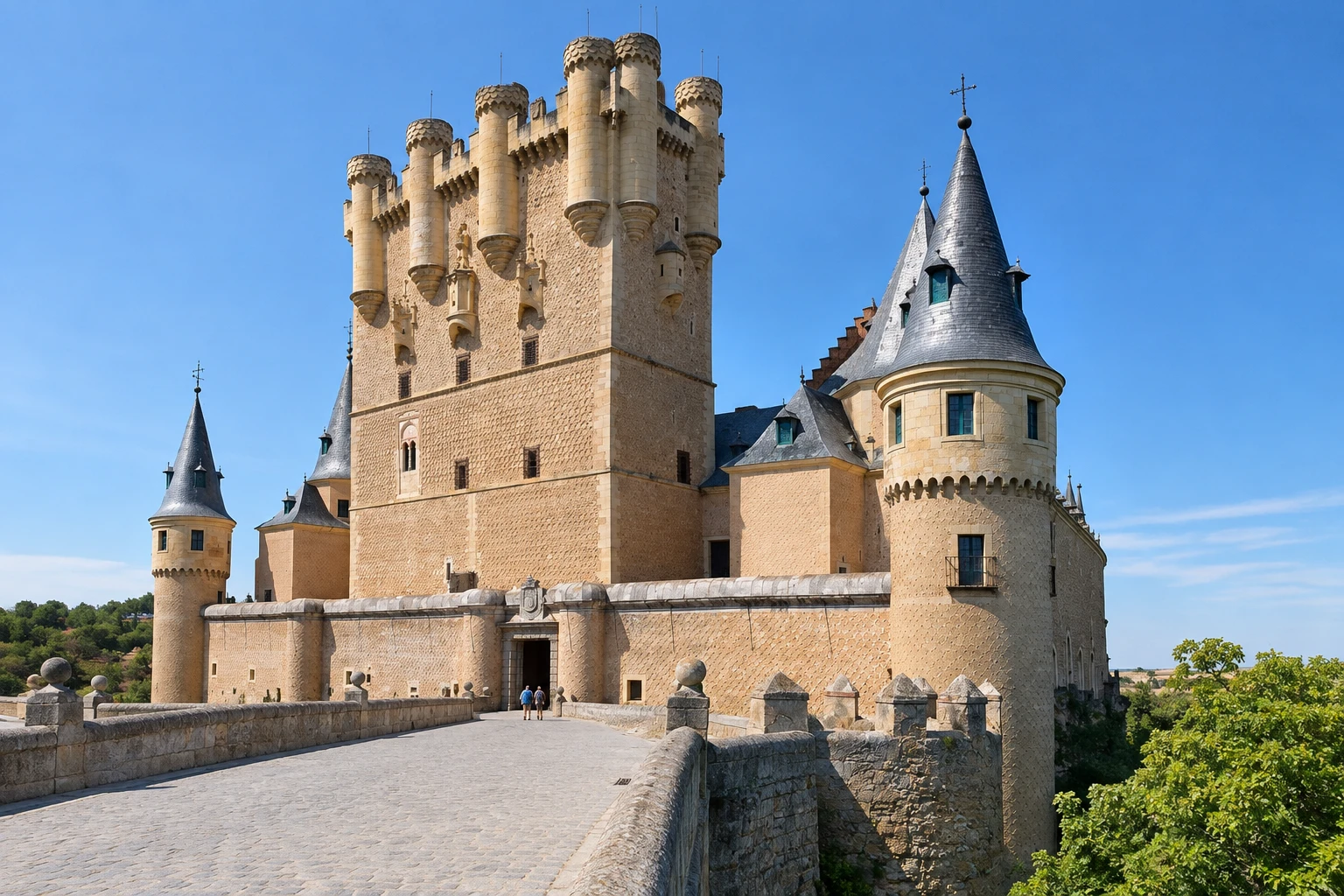
Segóvia, in Castela y Leão, is known for the Roman stone Aqueduct that crosses the entrance plaza of the old town. At the top of the historic centre are the Gothic Cathedral and, on the tip of the rock, the Alcázar, a castle that served as a residence for the kings of Castile.

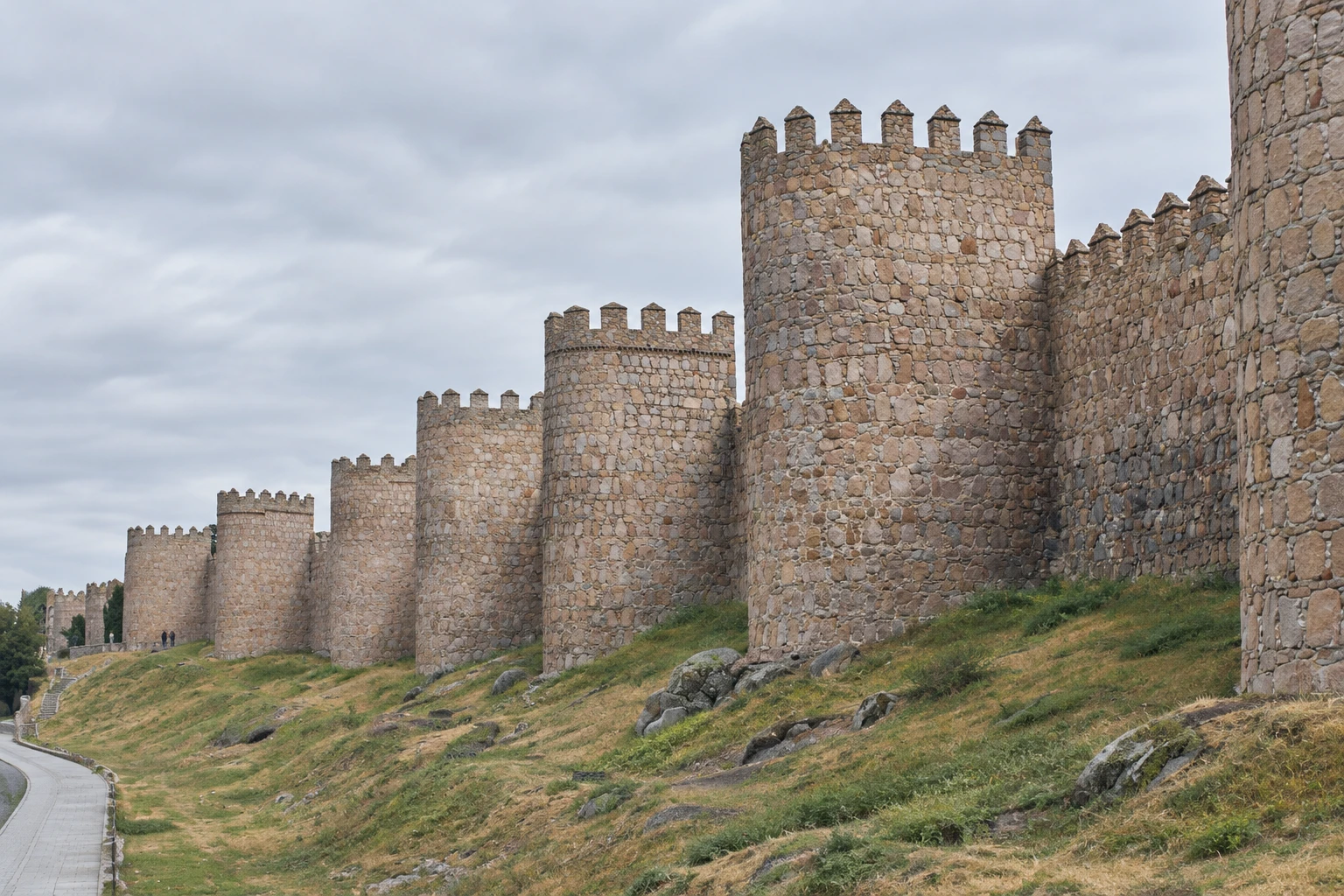
Ávila, also in Castela y Leão, is surrounded by medieval walls with towers and gates, which can be partly walked along at the top. Inside them are the Cathedral, whose apse is part of the wall itself, and places linked to Santa Teresa de Jesus, the mystic born in the city in 1515.

This destination brings together 3 cities: Toledo, Ávila, Segovia.

Share: WhatsApp
Traveler, share your experiences through photos Up to 5 photos of each place you visited.

One destination, many paths

The cities on this trip

Start with one city or combine several in your itinerary.

Where Toledo, Segovia, and Ávila is The star marks the nearest capital, Madrid.
MadridToledoÁvilaSegovia

Outlines: IGN/CNIG, unidades administrativas, CC BY 4.0. Adapted by Cidade Turismo.

How to get there: Toledo, Segovia, and Ávila

Aeropuerto Adolfo Suárez Madrid-Barajas (MAD), in Madri · 86 km to Toledo

The entry point is Madri. Connections with Brazil can be direct flights or with a stopover, depending on the season and the airline. Check before purchasing. From Madri there are trains: Avant to Toledo, departing from Puerta de Atocha; high-speed trains to Segovia-Guiomar, departing from Chamartín; and conventional trains to Ávila.

Suggested arrival point: Toledo

Toledo
Castilla-La Mancha · Toledo, Segovia, and Ávila Capital Suggested arrival point

Toledo

Capital of Castela-Mancha, on a hill surrounded on three sides by a bend of the rio Tejo, about 70 km south of Madri. It was the capital of the Visigothic kingdom and a Muslim city, and it preserves the Catedral Primada, the Alcázar, the synagogues of Santa María la Blanca and del Tránsito, the Mezquita del Cristo de la Luz, San Juan de los Reyes and works by El Greco in Santo Tomé and in the Museo del Greco. The language is Spanish (Castilian). The historic center has been a UNESCO World Heritage Site since 1986.

Ávila
Castile and León · Toledo, Segovia, and Ávila

Ávila

Ávila, in Castela y Leão, is the highest provincial capital in Spain, over 1,100 metres above sea level. The old town is enclosed by a complete medieval wall, with 87 towers, and is a World Heritage site. Inside and around it are the Cathedral, the Basilica of San Vicente, the Monastery of Santo Tomás and the places associated with Santa Teresa: the convent where she was born and the Convent of the Encarnación. The language is Spanish.

Segovia
Castile and León · Toledo, Segovia, and Ávila

Segovia

Segóvia, in Castela e Leão, sits on a rocky outcrop about 1,000 meters above sea level, north of the serra de Guadarrama. The historic center and the Aqueduto romano are a World Heritage Site. Besides the Aqueduto, the city has the Alcázar, the Gothic Cathedral, the Plaza Mayor, the Judería and Romanesque churches such as San Millán. In the valley lie the monastery of El Parral, the Casa de Moneda and the Vera Cruz; 13 km away is the Palácio de La Granja. The language is Spanish.

The local experience

Things to do in Toledo, Segovia, and Ávila

Segovia · Castile and León · Monument

Aqueduct of Segovia

Roman Aqueduto from the early 2nd century, with 167 granite arches assembled without mortar. The arcade crosses the Plaza del Azoguejo and reaches 28 meters at its highest point.

Explore Aqueduct of Segovia

Toledo · Castilla-La Mancha · Catedral

Toledo Cathedral

Gothic cathedral begun in 1226, seat of the Primate Archbishop of Spain. It houses the Transparente by Narciso Tomé, the choir by Berruguete and Vigarny, El Expolio by El Greco and the monstrance by Enrique de Arfe.

Explore Toledo Cathedral

Ávila · Castile and León · Wall

Walls of Ávila

Medieval wall enclosing the historic center, with 2,515 meters of perimeter, 87 towers and 9 gates. Several sections of the adarve, the walkway along the top of the wall, are open to visitors.

Explore Walls of Ávila

Segovia · Castile and León · Castle

Alcázar of Segovia

Castle-palace on the rocky spur of Segóvia, between the Eresma and Clamores valleys. It was a residence of the kings of Castile, a state prison and the Real Colegio de Artillería, and it has the Torre de Juan II open to visitors.

Explore Alcázar of Segovia

See 30 more places in Toledo, Segovia, and Ávila

To choose before you go

Tours in Toledo, Segovia, and Ávila

Where each tour starts, how long it takes, how it is done, what is included and the price range.

Primatial Cathedral of Toledo

From Plaza del Ayuntamiento, Toledo, entrance via the Puerta Llana on foot, in the historic center about 1 h 30 morning or afternoon easy

The Cathedral of Toledo is a 13th-century Gothic church, seat of the primate of Spain, and occupies the center of the old town. The cultural visit covers the nave, the Choir with carved wooden stalls, the Capilla Mayor with its gilded altarpiece, and the Chapter House. Behind the altar is the Transparente, a Baroque opening in the ceiling that lets natural light fall onto the tabernacle; late morning usually produces the clearest effect. The Sacristía functions as an art gallery: paintings by El Greco, including the Expolio, as well as works by Goya, Titian and Van Dyck. The Treasury holds the silver and gold monstrance that is carried in the Corpus Christi procession. Visits are with an audio guide or as guided groups. On Sundays the tourist visit starts only in the afternoon because the morning is reserved for worship.

Stops: Primatial Cathedral, Sacristía, Transparente, Choir, Chapter House.

Includes: Cultural visit with audio guide: nave, Choir, Capilla Mayor, Transparente, Sacristía, Chapter House and Treasury. Ascent to the tower sold separately at scheduled times. Ticket sold separately; not included in Toledo’s tourist wristband.

Tip: Buy in advance on the official website and enter through the Puerta Llana. Allow at least one hour and a half; the Sacristía alone requires about half an hour. On Sundays go in the afternoon. Wear clothing that covers shoulders and knees.

Best time: All year. Weekday mornings have fewer groups.

Alcázar of Toledo and Museo del Ejército

From Calle de la Paz, Toledo, next to Plaza de Zocodover on foot, at the high point of the old town about 1 h 30 (just the viewpoint, 15 minutes) morning or afternoon easy

The Alcázar is the square fortress that dominates Toledo’s skyline, at the highest point of the old town. The current building was rebuilt after the 1936 siege and houses the Museo del Ejército, the national military museum: armors, weapons, flags, uniforms and models tell Spain’s military history from Antiquity. In the basement there are archaeological remains excavated during the renovation. The Renaissance courtyard and the gardens are freely accessible. On the top floor is the Biblioteca de Castilla-La Mancha, with a café whose terrace overlooks the Tagus valley and the city’s roofs. The museum is closed on Mondays. If you don’t want the whole museum, you can go up just for the view and see the courtyards.

Stops: Alcázar of Toledo, Museo del Ejército, Biblioteca de Castilla-La Mancha.

Includes: Museo del Ejército (separate ticket), archaeological remains, courtyards, gardens and the library café.

Tip: The museum is large; choose the rooms that interest you and allow an hour and a half. The library café has its own hours and closes with the library. The museum is closed on Mondays; check the current schedule for days with special admissions.

Best time: All year. In summer, the interior visit provides relief from the midday heat.

Santo Tomé, Museo del Greco and Toledo’s Judería

From Iglesia de Santo Tomé, Plaza del Conde, Toledo on foot, through the streets of the Judería about 2 hours morning easy

The Judería is Toledo’s old Jewish quarter, on the west side of the old town, and concentrates visits related to El Greco. The Iglesia de Santo Tomé houses The Burial of the Count of Orgaz, the painter’s large canvas, displayed in its own chapel: the visit is short, ten to fifteen minutes, and lines grow after mid-morning. Two minutes away is the Museo del Greco, a house recreated in the early 20th century with a courtyard and Mudéjar cellars, showing the complete Apostolado, the View and plan of Toledo, and other works by the painter and his contemporaries. The museum is closed on Mondays. Next to it, the Paseo del Tránsito is a terrace overlooking the river Tajo, good for a break. It’s worth completing the circuit with the two synagogues and San Juan de los Reyes, which are on the next streets.

Stops: Iglesia de Santo Tomé, The Burial of the Count of Orgaz, Museo del Greco, Judería, Paseo del Tránsito.

Includes: Santo Tomé (paid admission separately; included on the tourist wristband) and Museo del Greco (state museum, paid admission separately, with a combined ticket with the Museo Sefardí).

Tip: Go to Santo Tomé right at opening. The painting may not be photographed, not even without flash. The Museo del Greco is closed on Mondays; check the current schedule for special opening days. Combine it with the synagogues on the same walk.

Best time: All year. Spring and autumn have pleasant temperatures for walking the slopes.

Sinagoga del Tránsito, Museo Sefardí and Santa María la Blanca

From Calle Samuel Leví, Toledo, in the Judería on foot, within the Judería about 1 h 30 morning or afternoon easy

Toledo’s two synagogues are a few minutes apart, in the Judería. The Sinagoga del Tránsito, from the 14th century, has a large prayer hall covered by a cedar wood ceiling and walls of carved plaster with Hebrew inscriptions; the upper women’s gallery allows a view of the ceiling from above and may be closed at times. The same building houses the Museo Sefardí, a state museum about the history of Jews in Spain, from the Roman era to the 1492 expulsion, with tombstones, liturgical objects, marriage contracts and a room dedicated to the exile. It is closed on Mondays. The Sinagoga de Santa María la Blanca, from the 12th century, is a hall of white horseshoe arches on columns, without ritual decoration, later used as a church. The visit is short and photos are allowed without flash.

Stops: Sinagoga del Tránsito, Museo Sefardí, Sinagoga de Santa María la Blanca.

Includes: Sinagoga del Tránsito and Museo Sefardí (paid admission separately, with a combined ticket with the Museo del Greco). Santa María la Blanca (paid admission separately; included on the tourist wristband).

Tip: Buy the combined Greco + Sefardí ticket at the ticket office if you plan to visit both. The Museo Sefardí is closed on Mondays and some holidays. Santa María la Blanca is quick; fit it between Santo Tomé and San Juan de los Reyes.

Best time: All year.

Monasterio de San Juan de los Reyes

From Calle de los Reyes Católicos, Toledo, next to Puerta del Cambrón on foot, at the western end of the Jewish Quarter about 1 hour morning or afternoon easy

The Franciscan monastery was commissioned by the Catholic Monarchs at the end of the 15th century, in Isabelline Gothic style, to be their pantheon, which eventually ended up in Granada. The exterior façade displays chains of Christian captives freed in the conquest of Granada. Inside, the two-story cloister is the main feature: pierced arches, a central garden and, on the upper floor, a Mudéjar wooden ceiling. The church has a single, tall nave with the royal coats of arms and the elevated choir. The visit is self-guided and takes about an hour. The monastery lies on the edge of the old town, near Puerta del Cambrón and the descent to Puente de San Martín, so it usually closes the Jewish Quarter circuit.

Stops: Monasterio de San Juan de los Reyes, Cloister, Puente de San Martín.

Includes: Church and cloister (separate paid entry; included in the Toledo tourist wristband).

Tip: Go at the end of the Jewish Quarter circuit and then descend to Puente de San Martín for the river view. On worship days the church may be closed for a time.

Best time: All year. The cloister is also pleasant in summer, in the shade.

Puerta de Bisagra, Mezquita del Cristo de la Luz and Zocodover

From Puerta Nueva de Bisagra, Toledo, at the north entrance to the old town on foot, with escalators on the uphill section about 2 hours morning or afternoon moderate (hills)

This is the classic entrance route to Toledo for those arriving by bus or on foot from the station. The Puerta Nueva de Bisagra, bearing the imperial coat of arms of Charles V, is the main gate in the wall and can be seen from the outside, with no ticket booth. From there you can ascend by the public escalators that start at Ronda de Recaredo, or on foot up the slope that passes the Puerta del Sol, a 14th‑century Mudéjar gate. Just above is the Mezquita del Cristo de la Luz, a small mosque from the year 999, with nine different vaults and a Romanesque‑Mudéjar apse added when it became a church; the visit takes about twenty minutes. The route ends at Plaza de Zocodover, the city’s central square and meeting point for guided tours and mazapán shops. Nearby, the Iglesia de los Jesuitas allows access up its two towers to view the roofs and the cathedral from above.

Stops: Puerta Nueva de Bisagra, Puerta del Sol, Mezquita del Cristo de la Luz, Plaza de Zocodover, Iglesia de los Jesuitas.

Includes: Mezquita del Cristo de la Luz and the Jesuit towers (separate paid tickets; both are included on the tourist wristband). Gates, the city wall and the escalators have free access.

Tip: Do the ascent in the morning and the Ronda de Recaredo, next to the wall, in the late afternoon. The climb to the Jesuit towers has about 130 steps. In August, use the escalators.

Best time: All year. Avoid midday in summer.

See 12 more tours

Mirador del Valle and the bridges of San Martín and Alcántara

From Puente de San Martín, Toledo, on the west side of the old town on foot along the riverside, urban bus 71 or tourist train about 2 h 30 late afternoon moderate (ascent to the viewpoint)

Toledo sits on a hill surrounded by the Tagus River, and the full view of the city is from the opposite bank. The Puente de San Martín, medieval and with towers at both ends, leads out of the Jewish Quarter and crosses the river to the west; the Puente de Alcántara, of Roman origin, does the same to the east, below the Alcázar. Between them, along the far bank, runs the ring road with the Mirador del Valle, the classic spot to see the entire city with the cathedral and the Alcázar on the hill. On foot, it is about a forty-minute uphill walk from Puente de San Martín to the viewpoint; city bus 71 and the tourist train that departs near Zocodover cover the route with no effort. The viewpoint’s shoulder fills up before sunset. To complete the circuit, descend to Puente de Alcántara and return to the old town via Puerta de Alcántara.

Stops: Puente de San Martín, Mirador del Valle, Puente de Alcántara, Tagus River.

Includes: Outdoor walk, no entry fee. Tourist train and urban bus are paid separately.

Tip: Go for sunset, but arrive early. Bring water and sturdy shoes if you walk; in August prefer the bus or tourist train. The town is illuminated at night.

Best time: Spring and autumn for the climate. In winter the sun sets early, around 18:00.

Acueducto de Segovia and Plaza del Azoguejo

From Plaza del Azoguejo, Segovia, at the entrance to the old town on foot; bus 11 from Segovia-Guiomar station for those arriving by train about 1 hour morning or late afternoon easy

The Roman aqueduct is the first thing you see in Segovia and the city’s emblematic image. Built around the 1st and 2nd centuries, it carried water from the mountains to the upper town, and the monumental section crosses the Plaza del Azoguejo with 167 granite arches fitted without mortar, in two tiers at the highest point, near 28 meters. The visit is outdoors and free: the square gives the view from below; the stairs of the Postigo del Consuelo beside it lead up to the wall and allow you to see the arches at the height of the second tier; and the Plaza de Día Sanz on the opposite side shows the sequence of descending arches. It’s worth walking along the aqueduct until the arches get low, toward the mountains. At night the aqueduct is illuminated. The aqueduct is the natural start of any walk: from there Calle Real rises to the Plaza Mayor and the Alcázar.

Stops: Acueducto de Segovia, Plaza del Azoguejo, Postigo del Consuelo, Plaza de Día Sanz.

Includes: Outdoor walk, no ticket. The Tourist Office is located in the Plaza del Azoguejo itself.

Tip: Arrive early for an empty square or return at dusk to see it lit up. Climb the stairs of the Postigo del Consuelo for the view from above. If you come by train you get off bus 11 right next to it.

Best time: All year. In winter, with snow on the mountains in the background, the view changes; in summer the square fills up at midday.

Alcázar of Segovia

From Plaza de la Reina Victoria Eugenia, Segovia, at the western end of the old town on foot, about 20 minutes from the aqueduct along Calle Real about 1 h 30 morning or afternoon easy (tower: moderate)

The Alcázar stands on the tip of the rocky spur where the town ends, between the valleys of the Eresma and Clamores rivers, shaped like a ship’s bow with pointed slate roofs. It was the palace of the kings of Castile and, according to tradition, inspired Snow White’s castle. The visit goes through the palace rooms, with gilded Mudéjar ceilings, the Sala de Reyes with the frieze of all the monarchs of Castile and León, the chapel and the Museo de Artillería, from the former military academy housed in the building. With a separate ticket you can climb the Torre de Juan II by 152 spiral steps, and from the top you can see the cathedral, the whole town and the mountain range. The palace visit takes about an hour; the tower, another 25 minutes. It is open every day except for a few dates. Outside, the square’s gardens and the viewpoint on the other side of the valley complete the visit.

Stops: Alcázar of Segovia, Torre de Juan II, Sala de Reyes, Museo de Artillería.

Includes: Palace and museum (separate paid admission). Juan II tower sold separately, chosen at time of purchase.

Tip: Buy in advance on the official website, especially for the tower, whose time slots often sell out on weekends and holidays. The tower is not accessible for people with reduced mobility. Decide about the tower before purchasing: it cannot be added later.

Best time: All year. On clear winter days the mountains can be seen with snow.

Segovia Cathedral and Plaza Mayor

From Plaza Mayor, Segovia on foot, in the upper old town about 1 h 30 morning or afternoon easy (tower: moderate)

Segovia Cathedral was the last great Gothic cathedral in Spain, begun in the 16th century, with a light stone façade and a tower of nearly 90 meters; it is called the lady of cathedrals for its slender silhouette. It stands on the Plaza Mayor, the main square of the old town, with the Juan Bravo Theater, cafés with outdoor seating and the town hall. Inside, the general visit covers the side chapels, the choir, the cloister—reassembled stone by stone from the old cathedral that stood near the Alcázar—and the chapter house with tapestries. The tower ascent is in a timed group and passes through the bell ringer’s house up to the top, with views over the city and the valley. The Plaza Mayor is also the spot between the aqueduct and the Alcázar: from there the streets of the Judería and Calle Real radiate.

Stops: Segovia Cathedral, Plaza Mayor, Cloister, Cathedral Tower, Juan Bravo Theater.

Includes: General visit, guided tour and tower ascent each require a separate paid ticket; combined packages are available at the ticket office. On Sundays the visit only starts in the afternoon.

Tip: Combine the general visit in the morning with the tower visit, which has fixed times: ask at the ticket office. On Sundays go after lunch. Plaza Mayor often has a market and events on festival dates.

Best time: All year round.

Calle Real, Casa de los Picos, Judería and San Millán

From Plaza del Azoguejo, Segovia, at the foot of the aqueduct on foot about 2 h 30 min morning or afternoon moderate (hill)

Calle Real is the main axis that climbs from the aqueduct to the Plaza Mayor and brings together the old town’s palaces and Romanesque churches. Right at the start is the Casa de los Picos, its facade covered with stone points shaped like diamonds; the building houses an art school and is viewed from the outside, with the entrance hall and courtyard open on some days. Higher up, the Plaza de Medina del Campo contains the Iglesia de San Martín, with a Romanesque columned portico, the Torreón de Lozoya and the statue of Juan Bravo. From the Plaza Mayor, the streets of the Judería descend to the Puerta de San Andrés, where a stretch of the wall can be walked on in the morning. The Judería Teaching Center explains the neighborhood’s life. Outside the wall, in the Clamores valley, is the 12th-century Romanesque Iglesia de San Millán, with arcaded side galleries and a Mudejar tower: the surrounding low houses show Segovia’s suburban side.

Stops: Calle Real, Casa de los Picos, Plaza de Medina del Campo, Iglesia de San Martín, Judería, Puerta de San Andrés, Iglesia de San Millán.

Includes: Walking tour. Wall at the Puerta de San Andrés and the Judería Teaching Center require a separate paid ticket. Churches open during worship times or visiting hours.

Tip: The Puerta de San Andrés only opens in the morning: do the Judería first. San Millán lies outside the wall, about a ten-minute walk from the aqueduct. Bring the map from the Tourist Office.

Best time: All year round. Spring and autumn are best for comfortable walking.

Palace and gardens of La Granja de San Ildefonso

From Segovia Bus Station, Paseo de Ezequiel González regular bus (about 11 km) or car via the CL-601 half day afternoon easy

La Granja de San Ildefonso is the palace that Philip V, the first Bourbon of Spain, ordered built at the foot of the Guadarrama mountain range, about 11 km from Segovia, modeled on Versailles. The palace is closed on Mondays and is visited inside: halls, tapestries and the glass collection of the royal factory. What makes the place famous are the gardens: a park of pines and promenades with 26 monumental bronze and lead fountains, driven only by gravity from a lake above. The fountains do not operate every day: there is a water season that usually runs from spring to summer, with a calendar per fountain published each year, and three dates when generally all are activated, May 30, July 25 and August 25. On non-fountain days the gardens can be walked without a ticket. In the village, the Real Fábrica de Cristales houses a glass museum.

Stops: Royal Palace of La Granja de San Ildefonso, Gardens of La Granja, Fuente de la Cascada, Baños de Diana, Real Fábrica de Cristales.

Includes: Palace (separate paid entry, closed on Mondays). Gardens free to access, except on fountains days, which are charged separately. Night sessions of the Baños de Diana on summer dates, paid separately.

Tip: Check the Patrimonio Nacional website for the fountains calendar of the year before choosing a date. The bus departs from Segovia’s bus station, five minutes from the aqueduct; check the schedules, which change with the season. Bring a coat: it is higher and colder than the city.

Best time: From spring to summer, on fountain days; autumn for the park colors.

Walls of Ávila: walk along the battlement walk

From Casa de las Carnicerías, Calle de San Segundo, Ávila, next to the cathedral on foot about 1 h 30 morning or late afternoon moderate (stairs)

The walls of Ávila are a fully preserved medieval enclosure: about 2.5 km in perimeter, 87 turrets and nine gates, built from the late 11th century in granite. The walk along the adarve, the battlement path on top, covers about 1.7 km in sections open to the public, with access via the Casa de las Carnicerías, the Puerta del Alcázar and the Puerta del Carmen. From above you can see the roofs of the old town, the cathedral apse, which is part of the wall, the Plaza del Mercado Grande and, on the other side, the Adaja valley and the mountain range. In the highest sections the wind is constant. Entry is by ticket, with winter closure days; at other times it is open every day. Outside, the path at the foot of the wall, between the Puerta de San Vicente and the Paseo del Rastro, is free to access and completes the visit.

Stops: Walls of Ávila, Puerta del Alcázar, Casa de las Carnicerías, Puerta del Carmen, Puerta de San Vicente.

Includes: Open sections of the wall walk (separate paid entry; included on the Ávila tourist card). Main entrance and audio guide at the Casa de las Carnicerías.

Tip: Go up at late afternoon, when the light hits the towers, and finish at Los Cuatro Postes to see the illuminated wall. In winter check the closing day. High steps: sturdy footwear.

Best time: Spring and autumn. In winter there is frost and wind; in summer go up early or at the end of the day.

Ávila Cathedral

From Plaza de la Catedral, Ávila on foot, inside the wall about 1 hour morning or afternoon easy

Ávila Cathedral is regarded as the first Gothic cathedral in Spain, begun in the 12th century, and was also designed as a fortress: the apse, called the cimorro, is a tower of the city wall itself. Inside, the red-and-white sandstone of the ambulatory, known as the bleeding stone, colors the girola. The visit includes the Main Chapel with the altarpiece by Pedro Berruguete, the carved wooden choir, the alabaster tomb of Bishop El Tostado, the cloister and the museum, which houses a silver monstrance by Juan de Arfe. In the cloister is the tomb of Adolfo Suárez, the first president of Spanish democracy, who was born in the province. The visit is self-guided, with audio guide. The visit does not include access to the towers. On Sundays the visit starts later, after the masses.

Stops: Ávila Cathedral, Cimorro, Cloister, Main Chapel.

Includes: Nave, Main Chapel, choir, cloister and museum (separate paid admission; included on the Ávila tourist card).

Tip: First view the apse from outside, from Calle de San Segundo, to understand how the cathedral fits into the wall. On Sundays go in the afternoon. There are no visits during worship.

Best time: All year round.

Basilica of San Vicente

From Plaza de San Vicente, Ávila, outside the Puerta de San Vicente on foot, just outside the city wall about 45 minutes morning easy

The basilica is a few steps from the Puerta de San Vicente, outside the city wall, and is Ávila’s main Romanesque church. It was built beginning in the 12th century on the site where, according to tradition, Vicente, Sabina and Cristeta were martyred in the 4th century. The southern granite portico, with an arcade, and the western portal, with statues of the apostles, are the most photographed parts. Inside, the 12th-century cenotaph of the three martyrs is a stone chest with polychrome reliefs depicting the martyrdom, protected by a baldachin. The crypt holds the rock where, by legend, the bodies were left. The visit is short and peaceful; there are no visits during Masses. From the square in front you can see a long stretch of the wall with its towers.

Stops: Basilica of San Vicente, Cenotaph of the Holy Martyrs, Puerta de San Vicente.

Includes: Church, cenotaph and crypt (separate ticket; included in the Ávila tourist card).

Tip: Do the visit in the morning, together with the walk outside the city wall. In winter the church closes at midday on some weekdays; check at the Tourist Office.

Best time: All year round.

Convent of Saint Teresa and Los Cuatro Postes

From Plaza de la Santa, Ávila, next to the Puerta de la Santa on foot; to Los Cuatro Postes, 15 minutes via the Puente Adaja about 2 hours late afternoon easy

Teresa of Jesus was born in Ávila in 1515, and the city revolves around her. The 17th‑century Convent of Saint Teresa was built over the saint’s birthplace, next to the section of the city wall that bears her name: the Baroque church has its chapel where Teresa’s bedroom once stood, and beside it is a relic room and a Teresian museum in the crypt that tells the life and foundations of the saint with objects and documents. The church and relic room are free to enter; the museum requires a ticket. From there, exiting by the Puerta del Puente and crossing the bridge over the Adaja River, a short climb leads to Los Cuatro Postes — four granite columns with a cross on a rock outcrop — the classic viewpoint of Ávila with the full wall facing you. Legend says it was there that Teresa, as a child, was found by her uncle after running away from home. At late afternoon the light hits the wall and, after dark, it remains illuminated.

Stops: Convent of Saint Teresa, Teresian Museum, Puerta de la Santa, Adaja Bridge, The Four Posts.

Includes: Church and relic room with free access; Teresian Museum with a separate paid ticket. Los Cuatro Postes are outdoors, no ticket office.

Tip: Go to the convent at late afternoon and walk to Los Cuatro Postes for the sunset. The return is uphill. In October, on Saint Teresa’s feast day (the 15th), the city often holds a procession and its own program.

Best time: All year. In winter the sun sets early; bring a coat for the wait at the viewpoint.

Real Monasterio de Santo Tomás

From Plaza de Granada, Ávila, south of the old town on foot, about 15 minutes from the city wall about 1 h 15 morning or afternoon easy

The Dominican monastery was founded in 1482 under the protection of the Catholic Monarchs, who used it as a summer residence. It sits outside the wall to the south, in an open plaza. The Gothic church houses, in front of the altar, the alabaster tomb of Infante Don Juan, the only son of Isabel and Ferdinand, who died at 19, a work by Domenico Fancelli, and the altarpiece by Pedro Berruguete on the life of Saint Thomas Aquinas. The visit covers the three cloisters — the Noviciado, the Silencio and the Reyes cloister, the latter the largest with two tiers of arches — and the Museum of Oriental Art, made up of pieces brought by Dominican missionaries from Asia. The monastery was also the seat of the University of Ávila and a tribunal of the Inquisition; the inquisitor Tomás de Torquemada is buried there. The visit with audio guide takes a little over an hour.

Stops: Real Monasterio de Santo Tomás, Claustro de los Reyes, Sepulcro del Infante Don Juan, Museo de Arte Oriental.

Includes: Church, three cloisters and museums (separate paid admission with audio guide; included on the Ávila tourist card).

Tip: Combine it with the return via Paseo del Rastro, which offers views of the valley on the way back to the wall. The Gothic portico can be seen from the outside, from the churchyard.

Best time: All year.

El Escorial, on the route from Madrid to Ávila or Segovia

From Monasterio de San Lorenzo de El Escorial, about 50 km from Madrid Madrid commuter train (Cercanías) to El Escorial, bus from Moncloa or car via the A-6 half day to a full day morning easy

San Lorenzo de El Escorial lies in the Sierra de Guadarrama, between Madrid and Ávila, and is a natural stop for those driving or looking for a day trip. The granite monastery-palace was built by Philip II in the 16th century and combines a basilica, palace, monastery, library and royal pantheon in a single rectangular block of courtyards and towers. The visit includes Philip II’s apartments, the Pantheon of the Kings, the marble crypt where Spain’s monarchs are buried, the library with a painted ceiling and wooden shelves, the basilica, the Patio de los Evangelistas with its central temple and beds, and the painting and architecture museums. The terraced gardens and the Silla de Felipe II, a viewpoint in the sierra, round out the visit. It is closed on Mondays. You can reach it by Madrid Cercanías, getting off at El Escorial station and walking up or taking a bus to the monastery, or by buses 661 and 664 from Moncloa.

Stops: Royal Monastery of San Lorenzo de El Escorial, Basilica, Pantheon of the Kings, Library, Patio de los Evangelistas, Gardens.

Includes: Monastery, palace, pantheons, library, basilica, museums and gardens (separate paid entry, closed on Mondays). Casitas del Príncipe and Casita del Infante are visited on a separate guided tour.

Tip: Allow at least three hours for the complex. Buy tickets in advance on the Patrimonio Nacional website on weekends. If you’re driving to Ávila you can stop here in the morning and continue via the AP-6 and AP-51.

Best time: Year-round. Spring and autumn are best for the gardens; in winter the mountains may have snow.


Day by day

2, 3 and 5-day itinerary in Toledo, Segovia, and Ávila

Suggestions to plan the trip. Change the order of the days according to the weather and tour availability.

2 days · Toledo and Segovia as two day trips from Madrid

For If you are in Madrid and have two days for the two classic cities, without changing hotels. · Based in Madrid, near Atocha or with easy metro access to Atocha and Chamartín.
  1. Day 1 · Toledo: cathedral, Jewish Quarter and sunset at the Mirador del Valle

    Avant from Atocha to Toledo early. From the station, bus or moving walkways to Zocodover. Morning at the Catedral Primada de Toledo and at the Alcázar of Toledo and the Army Museum. Lunch in the old town. Afternoon in Santo Tomé, the Museo del Greco and Toledo’s Jewish Quarter, with the two synagogues and the Monasterio de San Juan de los Reyes. Late afternoon at the Mirador del Valle and the bridges of San Martín and Alcántara; train back at night.

  2. Day 2 · Segovia: aqueduct, cathedral and Alcázar

    Avant from Chamartín to Segovia-Guiomar and bus 11 to the aqueduct. Segovia Aqueduct and Plaza del Azoguejo, climb up Calle Real, Casa de los Picos, Jewish Quarter and San Millán up to Segovia Cathedral and the Plaza Mayor. Lunch at the Plaza Mayor. Afternoon at the Alcázar of Segovia, with the tower if you have a ticket. Return by the illuminated aqueduct and train to Madrid.

3 days · The three cities in three days, based in Madrid
For If you want Toledo, Segovia and Ávila with a full day for each, always sleeping in Madrid. · Based in Madrid. The three days can be rearranged; avoid Monday for the Alcázar of Toledo and the Greco and Sefardí museums.
  1. Day 1 · Toledo, the whole day

    Avant from Atocha early. Puerta de Bisagra, Mezquita del Cristo de la Luz and Zocodover on arrival, Catedral Primada de Toledo before lunch. Afternoon in the Jewish Quarter: Santo Tomé, Museo del Greco, Sinagoga del Tránsito, Santa María la Blanca and Monasterio de San Juan de los Reyes. Sunset at the Mirador del Valle and the bridges of San Martín and Alcántara. Train back at night.

  2. Day 2 · Segovia, with the Alcázar reserved

    Avant from Chamartín to Segovia-Guiomar. Segovia Aqueduct and Plaza del Azoguejo, Calle Real, Casa de los Picos, Jewish Quarter and San Millán, Segovia Cathedral and Plaza Mayor. Lunch and the Alcázar of Segovia in the afternoon, with the Torre de Juan II bought in advance. If you have time and it is fountain season you can swap the afternoon for La Granja de San Ildefonso.

  3. Day 3 · Ávila, the walled city

    Medium-distance train from Príncipe Pío or Chamartín to Ávila; about a 20-minute walk from the station to the Puerta de San Vicente. Basilica of San Vicente, Ávila Cathedral and the Walls of Ávila along the adarve in the morning. Lunch inside the wall. Afternoon at the Royal Monastery of Santo Tomás and the Convent of Santa Teresa, with sunset at Los Cuatro Postes. Train back in the early evening.

5 days · Five days with overnight stays in Toledo and in Segovia
For If you arrive from Brazil via Madrid and want to see the three cities at a relaxed pace, staying overnight in Toledo and in Segovia to see them by night as well. · Based in Nights 1 and 2 in Toledo, nights 3 and 4 in Segovia; Ávila as a day trip from Segovia or on the way back to Madrid.
  1. Day 1 · Arrival in Madrid and train to Toledo

    The flight from Brazil arrives in Madrid in the morning. Take Cercanías or the metro from the airport to Atocha and an Avant to Toledo. Leave your luggage and take a light afternoon: Puerta de Bisagra, Mezquita del Cristo de la Luz and Zocodover, with the Alcázar of Toledo and the Army Museum as viewpoints. Early dinner and the old town by night.

  2. Day 2 · Whole Toledo

    Catedral Primada de Toledo at opening. Then the Jewish Quarter: Santo Tomé, Museo del Greco, Sinagoga del Tránsito, Museo Sefardí, Santa María la Blanca and Monasterio de San Juan de los Reyes. Late afternoon at the Mirador del Valle and the bridges of San Martín and Alcántara, by bus or tourist train. Second night in Toledo.

  3. Day 3 · From Toledo to Segovia via the capital

    Avant from Toledo to Atocha, Cercanías to Chamartín and Avant to Segovia-Guiomar; the transfer in Madrid allows plenty of time—just over an hour. Arrival in the early afternoon: Segovia Aqueduct and Plaza del Azoguejo, Calle Real, Casa de los Picos, the Jewish Quarter and San Millán, Segovia Cathedral and Plaza Mayor. Evening with the aqueduct lit up.

  4. Day 4 · Alcázar in the morning and La Granja in the afternoon

    Alcázar of Segovia in the morning, including the Juan II Tower. Lunch and bus to La Granja de San Ildefonso: palace, gardens and, on calendar days, the fountains. Return to Segovia late afternoon. If it is not fountain season, substitute La Granja with a relaxed visit to the Jewish Quarter and the wall at the Puerta de San Andrés.

  5. Day 5 · Ávila and return to Madrid

    Bus from Segovia to Ávila, about one hour. Walls of Ávila along the adarve, Ávila Cathedral and Basilica of San Vicente in the morning; Convent of Santa Teresa and Los Cuatro Postes after lunch. Medium-distance train from Ávila to Madrid late afternoon, to sleep in the capital or continue traveling. Those with a car can stop at El Escorial on the way.

Best time to go

When to go: Toledo, Segovia, and Ávila month by month

Spring (April and May) and autumn (September to November) usually have pleasant temperatures for walking. The Spanish summer, from June to August —which is winter in Brazil— is typically hot, especially in Toledo. Segóvia and Ávila are at higher altitude and tend to have cold winters, from December to February.

The seasons shown are the most usual ones; nature doesn't always follow the calendar.

January Some rain

European winter · Frost in Ávila and Segovia

January is full winter in the Northern Hemisphere, the opposite of the Brazilian summer. In Toledo highs are around 12 °C and lows near 2 °C; in Segovia, at one thousand meters altitude, highs of 8 °C and lows around 0 °C; in Ávila, at 1,130 m, lows below zero and frost most mornings. It rains little, but it can snow in both Castilian cities. It gets dark before 6 p.m., shortening walks along the adarve and the Mirador del Valle. It is the quietest month: monuments without lines. January 6, Epiphany, is a holiday. Heavy coat, hat and gloves.

February Low rain

Still cold · Empty monuments

February remains in winter, with slightly longer days. Toledo has highs around 14 °C and lows of 3 °C; Segovia, 10 °C and 1 °C; Ávila, 9 °C and lows near −1 °C. Rainfall is low, about 25 to 30 mm, and the sky is usually clear, with the Guadarrama range snowcapped behind Segovia. Cold wind on top of the walls. Little crowding, good for the Alcázar of Segovia and Toledo Cathedral without tight bookings. Full winter clothing.

March Some rain

Beginning of spring · Holy Week in some years

March marks the end of winter: Toledo reaches highs of 18 °C, Segovia 14 °C and Ávila 13 °C, with still-cold lows of 2 to 5 °C. Rainfall is around 30 mm. Days lengthen and at the end of the month European summer time begins. When Easter falls in March, Toledo and Ávila have processions and hotels are full; check the year’s calendar. The La Granja fountain season has not started yet. Coat and layers for the difference between midday and night.

April Some rain

Spring · Holy Week and public holidays

April is spring, with Toledo at highs of 21 °C and lows of 8 °C, Segovia at 15 °C and 4 °C, Ávila at 15 °C and 4 °C. It is one of the rainiest months of the year in Segovia and Ávila, about 40 mm, with alternating sunny days and showers. Holy Week often falls in April, with processions in Toledo and Ávila and heavy traffic in all three cities; book trains and tickets in advance. Green fields around Ávila. Light jacket and raincoat.

May Some rain

Full spring · La Granja fountains

May is the most pleasant month for walking the slopes: Toledo with highs of 25 °C, Segovia 20 °C and Ávila 19 °C, lows between 7 and 12 °C. It is the rainiest month in Segovia and Ávila, around 50 to 65 mm, in short showers. The La Granja fountain season is usually open, and on the 30th generally all fountains are running. Weekends are crowded with Madrileños in all three cities. Layers and sunscreen.

June Low rain

Start of summer · Corpus Christi in Toledo

June is the start of the European summer. Toledo already reaches highs of 31 °C and lows of 16 °C; Segovia and Ávila are milder, with highs of 25 to 26 °C and lows of 11 to 12 °C. Rainfall is moderate, about 20 to 40 mm. Days are long, with light until after 21:00, good for the Mirador del Valle and the Cuatro Postes. Corpus Christi, usually in June, is Toledo’s major festival, with the monstrance procession and decorated streets; check the date for the year. Awnings cover Toledo’s streets against the sun.

July Low rain

Dry summer · Strong heat in Toledo

July is the hottest month: Toledo exceeds 35 °C for highs, with lows of 19 °C, and it hardly rains. Segovia and Ávila are at 29 to 30 °C highs and 14 to 15 °C lows, with cool nights due to altitude. In Toledo, visit interiors at midday and save the slopes and the viewpoint for late afternoon; use the escalators. The La Granja fountains usually operate, with the 25th among the dates when all are turned on. Water, hat and shade.

August Low rain

Peak summer · European holidays

August repeats July: Toledo with highs around 35 °C and lows of 19 °C, Segovia and Ávila at 28 to 29 °C and lows near 14 °C, minimal rain. It is holiday month in Europe, with all three cities busy and trains and the Alcázar of Segovia crowded; buy everything in advance. On the 25th, San Luis, La Granja usually runs all fountains. In Toledo, schedule the Cathedral and museums for midday and the Mirador del Valle for sunset, around 21:00.

September Low rain

End of summer · Heat easing

September is still warm but milder: Toledo with highs of 29 °C and lows of 15 °C, Segovia 24 °C and 11 °C, Ávila 23 °C and 10 °C. Little rain, around 20 to 30 mm. Crowds decline after the first half of the month, and the weather is again good for Ávila’s ramparts and the walk to the Mirador del Valle. In Toledo, the Noche del Patrimonio, usually in September, often opens monuments at night; check the date. Light clothing by day and a jacket for nights in Ávila and Segovia.

October Some rain

Autumn · Rainiest month in Toledo

October is autumn, with colors in the poplars along the Tajo and in the gardens of La Granja. Toledo has highs of 23 °C and lows of 11 °C; Segovia, 18 °C and 8 °C; Ávila, 17 °C and 7 °C. It is the rainiest month in Toledo and Ávila, about 50 to 55 mm. At the end of the month daylight saving time ends and Ávila’s wall moves to winter hours. October 15 is the feast of Saint Teresa in Ávila. October 12 is a national holiday. Coat and umbrella.

November Some rain

Onset of cold · Short days

November is already cold in the high cities: Segovia with highs of 12 °C and lows of 3 °C, Ávila with 11 °C and 2 °C, with frost in the mornings; Toledo stays at 16 °C and 6 °C. Rain is around 40 to 50 mm, with fog on some days. It gets dark before 6 p.m., which forces early starts for day trips. Few tourists; monuments can be visited at leisure. November 1, All Saints’ Day, is a holiday. Heavy coat, especially for the adarve of Ávila.

December Some rain

Winter · Christmas and Epiphany

December is winter: Toledo with highs of 12 °C and lows of 3 °C, Segovia with 9 °C and 1 °C, Ávila with 9 °C and lows around 0 °C. It rains or snows little, about 35 to 45 mm, and snow on the mountains appears behind Segovia. Monuments close on the 25th and, in part, the 24th and 31st; check each one. Nativity scenes and Christmas lights in all three cities, with belenes in Toledo’s churches. Holidays on the 6th and 8th. Bitter wind on top of the walls: hat, gloves and scarf.

Plan the journey

How to get there: Toledo, Segovia, and Ávila

By plane, departing from Brazil

There is no flight from Brazil to Toledo, Segovia or Ávila: arrival is via Madrid. There is a direct flight from São Paulo (Guarulhos) to Madrid, about 9 h 50 of flight, usually overnight, arriving in the morning; from other Brazilian cities, connections via São Paulo or another European city; confirm before purchasing. Adolfo Suárez Madrid-Barajas airport is about 13 km from central Madrid. From there, Cercanías line C-1 departs from terminal T4 and takes you to Chamartín and Atocha, the two stations from which trains to the three cities depart; the metro (line 8) and the Airport Express bus also serve the airport.

By train to Toledo: Avant from Atocha

The Avant train departs from Madrid-Puerta de Atocha – Almudena Grandes and reaches Toledo station in about 33 minutes, non-stop, with departures every hour or every hour and a half depending on the day. Seats are reserved: buy in advance on Renfe’s website, especially for weekends and holidays, and arrive with time for baggage control. Toledo station, a neomudéjar-style building, is in the lower part, outside the city wall. To the old town it’s a 20–25 minute walk uphill, or city buses stop at the station and go up to Zocodover; there are also taxis and, near the bus station, public escalators that take you up in a few minutes. The bus alternative is ALSA’s line that departs from the Plaza Elíptica interchange (metro lines 6 and 11) and arrives at Toledo bus station, at the foot of the wall, in about an hour on the direct service.

By train to Segovia: Avant from Chamartín

The Avant train departs from Madrid-Chamartín – Clara Campoamor and arrives at Segovia-Guiomar station in about 30 minutes. Guiomar is outside the city, about 6 km from the aqueduct: when you exit the station, city bus 11 takes you to Plaza del Azoguejo, next to the aqueduct, and 12 goes to the bus station; the trip takes about 20 minutes and the fare is paid to the driver. On the return, check the line number, because the two stop at different points in the city. There are also taxis at the station. Conventional regional trains arrive at Segovia station, inside the city, but take about two hours. By bus, Avanza departs from the Moncloa interchange and reaches Segovia bus station, five minutes on foot from the aqueduct, in about an hour. Buy the train in advance on Renfe's website.

By train or bus to Ávila

Ávila does not have high-speed service. Renfe Media Distancia trains depart from Madrid-Príncipe Pío and Madrid-Chamartín – Clara Campoamor and take between 1 h 20 and 1 h 40 on direct services; check Renfe’s website for the departure station of each schedule. Ávila station is in the new part of the city: to the Puerta de San Vicente at the walls it is about 1.3 km on flat ground, roughly 15 to 20 minutes on foot, or the city bus line 1. By bus, Jiménez Dorado departs from Madrid’s Estación Sur de Autobuses (Méndez Álvaro) and arrives at Ávila’s bus station, near the train station, in about one and a half hours. Between Segovia and Ávila, Avanza’s direct bus takes about one hour, with few departures per day; the train is not practical on this route.

By car, from Madrid

A car only pays off to link Segovia, Ávila and El Escorial with each other or to include villages in the region. Madrid to Toledo: about 70 km via the A-42, toll-free, in 45 to 50 minutes without traffic; on weekends there are jams leaving Madrid. Madrid to Segovia: about 90 km via the A-6, AP-6 (toll at the Guadarrama tunnel) and AP-61, around one hour. Madrid to Ávila: about 110 km via the A-6, AP-6 and AP-51, with tolls, in just over an hour; El Escorial is on the way via the A-6 and M-505. Segovia to Ávila: about 67 km, roughly one hour. The historic centers of all three cities have restricted traffic and camera fines; Toledo is a low-emission zone. Leave the car in parking lots outside the walls and go on foot. In Toledo, parking at the foot of the escalators is the most practical option.

How to get around the three cities

All three historic centers are explored on foot, and that is how you visit them. Toledo is the most tiring: narrow streets, slopes and stairs, with public escalators on Ronda de Recaredo and at the Safont parking helping the climb; city bus 71 and the tourist train take you to the Mirador del Valle on the other side of the river. Segovia has a continuous climb from the aqueduct to the Alcázar along Calle Real, about 20 minutes; the city bus links Guiomar station and the bus station to the center, and the bus line to La Granja departs from the bus station. Ávila is flat inside the walls, with the train station and Santo Tomás about 15 minutes on foot from the center; city bus line 1 connects the station to the Puerta de San Vicente. Toledo sells a tourist wristband that grants entry to several monuments; Ávila has a 48-hour tourist card including the wall, cathedral and other sites. Check at the Tourist Office what each includes.

Documents, time zone and tickets

Brazilians enter Spain with a passport; requirements can change: confirm before traveling. Peninsular Spain uses Central European Time with daylight saving: 4 or 5 hours ahead of Brasília, depending on the time of year. Tickets: Toledo Cathedral, the Alcázar of Segovia, the wall and cathedral of Ávila, La Granja and El Escorial charge separate admission; the Greco and Sefardí museums in Toledo are state-run and have a combined ticket. Buy in advance on each site’s official website, especially the Alcázar of Segovia with tower access on weekends and holidays. Several monuments close on Mondays: the Museo del Ejército, the Museo del Greco and the Museo Sefardí in Toledo, the palace of La Granja and El Escorial, and Ávila’s wall in winter. Check the current schedule for each monument, including days with special entry conditions.

Before you go

Practical information

A little planning leaves more time to enjoy the journey.

When to go

Spring (April and May) and autumn (September to November) usually have pleasant temperatures for walking. The Spanish summer, from June to August —which is winter in Brazil— is typically hot, especially in Toledo. Segóvia and Ávila are at higher altitude and tend to have cold winters, from December to February.

The seasons shown are the most usual ones; nature doesn't always follow the calendar.

How many days to stay

One day per city is the minimum for a day trip from Madri. Toledo deserves two days for those who want to visit the museums and synagogues at a relaxed pace. To see all three without rushing, allow three to four days. Staying overnight in one of them lets you see the streets at night, when tour groups have already returned to Madri.

Which city to stay in

In Toledo, the historic centre inside the hill is all walkable; near the Plaza de Zocodover and the Cathedral the streets are busier, and in the old Jewish quarter, near San Juan de los Reyes, quieter. In Segóvia, the area between the Aqueduct, the Plaza Mayor and the Cathedral. In Ávila, inside the walls, near the Cathedral. Those who prefer a single base can stay in Madri and do day trips, near the Atocha station (for Toledo) or Chamartín (for Segóvia and Ávila).

Respect the place

Take your trash with you, follow the signs and support local businesses. In natural areas, follow the visiting guidelines.

Beyond the guide

Your questions

Frequently asked questions about Toledo, Segovia, and Ávila

Can you do a day trip from Madri to Toledo, Segóvia and Ávila?

Yes —and it is the most common way to visit the three. Toledo is about half an hour from Madri on the Avant train, which departs from Puerta de Atocha and arrives at Toledo station, roughly 2 km from the centre. Segóvia has the high-speed station Segovia-Guiomar, linked to Madri-Chamartín; it is about 7 km from the centre, and you need a city bus or taxi to reach the Aqueduct. Ávila has a conventional train from Madri, which is slower. In all cases, leave early, check the return times and buy train tickets in advance.

Can you see two cities in the same day?

Segóvia and Ávila are relatively close to each other and there are day tours that combine them, but time in each is short. Toledo is on the other side of Madri, to the south, and does not pair with the others in the same day. To see them properly, ideally allow one day per city.

Do I need a car?

No. Trains cover all three from Madri, and the historic centres are walked on foot. Toledo's streets are narrow and steep, and driving inside the old town is difficult. A car only helps to link Segóvia and Ávila with each other or to include villages in the same route.

What is the best time to visit?

April and May, and September to November. In the Spanish summer, June to August —which is winter in Brazil— the heat can be strong, especially in Toledo. In winter, December to February, Segóvia and Ávila are often cold and the days are short. In all three cities the clock is 4 or 5 hours ahead of Brasília, depending on the time of year.

What language is spoken and what are the meal times like?

In all three cities Spanish (Castilian) is spoken. Lunch is usually served after 13:30 or 14:00 and dinner usually starts after 21:00 —much later than in Brazil. On day trips, plan to have lunch at the destination and return to Madri afterwards.

Explore other destinations Search by state and city