Nuremberg and Bamberg

Bavaria

Nuremberg and Bamberg

Two cities in Francônia less than an hour by train: the imperial castle and the history of Nuremberg, and Bamberg's town hall on the river, a World Heritage Site.

South

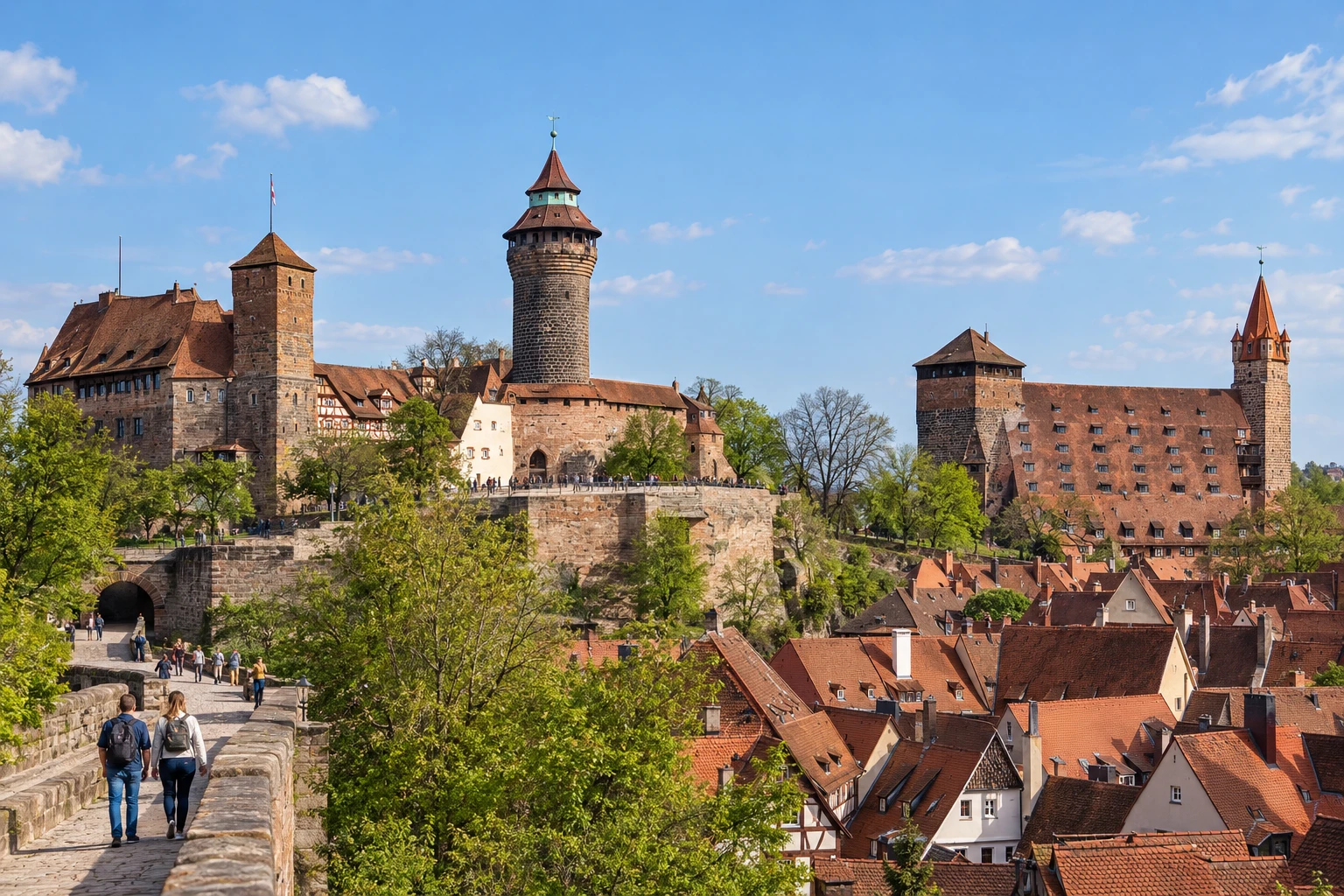
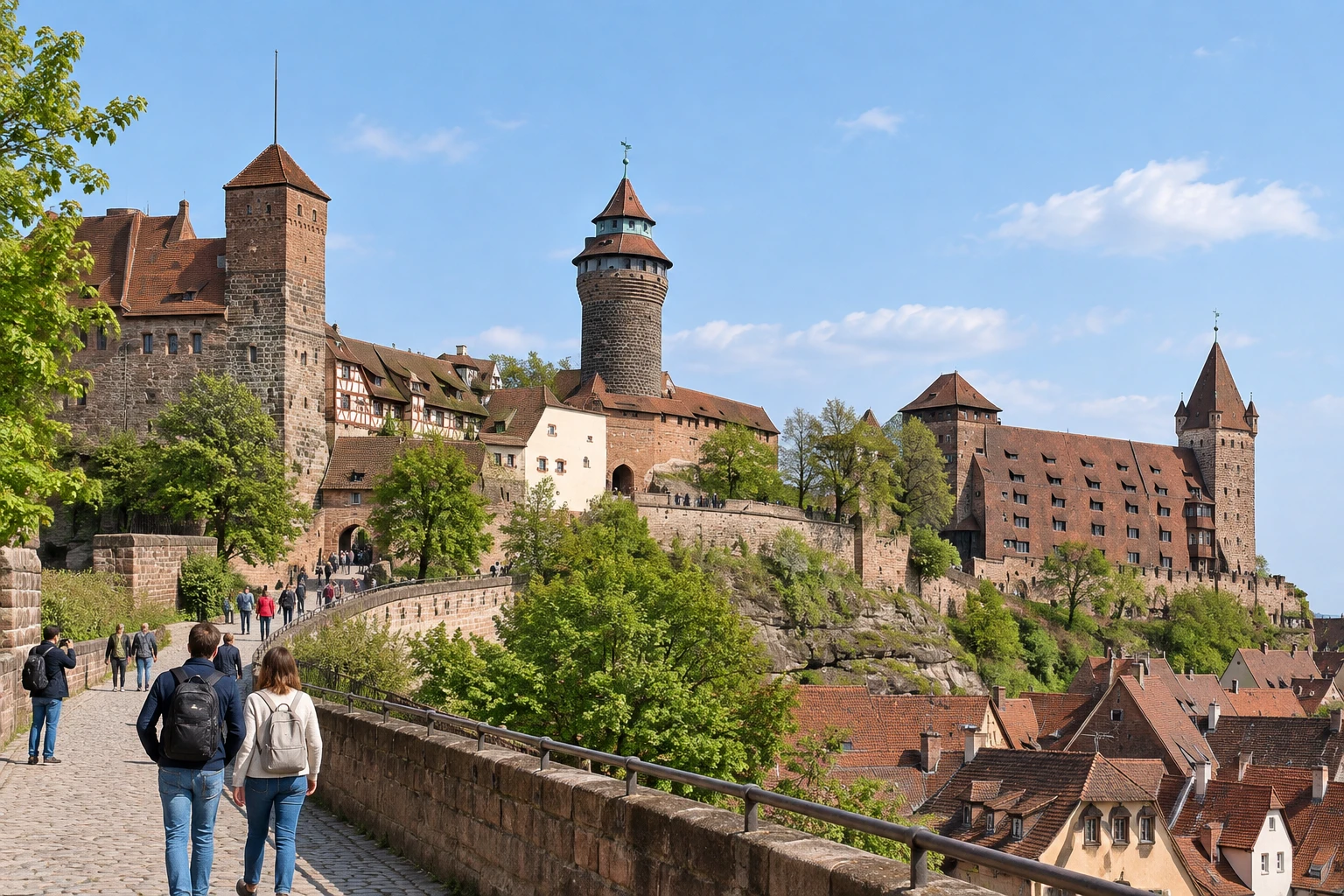
In the photo: Kaiserburg Nürnberg, Nuremberg

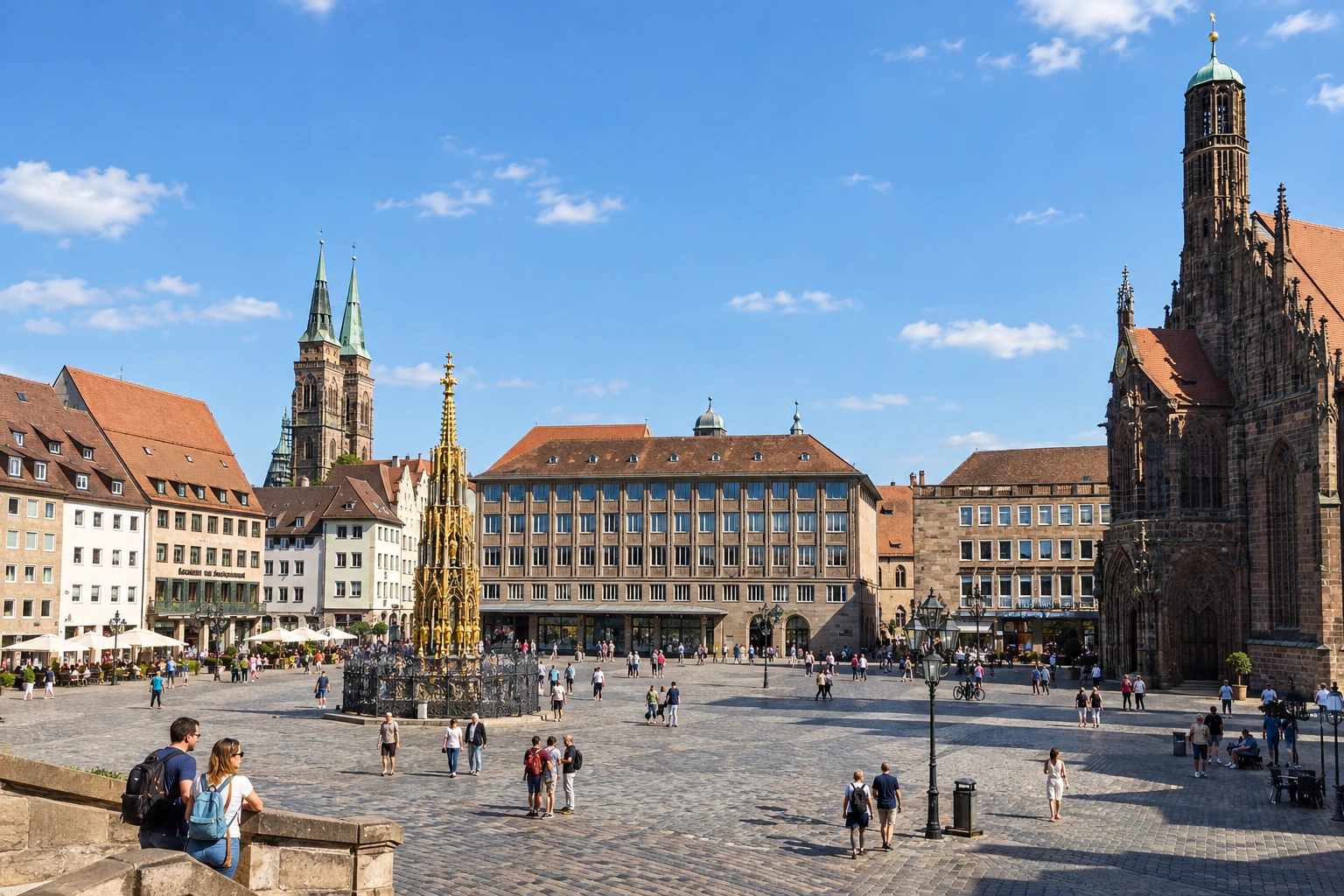
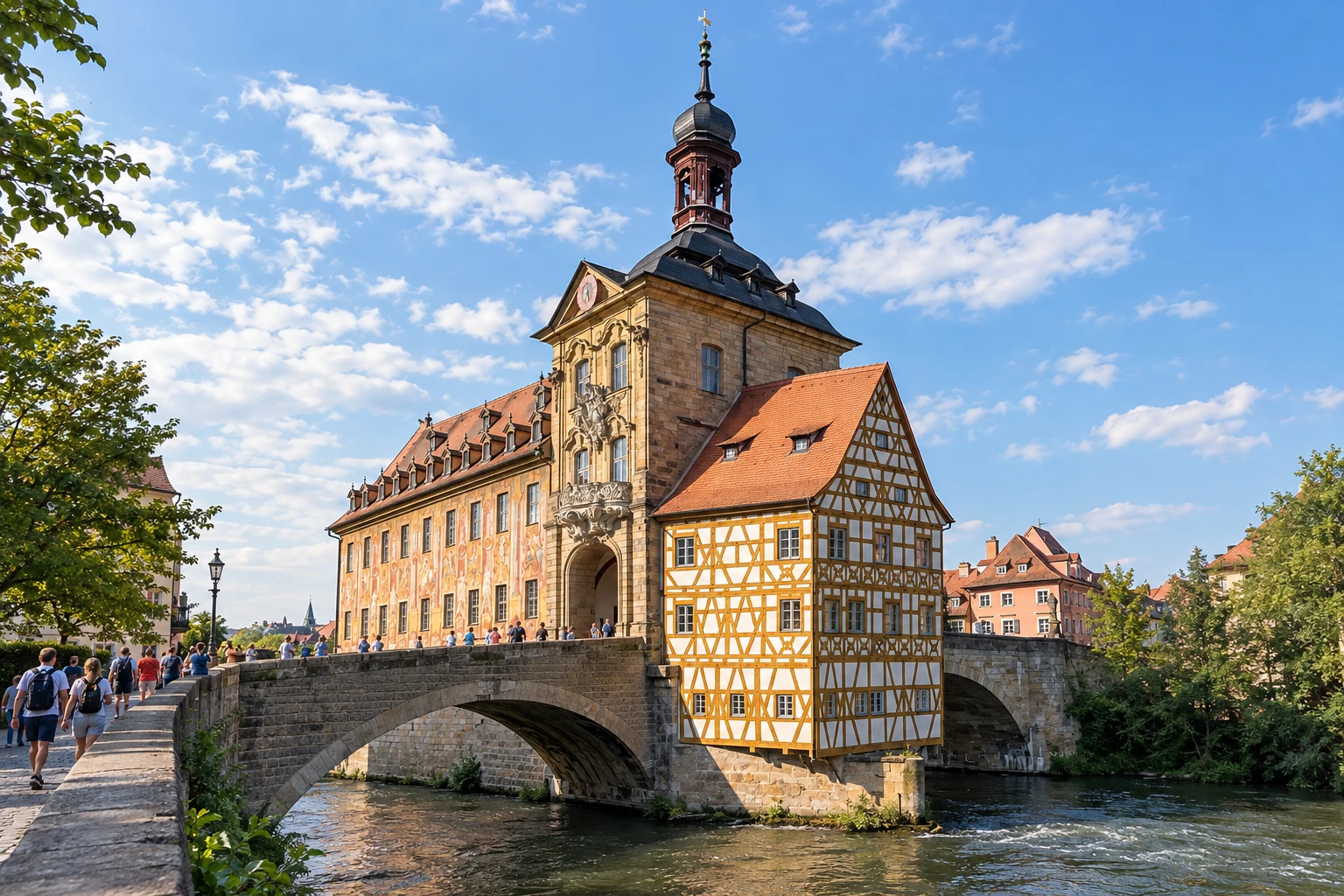
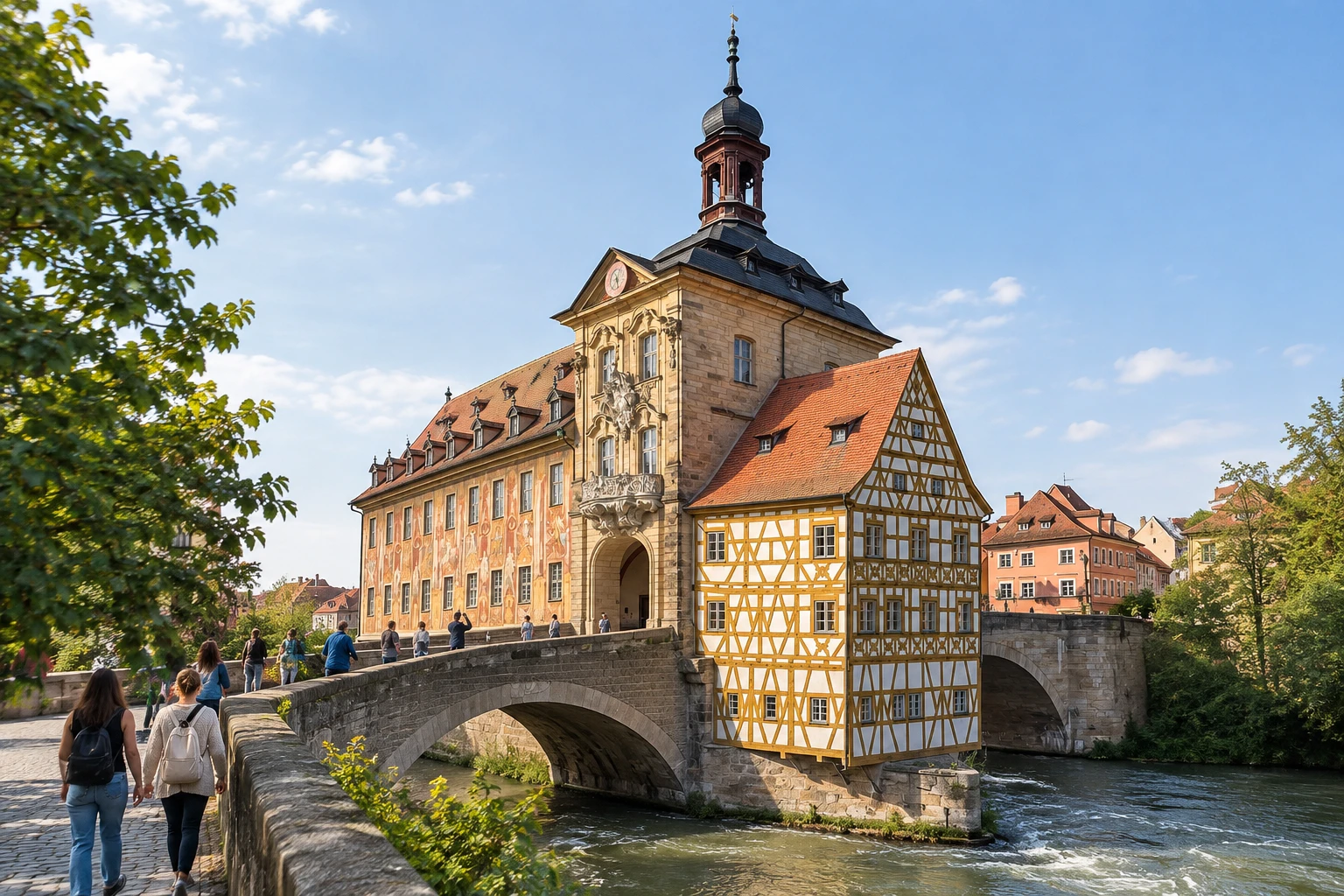
Illustrative images. The pictures in this guide are illustrations based on the real place, not photographs, and may differ from it.

Get it on Google Play

Get to know the place

A region to enjoy
at your own pace.

Nuremberg and Bamberg are in Francônia, the north of Baviera, where the accent, the food and the beer are different from those of Munique. The two are connected by train in under an hour and make for a three-day itinerary that mixes the Middle Ages, Renaissance art and twentieth-century history.

In Nuremberg, the old town is surrounded by walls and dominated by the Kaiserburg, the castle where the emperors of the Holy Roman Empire stayed. Below are the Hauptmarkt, with the Schöner Brunnen and the clock of the Frauenkirche, the Gothic churches of St. Sebald and St. Lorenz, Albrecht Dürer's house and the Germanisches Nationalmuseum, the country's largest museum of cultural history.

Nuremberg also carries a difficult part of German history. The Nazi Party held its annual rallies there, and the city was chosen for the trials of the regime's leaders starting in 1945. The Dokumentationszentrum, on the former rally grounds, and the Memorium Nürnberger Prozesse, in the Palácio da Justiça, are sites of memory that require time and respect.

Bamberg has its old town inscribed by UNESCO as a World Heritage Site. The city spreads across seven hills and the islands of the Regnitz river: the old town hall was built in the middle of the water, the fishermen's houses of Klein-Venedig overlook the river and, above, the four-tower cathedral houses the Knight of Bamberg. The smoked beer, the Rauchbier, is part of the local identity.

This destination brings together 2 cities: Nuremberg, Bamberg.

Share: WhatsApp
Traveler, share your experiences through photos Up to 5 photos of each place you visited.

One destination, many paths

The cities on this trip

Start with one city or combine several in your itinerary.

Where Nuremberg and Bamberg is The star marks the nearest capital, Erfurt.
ErfurtNurembergBamberg

Outlines: © BKG (2026), dl-de/by-2-0. Adapted by Cidade Turismo.

How to get there: Nuremberg and Bamberg

Albrecht Dürer Airport Nürnberg (NUE) · 7 km to Nuremberg

Flights from Brazil usually connect in another city. Confirm before buying. Nuremberg Airport (NUE) is 7 km from the center, connected by metro. From Munique, the ICE reaches Nuremberg in just over an hour; there are also direct trains from Frankfurt and Berlim. From Nuremberg to Bamberg it's 40 minutes to an hour by train.

Suggested arrival point: Nuremberg

The local experience

Things to do in Nuremberg and Bamberg

Bamberg · Bavaria · Architecture

Old Town Hall

Old town hall built over the Regnitz river, between two bridges, with painted façades and a half-timbered little house attached to the tower. It houses a porcelain museum.

Explore Old Town Hall

Nuremberg · Bavaria · Square

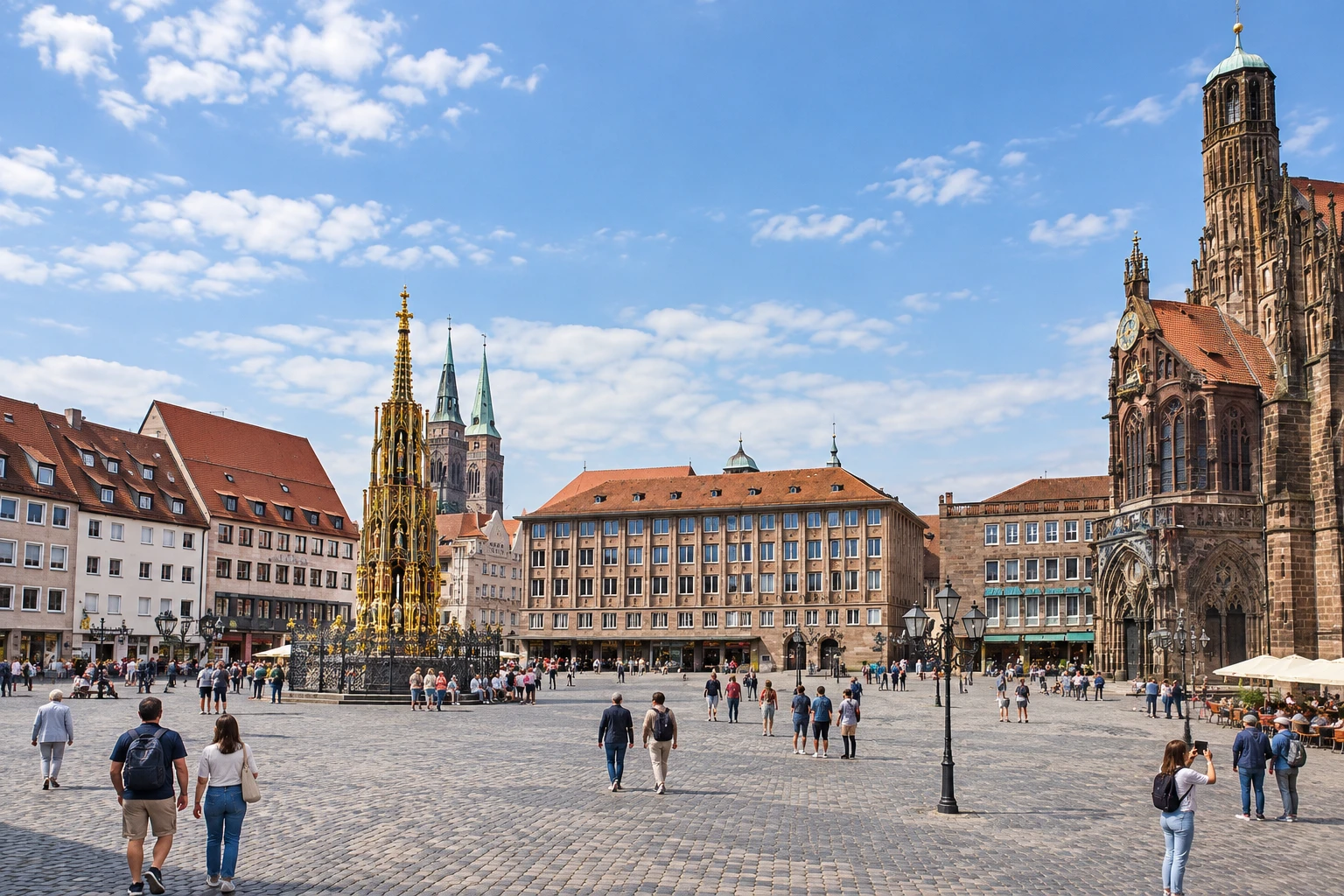
Main Market Square

Central square of Nuremberg, with a daily market, the golden Schöner Brunnen and the façade of the Frauenkirche. This is where the Christkindlesmarkt, the city's Christmas market, usually takes place.

Explore Main Market Square

Bamberg · Bavaria · Historic quarter

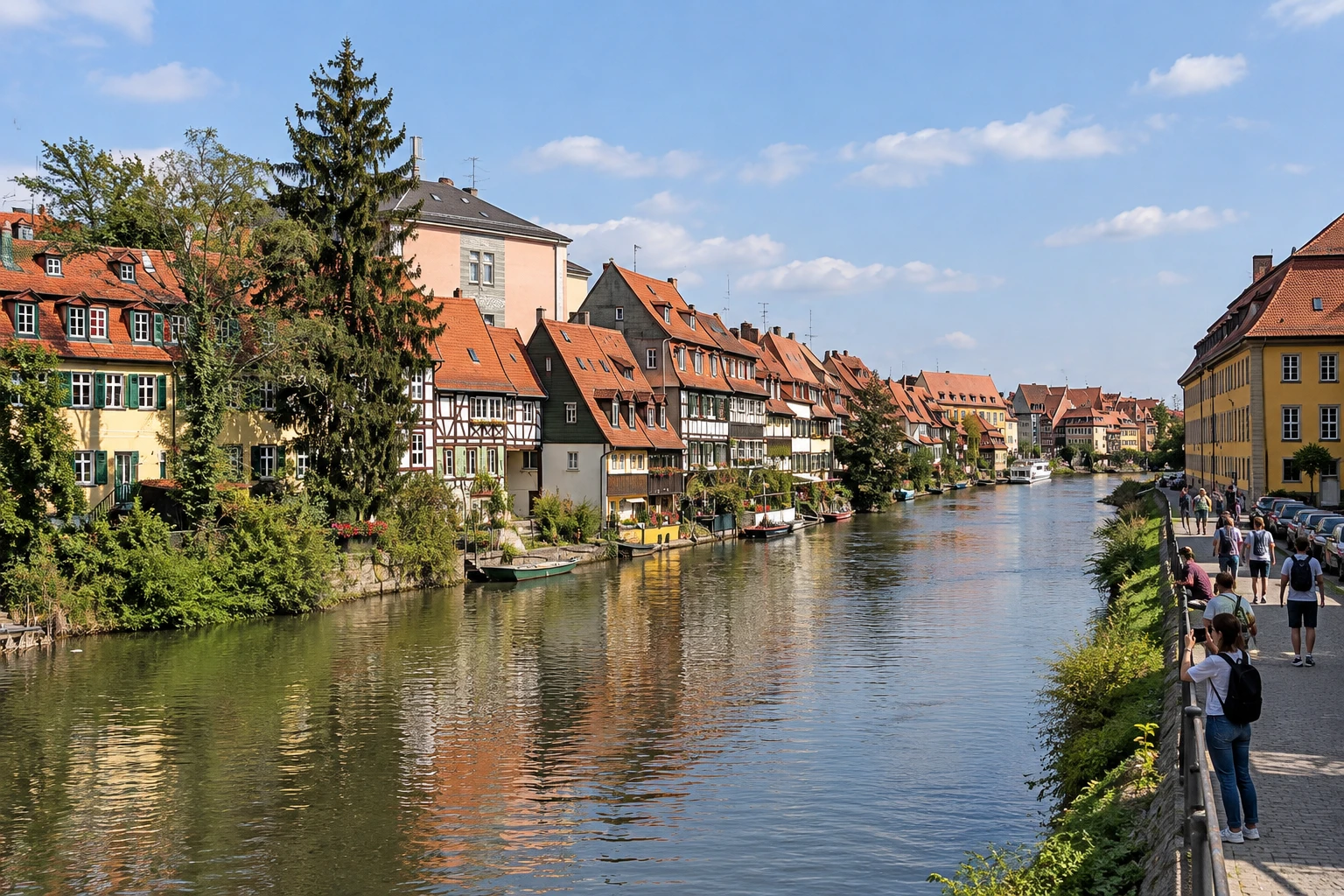
Little Venice

Row of old fishermen's houses on the Regnitz bank, with wooden balconies and small waterside gardens.

Explore Little Venice

See 13 more places in Nuremberg and Bamberg

To choose before you go

Tours in Nuremberg and Bamberg

Where each tour starts, how long it takes, how it is done, what is included and the price range.

Kaiserburg: the imperial castle of Nürnberg, with the deep well and the Sinwell tower

From Tiergärtnertorplatz (tram 4) or on foot from the Hauptmarkt Walk and castle visit about 2 h 30 morning easy (slope and stairs in the tower)

The Kaiserburg (imperial castle) occupies a sandstone hill at the highest point of Nürnberg’s (Nuremberg’s) old town. The town first appears in a document from 1050 as royal property, and the emperors of the Hohenstaufen dynasty built the complex that can still be seen, starting in 1167. the Golden Bull of 1356 required every newly elected king to hold his first imperial diet there; Ludwig IV stayed at the castle 74 times and Karl IV 52. The visit begins in the Palas, with the two‑storey Romanesque double chapel, where the emperor attended mass on the upper floor while court sat below. The Kaisersaal (imperial hall) houses the permanent exhibition on how the Holy Roman Empire worked. In the Kemenate is the Kaiserburg Museum, a branch of the Germanisches Nationalmuseum, with excavation finds, weapons and armour. In the outer courtyard, the Tiefer Brunnen (deep well) descends about 50 m into the rock: it can only be seen on a short guided visit in which a tray with candles is lowered to the water. Beside it, the Sinwellturm, a late 13th‑century round tower, has a spiral staircase up to the viewpoint over the city’s red roofs. The Burggarten, a garden atop the bastions, is generally open from late March to early November. The castle was heavily damaged in 1945 and rebuilt after the war.

Stops: Kaiserburg Nürnberg.

Includes: Paid admission separately, with a combined ticket for the Palas with the double chapel, the museum, the deep well and the Sinwell tower, or separate tickets; under‑18s enter free. The well visit is guided and included with admission. Audioguide in several languages for a small fee. The courtyard, the Burggarten and the terraces are free to enter. Check the current rates.

Tip: Go early: the castle is open every day, including Mondays, and closes earlier from October through March. Enter via Tiergärtnertorplatz, the gate square with half-timbered houses and Dürer’s bronze rabbit, and exit through the Burggarten in season. The Sinwellturm is only stairs: save it for last.

Best time: All year. From April to September opening hours are longer and the Burggarten is open; in December the view includes the Christmas market down below.

Hauptmarkt, Schöner Brunnen and Frauenkirche: the heart of the old town

From Hauptmarkt (U1 Lorenzkirche, 5 min walk) Walk through the old town around 2 hours morning, until noon easy (flat terrain)

The Hauptmarkt is Nuremberg’s main square, where from Monday to Saturday a market sells fruit, flowers and bread. In one corner stands the Schöner Brunnen (Beautiful Fountain), a 19 m stone pyramid built between 1385 and 1396 by Heinrich Beheim, with 40 figures representing the worldview of the Holy Roman Empire: electors, heroes, prophets and evangelists. On the railing there is a golden ring—tradition says that turning it three times grants a wish. On the east side is the Frauenkirche (Church of Our Lady), built between 1355 and 1358 by order of Emperor Karl IV on the site of the synagogue destroyed in the 1349 pogrom; it was the first hall-type Gothic church in Franconia. Inside is the Tucheraltar, an altarpiece from around 1445, and the three oldest stained-glass windows in the city. On the façade every day at noon the Männleinlaufen (little men’s procession), a 1509 mechanism, shows the seven prince-electors paying homage to Karl IV seated on the throne, in memory of the Golden Bull of 1356. From the balcony of this church the Christkind opens the Christmas market each year. The square lies between the two bridges over the Pegnitz River and the climb up to the castle; alongside is the Altes Rathaus (old town hall) and, a few steps away, St. Sebald.

Stops: Hauptmarkt, Frauenkirche.

Includes: The square and market are open; entry to the Frauenkirche is free, although a contribution is requested. Guided tours in German are offered on Saturdays and Sundays. The church closes to visitors during services.

Tip: Arrive about 10 minutes before noon and stand in front of the Frauenkirche façade to see the full Männleinlaufen. The market is a good place to buy fruit and Lebkuchen (Nürnberg gingerbread). Combine this walk with St. Sebald and the climb to the castle, which start from the same square.

Best time: All year. From late November to December 24 the square usually hosts the Christkindlesmarkt and the regular market moves elsewhere.

St. Lorenz and St. Sebald: the two great Gothic churches and their works of art

From Lorenzer Platz (U1 Lorenzkirche) Walk with visits to two churches about 2 hours morning or afternoon easy (flat terrain)

Nuremberg (Nuremberg) is divided by the Pegnitz River into two halves, each with its parish church. To the south is St. Lorenz, begun around 1250 as a three‑aisled basilica and expanded between 1439 and 1477 with a hall choir in late Gothic style; the west façade, with its portal and rose window, dates from the mid‑14th century, and the two towers measure 80 and 81 m. Inside are two well‑known works: the Englischer Gruß (Annunciation) by Veit Stoß, from 1518, a linden‑wood sculpture suspended above the nave, and Adam Kraft’s sacramentary, from 1496, a delicately carved stone tower of about 18 m. The organ has roughly 12,000 pipes. North of the river, near the Hauptmarkt, is St. Sebald, the city’s oldest parish, raised around 1215 as a late Romanesque basilica with two choirs and altered in the Gothic style until 1309. At its center is the tomb of Saint Sebald, a bronze shrine cast by Peter Vischer and his sons between 1508 and 1519, which contains a reliquary from about 1397. Both churches became Lutheran in 1524, were heavily damaged in the bombings and rebuilt: St. Lorenz was re‑dedicated in 1952 and St. Sebald in 1957.

Stops: St. Lorenz, St. Sebald.

Includes: St. Lorenz requests a contribution; St. Sebald charges admission for adults and under-18s are free. Guided tours in German are offered at both, with times posted on the entrance noticeboard; English-language group tours are available on request. Both close to visitors during services, especially Sunday morning.

Tip: Start at St. Lorenz in the morning, when light comes through the rose window, and walk along the Pegnitz to St. Sebald, 15 minutes. Look at the details of Sebald’s tomb: shells, dolphins and Vischer himself wearing a founder’s apron. In winter the churches close early.

Best time: All year. On Sundays, between the morning and early afternoon, St. Lorenz opens only after services; from April to December St. Sebald has longer opening hours.

Albrecht-Dürer-Haus and Tiergärtnertorplatz: the painter’s house and the neighbourhood below the castle

From Tiergärtnertorplatz (tram 4) Visit to the house-museum and short walk about 1 h 30 morning or afternoon easy (narrow internal stairs)

Albrecht Dürer (1471–1528), the best‑known painter and printmaker of the German Renaissance, was born in Nürnberg (Nuremberg) and lived from 1509 until his death in the half‑timbered house located just below the castle, on the corner of Tiergärtnertorplatz. The building dates from the 15th century and is described as the only artist’s house from that century to survive in northern Europe; since 1828 it has functioned as a memorial, the first in Germany dedicated to an artist. The floors contain the kitchen and furnished rooms, exhibitions with items from the city’s art collections and copies of Dürer’s paintings, since the originals are in museums in Vienna, Munich and other cities. In the top‑floor workshop, an artist demonstrates metalplate and woodcut printmaking techniques on Wednesday afternoons and Saturday mornings. An actress dressed as Agnes Dürer, the painter’s wife, leads staged visits; the English version is usually on Saturday afternoons. On the square in front are the Pilatushaus, a 15th‑century craftsman’s house, and Jürgen Goertz’s bronze rabbit (1984), a playful reference to Dürer’s watercolor of a hare. From the Tiergärtnertor bastion next door you get a high view over the square. A few metres away on Bergstraße the Felsengänge tours begin: beer cellars carved into the sandstone since the 14th century, covering more than 20,000 m², which served as shelters during the bombings.

Stops: Albrecht-Dürer-Haus.

Includes: Separate admission fee; the printmaking demonstration is included, and the staged visit with Agnes Dürer runs at fixed times. The house is closed on Mondays except in July–September and during the Christmas market, and on 24 and 25 December. The Felsengänge are visited only with a guide and have a separate ticket.

Tip: Combine it with the Kaiserburg, a 5-minute uphill walk, and with the Weißgerbergasse on the descent. Tiergärtnertorplatz has outdoor tables and is a good spot for a late-afternoon break. If you enjoy printmaking, go on Wednesday afternoon or Saturday morning when demonstrations take place.

Best time: Year‑round. From July to September and in December the house also opens on Mondays; Felsengänge tours in English are usually on Sundays.

Weißgerbergasse, Henkersteg and the Pegnitz bridges: Nürnberg’s half-timbered side

From Hauptmarkt Walk along the river about 1 h 30 late afternoon easy (flat terrain)

Nürnberg (Nuremberg) lost almost all of its old center in the 1945 bombings, but a stretch along the Pegnitz River preserves a medieval appearance. The Weißgerbergasse (tanners’ street) has nearly 20 half-timbered houses that survived the war, built by craftsmen who treated fine leather with alum; in house number 24 you can still see the pestle and the trade knife. Today the street is full of bars and cafés. Going down to the river you reach the Henkersteg (executioner’s bridge), a covered wooden walkway that links the Trödelmarkt island to Unschlittplatz and was rebuilt after the 1595 flood. The city’s executioner lived in the tower over the river between the 16th and 19th centuries, isolated because he could not have contact with respectable citizens. Beside it is the Weinstadel, from the mid-15th century, built as a shelter for lepers, who could only enter the city three days a year at Easter; today it houses students. Further on is the Kettensteg, from 1824, the first chain-suspension bridge in Germany. In Unschlittplatz, a plaque recalls Kaspar Hauser, the young man of unknown origin who appeared there in 1828. Downriver, the Fleischbrücke, a single-arch bridge from 1596–1598 inspired by Venice’s Rialto, rests on more than 2,000 oak piles. The Trödelmarkt, an island of about 1,000 m², has small shops.

Stops: Weißgerbergasse, Henkersteg.

Includes: Self-guided walk along the streets and bridges; nothing is charged. There are paid guided tours separately that cover the same stretch, departing from the Hauptmarkt.

Tip: Do it in the late afternoon, when sunlight hits the façades of the Weißgerbergasse and bars put tables outside. Classic photos of the river are taken from the Henkersteg and the Kettensteg. After a flood or on rainy days the cobbles become slippery.

Best time: All year. From May to September there are outdoor tables and long days; in December the stretch is illuminated for Christmas.

Handwerkerhof and the city wall: from Königstor to the round towers

From Nürnberg Hauptbahnhof (central station), Königstor exit Walk the city wall and visit the craftsmen’s courtyard about 2 hours afternoon easy (flat terrain)

If you leave Nürnberg (Nuremberg) Hauptbahnhof (central station) you will find the city wall in front of you. The stone ring that encircled the old town measured about 5 km when it was completed in 1400, and about 4 km still stand, with 71 of the 88 towers that existed at the end of the war; the moat, dug between 1430 and 1452, became a park. At the four corners are the large round towers—Frauentorturm, Spittlertorturm, Laufer Torturm and Neutorturm—which took their present form between 1556 and 1564. Next to the Frauentorturm, inside the wall, is the Handwerkerhof (craftsmen’s courtyard), created in 1971 for the 500th anniversary of Dürer’s birth and maintained since: in the little houses work a Lebkuchen maker, a leatherworker, a glass painter and lapidary, a potter, a tinsmith and a goldsmith, and there are dolls, tin and wooden toys and taverns serving Franconian food. The route along the Frauentormauer, with the covered walkway on the wall, takes about 15 minutes to reach the Spittlertorturm; continuing north via the Neutor you arrive at the castle bastions. The Straße der Menschenrechte (Street of Human Rights), with 27 concrete columns by Dani Karavan from 1993, is a few steps away at the entrance to the Germanisches Nationalmuseum.

Stops: Handwerkerhof.

Includes: The wall, the moat and the courtyard are open and have no admission fee; the workshops sell what they produce. The Handwerkerhof has its own opening hours and usually closes on Sundays outside the Christmas market period; check before you go.

Tip: Do this walk on arrival, between the station and your hotel, or on the last day while you wait for the train: the courtyard is 2 minutes from the Hauptbahnhof. Try the Lebkuchen made fresh. The wall to the north, by the castle, has the best stretches of walkway.

Best time: All year. In December the Handwerkerhof is open every day and becomes part of the Christmas market circuit; from April to October the moat is a pleasant park for walking.

See 11 more tours

Germanisches Nationalmuseum: German cultural history, from Dürer to the first globe

From Kartäusergasse 1 (U1/U2/U3 Hauptbahnhof or Opernhaus) Museum visit about 3 hours afternoon easy (large museum, lots of walking)

The Germanisches Nationalmuseum, founded in 1852, is one of the largest museums of cultural history in the German-speaking world, with about 1.3 million objects, a portion of which are on display. The building includes the former Carthusian monastery of Nürnberg (Nuremberg), a 14th‑century monastery whose cloister and church are part of the route. Among the most sought-after pieces are the Erdapfel, Martin Behaim’s terrestrial globe from 1492–1494, the oldest known globe made before Columbus’s arrival in the Americas and therefore without the continent; paintings by Albrecht Dürer, Rembrandt and Lucas Cranach; sculptures by Veit Stoß and Tilman Riemenschneider; the first pocket watch by Peter Henlein; and the largest collection of historical musical instruments in Europe. There are also weapons and armour, dollhouses, toys, clothing and furniture from various periods, and a print collection with 350,000 sheets. The entrance is on Kartäusergasse, crossed by the Straße der Menschenrechte, Dani Karavan’s columns each bearing an article of the Universal Declaration of Human Rights in a different language. The museum is closed on Mondays and stays open later on Wednesdays, when late-afternoon entry is free.

Stops: Germanisches Nationalmuseum.

Includes: Separate paid admission, with reduced price for students and families; on Wednesdays, from late afternoon, admission is free except for temporary exhibitions. Cloakroom, café and shop on site. Audioguides and guided tours require separate payment; check the current schedule.

Tip: Decide in advance what to see: the museum is too large for a complete visit. The Behaim globe, the Dürer room and the musical instruments can fill an afternoon. If you are in the city on a Wednesday, take advantage of the late opening hours when there are fewer people.

Best time: All year; it’s the right plan for rainy or cold days, from November to March. Closed on Mondays.

Dokumentationszentrum Reichsparteitagsgelände: the site of the Nazi party rallies

From Doku-Zentrum stop (tram 6 or 8) or S2 Dutzendteich Visit to the documentation center and walk around the site about 3 to 4 hours morning or afternoon easy (long walk outdoors)

Between 1933 and 1938, the Nazi party held its annual rallies in Nürnberg (Nuremberg) on a site of about 11 km² south of the city, around Lake Dutzendteich. The Dokumentationszentrum (documentation center) is located in the north wing of the Kongresshalle, the never-completed congress hall, described by the city as the largest preserved ensemble of state and party architecture from the Nazi era. The center’s building, by Austrian architect Günther Domenig, cuts through the old structure with a diagonal glass-and-steel walkway deliberately designed not to respect the original symmetry. The permanent exhibition, Nürnberg und die Reichsparteitage, covers about 1,600 m², in German and English, with 120 objects, films, biographies of victims and perpetrators, and interactive stations: it shows how the rallies were staged, the use of the site for forced labour, prisoners of war and deportations from 1939 onward, and what the city did with the place after 1945. Outside, a walk leads to the Große Straße, a 2 km granite avenue, and to the Zeppelintribüne, the Zeppelinfeld grandstand where Hitler spoke, now being conserved as a place of learning; part of it may be cordoned off by safety works. The tone of the site is informational; it is a space of memory, not of curiosity.

Stops: Dokumentationszentrum Reichsparteitagsgelände.

Includes: Separate paid admission; the outdoor grounds, the Große Straße and the area around the Zeppelinfeld are open and do not charge entry. Guided tours in English for groups are available by reservation. During major events on the grounds (races, music festivals), parts of the area may be closed; the center also closes on some days of the year: check before you go.

Tip: Allow a full morning: the exhibition takes about 2 hours and the walk to the Zeppelintribüne, round trip, adds roughly 1 hour. Take tram 6 or 8 to the Doku-Zentrum stop, at the entrance. Not suitable for very young children; for teenagers it works as a history lesson.

Best time: All year; from April to October the walk across the grounds is more pleasant. Avoid the days of the Norisring race (usually in summer) and the Rock im Park festival (usually in June).

Memorium Nürnberger Prozesse: Hall 600, where the Nazi leaders were tried

From U1 Bärenschanze (Bärenschanzstraße 72) Visit to the memorial in the Palace of Justice about 2 hours morning or afternoon easy (there is an elevator)

In the Justizpalast (Palace of Justice) in Nuremberg, west of the center, is Saal 600, the courtroom where, from November 20, 1945 to October 1, 1946, the International Military Tribunal of the four Allied powers tried 21 leaders of the Nazi regime on charges of crimes of aggression, violations of the laws of war, and crimes against humanity. It was the first time that heads of state were held personally accountable before an international tribunal, and the principles established there led to the International Criminal Court in The Hague. The Memorium, opened in 2010 on the upper floor of the tribunal wing, presents in German and English who the defendants were and what they were charged with, how the trial was organized, with simultaneous translation improvised for the occasion, the twelve subsequent trials from 1946 to 1949 against doctors, judges, industrialists and military figures, and what remained of that in international law. Saal 600 continued to be used by the German judiciary for decades and today is part of the memorial; a media installation reconstructs the original arrangement of the benches and the voices from the trial. The hall may be closed on event days, and the installation is not on display all the time. There are original objects and documents from the trial, and the audio guide is available in several languages.

Stops: Memorium Nürnberger Prozesse.

Includes: Separate admission fee; audio guide included in several languages. Closed on Tuesdays and on December 24 and 25; opening hours change on public holidays. Hall 600 may be closed on event days: confirm before you go.

Tip: Combine it with the Dokumentationszentrum on the same day, one in the morning and the other in the afternoon: they complement each other. Take the U1 to Bärenschanze, a 3-minute walk. There is a combined ticket with the documentation center; check in advance.

Best time: All year. Closed on Tuesdays; from April to October it opens earlier on weekdays.

Nuremberg with kids: Spielzeugmuseum and DB Museum

From Karlstraße 13 (Spielzeugmuseum) and Lessingstraße 6 (DB Museum) Visit to two museums, reached on foot or by U-Bahn full day (about 2 hours at each) morning and afternoon easy (both have an elevator)

Nuremberg (Nuremberg) has been making toys for more than 600 years and hosts the international trade fair for the industry. The Spielzeugmuseum (toy museum) is on Karlstraße, in a house from 1517 a short walk from the Weißgerbergasse, and opened in 1971 with Lydia and Paul Bayer’s collection of about 12,000 items; today the holdings total 87,000 objects, with part displayed in 1,400 m². The floors follow history: wooden toys on the first, dolls, dollhouses and Nürnberg kitchens on the second, the Welt der Technik (world of technology) on the third, with a large model railway, tinplate trains and steam engines, and on the top floor toys since 1945, including Lego, Barbie and Playmobil, plus an indoor play area. In summer there is a playground in the courtyard. The DB Museum, an 8-minute walk from the Hauptbahnhof (central station), originated as the Royal Bavarian Railway Museum of 1899 and is Germany’s oldest railway museum. Under 6,800 m² of roof are a working replica of the Adler, the locomotive of Germany’s first railway between Nürnberg and Fürth from 1835; carriages from King Ludwig II of Bavaria’s train; and an ICE. The model layout covers 80 m², with about 30 trains on 500 m of track. Kibala, the children’s railway country, has 1,000 m² with a driving simulator and a small train. The outdoor yard, 15,000 m², contains a historic platform, signal boxes and vehicles.

Stops: Weißgerbergasse, Handwerkerhof.

Includes: Separate paid admission at each museum, with family discounts. Both are closed on Mondays, except during the Spielzeugmuseum's Christmas market period, and on December 24 and 25. Left-luggage and a café are available at the DB Museum. Check the current timetable.

Tip: Do the Spielzeugmuseum in the morning, when children have more energy, and save the DB Museum for the afternoon, near the station. At the DB Museum ask about the summer schedules for trips with the Adler, which usually run on certain days of the year. Both museums accept baby carriers and have a changing table.

Best time: All year round; they’re the option for rainy days. From June to September the playground at the Spielzeugmuseum and the courtyard at the DB Museum remain open; in December opening hours are extended.

Christkindlesmarkt: Nürnberg’s Christmas market at the Hauptmarkt

From Hauptmarkt Walk through the market and neighboring squares about 2 hours late afternoon and early evening easy (very crowded and cold)

The Christkindlesmarkt is Germany’s best-known Christmas market and fills Nürnberg’s Hauptmarkt from late November to December 24; the season usually begins on the Friday before the first Sunday of Advent, when the Christkind, a young woman from the city chosen every two years, reads the prologue from the balcony of the Frauenkirche at dusk. The wooden stalls with red-and-white striped awnings sell Lebkuchen (Nürnberg gingerbread, protected by designation of origin), Rostbratwürste (small grilled sausages, served three in a roll), Glühwein (mulled wine) in ceramic mugs, glass and wooden ornaments, and Zwetschgenmännle, little figures made from dried plums. The market only sells traditional goods; there is no funfair. Nearby, the Kinderweihnacht (children’s Christmas) at Hans-Sachs-Platz has a carousel and workshops, and the Markt der Partnerstädte (market of twin towns) at Rathausplatz sells products from places Nürnberg has ties with, including towns in Italy, Scotland and China. The city center streets are lit up and the churches hold Advent concerts. The market runs every day from morning until early evening, and closes on Christmas Eve.

Stops: Hauptmarkt, Frauenkirche.

Includes: Free entry; food, drink and purchases are paid separately. Glühwein mugs require a deposit, returned at the stall. There are paid guided tours of the market in several languages, departing from the tourist information at the Hauptmarkt.

Tip: Go in the afternoon on weekdays: on December weekends the square becomes crowded. Dress for temperatures near 0 °C, with waterproof shoes, and book everything months in advance because the town fills up. The Kaiserburg viewpoint and the walkway of the Altes Rathaus give an elevated view of the market.

Best time: From late November to December 24; confirm the dates for the year. The first two weeks usually have fewer visitors than the days immediately before Christmas.

Bamberger Dom and Domplatz: the Bamberg Knight and the emperor’s tomb

From Bamberg Bahnhof (station), 25 min on foot or bus 910 to Domplatz Walk and visit the cathedral about 2 h 30 min morning easy (hill up to Domplatz)

Bamberg, about 60 km north of Nürnberg (Nuremberg), has an old town inscribed on the UNESCO World Heritage List since 1993, spread over seven hills and along the arms of the Regnitz River. The main hill is the Domberg, with the cathedral of four towers. Emperor Heinrich II founded the bishopric in 1007 and the first cathedral was consecrated in 1012; after two fires, the present building, late Romanesque with Gothic parts, was consecrated in 1237. On the column beside the east choir stands the Bamberger Reiter (Bamberg Knight), a stone statue from around 1235, the first life-size equestrian figure of the European Middle Ages, whose model has never been identified. In the center of the nave is the tomb of Heinrich II and Empress Kunigunde, carved in marble by Tilman Riemenschneider between 1499 and 1513, with scenes from the couple’s life in the side reliefs. In the west choir is the tomb of Pope Clement II, who died in 1047, the only papal tomb north of the Alps. There is also the Marienaltar by Veit Stoß, from 1520 to 1523, with the Nativity at its center. On the Domplatz are the Alte Hofhaltung, the former palace with a 15th-century half-timbered courtyard, and the Neue Residenz. The Diözesanmuseum beside the cathedral houses the imperial mantles and the cathedral treasury; it is closed on Wednesdays.

Stops: Bamberger Dom.

Includes: Entry to the cathedral is free; the Diözesanmuseum has separate paid admission. Guided tours in German several times a day depart from the cathedral; groups in other languages only with accredited guides, by reservation. The cathedral closes to visitors during masses and on liturgical dates: confirm before you go.

Tip: Arrive before 10:00, when groups have not yet climbed the Domberg. On Saturdays at noon, from May to October, there is usually an organ concert. Continue this walk to the Neue Residenz and the Rosengarten on the same square, and descend via Karolinenstraße to the Altes Rathaus.

Best time: All year. From May to October there are organ concerts on Saturdays; in December the square usually hosts part of the Christmas market.

Altes Rathaus and the Regnitz bridges: the town hall in the middle of the river

From Obere Brücke, central Bamberg Walk across the bridges and around the Inselstadt about 1 hour morning or afternoon easy (flat terrain)

The Altes Rathaus (old town hall) of Bamberg stands on an artificial island in the middle of the left arm of the Regnitz River, wedged between two bridges: the Obere Brücke (upper bridge), opened between 1453 and 1456, and the Untere Brücke (lower bridge). Legend has it that the bishop refused to cede land to the townspeople for a town hall, so they drove piles into the river and made the island themselves; the city historian regards the story as unlikely, but more than 1,000 oak piles were found in recent works, and the technique was authentic for the period. The Gothic core dates to 1463 and, in the mid-18th century, the building received the Baroque façade with a mansard roof, the lantern and Rococo balconies. The façade paintings, done by Johann Anwander in 1755, simulate architecture in perspective; from one of them protrudes the leg of an angel, sculpted in three dimensions. At the tip of the island is the Rottmeisterhäuschen, a half-timbered little house hanging over the water. Inside are the Rokokosaal and the Sammlung Ludwig, a collection of Meissen porcelain and Strasbourg faience, which is not open to visitors during the building’s renovation: confirm before you go. The Obere Brücke is the passage between the Bergstadt (hill town, of the bishops) and the Inselstadt (island town, of the citizens), with a statue of Saint John of Nepomuk; from the Untere Brücke, beside the statue of Empress Kunigunde, you get the view of the painted façade and the river.

Stops: Altes Rathaus.

Includes: Free walk; the bridges and the view are open. The interior (Rokokosaal and Sammlung Ludwig) requires a paid ticket when open. Scaffolding may be present on the bridges or façade at times of the year; check before you go.

Tip: Do it twice: in the morning with the sun on the painted façade on the Obere Brücke side, and in the afternoon from the Untere Brücke side. The Untere Brücke is the spot for the photo with the little Rottmeisterhäuschen. From the bridge a 5‑minute walk downstream leads to Klein‑Venedig.

Best time: Year‑round. From May to September the river has boats and the banks have outdoor tables; in December the Inselstadt usually hosts the Christmas market on Maxplatz.

Klein‑Venedig and a boat trip on the Regnitz

From Untere Brücke or Am Kranen, Bamberg centre Walk along the riverbank and boat or gondola ride about 1 h 30 (boat: 30 min to 1 hour) afternoon easy (flat terrain)

Klein-Venedig (Little Venice) is the row of old fishermen’s houses on the left-hand arm of the Regnitz River in Bamberg, between the Untere Brücke and the Markusbrücke. The half-timbered houses, narrow and built close together, have wooden balconies where nets used to be hung to dry and small gardens that slope down to the water, with geraniums in summer. The comparison with Venice is long-standing, made by travelers for centuries, and the name was adopted by the tourism association in the 1920s; in the Franconian dialect it’s Klaa-Fnedich. The guild of boatmen and fishermen from the lower town still has its headquarters in one of the houses and organizes, on the Sunday of the Sandkerwa, the August street festival called Fischerstechen, a tournament in which fishermen try to knock each other off the boats with poles. The most open view is from the opposite bank, the Am Leinritt path that follows the river from the Untere Brücke, and from the bridges. From the quay Am Kranen, the city’s old port with the 1766 crane, sightseeing boats run the Regnitz in season, generally from April to October, with commentary on board. There are also gondolas with two licensed gondoliers, leaving the old canal beneath the Obere Brücke, on half-hour to one-hour rides to lock 100 of the old Ludwig Canal between the Main and the Danube.

Stops: Klein-Venedig.

Includes: Free walk along the riverbank; boats and gondolas are paid separately, per person or per vessel (the gondola holds up to six people and requires booking). Trips depend on river level and wind and do not run in winter: check before you go.

Tip: Do the walk at late afternoon, when the sun hits the facades, and the boat trip earlier in the afternoon. For the classic photo, stop in the middle of the Untere Brücke and at Am Leinritt. During Sandkerwa in August the area gets crowded: book ahead or go another week.

Best time: April to October for boats and gondolas; June to September the balconies are in bloom. In winter the walk is still worthwhile.

Neue Residenz and Rosengarten: the prince-bishops' palace and the garden with a view

From Domplatz, Bamberg Visit to the palace and garden about 1 h 30 morning or afternoon easy (stairs in the palace)

The Neue Residenz (new residence) closes off the north side of Bamberg's Domplatz. The two Baroque wings were built between 1697 and 1703 by architect Leonhard Dientzenhofer for Prince-Bishop Lothar Franz von Schönborn, who also commissioned palaces in Pommersfelden and Vienna; it was the first large Franconian palace of the absolutist era and served as the prince-bishops' seat until 1802. The rear wings, in Renaissance style with arcades facing the courtyard, date from 1604 to 1612. The visit passes through more than 40 state rooms with furniture, tapestries and stucco ceilings, and the Kaisersaal (imperial hall) on the second floor, painted between 1707 and 1709 by Melchior Steidl with 16 larger-than-life portraits of emperors and allegories of the empires of the world. The prince-bishop's apartments are seen on a guided tour in German every half hour; the rest is self-guided. In the same building is the Staatsgalerie, with early and Baroque German painting from the Bavarian State Collection; some of those rooms may be closed, so check before you go. The inner courtyard is the Rosengarten (rose garden), a Baroque garden with about 4,500 rose bushes in more than 70 beds, statues and a pavilion that is now a café; from the balustrade you can see the old town center, the roofs of the Inselstadt and the Michaelsberg monastery on the hill opposite.

Stops: Neue Residenz.

Includes: Separate paid ticket required for the palace, with a combined ticket available with Seehof Palace in the outskirts; under-18s are free. The visit to the state rooms is a guided tour in German and is included with the ticket. The Rosengarten is outdoors and has no entry fee. It is closed on January 1, Carnival Tuesday, and December 24, 25 and 31.

Tip: You can enter the Rosengarten even if you don't visit the palace: the view from Michaelsberg and of the rooftops is free. The roses bloom from June to September. The palace is open every day, including Mondays, with shorter hours from October to March.

Best time: June to September for the roses; the palace is worth visiting year-round, and from April to September it has longer opening hours.

Michaelsberg: the former Benedictine monastery, the church with the rooftop garden and the terrace

From Domplatz (15 min on foot) or bus 910 to Michelsberg Uphill walk and visit to the church and terrace about 1 h 30 afternoon moderate (about a 15-minute climb)

The Michaelsberg is one of Bamberg’s seven hills, opposite the Domberg across the valley. At the top stands the former Benedictine monastery of St. Michael, founded in 1015 at the initiative of Emperor Heinrich II. The church was destroyed by an earthquake in 1117 and rebuilt over the centuries; the Baroque façade with its two towers dates from the turn of the 17th to the 18th century, by the same Leonhard Dientzenhofer of the Neue Residenz, and the monastery buildings, now owned by a city foundation, long served as an almshouse. The interior preserves two rare features: the vaulted ceiling painted with a herbarium of about 600 identifiable plants, flowers and herbs, painted around 1617 as an image of paradise, and, beneath the choir, the tomb of Saint Otto, bishop of Bamberg in the 12th century, through which pilgrims pass crouched, in a low passage, asking for health. The church was closed for many years due to risk of collapse and underwent a complete restoration; it opens to visitors on certain days of the week, generally Friday to Sunday and on public holidays, and admission is free: check before you go. Outside, the monastery terrace looks out over the Cathedral, the Neue Residenz and the roofs of the old town, and the terraced gardens descend the hill to the city. In the former monastery brewery building, dating from about 1122, is the Fränkisches Brauereimuseum.

Stops: Michaelsberg.

Includes: Terrace and gardens open, free of charge; entry to the church is free, but opening hours are limited to certain days of the week. Guided visits and groups by reservation through Bamberg’s tourist service. The Brauereimuseum has a separate admission fee.

Tip: Walk up on foot along Michaelsberger Straße from the Domplatz, between walls and gardens, and return via the garden staircase to the Inselstadt. Schedule Michaelsberg for a Friday, Saturday or Sunday, days when the church is usually open. The terrace at late afternoon has the light over the cathedral.

Best time: From April to October, when the gardens are in bloom and the Brauereimuseum is open; the church is open Friday to Sunday year-round. Confirm the days before you go.

Bamberg and beer: the Brauereimuseum, Schlenkerla and the historic breweries

From Michaelsberg (museum) and Dominikanerstraße (Schlenkerla) Visit the museum and walk among the historic breweries about 3 hours afternoon easy (ascent to Michaelsberg)

Bamberg is known in Germany as a beer city: it has more than ten breweries in operation within the town, and in the 19th century it had more than 60; the surrounding district adds dozens more. The local speciality is Rauchbier (smoked beer), made with malt dried over beech wood fire, a technique common before modern kilns and now surviving in few places. The starting point is the Fränkisches Brauereimuseum (Franconian Brewery Museum), in the vaults of the former brewery of the Michaelsberg monastery, from around 1122: in roughly 1,000 m² and more than 1,850 items, it displays the brewing room, the malt house, the fermentation and storage cellars, the ice cellar, the cooperage and the filling of barrels and bottles, with explanations about the role of monasteries and cellars carved into the rock. The museum is open April to October, Wednesday to Sunday. Descending into the town, on Dominikanerstraße just below the cathedral, is the Schlenkerla, a house mentioned in 1405 as the Blue Lion house, with the tavern in a former Dominican chapel with a wooden ceiling; the Trum family has run it for six generations, and there beer still comes from wooden casks. The Spezial brewery, on Obere Königstraße across the river, also smokes its malt in its own kiln for over 475 years. In summer, the Bierkeller (beer cellars) on the hills operate like outdoor gardens under chestnut trees. The point is the history and the craft; drinking is optional, and the places serve Franconian food and soft drinks.

Stops: Michaelsberg, Altes Rathaus.

Includes: Museum with separate paid admission, open from April to October, with guided tours for groups by reservation. The historic taverns are restaurants: food and drink paid separately, no reservation during quieter hours. There are paid guided brewery tours leaving from the tourist office.

Tip: Go to the taverns in the mid-afternoon, between lunch and dinner, when tables are available; in the evening and on weekends they fill up. Also order Bratwurst and dishes of Franconian cuisine. Non-drinkers equally enjoy the architecture and the history. Combine the museum with the Michaelsberg terrace.

Best time: From April to October, when the museum is open and the Bierkeller operate outdoors (generally May to September). The taverns are open year-round.


Day by day

2, 3 and 5-day itinerary in Nuremberg and Bamberg

Suggestions to plan the trip. Change the order of the days according to the weather and tour availability.

2 days · Nürnberg and Bamberg in 2 days: the old town and a day on the Domberg

For Anyone coming by train from Munich or Frankfurt and who has only one weekend to see the essentials of both cities. · Based in Nürnberg, near the Hauptmarkt or the Hauptbahnhof (main station)
  1. Day 1 · Arrival, Hauptmarkt, churches and Kaiserburg

    The overnight flight from São Paulo arrives in the morning at Munich or Frankfurt. From Munich, take the S-Bahn to the Hauptbahnhof and an ICE of about 1 h 10 to Nürnberg; from Frankfurt, an ICE direct from the airport station, about 2 hours. Leave your luggage and cross the Königstor, with the Handwerkerhof right at the entrance to the wall. Climb Königstraße to St. Lorenz, cross the Pegnitz and reach the Hauptmarkt to see the Schöner Brunnen and the Frauenkirche; if time allows, St. Sebald. In the late afternoon, go up to the Kaiserburg for the view from the Sinwell tower, or save the castle for the next morning and walk the Weißgerbergasse and the Henkersteg. Dine early, with Rostbratwürste, and sleep to beat the jet lag.

  2. Day 2 · Bamberg: cathedral, Neue Residenz, Altes Rathaus and Klein-Venedig

    Leave early from Nuremberg Hauptbahnhof: the regional train or ICE takes about 35 to 45 minutes to Bamberg. From the station, it’s a 25-minute walk or take bus 910 to Domplatz. See Bamberg Cathedral with the Rider and Riemenschneider’s tomb, then the Neue Residenz and the view from the Rosengarten. Walk down Karolinenstraße to the Altes Rathaus, cross the Obere Brücke and have lunch in the Inselstadt. In the afternoon, walk along Am Leinritt to Klein-Venedig and, from April to October, take the boat tour. Return to Nuremberg in the early evening; if you’re leaving the next day you can travel from Bamberg directly to Frankfurt or Munich by train.

3 days · Nürnberg and Bamberg in 3 days: old town, 20th-century memory and Bamberg
For First trip, arriving from Brazil on the direct flight to Munich or Frankfurt, interested in history and old towns. · Based in Nürnberg, near the Hauptmarkt or the Hauptbahnhof (main station)
  1. Day 1 · Arrival and the old town on foot

    Arrive in the morning to Munich or Frankfurt and take the train to Nürnberg (about 1 h 10 from Munich, about 2 hours from Frankfurt airport). Leave your luggage and take an easy day on foot: Handwerkerhof by the Königstor, St. Lorenz, Hauptmarkt with the Schöner Brunnen and the Frauenkirche at midday for the Männleinlaufen, and St. Sebald. In the late afternoon, the Weißgerbergasse, the Henkersteg and the Kettensteg, with low light on the river. Sleep early.

  2. Day 2 · Kaiserburg, Dürer’s house and the memorial sites

    In the morning, visit the Kaiserburg with the Palas, the deep well and the Sinwell Tower, and the Albrecht-Dürer-Haus just below. After lunch at Tiergärtnertorplatz, take tram 6 or 8 to the Dokumentationszentrum Reichsparteitagsgelände and walk to the Zeppelintribüne. If you prefer to stay in the center, spend the afternoon at the Germanisches Nationalmuseum, with Behaim’s globe and the Dürer rooms. In the evening, if it’s December, the Christkindlesmarkt at the Hauptmarkt.

  3. Day 3 · Bamberg: Domberg, bridges and Klein-Venedig

    Early train from Nuremberg to Bamberg, about 35 to 45 minutes. In the morning, Bamberg Cathedral, the Alte Hofhaltung and the Neue Residenz with the Rosengarten. Walk down to the Altes Rathaus and have lunch in the Inselstadt. In the afternoon, Klein-Venedig via Am Leinritt and the Regnitz boat in season, or climb up to Michaelsberg for the terrace and, Friday to Sunday, the church with the painted ceiling garden. To finish, stop at the Schlenkerla tavern for a taste of the place’s history. Return to Nuremberg in the early evening or continue from Bamberg to your departure airport.

5 days · Nürnberg and Bamberg in 5 days: both cities at a relaxed pace
For Anyone who wants to see Nürnberg in full, with museums and both memorials, and spend two days in Bamberg, including the Michaelsberg and the historic breweries. · Based in Nürnberg in the first four days; optional to sleep in Bamberg on the last night
  1. Day 1 · Arrival and first contact with the old town

    The overnight flight from Brazil arrives in the morning in Munich or Frankfurt; train to Nuremberg, about 1 h 10 from Munich or 2 hours from the airport station in Frankfurt. From the Hauptbahnhof, go past the Handwerkerhof and the city wall and walk up Königstraße to St. Lorenz. Have lunch and continue to the Hauptmarkt: Schöner Brunnen, Frauenkirche and St. Sebald. Late afternoon in Weißgerbergasse and on the Pegnitz bridges. Eat an early dinner.

  2. Day 2 · Kaiserburg, Dürer and the Toy Museum

    In the morning, the full Kaiserburg: Palas, double chapel, museum, deep well and Sinwell Tower, with exit through the Burggarten in season. Lunch at Tiergärtnertorplatz and visit the Albrecht-Dürer-Haus, with the printmaking demonstration if it’s Wednesday or Saturday. In the afternoon, the Spielzeugmuseum on Karlstraße, or, if you’re traveling without children, the guided tours of the Felsengänge, the beer cellars carved into the rock, starting from Bergstraße.

  3. Day 3 · Dokumentationszentrum, Memorium and Germanisches National Museum

    Morning at the Dokumentationszentrum Reichsparteitagsgelände and walk to the Zeppelintribüne, reached by tram 6 or 8. After lunch, take U1 to Bärenschanze for the Memorium Nürnberger Prozesse and Hall 600 (closed on Tuesdays). In the late afternoon, visit the Germanisches Nationalmuseum; if it’s Wednesday, take advantage of the late opening. An alternative for travelers with children is the DB Museum instead of the Memorium.

  4. Day 4 · Bamberg: Domberg, Altes Rathaus and Klein-Venedig

    Train from Nuremberg to Bamberg, about 35 to 45 minutes; if you want to stay overnight in Bamberg bring your luggage. In the morning, Bamberg Cathedral with the Diözesanmuseum, the Alte Hofhaltung and the Neue Residenz with the Rosengarten. Walk down to the Altes Rathaus via the Obere Brücke and have lunch in the Inselstadt. In the afternoon, Klein-Venedig, the Regnitz boat in season and a walk through the Gärtnerstadt, the gardeners’ quarter on the other side of the canal. Dinner in one of the historic taverns.

  5. Day 5 · Michaelsberg, historic breweries and departure

    In the morning, climb up to Michaelsberg: the terrace, the gardens and, Friday to Sunday, the church with the plant-decorated ceiling and the tomb of Saint Otto; from April to October, the Fränkisches Brauereimuseum in the former monastery brewery. Descend via Dominikanerstraße to visit the Schlenkerla tavern, from 1405, and have lunch. In the afternoon, take the train from Bamberg to Munich Airport (approx. 2 h 45 to 3 h 30, changing in Nuremberg) or to Frankfurt (approx. 2 h 30 to 3 h, changing in Würzburg) for the overnight flight; check schedules with plenty of time.

Best time to go

When to go: Nuremberg and Bamberg month by month

From May to September, with long days and outdoor tables; summer runs from June to August. Nuremberg's Christkindlesmarkt usually runs from late November until December 24 and fills the city. Winter, from December to February, is cold and has short days.

The seasons shown are the most usual ones; nature doesn't always follow the calendar.

January Low rain

winter · museums and castle

Winter (summer in Brazil). At the DWD Nürnberg station (airport, 314 m) the average is 1 °C and about 40 mm of precipitation; in Bamberg (240 m), 1 °C and about 47 mm, some as snow. Short days, with just over 8 hours of daylight, and nights below zero. Plan for museums, churches, the Kaiserburg and the Neue Residenz, which operate on winter hours; the Burggarten and Bamberg’s Brauereimuseum remain closed, and Regnitz boats do not run. Low activity after the 6th; it’s the least crowded month. Bring a heavy coat, a hat, and non-slip shoes.

February Low rain

winter · Carnival

Winter (summer in Brazil), the driest month of the year in Nürnberg (314 m): about 33 mm, average 1.5 °C; Bamberg (240 m) has 1 °C and about 37 mm. Snow on some days; the old town’s stone pavements become slippery. On Carnival Tuesday (Faschingsdienstag) the Kaiserburg and the Neue Residenz close, and there are street parades across Franconia. Museums and churches are the main attractions; Bamberg on weekdays is almost empty. Low season, except during trade fair weeks in Nürnberg, when the city fills up.

March Low rain

late winter · longer days

Late winter (autumn in Brazil). Nürnberg (314 m) has an average of 5 °C and about 39 mm; Bamberg (240 m), 5 °C and about 43 mm. Days exceed 12 hours of light, but mornings still hover near zero. At the end of the month the Burggarten of the Kaiserburg usually reopens, and European daylight saving time begins on the last Sunday, when the difference with Brasília falls to 4 hours. A good time for museums and for walking the walls without crowds; Bamberg boats still do not run. Easter falls in March some years, with holidays when shops close.

April Low rain

spring · Easter

Spring (autumn in Brazil). Nürnberg (314 m) has an average of 10 °C and about 33 mm, one of the driest months; Bamberg (240 m), 9 °C and about 35 mm. Variable weather, with sunny days and cold winds. The Kaiserburg and the Neue Residenz switch to summer hours, Bamberg’s Brauereimuseum opens its season and Regnitz boats usually return. At Easter, Good Friday and Easter Monday are public holidays; churches have more services and close to visitors. Moderate activity, increasing on weekends.

May Some rain

spring · holidays

Spring (autumn in Brazil). Nürnberg (314 m) has an average of 14 °C and about 61 mm, with afternoon showers; Bamberg (240 m), 14 °C and about 61 mm. The Michaelsberg gardens bloom, Bamberg’s Bierkeller open outdoors and the cathedral’s organ concerts usually start on Saturdays. Public holidays on May 1, Ascension and, in some years, Pentecost and Corpus Christi, with long weekends that crowd regional trains and both towns. Days with 15 hours of daylight; bring a raincoat.

June Some rain

early summer · long days

Early summer (winter in Brazil). Nürnberg (314 m) has an average of 18 °C and about 64 mm, with short, heavy showers; Bamberg (240 m), 17 °C and about 62 mm. Days are the longest of the year, with daylight lasting past 9 p.m. Sidewalk tables, boats on the Regnitz, rose garden in bloom. In Nürnberg, the Rock im Park festival and the Norisring race often take over the Nazi congress grounds on weekends in June or July, when access to the Zeppelinfeld is restricted and the city gets crowded. High activity.

July Some rain

summer · wettest month

Summer (winter in Brazil), the hottest and also the wettest month: Nürnberg (314 m) has an average of 19.5 °C and about 77 mm, with stormy afternoons; Bamberg (240 m), 19 °C and about 79 mm. Days with highs exceeding 30 °C during heat waves; churches and the Felsengänge, at 8 to 10 °C, offer refuge. The Albrecht-Dürer-Haus also opens on Mondays. Bavarian school holidays start at the end of the month, and both towns fill with families; Nürnberg has outdoor festivals and in Bamberg the Bierkeller operate every night. Book ahead.

August Some rain

summer · Sandkerwa in Bamberg

Summer (winter in Brazil). Nürnberg (314 m) has an average of 19 °C and about 60 mm; Bamberg (240 m), 18 °C and about 60 mm, with warm days and mild nights. Bavarian school holidays run the whole month. In Bamberg, the Sandkerwa, a street festival on Sandstraße, usually takes place over five days at the end of August, with the Fischerstechen on the Regnitz in front of Klein-Venedig; the town receives over 200,000 visitors those days and everything sells out. August 15, the Assumption, is a public holiday in Bavaria and shops close. Regnitz boats run frequently.

September Low rain

late summer · good season

End of summer and start of autumn (spring in Brazil). Nürnberg (314 m) has an average of 14 °C and about 49 mm; Bamberg (240 m), 14 °C and about 56 mm. Clear, stable days and cool mornings; it is one of the best months for walking the city walls and the Domberg. The Kaiserburg and the Neue Residenz still observe daylight saving hours until the end of the month, Bamberg’s Bierkeller gradually close and the Brauereimuseum remains open. After schools resume, around midmonth, foot traffic falls on weekdays and rises on weekends.

October Low rain

autumn · leaves

Autumn (spring in Brazil). Nuremberg (314 m) averages 9.5 °C and about 49 mm; Bamberg (240 m), 9 °C and about 50 mm, with morning fog and golden afternoons. The trees in the moat and the Michaelsberg gardens change color. From October, the Kaiserburg and the Neue Residenz close earlier, and at the end of the month the season for the Brauereimuseum, the Burggarten and Bamberg’s boats ends. October 3 is German Unity Day. European summer time ends on the last Sunday, and the difference to Brasília returns to 5 hours. Bavarian autumn break at the end of the month.

November Low rain

late autumn · opening of the Christkindlesmarkt

Late autumn (spring in Brazil). Nürnberg (314 m) has an average of 5 °C and about 47 mm; Bamberg (240 m), 4.5 °C and about 52 mm, with gray, short days, under 9 hours of daylight. November 1, All Saints’ Day, is a public holiday in Bavaria. Museums and churches are the main activities; the first three weeks are the emptiest of the year. On the last Friday before Advent the Christkindlesmarkt usually opens on Nürnberg’s Hauptmarkt, with the Christkind’s prologue from the Frauenkirche balcony, and Bamberg’s Christmas market typically opens at Maxplatz a few days later; from then on both towns fill up.

December Low rain

Christmas markets · winter

Early winter (summer in Brazil). Nürnberg (314 m) has an average of 1.5 °C and about 49 mm, with snow on some days; Bamberg (240 m), 1.5 °C and about 55 mm. The Christkindlesmarkt runs daily until the 24th, with the Kinderweihnacht and the sister-cities market alongside; in Bamberg, the Maxplatz market usually runs until the 23rd. During this period the Albrecht-Dürer-Haus and the Toy Museum also open on Mondays. On the 24th, 25th and 31st the Kaiserburg, the Neue Residenz and most museums are closed; the Memorium is closed on the 24th and 25th. Bring genuinely warm clothing and waterproof shoes.

Plan the journey

How to get there: Nuremberg and Bamberg

From Brazil by plane

There are no direct flights from Brazil to Nürnberg (Nuremberg). The two main entry points are Munich (MUC), with a direct flight from São Paulo (Guarulhos) about four times per week, and Frankfurt (FRA), with a direct daily flight from São Paulo and about six per week from Rio de Janeiro (Galeão). Flights depart overnight and arrive in the morning after roughly 11–12 hours. From Frankfurt the ICE departs the long-distance station at the airport, Frankfurt Flughafen Fernbahnhof, and reaches Nürnberg Hauptbahnhof in about 2 h 10, direct, with more than 20 trains a day. From Munich the S-Bahn S1 or S8 takes about 40 minutes to München Hauptbahnhof, and from there the ICE reaches Nürnberg in about 1 h 10. If you prefer to fly into Nürnberg you will usually have a connection in another European city; confirm before buying. Nürnberg Airport is north of the city, and the U2 links the terminal to Hauptbahnhof in about 12 minutes. Bamberg has no airport: it is reached by train via Nuremberg.

By train (Deutsche Bahn) from Munich, Frankfurt and Berlin

Nürnberg Hauptbahnhof (central station) sits on the southern edge of the old town, opposite the Königstor and the Handwerkerhof, a 15-minute walk from the Hauptmarkt; it is a hub of Germany’s high-speed network. Approximate ICE travel times, per Deutsche Bahn: from München Hauptbahnhof (Munich) about 1 h 10, direct, with trains roughly every half hour most of the day; from Frankfurt (Main) Hauptbahnhof about 2 hours, direct, hourly; from Frankfurt Airport long-distance station about 2 h 10, direct; from Berlin Hauptbahnhof about 2 h 45 on the fastest trains, slightly longer on others, via the Erfurt route, direct. Other connections: Würzburg about 1 hour; Stuttgart about 2 hours; Leipzig about 2 hours; Dresden about 3 h 30; Prague and Vienna with direct trains or one change. Buy ICE tickets in advance on DB’s website or app, where fixed-price fares are cheaper for a specific date and train; on regional trains the Bayern-Ticket applies, a one-day ticket for all Bavaria for up to five people, valid from 9:00 on weekdays, and the Deutschlandticket, a monthly pass for regional and urban transport nationwide.

From Nuremberg to Bamberg by train

Bamberg is about 60 km north of Nuremberg, and the train is the natural way to go: from Nürnberg Hauptbahnhof regional trains (RE), the S-Bahn S1 and ICE depart, mostly direct, with about 45 direct connections per day. The ICE covers the route in about 35 minutes; the RE in about 40–45 minutes; and the S1, calling at all stops, in about 1 hour. For a day trip the regional service is usually the simplest choice: it requires no reservation, accepts the Bayern-Ticket (which on weekdays is valid from 9:00), the Deutschlandticket and the VGN day tickets that cover both cities and their local transport. The ICE requires its own long-distance ticket. Travelers from Frankfurt can reach Bamberg with a change in Würzburg in about 2 h 30–3 h; from Munich, about 2 h 45–3 h 30, direct or with a change in Nürnberg. Bamberg station lies east of the center, across the canal: the Altes Rathaus is about 20 minutes on foot and the Domplatz about 25; city buses link the station to the ZOB (central bus terminal), and line 910 climbs from the ZOB to Domplatz and Michaelsberg.

Getting around Nuremberg: U-Bahn, tram, bus and VGN tickets

Nuremberg’s old town, inside the walls, is done on foot: from Hauptbahnhof to the Kaiserburg is about 25 minutes, with a climb near the end. Public transport is run by VAG, with three U-Bahn lines (U1, U2 and U3; the last two driverless), trams and buses, all within the VGN fare network, which also covers Fürth, Erlangen and Bamberg. For the walks in this guide: tram 4 to Tiergärtnertorplatz for the castle and Dürer’s house; trams 6 and 8 to Doku-Zentrum, or S2 to Dutzendteich for the documentation center; U1 to Bärenschanze for the Memorium; U2 between Hauptbahnhof and the airport, 12 minutes. There are single tickets, a four-ride strip, and the TagesTicket Solo or Plus, a one-day ticket for one person or up to six (maximum two adults), plus the Deutschlandticket, accepted everywhere. Tickets are bought at station machines and on trams, or via the VGN app; paper tickets must be validated before boarding, and there are onboard inspections. The city also offers a two-day tourist card that includes museums and transport; compare it with what you plan to visit. Taxis are common at the station; apps work too.

By car: motorways, distances and environmental zone

A car is not necessary for this destination: train and walking cover all the sights, and parking in Nuremberg’s old town or Bamberg’s Bergstadt is difficult. If you arrive by car from elsewhere in Germany, Nuremberg sits at the junction of motorways A 3 (Frankfurt–Würzburg–Regensburg–Passau), A 6 (Heilbronn–Amberg–Czech border), A 9 (Munich–Leipzig–Berlin) and A 73, which runs north to Bamberg and Coburg; the Nürnberg–Bamberg link via A 73 is about 60 km. Approximate distances: Munich, about 170 km; Frankfurt, about 225 km; Berlin, about 440 km; Prague, about 300 km. On the motorways there are stretches without speed limits, but many with limits and roadworks; in towns the limit is 50 km/h, 30 km/h in residential areas. Nürnberg has an Umweltzone (low-emission zone) in the center: only cars with the green sticker may enter, and rental cars in Germany already carry it. In both cities the usual approach is to leave the car in an edge-of-center car park (in Bamberg there are lots by the station and on the Heinrichdamm) and continue on foot. To drive into the Czech Republic you need the toll vignette.

Documents and time zone for Brazilians

Germany is in the Schengen area: Brazilian citizens enter with a valid passport. Entry requirements for Europe can change: confirm before you travel. On arrival you may be asked for a return ticket, proof of accommodation and funds for your stay; travel insurance is recommended. For minors, check requirements in advance. The time zone is CET: Germany is 5 hours ahead of Brasília in European winter and 4 hours ahead during European daylight saving time, which runs from late March to late October. The language is German, with a Franconian accent on the streets; English works in museums, stations and hotels, and ticket machines and audio guides have English versions. Bavaria has more public holidays than the rest of the country (Epiphany, Corpus Christi, Assumption, All Saints): shops close, and museums and churches generally open on holiday hours. Power outlets are the European two-round-pin type, the same as new Brazilian plugs, with 230 V. Cards are accepted at most places, but market stalls and traditional taverns sometimes accept cash only.

Tickets, closing days and reservations

Almost all museums in both cities close one day a week, and the day varies: the Germanisches Nationalmuseum, the Spielzeugmuseum, the DB Museum and the Albrecht-Dürer-Haus close on Mondays (Dürer’s house and the toy museum open on Mondays from July to September, or only in December); the Memorium Nürnberger Prozesse closes on Tuesdays; the Diözesanmuseum in Bamberg closes on Wednesdays; Bamberg’s Brauereimuseum is open only Wednesday to Sunday, from April to October; the Michaelsberg church is open Friday to Sunday. The Kaiserburg and the Neue Residenz are open daily except January 1, Carnival Tuesday and December 24, 25 and 31. The Dokumentationszentrum is open every day but closes on specific dates and during major events on the site. Entry is free at Bamberg Cathedral, the Frauenkirche, the Rosengarten, the city wall and the outdoor grounds of the Nazi congress site; the Germanisches Nationalmuseum offers free entry late on Wednesday afternoons. Bavaria’s state museums grant free entry to under-18s. Few places require reservation: the staged visit to Dürer’s house, Bamberg gondola rides, the Felsengänge and group visits at memorials. Check the current schedule and price list on each attraction’s website before you go.

Before you go

Practical information

A little planning leaves more time to enjoy the journey.

When to go

From May to September, with long days and outdoor tables; summer runs from June to August. Nuremberg's Christkindlesmarkt usually runs from late November until December 24 and fills the city. Winter, from December to February, is cold and has short days.

The seasons shown are the most usual ones; nature doesn't always follow the calendar.

How many days to stay

Three days work well: two in Nuremberg, one for the old town and another for the Germanisches Nationalmuseum and the twentieth-century memorial sites, and one day in Bamberg as a day trip by train. If pressed for time, one day in each city covers the essentials.

Which city to stay in

In Nuremberg the best base is the old town within the walls: near the Hauptmarkt and St. Lorenz everything is within walking distance, and the Burgviertel area at the foot of the castle is quieter at night. Those doing a day trip to Bamberg can stay near the Hauptbahnhof, adjacent to the wall. In Bamberg, stay on the island between the Altes Rathaus and the pedestrian zone, or on the streets at the foot of the cathedral hill.

Respect the place

Take your trash with you, follow the signs and support local businesses. In natural areas, follow the visiting guidelines.

Beyond the guide

Your questions

Frequently asked questions about Nuremberg and Bamberg

What is the best way to get to Nuremberg from Brazil?

Flights from Brazil usually connect through another city. Confirm before booking. Another option is to fly to Munique or Frankfurt and continue by train: from Munique, the ICE reaches Nuremberg in just over an hour; from Frankfurt, in just over two hours.

How many days should I allocate for Nuremberg and Bamberg?

Three days allow you to see both at a relaxed pace: two in Nuremberg and one in Bamberg. If time is short, one day in each city covers the old centers, but the national museum or the twentieth-century memorial sites will be left out.

Do I need a car?

No. Both cities have old towns made for walking and are connected by frequent trains. In Nuremberg, metro, tram and buses serve the airport and places outside the center. Validate your ticket when the machine asks.

Is it possible to visit both cities from Munique?

Nuremberg works well as a day trip from Munique, with just over an hour by ICE. Bamberg is about 1h45 by train, which makes for a long day. It's best to stay overnight in Nuremberg and do Bamberg from there.

What's the best time to go?

From May to September, with long days and milder weather; summer runs from June to August. At the end of November and in December, the Christmas markets usually animate both cities, with cold and short days. The seasons are reversed compared to Brazil.

Do shops open on Sundays?

Most shops are closed on Sundays in Germany. Museums, churches, restaurants and cafés usually operate, as do shops inside train stations.

Cross-border routes

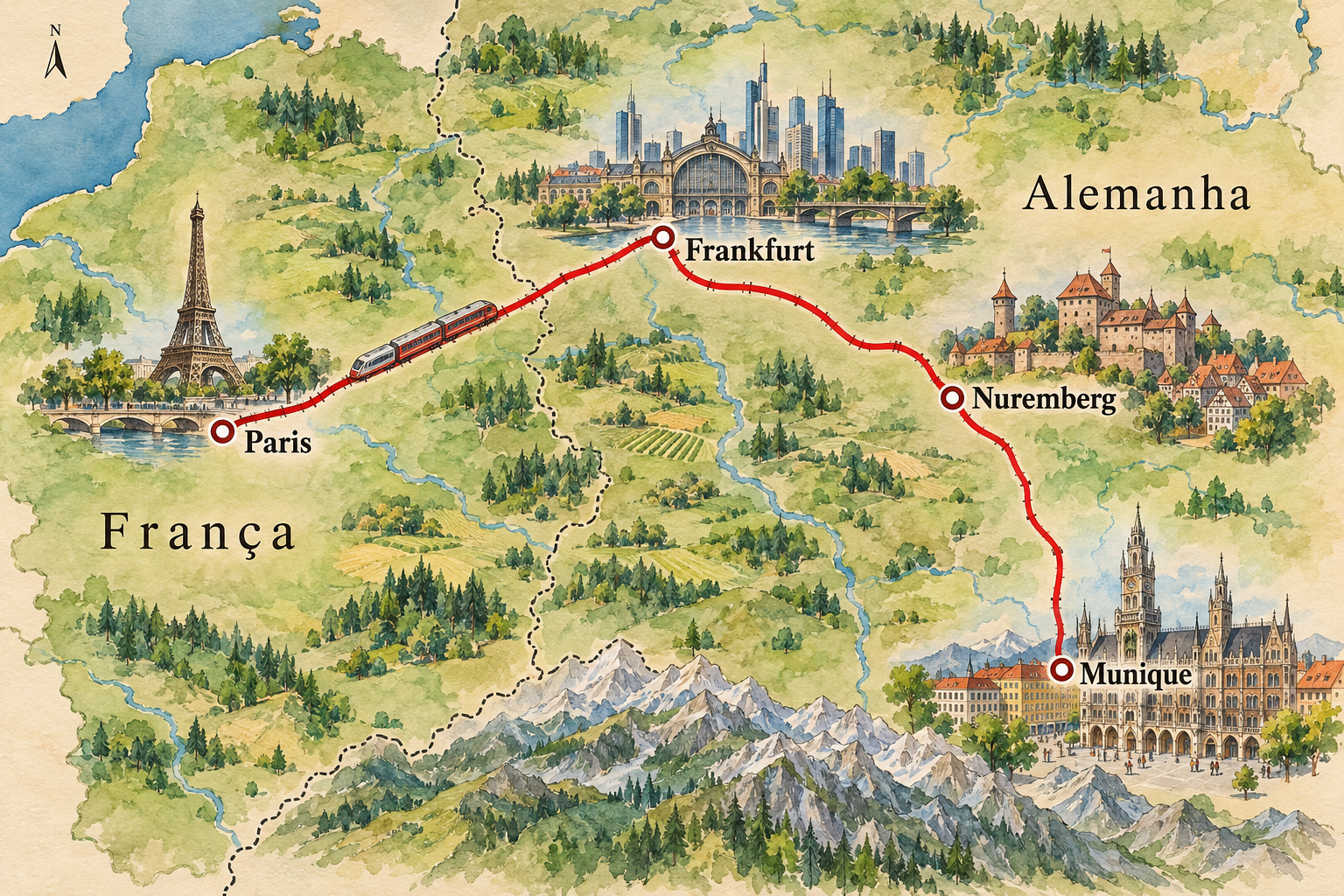
Nuremberg and Bamberg is on the Paris–Frankfurt–Munich by train

By train from Paris to Munich via Frankfurt and Nuremberg: TGV and ICE connect France with southern Germany from central station to central station.

Illustrative map, not to scale. Tap a city to open its page.
Illustrated map of Paris–Frankfurt–Munich by train
Explore other destinations Search by state and city