Münchner Weißwurst
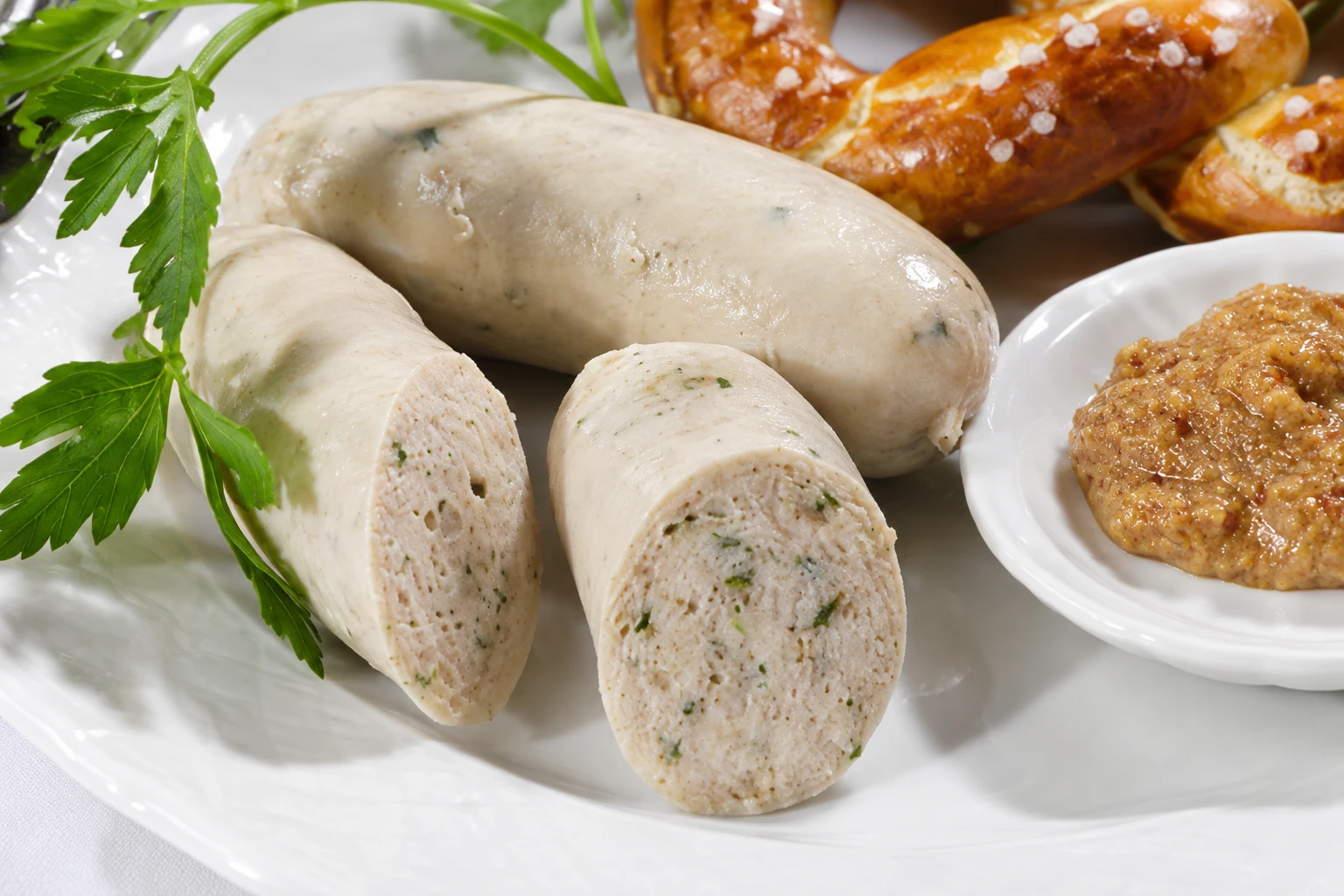
White veal sausage with bacon and parsley, warmed in hot water and served with sweet mustard and a pretzel, traditionally before midday. It is one of Munich’s best-known specialties.
Antarctica
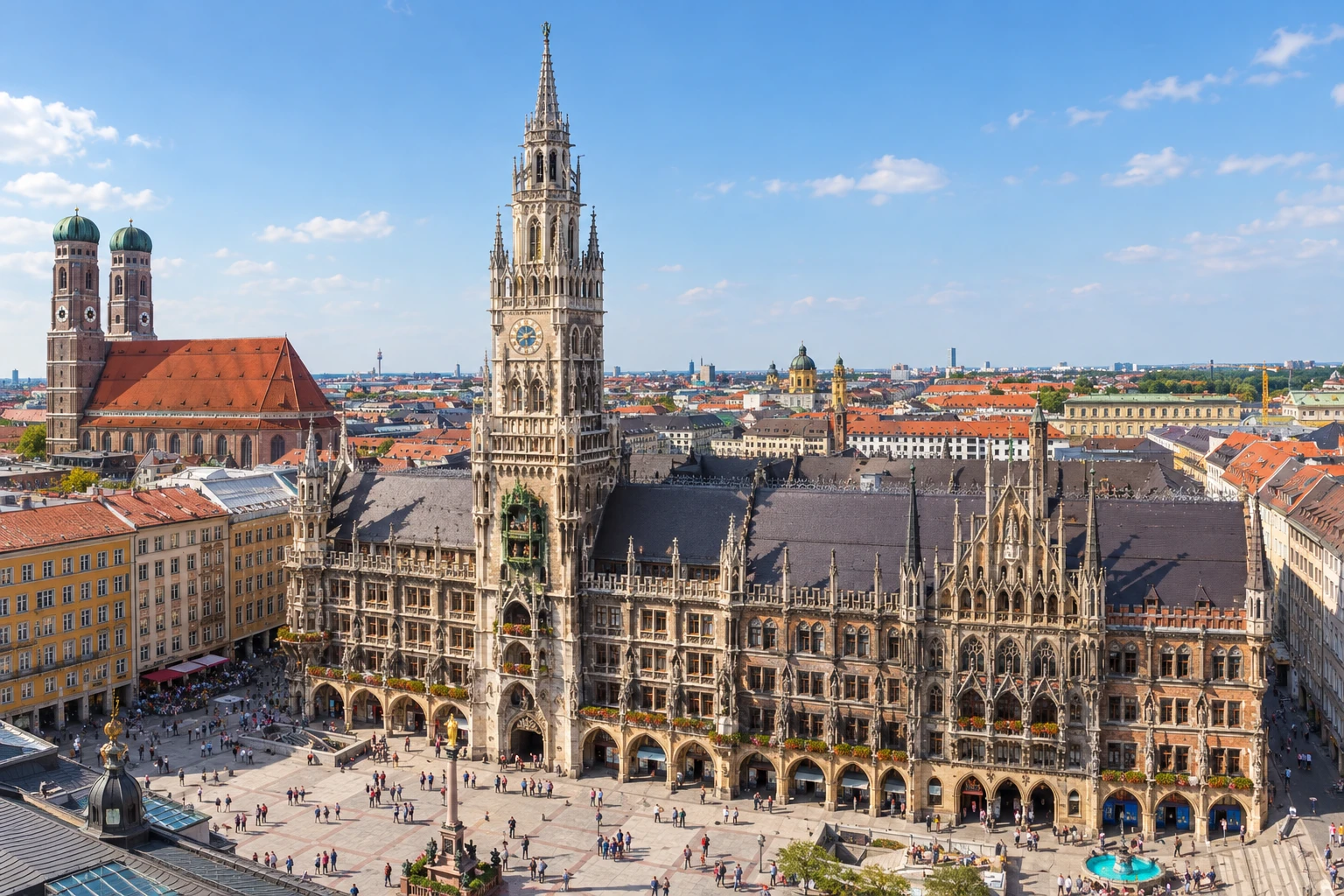
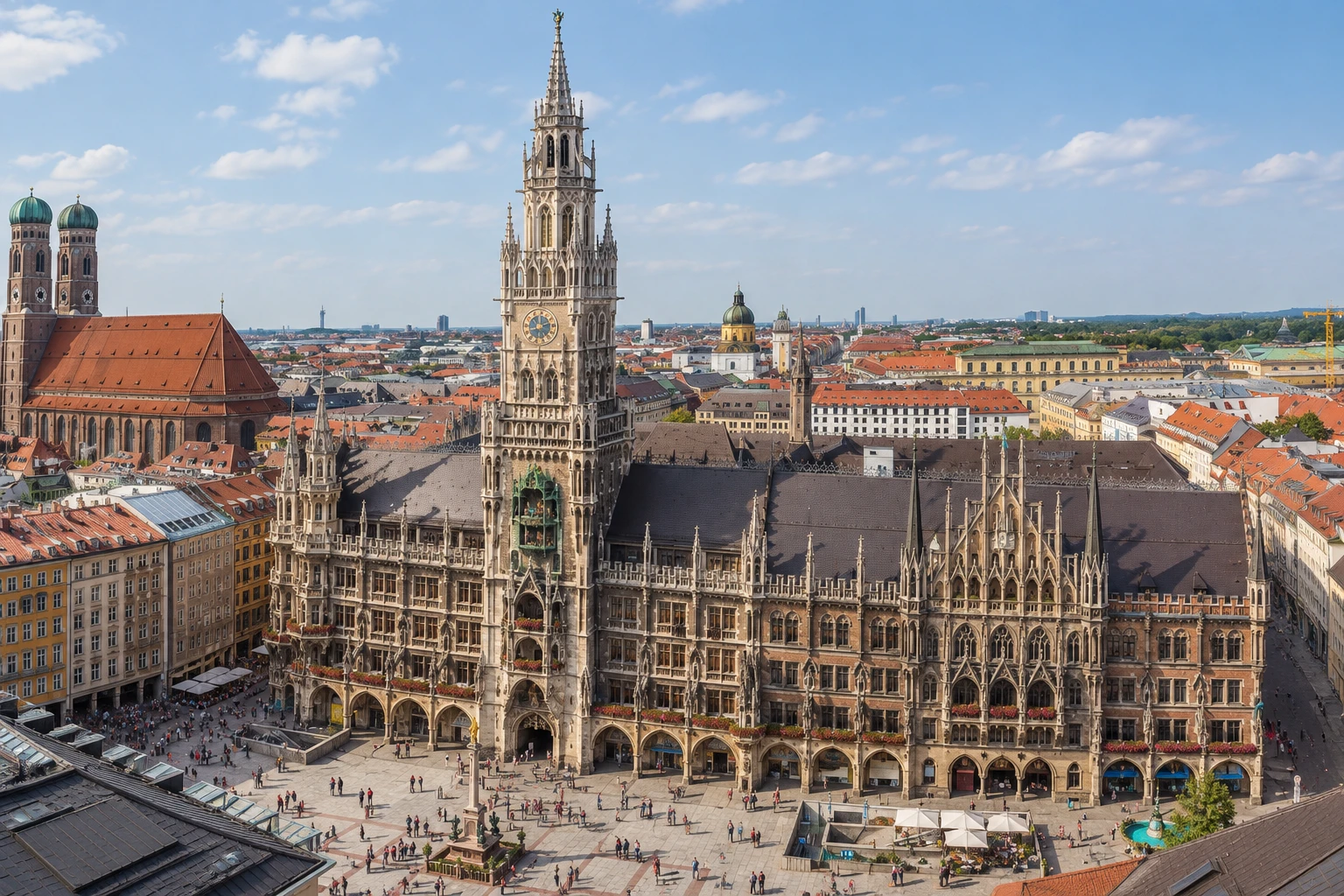
In the photo: Marienplatz, Munique
Illustrative images. The pictures in this guide are illustrations based on the real place, not photographs, and may differ from it.
The city
As the capital of Bavaria, Munique brings together the old town around the Marienplatz and the Frauenkirche, the Residenz palace, the Schloss Nymphenburg, the museums of the Kunstareal and the Deutsches Museum, the Englischer Garten with the Eisbach and beerhouse culture from the Hofbräuhaus to the Theresienwiese of the Oktoberfest. Nearby is the Dachau Memorial.
There's no accommodation in the guide yet in Munich.
Do you run a hotel, guesthouse or vacation rental here? List itThere are no restaurants in the guide yet in Munich.
Know a good one? Recommend it to usThe city's hotels and restaurants on the map.
how to get there · how many days · itinerary · questions
Cross-border routes
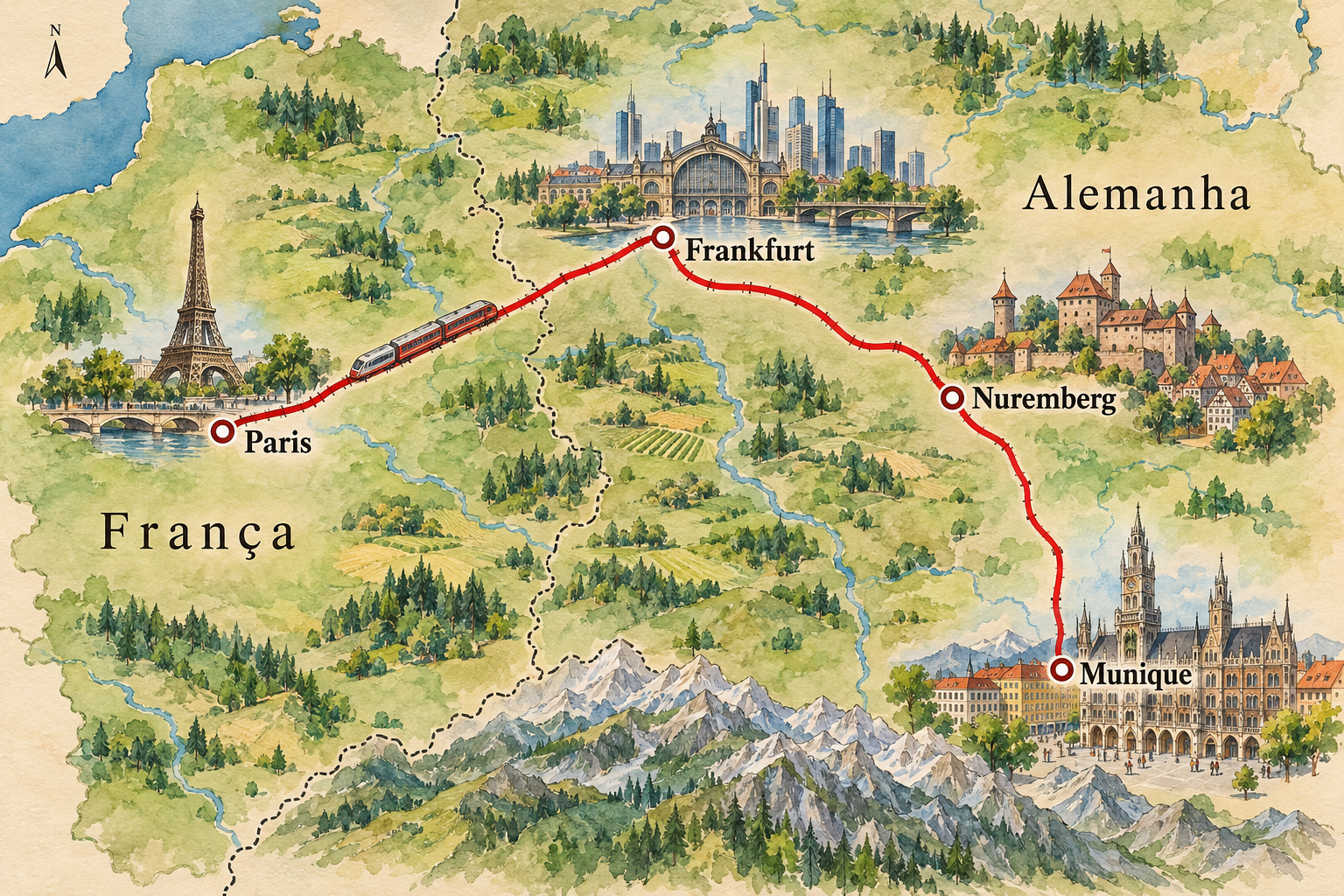
By train from Paris to Munich via Frankfurt and Nuremberg: TGV and ICE connect France with southern Germany from central station to central station.
Flavors of Germany
The local experience
Munich's central square, with the Mariensäule and the neo-Gothic façade of the Neues Rathaus, whose tower houses the city's most famous carillon.
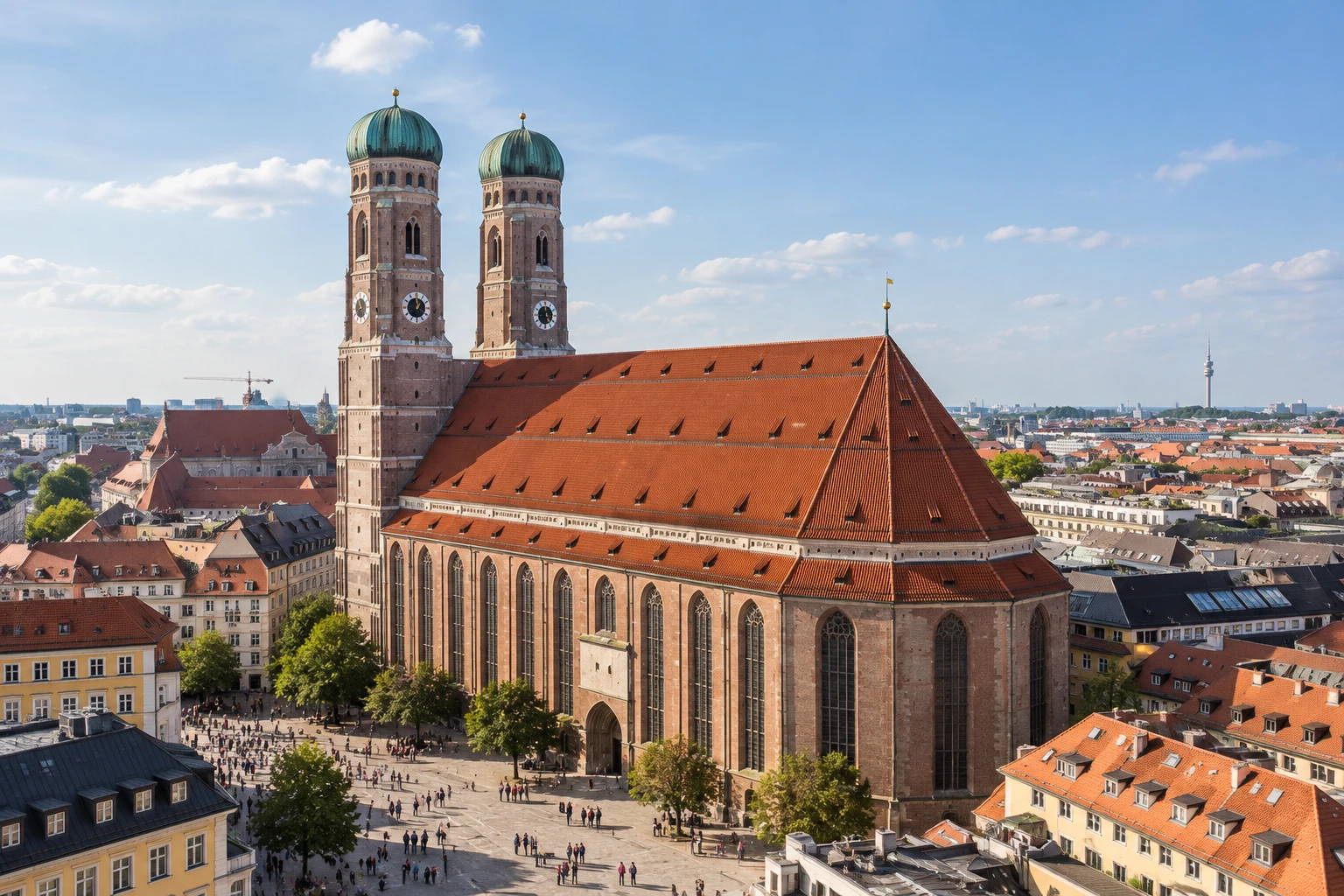
15th-century brick Gothic cathedral, with the two towers topped by rounded domes that are the symbol of Munich. The south tower can be visited.
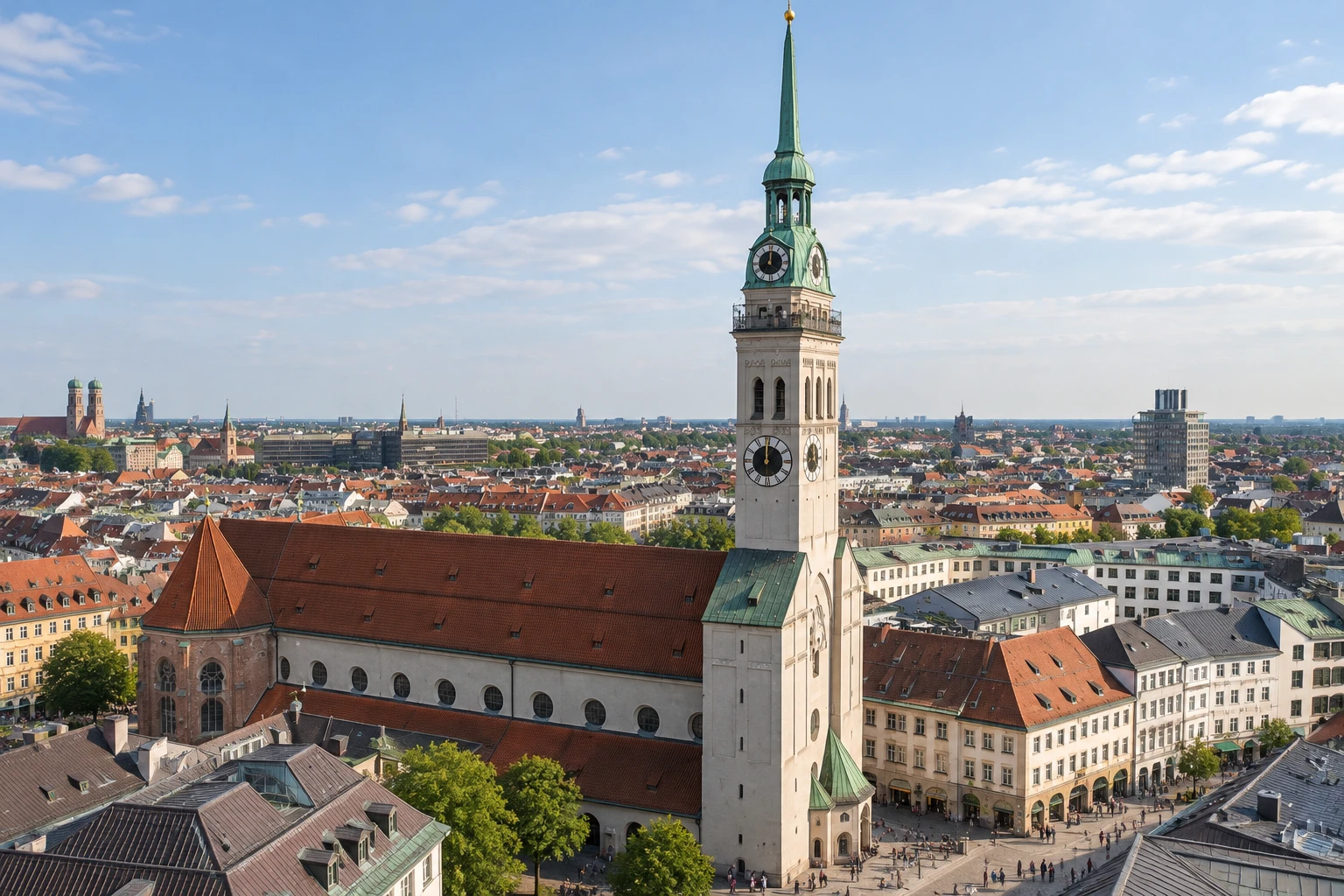
Munich's oldest church, next to Marienplatz. The tower, nicknamed Alter Peter by locals, has an open gallery with views over the center.
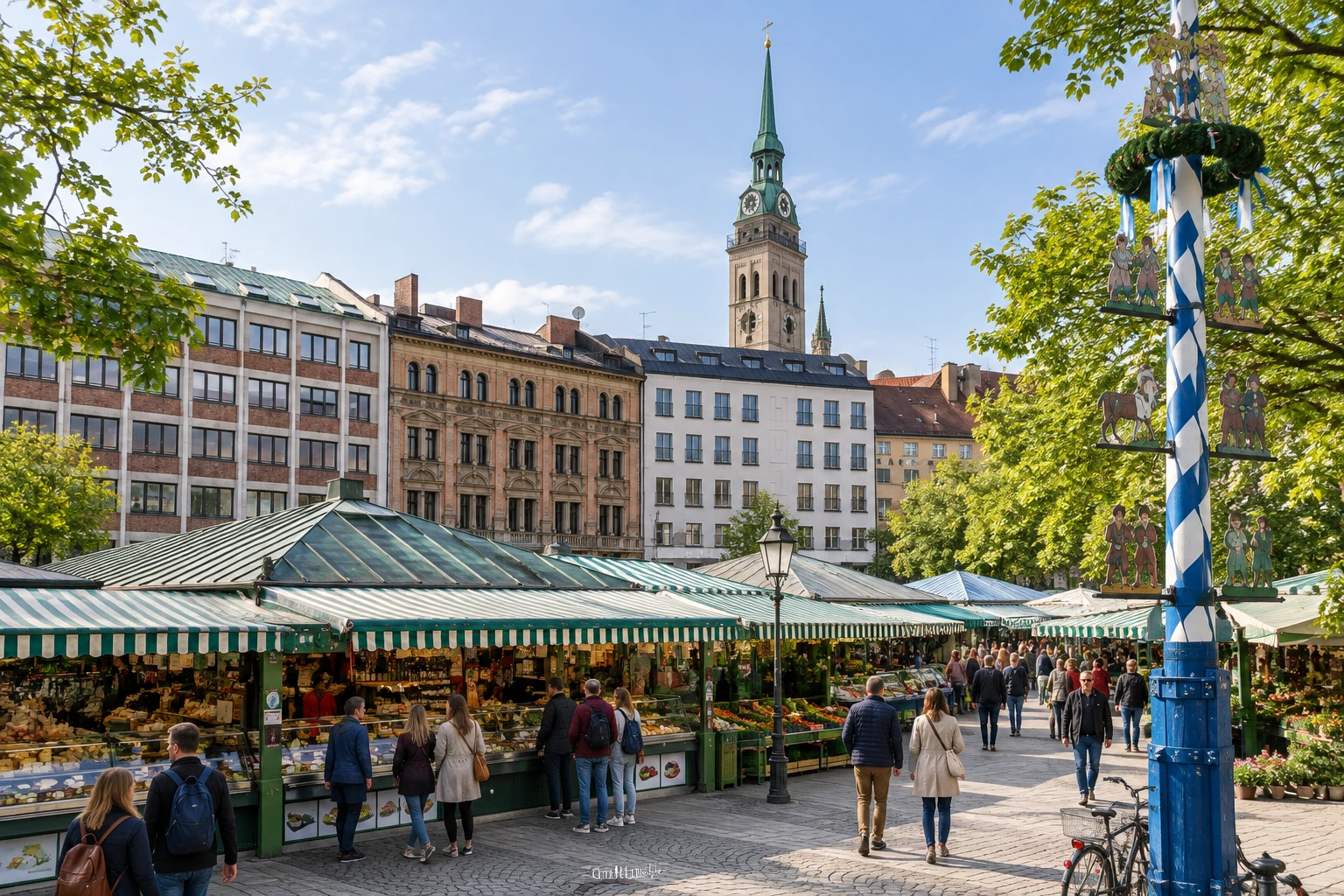
Open-air market next to Marienplatz, with stalls selling fruit, cheese, meats, flowers and ready-to-eat food around a biergarten and the town's Maibaum.
Before you go
Munich – Germany Capital
Approximate distances. Check flights and bus, train or boat schedules before you travel.
Connections with Brazil can be direct flights or with stopovers, depending on the season and the airline. Confirm before purchasing. The airport (MUC) is about 40 km from the center, connected by the S1 and S8 S-Bahn lines. München Hauptbahnhof, the central station, receives ICE trains from Berlin, Frankfurt, Nuremberg and Stuttgart, as well as trains to Austria and the Alps.
One day is enough for the old town, the Residenz and a stroll through the Englischer Garten. With two days you can include the Schloss Nymphenburg, a museum in the Kunstareal and the Olympiapark. Three days allow the Dachau Memorial and the Deutsches Museum. Adding day trips to the Alps or Neuschwanstein brings it to four or five days.
From May to September the days are long and the biergärten stay open. The Oktoberfest usually runs from late September into early October, with the city packed. Christmas markets usually operate from late November until close to Christmas. From December to February it is cold and gets dark early. Germany is 4 or 5 hours ahead of Brasília, depending on the time of year.
The seasons shown are the most usual ones; nature doesn't always follow the calendar.
No. U-Bahn (subway), S-Bahn, tram and integrated buses cover the city and reach Dachau and the airport. Validate your ticket in the machine when it asks. The center is in an environmental zone (Umweltzone) and parking is expensive. A car only helps to get around the Bavarian Alps.
Suggested itinerary
Built with the places on this page. No rush: it's paced so you have time to see them.
Start at Marienplatz, the central square, in front of the Neues Rathaus. Climb the tower of Peterskirche to see the rooftops of the center and, on a clear day, the Alps in the background. Walk to the Frauenkirche, the cathedral with the two towers.
Have lunch among the stalls of the Viktualienmarkt, a few steps from the square. Then walk to the Residenz, the Wittelsbachs' palace, and allow two hours for the rooms and the Treasury. Exit via the Odeonsplatz, with the Feldherrnhalle and the Theatinerkirche.
Cross the Hofgarten and enter the Englischer Garten via the Eisbach bridge. Walk to the Monopteros, the temple atop the hill, and finish at the Torre Chinesa, with the biergarten beside it.
Return to the center to dine at the Hofbräuhaus or at one of the traditional breweries in the Altstadt. Order a Bavarian dish such as Schweinshaxe (roasted pork knuckle) or Weißwurst (white sausages), which are traditionally eaten before noon.
Day 1
Spend the morning at Marienplatz, the glockenspiel of the Neues Rathaus, climbing Peterskirche and visiting the Frauenkirche. On the way, stop by the Asamkirche on Sendlinger Straße, a small Baroque church.
Lunch at the Viktualienmarkt and an afternoon at the Residenz, including the Antiquarium, the royal rooms and the Treasury. Finish at the Odeonsplatz and the Theatinerkirche.
Walk through the Hofgarten to the Englischer Garten. Stop at the Eisbach bridge, where surfers often ride the standing wave, and continue to the Monopteros and the Torre Chinesa.
Dine at the Hofbräuhaus, the brewery founded by the Bavarian court, with music and long communal tables. Keep an eye on your belongings in the crowded halls.
Day 2
Take the tram to Schloss Nymphenburg, the Wittelsbach summer palace. See the rooms, the Gallery of Beauties and the carriage museum, and walk through the park to the Amalienburg.
Head to the Kunstareal. Choose the Alte Pinakothek, with Dürer, Rubens and Rembrandt, or the Pinakothek der Moderne, for 20th-century art and design. Pass by the Königsplatz on the way out.
Take the U-Bahn to the Olympiapark. Walk under the fabric and acrylic roof of the 1972 stadium, climb Olympiaberg to see the city, and pass by the BMW Welt across the street.
Return to dine in Schwabing or in Maxvorstadt, neighborhoods with restaurants, bars and a university crowd, calmer than the center.
Day 1
First day in the center: Marienplatz, the glockenspiel of the Neues Rathaus, the Peterskirche tower and the Frauenkirche, with the climb of the south tower if you're up for the spiral staircase.
Lunch at the Viktualienmarkt, a quick visit to the Asamkirche and an afternoon at the Residenz, the largest urban palace in Germany, with the Treasury and the Cuvilliés Theatre.
From the Odeonsplatz, follow the Hofgarten to the Englischer Garten, stopping at the Eisbach, the Monopteros and the Torre Chinesa.
Dinner at the Hofbräuhaus or another historic brewery in the Altstadt, with Bavarian cuisine and one-liter steins.
Day 2
A full morning at Schloss Nymphenburg: palace rooms, the carriage and porcelain museums, and the park pavilions.
Afternoon in the Kunstareal: Alte Pinakothek for the old masters and, if time allows, the Museum Brandhorst or the Pinakothek der Moderne. The Königsplatz and the Documentation Center for National Socialism are next door.
Take the U-Bahn to the Olympiapark and BMW Welt. Climb Olympiaberg at the end of the day to see the city.
Dinner in Schwabing, north of the center, with streets of restaurants and bars around Leopoldstraße.
Day 3
Take the S-Bahn S2 to Dachau and bus 726 to the Concentration Camp Memorial. Allow at least three hours for the exhibition and the grounds of the former camp, in silence and with respect.
Back in Munique, spend the afternoon at the Deutsches Museum on the Isar island, with airplanes, boats, scientific instruments and historical machines.
Walk along the banks of the Isar and, if you like, continue to the Theresienwiese to see the Bavaria statue overlooking the Oktoberfest grounds.
End with a dinner in the Altstadt or in Haidhausen, across the Isar, a neighborhood of residential streets and local restaurants.
Check before you go. Opening hours and days change, and places may close for renovations, holidays or events. This itinerary is a suggestion from Cidade Turismo, not a commitment: plan yours by checking directly with each place you intend to visit.
Before you go
The S-Bahn lines S1 and S8 connect the airport to Marienplatz and the Hauptbahnhof in about 40 minutes. Buy your ticket at the airport station machines and validate it if the machine asks.
Most shops and the Viktualienmarkt are closed on Sundays. Museums, churches, restaurants and breweries usually open. Station shops, like those at the Hauptbahnhof and the airport, operate.
No. English is widely spoken in hotels, museums and restaurants. It's helpful to know a few words on the signs: Hauptbahnhof (Hbf) is central station, Altstadt is old town, Platz is square, Kirche is church and Schloss is palace or castle.
In most places, yes. Market stalls, bakeries and some biergärten still prefer cash, so it's worth having some euros.
The most common are the Dachau Memorial, half an hour by S-Bahn and bus, Nuremberg about an hour by ICE, Salzburg in Austria about an hour and a half by train, and Neuschwanstein Castle on a long day trip via Füssen.