Lisbon

Lisbon

Lisbon

The Portuguese capital on the banks of the Tejo: hills with yellow trams, the Manueline monuments of Belém, the Castelo de São Jorge and Alfama's fado houses.

Lisbon and the South

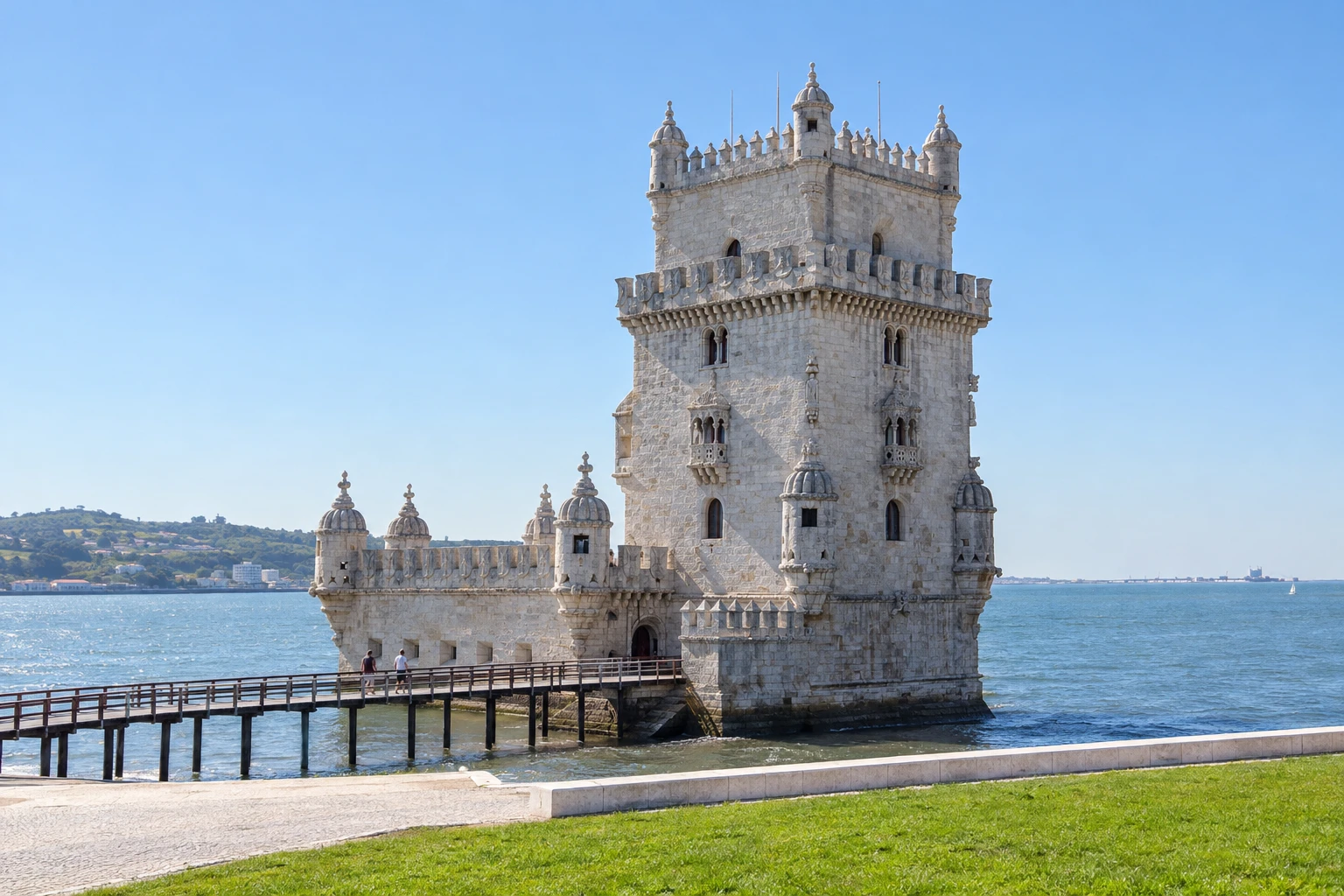
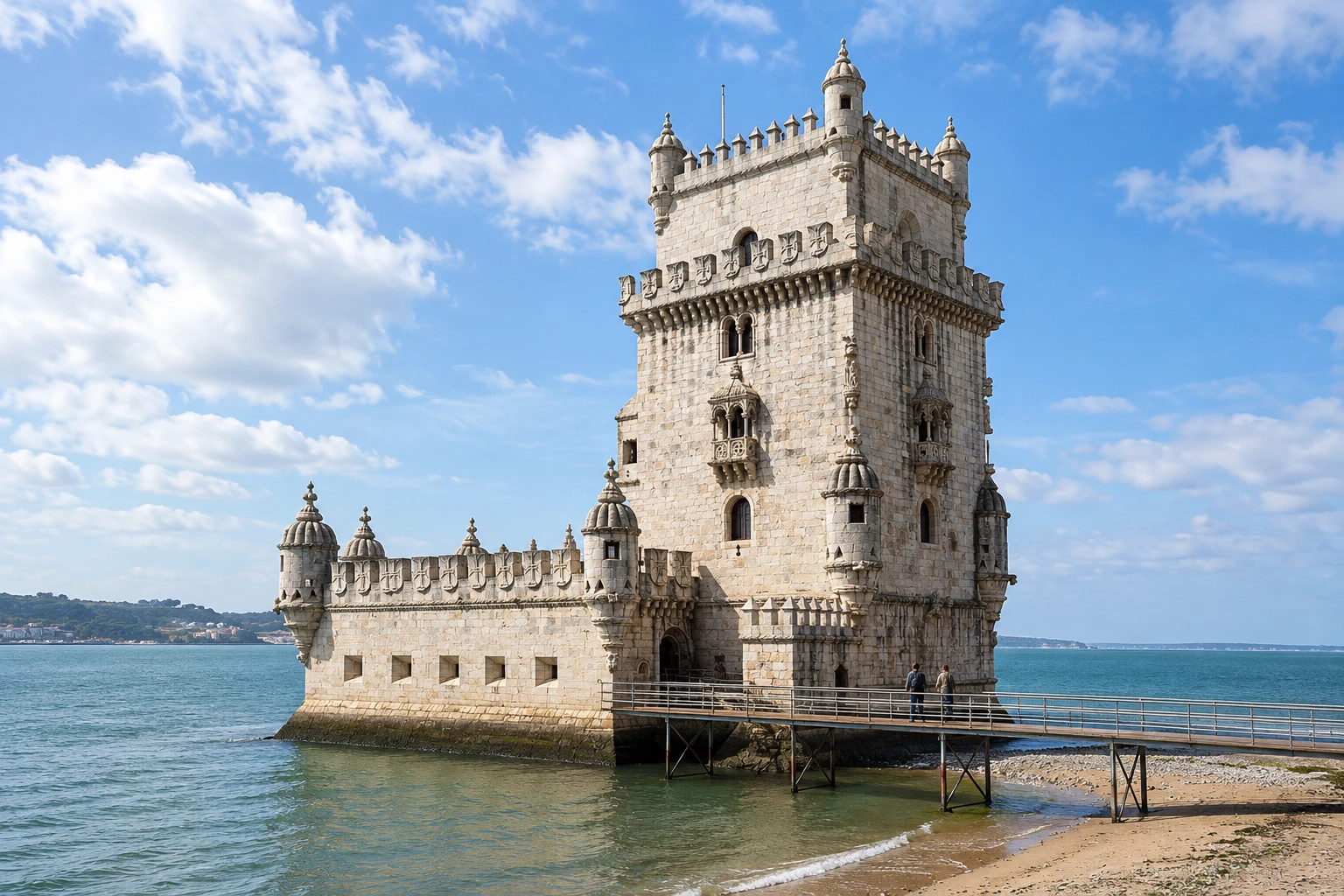
In the photo: Torre de Belém in Lisboa

Illustrative images. The pictures in this guide are illustrations based on the real place, not photographs, and may differ from it.

Get it on Google Play

Get to know the place

A region to enjoy
at your own pace.

Lisboa is the capital of Portugal and spreads over hills on the north bank of the Tejo estuary, near its mouth on the Atlantic. The center was rebuilt after the 1755 earthquake, and the Baixa Pombalina, with straight streets between the Rossio and Praça do Comércio, is the result of that plan. Around it, the old neighborhoods climb the slopes: Alfama and the Castelo on one side, Chiado and Bairro Alto on the other.

To the west, Belém preserves the memory of the Discoveries. There stand the Torre de Belém and the Mosteiro dos Jerónimos, a World Heritage Site since 1983, the Padrão dos Descobrimentos, the Museu Nacional dos Coches and the MAAT, by the river. On the hilltop, the Palácio Nacional da Ajuda displays the jewels of the Portuguese Crown.

On the east side, Alfama preserves a network of alleys of medieval origin, the Sé, the Panteão Nacional, the Mosteiro de São Vicente de Fora and the Museu do Fado. The miradouros, such as Santa Luzia, Senhora do Monte and São Pedro de Alcântara, open views over the rooftops and the river. Further north, the Museu Calouste Gulbenkian houses one of Europe’s best-known private art collections, and the Parque das Nações, the Expo 98 area, has the Oceanário.

For Brazilians, Lisboa is the most common gateway to Portugal. Portuguese is spoken, but with a different accent and vocabulary: the 'bonde' is called elétrico, the 'ônibus' is autocarro and 'trem' is comboio. The city has a metro, and the calçada portuguesa, made of white and black stones, calls for shoes with sturdy soles on the hills.

This destination brings together 2 cities: Lisbon, Oeiras.

Share: WhatsApp
Traveler, share your experiences through photos Up to 5 photos of each place you visited.

One destination, many paths

The cities on this trip

Start with one city or combine several in your itinerary.

Where Lisbon is The star marks the capital, Lisbon.
LisbonOeiras

Outlines: Direção-Geral do Território, CAOP 2025, CC BY 4.0. Adapted by Cidade Turismo.

How to get there: Lisbon

Aeroporto Humberto Delgado (LIS) · 9 km to Lisbon

Aeroporto Humberto Delgado (LIS) is about 7 km from the city center, linked by metro. Connections with Brazil may be direct flights or involve a transfer, depending on the season and airline. Check before booking. From Porto, the comboio takes about three hours; from the Algarve, roughly three and a half hours from Faro.

Suggested arrival point: Lisbon

Festivals and events

Festivals Lisbon

Dates change every year: check this year's date before you travel.

The local experience

Things to do in Lisbon

Oeiras · Lisbon · Palace

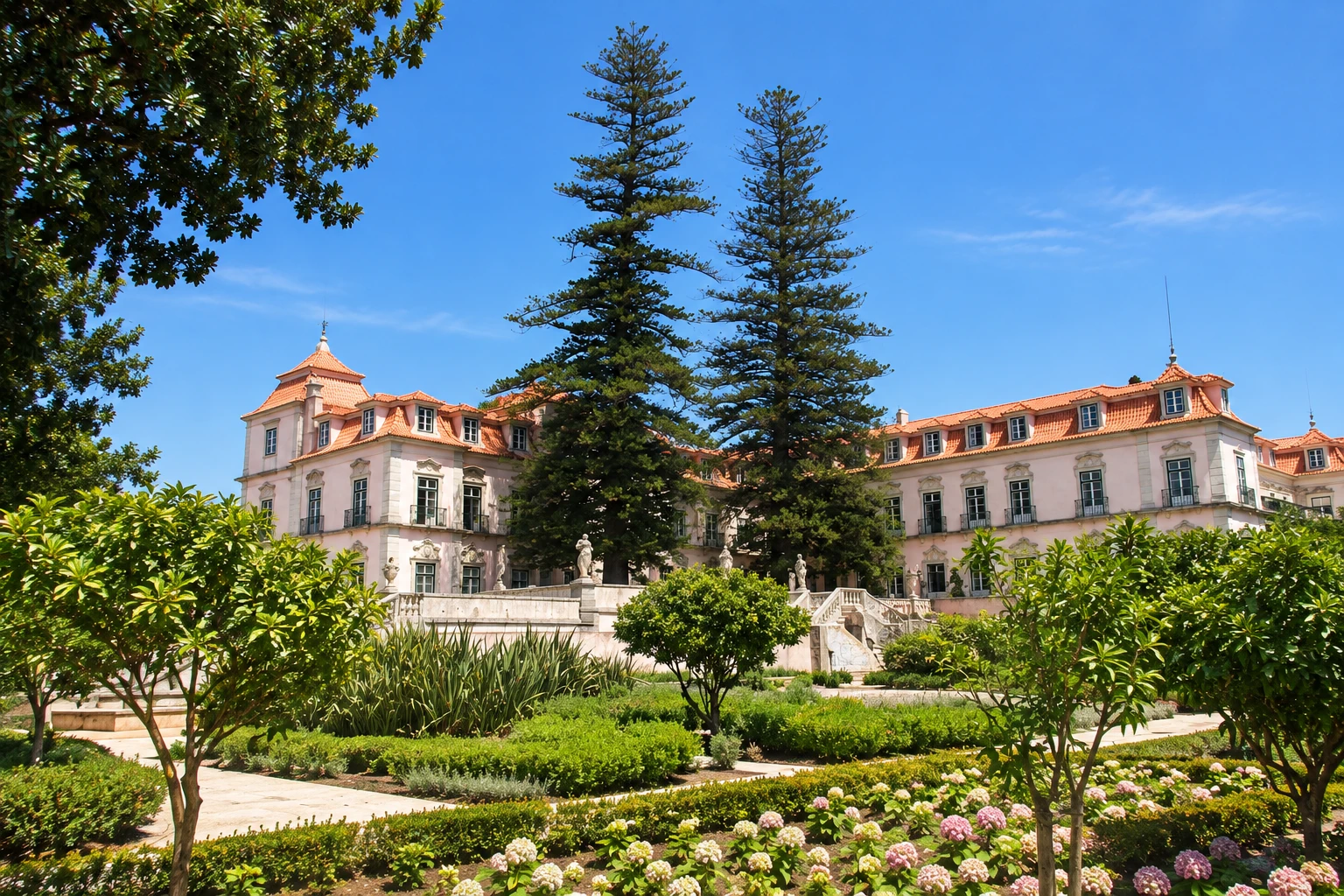
Palace of the Marquis of Pombal

18th‑century palace in Oeiras’s historic center, the country residence of Sebastião José de Carvalho e Melo, the Marquis of Pombal. The French‑influenced gardens include the Cascade of the Poets, the Casa da Pesca and tile‑clad terraces. Classified as a National Monument since 1940.

Explore Palace of the Marquis of Pombal

Lisbon · Lisbon · Monument

Belém Tower

Defensive tower from the early 16th century on the banks of the Tejo, a masterpiece of the Manueline style and a UNESCO World Heritage site since 1983 along with the Mosteiro dos Jerónimos. It has four visitable floors and a terrace at the top.

Explore Belém Tower

Lisbon · Lisbon · Monastery

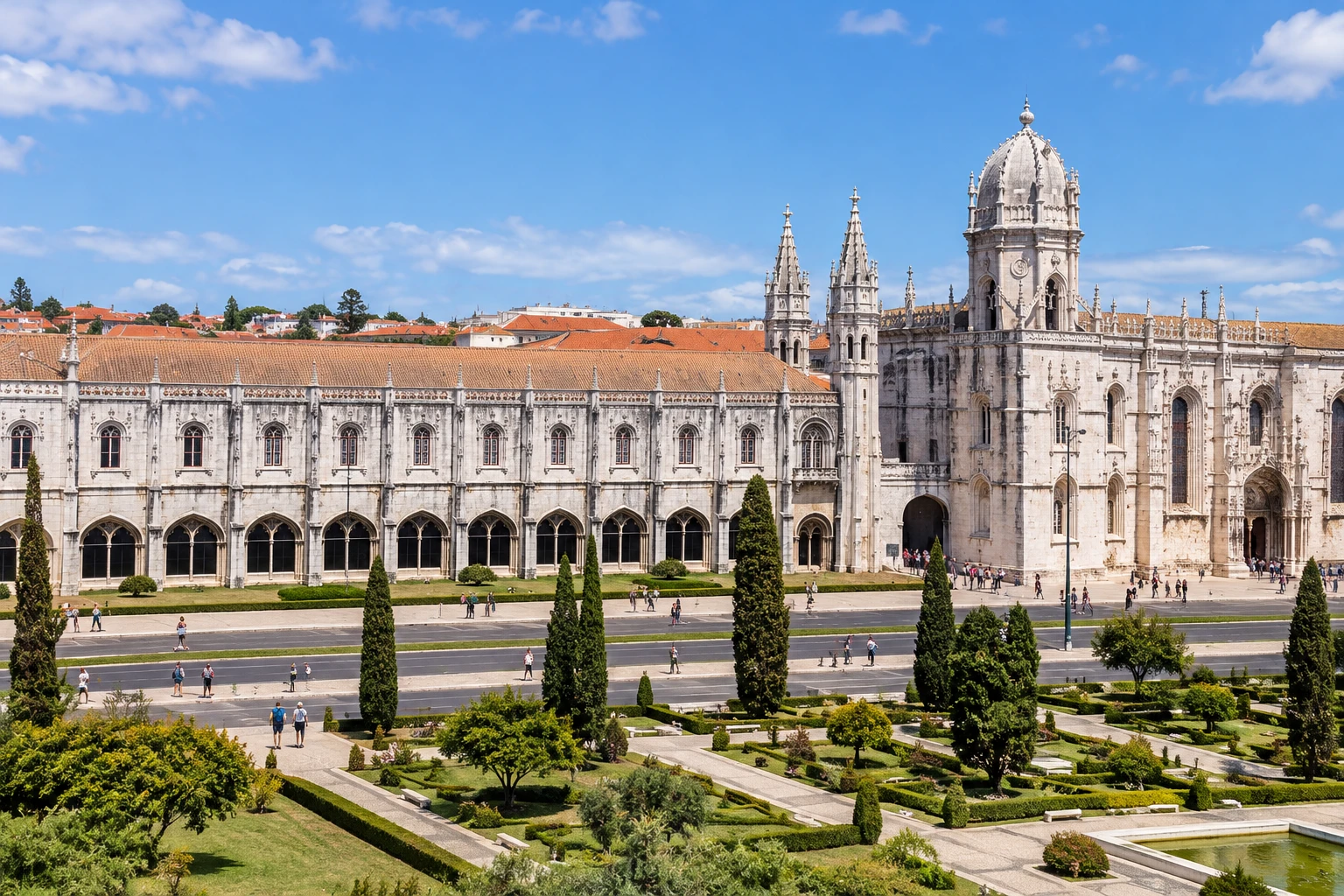
Jerónimos Monastery

Manueline monastery commissioned by D. Manuel I from 1501, featuring the church of Santa Maria de Belém and the intricately carved cloister. It houses the tombs of Vasco da Gama and Luís de Camões and has been a World Heritage site since 1983.

Explore Jerónimos Monastery

Oeiras · Lisbon · Seafront

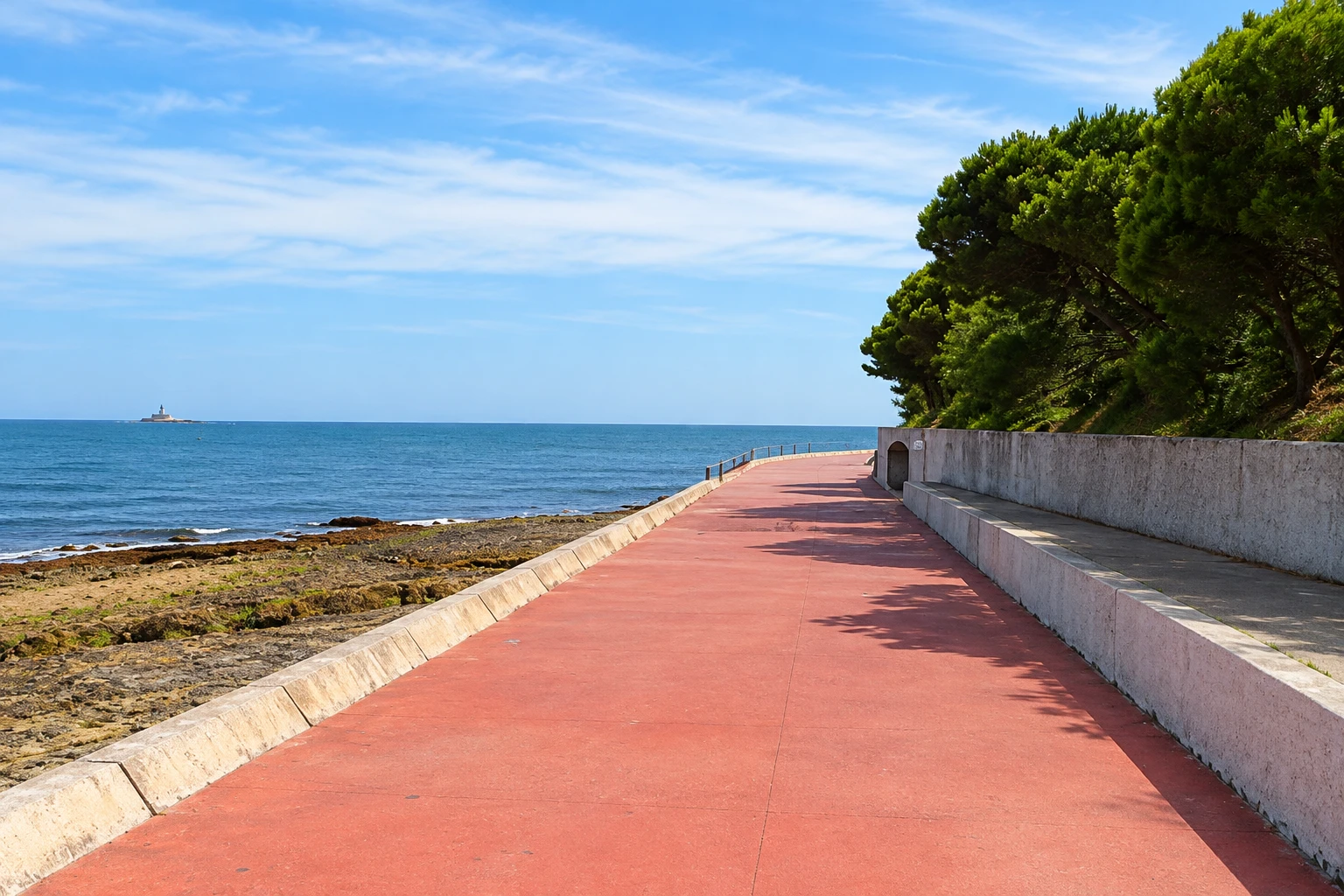
Oeiras Waterfront Promenade

Seaside promenade between Praia da Torre and Paço de Arcos, called the paredão by locals. It passes the marina, the ocean pool, the beaches of Santo Amaro and da Laje and old forts, with Forte de São Julião da Barra at one end.

Explore Oeiras Waterfront Promenade

See 33 more places in Lisbon

To choose before you go

Tours in Lisbon

Where each tour starts, how long it takes, how it is done, what is included and the price range.

Belém: Mosteiro dos Jerónimos, Torre de Belém and Padrão dos Descobrimentos

From Lisbon center (Praça da Figueira or Cais do Sodré) Tram (eléctrico) 15E, train (comboio) or bus (autocarro) about 5 hours morning easy

Belém sits on the banks of the Tagus River, west of the city center, and brings together the monuments associated with the Age of Discoveries. The Mosteiro dos Jerónimos was founded by D. Manuel I in 1496 and given to the monks of the Order of Saint Jerome. The church holds the tombs of Vasco da Gama and Luís de Camões, and the two‑story cloister contains much of the visit. Together with the Torre de Belém, the monastery was designated a UNESCO World Heritage site in 1983. The Torre de Belém was built between 1514 and 1521, designed by Francisco de Arruda, to defend the river entrance. The facade features ropes carved in stone, shields and the figure of a rhinoceros. Between the two stands the Padrão dos Descobrimentos, a prow‑shaped monument with figures of Infante D. Henrique and other navigators. An elevator takes you to the terrace, over 50 meters high, with views of the river and Belém. On the pavement in front, the Rosa dos Ventos shows a world map with the Portuguese routes. A few steps from the monastery, the Pastéis de Belém bakery has produced since 1837 the pastry made with the recipe that came from the convent.

Stops: Mosteiro dos Jerónimos, Torre de Belém, Padrão dos Descobrimentos, Pastéis de Belém, Jardim da Praça do Império, Tagus River.

Includes: Walk between the three monuments along the riverside and through the Jardim da Praça do Império. Separate paid entrances apply at the monastery, the tower and the Padrão terrace; check the current fee schedule.

Tip: The Mosteiro dos Jerónimos and the Torre de Belém usually close on Mondays. Buy your ticket in advance and arrive early: the monastery’s line grows through the morning. The line at Pastéis de Belém moves quickly; there are also indoor dining rooms to sit in.

Best time: All year; from March to June and in September and October the weather is mild and lines are smaller than in July and August.

Alfama and São Jorge Castle

From Baixa of Lisbon On foot, by tram (electric) 28 or 12 to go up about 4 hours morning moderate (hills and stairs)

Alfama is Lisbon’s old quarter that descends from the castle to the river, with narrow streets, alleys and stairways. At the top of the hill, São Jorge Castle has walls and towers you can walk along, gardens with city views and a small museum with finds from the site, from the 7th century BC to the 18th century. Admission includes the Camera Obscura, a periscope in the Tower of Ulysses that projects 360-degree images of Lisbon, and the archaeological section, visited with a guide. On the way down, Lisbon Cathedral (Sé) has a Romanesque façade, and beside it is the Church of Saint Anthony, built where, according to tradition, the saint was born. The viewpoints of Santa Luzia and Portas do Sol overlook Alfama’s roofs and the Tagus River. Further on are the Monastery of São Vicente de Fora and the National Pantheon, and at Campo de Santa Clara takes place the Feira da Ladra, a secondhand market operating on Tuesdays and Saturdays. Near the river, the Fado Museum tells the history of Lisbon’s music.

Stops: São Jorge Castle, Alfama, Lisbon Cathedral (Sé), Church of Saint Anthony, Miradouro de Santa Luzia, Miradouro das Portas do Sol, Monastery of São Vicente de Fora, National Pantheon, Feira da Ladra, Fado Museum.

Includes: Visit to the castle (separate paid admission; check the current fee table) and a walk through Alfama’s streets, with stops at viewpoints and churches.

Tip: Take the tram (electric) or a taxi up to the castle and walk down: the route is almost all downhill. Wear sneakers with a firm sole, because the calçada portuguesa can be slippery. For the Camera Obscura and the archaeological section, ask at the entrance about the guided visits scheduled for the day.

Best time: All year; in June Alfama hosts the street festivities of the Festas de Lisboa and becomes crowded at night.

Baixa, Praça do Comércio and Rossio

From Baixa of Lisbon On foot about 3 hours afternoon easy

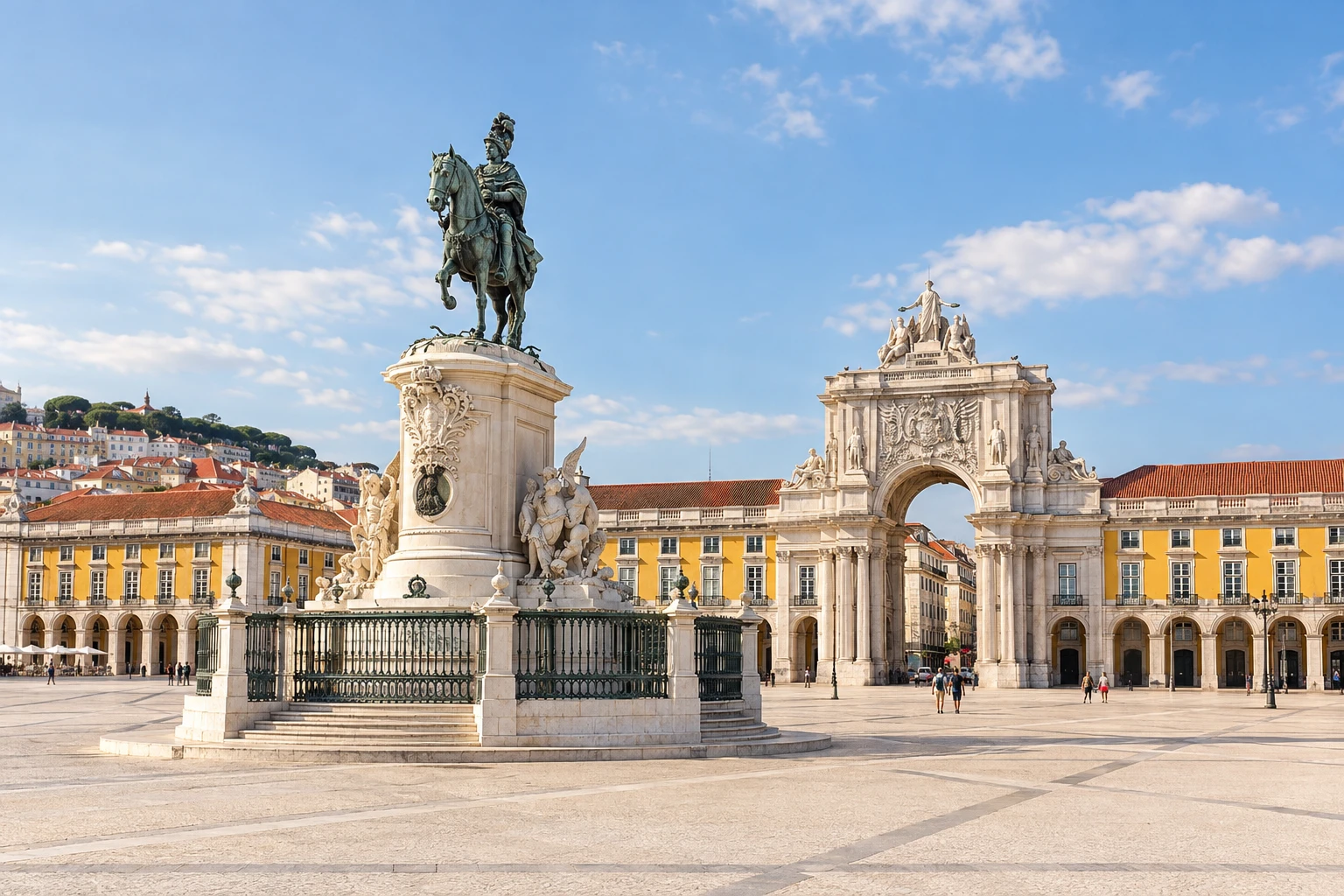
Baixa is the flat center of Lisbon, rebuilt after the 1755 earthquake with straight, grid-like streets in the plan known as Baixa Pombalina. Praça do Comércio, also called Terreiro do Paço, opens onto the Tagus River, with the equestrian statue of D. José I in the center and the Cais das Colunas at the water’s edge. The Arco da Rua Augusta links the square to the pedestrian street; the top of the arch is open to visitors and offers a 360-degree view over the Baixa and the river. The arch’s statues depict, among others, the Marquis of Pombal and Vasco da Gama. Rua Augusta leads to Rossio, the square with a wavy pavement in Portuguese calçada and a train station with a neo-Manueline facade. Beside it are Praça da Figueira and, a few blocks away, the Elevador de Santa Justa, from 1902, by Raoul Mesnier de Ponsard, which rises from the Baixa to Largo do Carmo and serves as a viewpoint over the center.

Stops: Praça do Comércio, Arco da Rua Augusta, Rua Augusta, Rossio, Praça da Figueira, Rossio Station, Elevador de Santa Justa, Cais das Colunas.

Includes: Walk through the squares and streets of the Baixa. The top of the Rua Augusta Arch and the Santa Justa Lift are paid separately; check the current fee table.

Tip: The line for the Santa Justa Lift is often long. If you only want the view you can reach the terrace via Largo do Carmo in Chiado. This is a good outing for the day you arrive from Brazil: it’s flat and close to everything.

Best time: All year; in December the Baixa is decorated with Christmas lighting.

Chiado, Bairro Alto and Príncipe Real

From Baixa de Lisboa On foot, by metro to Baixa-Chiado about 4 hours afternoon moderate (uphills)

Chiado is the area of shops, bookstores, cafés and theaters between the Baixa and Bairro Alto. In front of Café A Brasileira stands the bronze statue of the poet Fernando Pessoa, seated at a table. In Largo do Carmo are the ruins of the Convento do Carmo, a Gothic church begun in 1389 and destroyed by the 1755 earthquake: the arches remain roofless and the space houses the Museu Arqueológico do Carmo. Climbing via Largo de Camões, Bairro Alto has narrow grid-like streets with restaurants and bars that fill at night. The Igreja de São Roque, plain on the outside, has chapels decorated with gilded woodwork and marbles. The Miradouro de São Pedro de Alcântara is a two-level garden with views of the castle and the Baixa. Heading north you reach Príncipe Real, a neighborhood of design shops and a garden with a broad-crowned cedar.

Stops: Chiado, Café A Brasileira, Largo do Carmo, Convento do Carmo, Igreja de São Roque, Bairro Alto, Miradouro de São Pedro de Alcântara, Príncipe Real, Largo de Camões.

Includes: Walk through the three neighborhoods. The Museu Arqueológico do Carmo and the Igreja de São Roque have separate paid entry for exhibition areas; check the current rate table.

Tip: Do the ride late afternoon and finish at the Miradouro de São Pedro de Alcântara at sunset. The Museu Arqueológico do Carmo is closed on Sundays.

Best time: All year; from May to September nights in Bairro Alto are busier.

Tram (electric) 28

From Martim Moniz Tram (eléctrico) 28E of Carris about 1 hour (one way only) morning easy

The tram (electric) 28 is the line that crosses Lisbon’s historic neighborhoods. The old yellow wooden cars climb and descend the hills between Martim Moniz and Campo de Ourique, on streets that run close to the building facades. Along the way the tram passes through Graça, goes by the Church of São Vicente de Fora, the Largo das Portas do Sol, a few steps from the castle, and descends through Alfama to the Sé de Lisboa and the Church of Santo António. In the Baixa it continues along Rua da Conceição, climbs to Chiado and Largo de Camões and continues to the Parliament, the Basílica da Estrela and the Jardim da Estrela before reaching Campo de Ourique. At the end of the line the tram turns around, and you can return the same way. It is regular public transport, also used by residents, so it gets crowded at peak times.

Stops: Martim Moniz, Graça, Church of São Vicente de Fora, Largo das Portas do Sol, Sé de Lisboa, Rua da Conceição, Chiado, Largo de Camões, Basílica da Estrela, Jardim da Estrela, Campo de Ourique.

Includes: Ride on tram 28E with a separately paid ticket (a loaded transport card is valid); check the current fare table.

Tip: Board at the starting point, in Martim Moniz, early so you can get a seat. Get off at Portas do Sol to visit the castle or at Estrela to see the basilica and the garden. Keep your backpack in front of your body inside a crowded tram.

Best time: All year; from October to April lines at the starting point are usually shorter.

Lisbon viewpoints

From Graça On foot, by tram (electric) 28 or 12 about 3 hours afternoon moderate (hills)

Lisbon spreads over hills, and its viewpoints are the squares and terraces from which you see the city from above. The Miradouro da Senhora do Monte, at Graça’s highest point, shows the castle, the Baixa and the River Tagus straight ahead. Just below, the Miradouro Sophia de Mello Breyner Andresen, known as Miradouro da Graça, has pine trees, a kiosk and a view of the castle. Heading down to Alfama, the Miradouro de Santa Luzia has azulejo panels and a pergola with bougainvillea, and the Miradouro das Portas do Sol opens onto the neighborhood roofs and the river. On the other side of the Baixa, the Miradouro de São Pedro de Alcântara faces the castle, and the Miradouro de Santa Catarina, in Santa Catarina, shows the Ponte 25 de Abril and the port. Many viewpoints have kiosks with outdoor tables, and at late afternoon they gather locals and visitors to watch the sunset.

Stops: Miradouro da Senhora do Monte, Miradouro Sophia de Mello Breyner Andresen (Graça), Miradouro de Santa Luzia, Miradouro das Portas do Sol, Miradouro de São Pedro de Alcântara, Miradouro de Santa Catarina.

Includes: Walk between the viewpoints, with short tram (electric) sections. Access to the viewpoints is open to the public.

Tip: Start at Graça, the highest point, and go downwards. Leave Santa Catarina or São Pedro de Alcântara for sunset. Bring a jacket from October to April: it is windy at the high viewpoints.

Best time: All year; from May to September sunset is later and the viewpoints get crowded at the end of the day.

See 12 more tours

Fado night

From Alfama, Mouraria or Bairro Alto On foot or by taxi about 3 hours night easy

Fado is Lisbon’s urban song, recognized by UNESCO as Intangible Cultural Heritage of Humanity in 2011. A singer performs accompanied by the Portuguese guitar, with twelve metal strings and a pear-shaped body, and by the viola, as the Portuguese call the acoustic guitar. Fado houses are located in Alfama, Mouraria and Bairro Alto. Typically the performance takes place during dinner: musicians play in short sets, and between sets the kitchen service continues. During the songs the lights are dimmed and silence is requested in the room. There are also neighborhood taverns where fado is sung by amateurs, known as fado vadio, in a simpler setting. To learn the history beforehand, the Fado Museum in Alfama brings together instruments, recordings and portraits of fadistas.

Stops: Alfama, Mouraria, Bairro Alto, Fado Museum.

Includes: Dinner or fado live performance, paid separately; many venues charge a minimum amount per person. Check the current rates.

Tip: Book in advance, especially Friday through Sunday. Ask whether the price includes dinner or only the minimum consumption. Visit the Fado Museum in the afternoon and have dinner with fado the same night in Alfama.

Best time: All year; the venues operate in every season.

Parque das Nações and Oceanário de Lisboa

From Oriente Station Metro (red line) to Oriente about 5 hours full day easy

Parque das Nações is the neighborhood built in eastern Lisbon for Expo 98, on the banks of the Tagus River, featuring contemporary architecture and a long waterfront promenade. Oriente Station, by Santiago Calatrava, has a steel-and-glass canopy that resembles a forest of trees. The Oceanário de Lisboa, at Doca dos Olivais, displays more than 500 species around a large central aquarium, seen from multiple levels, with sharks, rays, sunfish and schools of fish. Around it are tanks of coastal habitats with otters, penguins and seabirds, plus temporary exhibitions. On the promenade you’ll find the Pavilhão de Portugal, by Álvaro Siza Vieira, with a thin curved concrete canopy, the Pavilhão do Conhecimento science museum, and the 140-meter Vasco da Gama Tower. The Telecabine Lisboa runs along the river, with views of the Vasco da Gama Bridge.

Stops: Oceanário de Lisboa, Oriente Station, Pavilhão de Portugal, Pavilhão do Conhecimento, Telecabine Lisboa, Vasco da Gama Tower, Vasco da Gama Bridge, Garcia de Orta Gardens.

Includes: Oceanário ticket and Telecabine ride paid separately; check the current price list. Walk along the promenade and the Garcia de Orta Gardens.

Tip: Allow two to three hours for the Oceanário and buy your ticket in advance. Weekends and Portuguese school holidays are busier. The red line metro that serves the airport stops at Oriente station.

Best time: All year; on rainy days, from October to March, the Oceanário is a good indoor option.

LX Factory and Ponte 25 de Abril

From Alcântara Tram (eléctrico) 15E or train (comboio) on the Cascais line about 3 hours afternoon easy

LX Factory occupies the former complex of the Companhia de Fiação e Tecidos Lisbonense, a factory founded in 1846 in Alcântara beneath the Ponte 25 de Abril. The warehouses, covering 23,000 square meters, were turned into design shops, studios, restaurants, cafés and offices, with graffiti-covered walls and an industrial vibe. The Livraria Ler Devagar occupies a former printing press, with shelves to the ceiling, a suspended bicycle and a reading mezzanine. On Sundays, a market fills the main street with crafts, clothing and food. Next to it is the Ponte 25 de Abril, a suspension bridge opened in 1966, about 2.3 km long, linking Lisbon to Almada and with separate decks for cars and trains. At the base of one of the pillars, the Experiência Pilar 7 tells the story of the bridge’s construction through interactive exhibits and has an elevator up to a viewpoint with views of the river and the city, from where you can see cars passing overhead.

Stops: LX Factory, Ler Devagar Bookshop, 25 de Abril Bridge, Pilar 7 Experience, Alcântara.

Includes: Visit to LX Factory (complex open to the public) and the Experiência Pilar 7, with separate paid admission; check the current price list.

Tip: Go on Sunday to see the market, but arrive before lunch, when it gets busier. Combine it with Belém or the MAAT on the same day: tram (eléctrico) 15E links all three. Check beforehand if the elevator at the Experiência Pilar 7 is operating.

Best time: Year round.

Time Out Market and Cais do Sodré

From Cais do Sodré Metro (green line) or train (comboio) to Cais do Sodré about 2 hours night easy

The Time Out Market Lisboa operates inside Mercado da Ribeira in Cais do Sodré, in a hall with stalls from restaurants, bakeries and city chefs arranged around communal tables. Each person chooses what they want at different stalls and sits where there is space, which makes it easy for groups and families with varied tastes. The menu ranges from Portuguese snacks and seafood to burgers and sweets, including the pastel de nata. Cais do Sodré is a transport hub: the metro, the Cascais line train and ferries to the other side of the Tagus all arrive there. A few steps away is Rua Nova do Carvalho, the street with the pink-painted pavement, with bars that enliven the neighborhood’s night. Along the river, the Ribeira das Naus promenade continues to Praça do Comércio.

Stops: Mercado da Ribeira, Time Out Market Lisboa, Cais do Sodré, Rua Nova do Carvalho, Praça Dom Luís I, Ribeira das Naus.

Includes: Meals paid separately at each stall; check prices on site.

Tip: At lunch and dinner on weekends tables are in demand; go outside those times or take food to the Ribeira das Naus riverside promenade. Walk back along the riverfront to Praça do Comércio.

Best time: All year round.

Calouste Gulbenkian Museum

From Avenidas Novas Metro to São Sebastião or Praça de Espanha about 3 hours morning easy

The Calouste Gulbenkian Museum houses the collection of businessman Calouste Gulbenkian, who established the foundation in his will. The Founder’s Collection spans millennia of art in rooms organized by region and period: Ancient Egypt, Greco-Roman art, Mesopotamia, the Islamic world with carpets and ceramics, China and Japan, and European art from the 12th to the 18th centuries, featuring painting, sculpture, furniture and a room dedicated to René Lalique’s jewelry. The Modern Art Centre, on the other side of the grounds, holds a large collection of 20th-century Portuguese art and hosts temporary exhibitions. The buildings sit within the Jardim Gulbenkian, with ponds, paths, an open-air amphitheater and plenty of shade. It’s a peaceful stroll away from the bustle of the historic center.

Stops: Calouste Gulbenkian Museum, Founder’s Collection, Gulbenkian Modern Art Centre, Jardim Gulbenkian.

Includes: Visit to the museum and the Modern Art Centre, with separate admission fees; check the current price list. The garden is open to the public.

Tip: The museum is usually closed on Tuesdays. Allow at least two hours for the Founder’s Collection. The garden is good for resting between visits.

Best time: All year; from April to June the garden is greener and more in bloom.

National Tile Museum

From Santa Apolónia Bus or taxi from the Baixa about 2 hours morning easy

Tiles appear on Lisbon’s façades, churches and stations, and the National Tile Museum tells that story from the 15th century to today. The museum occupies the Convent of Madre de Deus, founded in 1509 by Queen D. Leonor, in the eastern part of the city. The collection shows panels from several periods, including 17th-century hunting scenes, early 18th-century panels and 20th-century works by artists such as Maria Keil, Júlio Pomar and Querubim Lapa. Among the highlighted pieces is a long panel with a panoramic view of Lisbon before the 1755 earthquake. The visit includes the mannerist cloister, the church and the Chapel of Santo António, with Baroque gilt carving and 18th-century tiles.

Stops: National Tile Museum, Convent of Madre de Deus, Church of Madre de Deus, Chapel of Santo António.

Includes: Visit to the museum and the convent church, with separate admission fees; check the current price list.

Tip: The museum is outside the historic center; combine it with Alfama or Santa Apolónia.

Best time: All year; it’s a covered option for rainy days, from October to March.

Cristo Rei and Almada

From Cais do Sodré Boat to Cacilhas and bus (autocar) to the sanctuary about 4 hours afternoon easy

On the opposite bank of the Tagus River, in Almada, the Sanctuary of Cristo Rei has a statue of Christ with open arms facing Lisbon. The monument was inaugurated in 1959, after a vow made by Portuguese bishops during World War II, and the design was inspired by Rio de Janeiro’s Christ the Redeemer. The statue is 28 meters tall and stands on an 82-meter pedestal. An elevator takes you to the terrace atop the pedestal, offering 360-degree views of the Ponte 25 de Abril, the river and Lisbon. The trip itself is a short excursion: the boat departs Cais do Sodré and crosses the river to Cacilhas in about 10 minutes. In Cacilhas there are fish restaurants by the quay, and the Cais do Ginjal, a riverside walk among old warehouses, looks out toward Lisbon.

Stops: Cais do Sodré, Cacilhas, Sanctuary of Cristo Rei, Cais do Ginjal, Almada, Tagus River, Ponte 25 de Abril.

Includes: Boat and bus paid separately (use the loaded transport card). Sanctuary elevator paid separately; check the current rate. The terrace and chapel are open to the public.

Tip: Check at the Cacilhas stop which bus line goes to the sanctuary. Go on a clear day, when the view reaches farther. On the return, take the boat in the late afternoon to see Lisbon lit by the low sun.

Best time: Year-round; on foggy days, more common from November to February, the view is reduced.

Boat trip on the Tagus

From Doca do Bom Sucesso or Doca de Santo Amaro Sailing boat or catamaran from a local operator about 2 hours afternoon easy

From the river you can see how Lisbon was born facing the water. Local operators run sailing boat or catamaran tours that depart from the docks of Belém and Alcântara and sail the Tagus estuary, usually for about two hours. From the boat you’ll see the Belém Tower, the Padrão dos Descobrimentos, the MAAT, passage under the 25 de Abril Bridge, Cristo Rei on the south bank and, depending on the route, Praça do Comércio and Alfama. Many departures are at sunset to watch the river sunset. For a short crossing, the regular ferries between Cais do Sodré and Cacilhas take about 10 minutes and show the city’s waterfront.

Stops: Tagus River, Belém Tower, Padrão dos Descobrimentos, 25 de Abril Bridge, Sanctuary of Cristo Rei, Praça do Comércio.

Includes: Boat tour with an operator, paid separately; some include a drink or snack. Check the current price list.

Tip: Book in advance for summer. Bring a jacket: it’s windier on the river and temperatures drop late in the day. Departure depends on wind and tide, and the operator may reschedule.

Best time: The busiest season runs from April to October; there are fewer departures in winter.

MAAT and Belém riverside

From Belém Tram (electric) 15E or train (comboio) to Belém about 2 hours afternoon easy

The MAAT, Museum of Art, Architecture and Technology, is run by Fundação EDP and occupies two buildings on the banks of the Tagus River, between Belém and Alcântara. Central Tejo is a former brick thermoelectric power plant that houses the boilers and machines and hosts exhibitions. Next to it, the contemporary building, with curved lines and clad in white ceramic tiles, has a rooftop walkway with views of the river and the 25 de Abril Bridge. The temporary exhibitions cover contemporary art, architecture and technology. From the MAAT a riverside promenade runs on foot to the Padrão dos Descobrimentos and the Belém Tower.

Stops: MAAT, Central Tejo, Tagus River, Belém.

Includes: Visit to the exhibitions, with admission paid separately; check the current price list. Walk along the riverside promenade.

Tip: The museum is closed on Tuesdays. Combine it with the Belém walk in the afternoon, after visiting the monuments. Go up to the rooftop at the end of the day, facing the sunset.

Best time: All year; from May to September the riverside promenade is more enjoyable in the late afternoon.

Costa da Caparica

From Lisbon Bus (autocarro) direct or ferry to Cacilhas and bus about 6 hours full day easy

Costa da Caparica is the stretch of open-ocean beaches closest to Lisbon, on the south bank of the Tagus River, in the municipality of Almada. It’s about 15 km of continuous sand, from the center of Costa da Caparica to Fonte da Telha. The beaches near the center have a promenade, surf schools, restaurants and beach bars; farther south, the sand lies at the foot of the Arriba Fóssil, a cliff protected as a natural landscape. The sea is the Atlantic: the waves favor surfing and the water is usually cold, even in summer. Lisbon residents visit the Costa on summer weekends, and traffic on the Ponte 25 de Abril increases on those days.

Stops: Costa da Caparica, Fonte da Telha, Protected Landscape of the Arriba Fóssil of Costa da Caparica, Almada.

Includes: Transport paid separately (bus and boat use the loaded transport card). Chair and umbrella rental and surf lessons are paid separately.

Tip: Go on a weekday to avoid bridge traffic. Bring sunscreen and a light jacket: the sea breeze usually blows in the afternoon. Respect the lifeguards' flags.

Best time: The beach season runs from June to September; surfing takes place year-round.

Setúbal and Serra da Arrábida (round trip)

From Lisbon (Roma-Areeiro or Entrecampos station) Fertagus train and bus, or car about 9 hours full day easy

About 50 km south of Lisbon, Setúbal lies between the estuary of the Sado River and the Serra da Arrábida. The hills, within the Parque Natural da Arrábida, slope down in forested flanks to clear-water sea, with beaches in small coves: Figueirinha, Creiro, Galapos and Portinho da Arrábida. The road across the hills has viewpoints over the sea and the Tróia peninsula. A group of dolphins (common dolphins/roazes) lives in the Sado estuary, and operators from Setúbal run boat trips to watch them. In Setúbal, Mercado do Livramento sells fish and seafood, and choco frito is the town's typical dish. On the way back, the village of Azeitão is known for its cheese and for its tortas.

Stops: Setúbal, Parque Natural da Arrábida, Serra da Arrábida, Portinho da Arrábida, Praia da Figueirinha, Praia do Creiro, Estuário do Sado, Azeitão.

Includes: Transport paid separately; boat trip on the Sado and meals paid separately. Check the current table.

Tip: From June to September, car access to the Arrábida beaches is restricted during the day, and buses run from Setúbal to the beaches. Outside summer the road is open. The Fertagus train crosses the 25 de Abril Bridge and takes about one hour to reach Setúbal.

Best time: The beach season runs from June to September; for hiking in the hills, from March to June and in September and October.

Fátima, Batalha, Nazaré and Óbidos (round trip)

From Lisbon Organized tour, car or regular bus (autocar) about 9 hours full day easy

North of Lisbon, four stops are commonly made in the same day on agency tours or by car. The Sanctuary of Fátima, about 130 km from Lisbon, includes the Chapel of the Apparitions, at the site where it is said that Our Lady appeared to three shepherd children in 1917, the Basilica of Our Lady of the Rosary, with the tombs of Francisco, Jacinta and Lúcia, and the modern Basilica of the Holy Trinity. The Monastery of Batalha, of Santa Maria da Vitória, is a Gothic work and a UNESCO World Heritage Site. In Nazaré, the Sítio viewpoint looks over the beach and the fishing village; in winter, Praia do Norte receives the big waves that attract surfers. Óbidos is a walled town with streets of white houses and the castle on the hill.

Stops: Sanctuary of Fátima, Capelinha das Aparições, Basilica of Our Lady of the Rosary, Basilica of the Holy Trinity, Monastery of Batalha, Nazaré, Sítio da Nazaré, Óbidos.

Includes: Excursion with transport and guide, paid separately; admissions and meals are extra. Check the current price list.

Tip: If you go only to Fátima you can take the regular bus that departs from Sete Rios or Oriente, with about a 1 hour 30 minute journey. On May 12 and 13 and in October the sanctuary receives the large pilgrimages and becomes very crowded. Óbidos also has a direct bus from Lisbon, with about a one-hour trip.

Best time: Year round; for Nazaré’s waves, from October to March.

Day by day

3, 5 and 7-day itinerary in Lisbon

Suggestions to plan the trip. Change the order of the days according to the weather and tour availability.

3 days · Lisbon in 3 days: the essentials for a first trip

For For first-time visitors with only a few days, or for those visiting Lisbon as part of a trip through Portugal. · Based in Baixa or Chiado, near the metro
  1. Day 1 · Arrival from Brazil, Baixa and Chiado

    The overnight flight from Brazil usually arrives in the morning. From the airport, the metro (red line) or a taxi will take you to the center. Drop your bags and keep the day light: walk through Baixa, Praça do Comércio and Rossio — flat and close to everything — including the Arco da Rua Augusta. In the afternoon, go up to Chiado and finish at the Miradouro de São Pedro de Alcântara. Have an early dinner and rest to adjust to the time difference.

  2. Day 2 · Belém and the riverside

    In the morning, the Belém route: Mosteiro dos Jerónimos, Torre de Belém and Padrão dos Descubrimentos, with a stop at the Pastéis de Belém. In the afternoon, MAAT and the Belém riverside and, on the way back, LX Factory. End the day with dinner at the Time Out Market and Cais do Sodré.

  3. Day 3 · Alfama, castle and fado

    Early, tram (eléctrico) 28 from Martim Moniz to Portas do Sol. Continue to Alfama and São Jorge Castle, walking down by the Sé and the viewpoints of Santa Luzia and Portas do Sol. In the afternoon, the Fado Museum. In the evening, a fado night at a casa de fado in Alfama, with a reservation made beforehand.

5 days · Lisbon in 5 days: city, river and a day trip
For For those who want to see Lisbon at a relaxed pace, include museums and the river, and do a day trip. · Based in Baixa, Chiado or Avenida da Liberdade
  1. Day 1 · Arrival from Brazil and Baixa

    Arrival in the morning on the overnight flight from Brazil. After dropping your bags, take the Baixa, Praça do Comércio and Rossio walk at a relaxed pace. Late afternoon, walk along the Ribeira das Naus to Cais do Sodré and have dinner at the Time Out Market.

  2. Day 2 · Belém, MAAT and LX Factory

    Morning in Belém: Mosteiro dos Jerónimos, Torre de Belém and Padrão dos Descobrimentos. In the afternoon, MAAT and the riverside promenade and then LX Factory, with the Pilar 7 Experience at the Ponte 25 de Abril. If weather permits, take the sunset boat cruise on the Tagus, departing from the docks of Belém or Alcântara.

  3. Day 3 · Alfama, castle and fado night

    Tram (eléctrico) 28 first thing. Alfama and São Jorge Castle in the morning, including the Sé and the viewpoints. In the afternoon, the viewpoints of Graça and Senhora do Monte. In the evening, a fado night in Alfama or in Mouraria.

  4. Day 4 · Day trip to Sintra and Cascais

    Full day outside Lisbon. The train (comboio) to Sintra departs from Rossio station, and the one to Cascais departs from Cais do Sodré. For the palaces, the beaches and the route between them, see the Sintra and Cascais section in this guide. Return to Lisbon in the evening.

  5. Day 5 · Gulbenkian, Parque das Nações and Chiado

    Morning at the Calouste Gulbenkian Museum and its garden. After lunch, metro to Oriente for the Parque das Nações and the Lisbon Oceanarium, with the Telecabine along the river. At the end of the day, return to Chiado and Bairro Alto for the last night.

7 days · Lisbon in 7 days: the whole city and the surroundings
For For those with a week who want to see Lisbon without rushing and take day trips to the beach, the hills and the interior. · Based in Baixa, Chiado or Avenida da Liberdade
  1. Day 1 · Arrival from Brazil, Baixa and Rossio

    The flight from Brazil arrives in the morning. Walk through Baixa, Praça do Comércio and Rossio, go up to the top of the Arco da Rua Augusta and finish the day in Chiado. Sleep early to adjust to the time difference.

  2. Day 2 · Belém and the riverside

    The full Belém route in the morning, with the Jerónimos, Torre de Belém and Padrão dos Descubrimentos. In the afternoon, MAAT and the Belém riverside and LX Factory. Dinner at the Time Out Market and Cais do Sodré.

  3. Day 3 · Alfama, castle and fado

    Tram (eléctrico) 28 from Martim Moniz. Alfama and São Jorge Castle, with the Feira da Ladra if it’s Tuesday or Saturday. In the afternoon, the National Tile Museum (Museu Nacional do Azulejo), east of Alfama. In the evening, a fado night.

  4. Day 4 · Day trip to Sintra and Cascais

    Train (comboio) from Rossio to Sintra and, if time allows, from Cascais back to Cais do Sodré. The palaces, the hills and the coast are covered in the Sintra and Cascais section of this guide.

  5. Day 5 · Museums, Parque das Nações and viewpoints

    Morning at the Calouste Gulbenkian Museum. In the afternoon, Parque das Nações and the Lisbon Oceanarium. On the way back to the center, the Lisbon viewpoints route, with sunset at Santa Catarina or São Pedro de Alcântara.

  6. Day 6 · Setúbal and Serra da Arrábida

    Full day in Setúbal and the Serra da Arrábida, by Fertagus train (comboio) or by car. Beach in the Arrábida bays in summer or a boat trip to see dolphins in the Sado. Outside summer, swap for Costa da Caparica or for Cristo Rei and Almada, which are closer.

  7. Day 7 · Fátima, Batalha, Nazaré and Óbidos

    Full-day excursion to the north: Sanctuary of Fátima, Batalha Monastery, Nazaré and Óbidos. Those who prefer to stay in Lisbon can swap for Cristo Rei and Almada in the morning and a boat trip on the Tagus in the afternoon, finishing the week with a dinner in Bairro Alto.

Best time to go

When to go: Lisbon month by month

Spring (March to May) and autumn (September and October) usually have mild days for walking the hills. Summer, from June to August, is hot and dry, with more visitors; in June the city celebrates Santo Antônio. Winter, from December to February, is wetter and cooler, but it rarely freezes.

The seasons shown are the most usual ones; nature doesn't always follow the calendar.

January High rain

Winter · Short days

Coldest month of the year in Lisbon, with average highs around 14 °C and lows near 8 °C. It rains on about ten days of the month, interspersed with cold sunny days. Museums such as the Gulbenkian and the Oceanário are good options on rainy days. Shorter lines at the Belém monuments and on tram 28.

February Some rain

Winter · Low crowds

Still winter, with average highs around 16 °C and less frequent rain than in January. Days are slightly longer. A good month for monuments and museums with no queues. Carnival, when it falls in February, features small celebrations in the city.

March Some rain

Spring · Mild weather

Start of spring, with average highs near 18 °C. Trees and gardens begin to bloom. At the end of the month Portugal switches to daylight saving time and is 4 hours ahead of Brasília. A good month for walking through neighborhoods and viewpoints.

April Some rain

Spring · Easter

Average highs around 20 °C, with showers on some days. Holy Week and Easter increase tourist traffic. April 25 is a national holiday. Boat tours on the Tagus resume more frequent departures.

May Some rain

Spring · Long days

Average highs around 23 °C and less rain. Long days for walking and watching the sunset from viewpoints. On the 12th and 13th, Fátima hosts the large May pilgrimage. A good month for Arrábida and the Costa da Caparica before the summer.

June Low rain

Summer · Lisbon festivals

Start of summer, with average highs near 26 °C and little rain. The whole month features the Festas de Lisboa, with street parties in Alfama, Mouraria, and Graça and grilled sardines; on the night of the 12th to 13th, the eve of Saint Anthony, the popular marches descend Avenida da Liberdade and the neighborhoods are packed.

July Low rain

Summer · High season

Dry month, with average highs around 28 °C and days hotter than that. High season: long lines at Belém, the castle, and tram 28. Beach season on the Costa da Caparica and in Arrábida, with car access restricted to the beaches in the hills. Plan walks early in the morning or late in the afternoon.

August Low rain

Summer · Heat

Warmest month, with average highs near 29 °C and almost no rain. Vacation time for the Portuguese and other Europeans: city and beaches crowded. Buy tickets in advance and use museums during the hottest hours. The sea water remains cold.

September Low rain

End of summer · Sea still good

Average highs around 27 °C and the first rains at the end of the month. Crowds drop after the first half of the month. It’s still beach season on Costa da Caparica and Arrábida, and the evenings are pleasant for fado and the viewpoints.

October High rain

Autumn · Return of the rain

Average highs around 23 °C and rain returns on about eight days of the month. On the 13th, Fátima hosts the October pilgrimage. At the end of the month daylight saving time ends and Portugal is 3 hours ahead of Brasília again. The big-wave season begins in Nazaré.

November High rain

Autumn · Rainiest month

Rainiest month of the year, with average highs near 18 °C. Bring an umbrella and closed shoes: the calçada portuguesa becomes slippery. Low crowds at monuments. A good month for museums, fado houses, and the Oceanário.

December High rain

Winter · Christmas

Average highs around 15 °C and frequent rain. Baixa and Chiado receive Christmas lights, and there is a New Year’s party at Praça do Comércio. Between Christmas and New Year crowds increase. Days are the shortest of the year: plan outdoor activities for the morning.

Plan the journey

How to get there: Lisbon

From Brazil by plane

Lisbon receives direct flights from several Brazilian capitals, including São Paulo, Rio de Janeiro, Brasília, Belo Horizonte, Recife, Salvador and Fortaleza, on Portuguese and Brazilian carriers; the list of cities changes with the season. From other cities flights have connections. Generally the flight is overnight, arriving in the morning, and lasts 9 to 11 hours depending on the departure city. Porto also receives direct flights from São Paulo and Rio de Janeiro, and from there to Lisbon there are trains and buses. Humberto Delgado Airport is about 7 km from Lisbon’s center.

From the airport to the city center

The Aeroporto metro station, on the red line, is at Terminal 1. With one or two changes you can reach Baixa, Chiado or Cais do Sodré in about half an hour. Those arriving at Terminal 2 use the shuttle bus between terminals. Taxis and ride-hailing cars leave the airport and take about 20 minutes to the center, depending on traffic. For the metro, buy the rechargeable card at the station machines.

By train or bus from Porto and other cities

CP long-distance trains arrive in Lisbon at Santa Apolónia station, near Alfama, and Oriente, in Parque das Nações; from Porto the trip takes about 3 hours on the fast train. Trains from the Algarve arrive at Oriente. Long-distance buses arrive at the Sete Rios Bus Terminal or Gare do Oriente. Urban trains to Sintra depart from Rossio, those to Cascais leave from Cais do Sodré, and Fertagus trains to Setúbal depart from Roma-Areeiro and Entrecampos and cross the Ponte 25 de Abril.

By car

From Porto to Lisbon is about 300 km via the A1 motorway, which goes inland passing near Fátima. From the Algarve you reach it via the A2, which enters Lisbon over the Ponte 25 de Abril. The A5 connects Lisbon to Cascais, and the A8 goes north toward Óbidos. Motorways have tolls; rental cars usually come with an automatic toll device. Within Lisbon a car is not helpful: historic center streets are narrow and steep, and parking is difficult and paid. Leave the car for short trips out of town.

Getting around Lisbon

The metro has four lines, identified by the colors blue, yellow, green and red. Carris operates the buses, the trams (eléctricos), such as the 28E and 15E to Belém, and the elevators and lifts in the center. A rechargeable card works for metro, Carris, CP urban trains and ferries; load it with single trips or a one-day pass. The Lisboa Card, for 24, 48 or 72 hours, includes public transport and entry to several museums. Transtejo ferries link Cais do Sodré to Cacilhas. The center is good for walking, but it has hills and Portuguese pavement, which becomes slippery when wet: wear comfortable shoes with a firm sole.

Documents and time zone for Brazilians

Brazilians enter Portugal with a valid passport. Entry requirements for Europe can change: check before traveling. Minors: verify the requirements before you go. Mainland Portugal is 3 hours ahead of Brasília in the European winter and 4 hours ahead in European summer time, from the end of March to the end of October. The outlet is the European type with two round pins, and the voltage is 230 V.

Tickets and tourist tax

The main monuments have separate admission fees, including the Jerónimos Monastery, Belém Tower, São Jorge Castle and the Lisbon Oceanarium; check the current schedule and, in high season, buy in advance on each attraction’s website. Churches, viewpoints, squares and gardens are open to the public. Lisbon charges a municipal tourist tax per guest per night, payable at your accommodation; check the current rules and amount.

Your base to explore

Where to stay and where to eat

Before you go

Practical information

A little planning leaves more time to enjoy the journey.

When to go

Spring (March to May) and autumn (September and October) usually have mild days for walking the hills. Summer, from June to August, is hot and dry, with more visitors; in June the city celebrates Santo Antônio. Winter, from December to February, is wetter and cooler, but it rarely freezes.

The seasons shown are the most usual ones; nature doesn't always follow the calendar.

How many days to stay

Three days cover the Baixa, Alfama and the Castelo, Belém and the Chiado with Bairro Alto. With four or five days you can add the Gulbenkian, the Parque das Nações and a day trip to Sintra and Cascais, which are less than an hour away by comboio.

Which city to stay in

From the Baixa and Chiado you can walk to the Rossio, Praça do Comércio, Alfama and Bairro Alto, and there's metro nearby. Alfama and Graça have narrow streets and steep slopes, with a neighborhood feel. Bairro Alto and Cais do Sodré concentrate bars and are lively at night. Avenida da Liberdade and Marquês de Pombal have larger hotels and good metro links. Parque das Nações, more modern, is close to the airport and Estação do Oriente. Belém is quieter but farther from the center.

Respect the place

Take your trash with you, follow the signs and support local businesses. In natural areas, follow the visiting guidelines.

Beyond the guide

Your questions

Frequently asked questions about Lisbon

How to get to Lisboa from Brazil?

Via Aeroporto Humberto Delgado (LIS), about 7 km from the center, connected to the city by metro, bus, taxi and ride‑hailing apps. Flights from Brazil may be direct or include a connection, depending on season and airline. Check before booking. Brazilians enter Portugal with a valid passport. Entry requirements for Europe can change: confirm before traveling.

How many days to stay in Lisboa?

Three days allow you to see the Baixa, Alfama and Castelo de São Jorge, Belém and the Chiado with Bairro Alto. With four or five, you can include the Gulbenkian, Parque das Nações and a day in Sintra or Cascais.

What's the best time to go to Lisboa?

March to May and September and October usually have pleasant temperatures. From June to August it's hot and the city is busier, with the Santo Antônio festivals in June. From December to February it rains more. Remember that the seasons are reversed compared with Brazil.

Do you need a car in Lisboa?

No. The center is compact, and metro, elétricos, buses, comboios and ferries to the other side of the Tejo cover the city. Traffic and parking downtown are difficult. For Sintra and Cascais, the comboio also serves.

Can you do day trips from Lisboa?

Yes. Sintra is about 40 minutes by comboio from Rossio, and Cascais about 40 minutes from Cais do Sodré. Porto, about three hours by comboio, requires at least one overnight stay.

What is the time difference between Lisboa and Brasília?

Mainland Portugal is usually 3 hours ahead of Brasília in the European winter and 4 hours ahead during European summer time, from late March to late October. Check close to your trip.

Cross-border routes

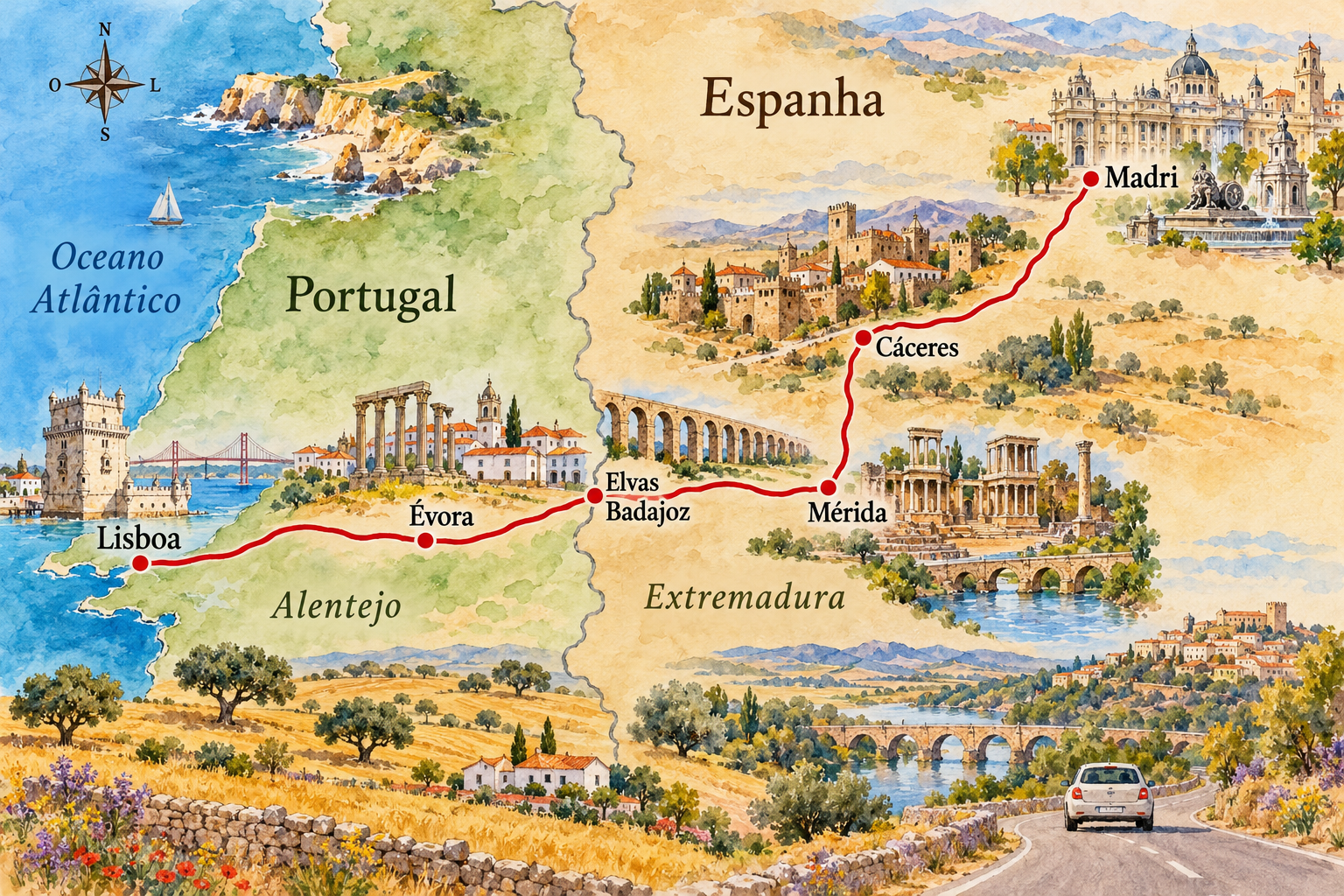
Lisbon is on the Lisbon–Évora–Mérida–Cáceres–Madrid by car

By car between the two capitals of the peninsula: the Alentejo around Évora, Roman Mérida and medieval Cáceres on the route from Lisbon to Madrid.

Illustrative map, not to scale. Tap a city to open its page.
Illustrated map of Lisbon–Évora–Mérida–Cáceres–Madrid by car

Cross-border routes

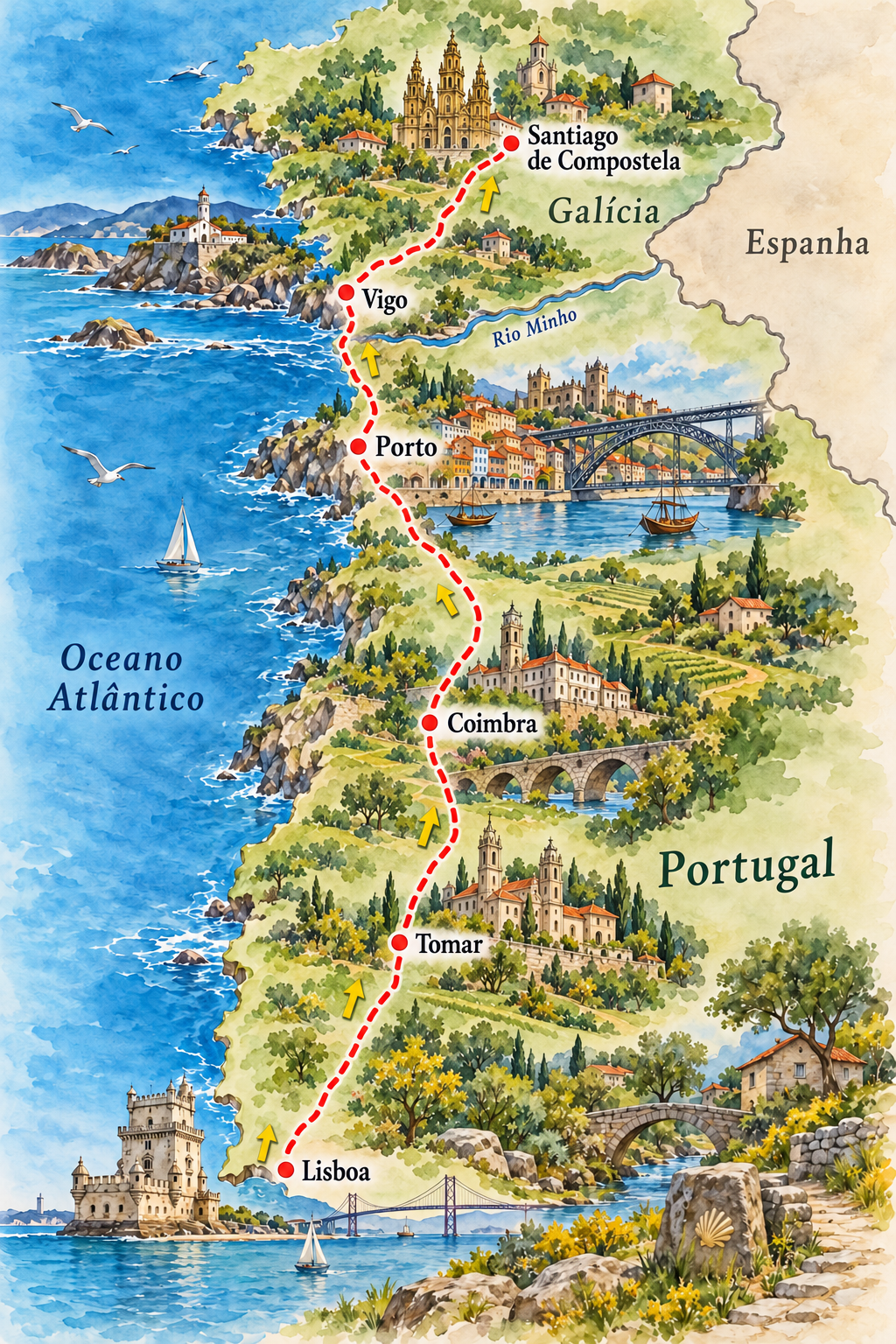
Lisbon is on the Portuguese Way to Santiago on foot

On foot from Portugal to Santiago de Compostela: the pilgrimage route that starts in Lisbon or Porto, follows yellow arrows and ends at Obradoiro Square.

Illustrative map, not to scale. Tap a city to open its page.
Illustrated map of Portuguese Way to Santiago on foot
Explore other destinations Search by state and city