 July
Music · Perugia
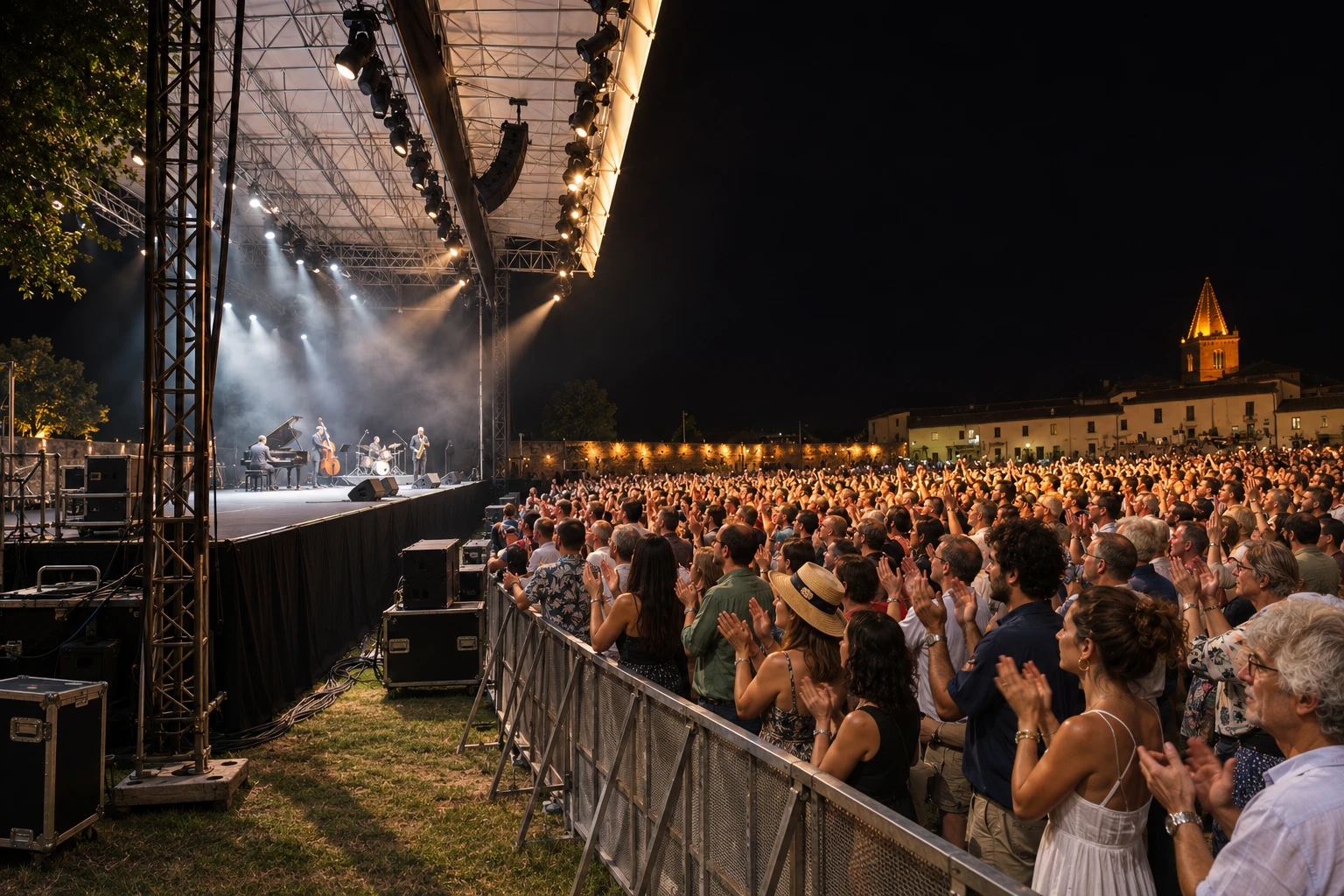
Umbria Jazz
For about ten days in July.
For about ten days in July, Umbria Jazz brings concerts to the Arena Santa Giuliana and to the squares and streets of Perugia’s historic center.

 Search
 Brazil
 Antarctica
 Argentina
 Bolivia
 Chile
 Colombia
 Ecuador
 Falkland Islands (Malvinas)
 French Guiana
 Guyana
 Paraguay
 Peru
 Suriname
 Uruguay
 Venezuela
 Austria
 Belgium
 Croatia
 Denmark
 Finland
 France
 Germany
 Greece
 Hungary
 Iceland
 IrelandItaly
 Luxembourg
 Norway
 Poland
 Portugal
 Slovakia
 Slovenia
 Spain
 Sweden
 Switzerland
 the Czech Republic
 the Netherlands
 the United Kingdom
 Turkey
 Bermuda
 Canada
 Greenland
 Mexico
 Saint Pierre and Miquelon
 the United States
 the Dominican Republic
 JapanTurkey
 Egypt
 South Africa
 Australia
 Fiji
 New Zealand
 Papua New Guinea
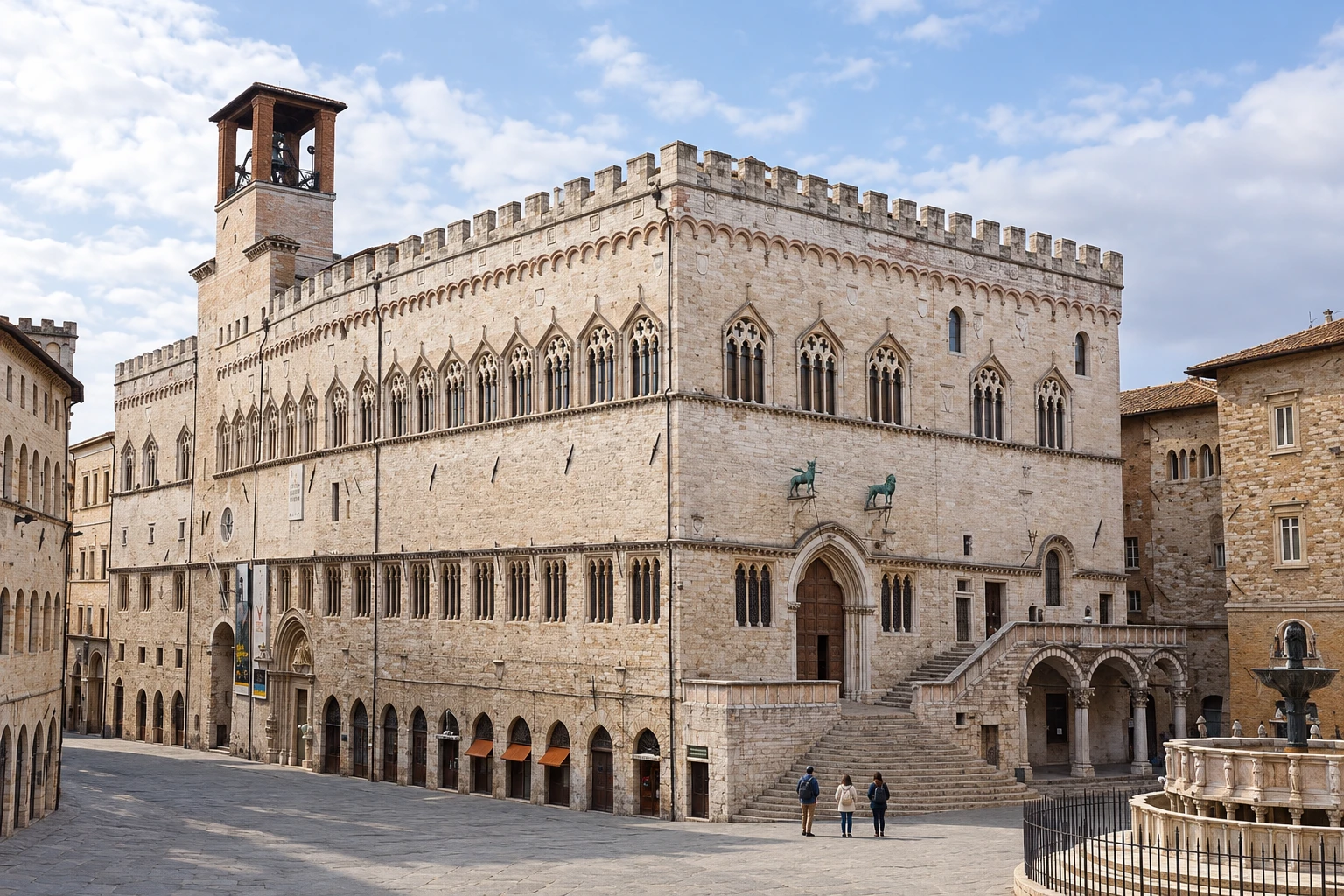
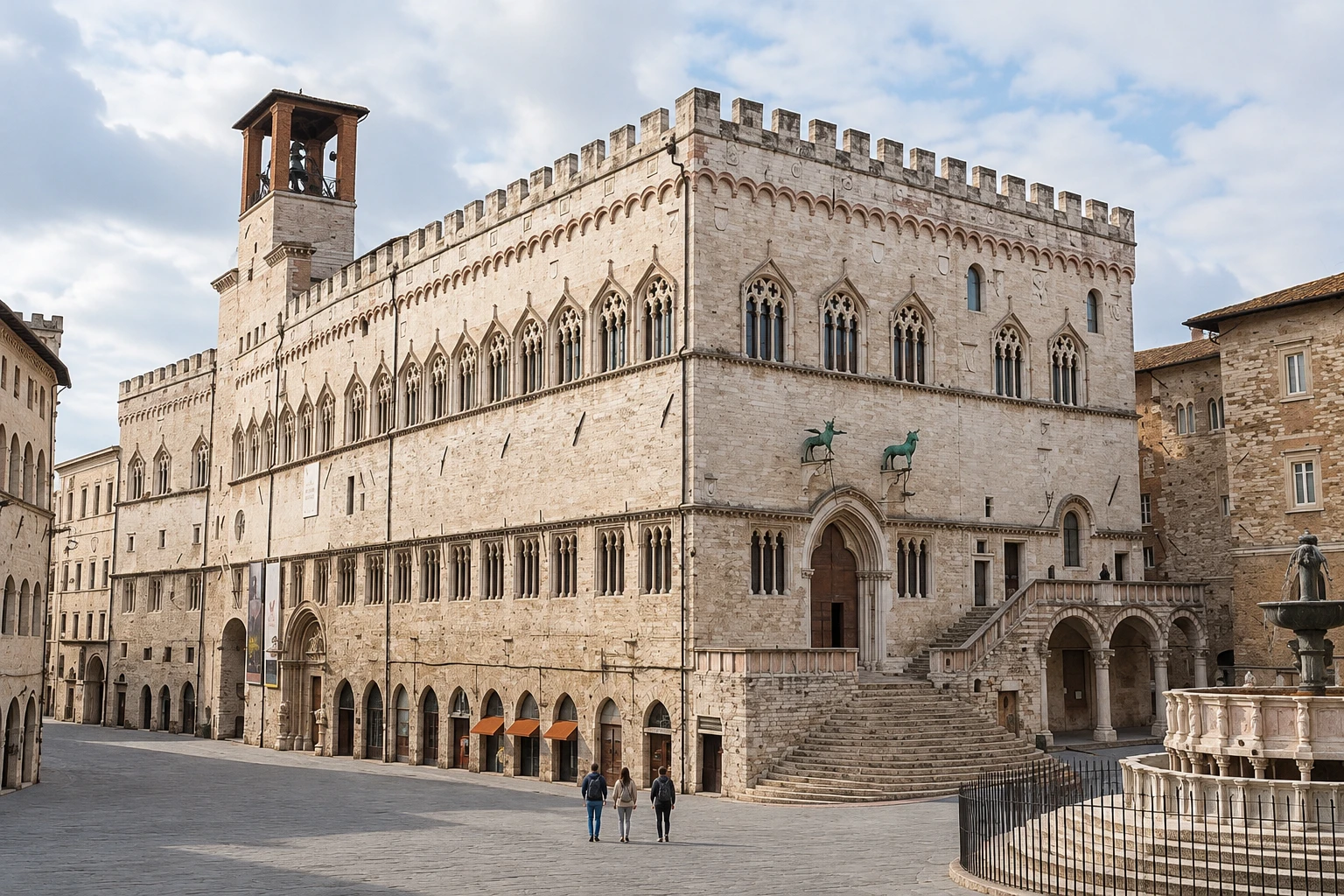
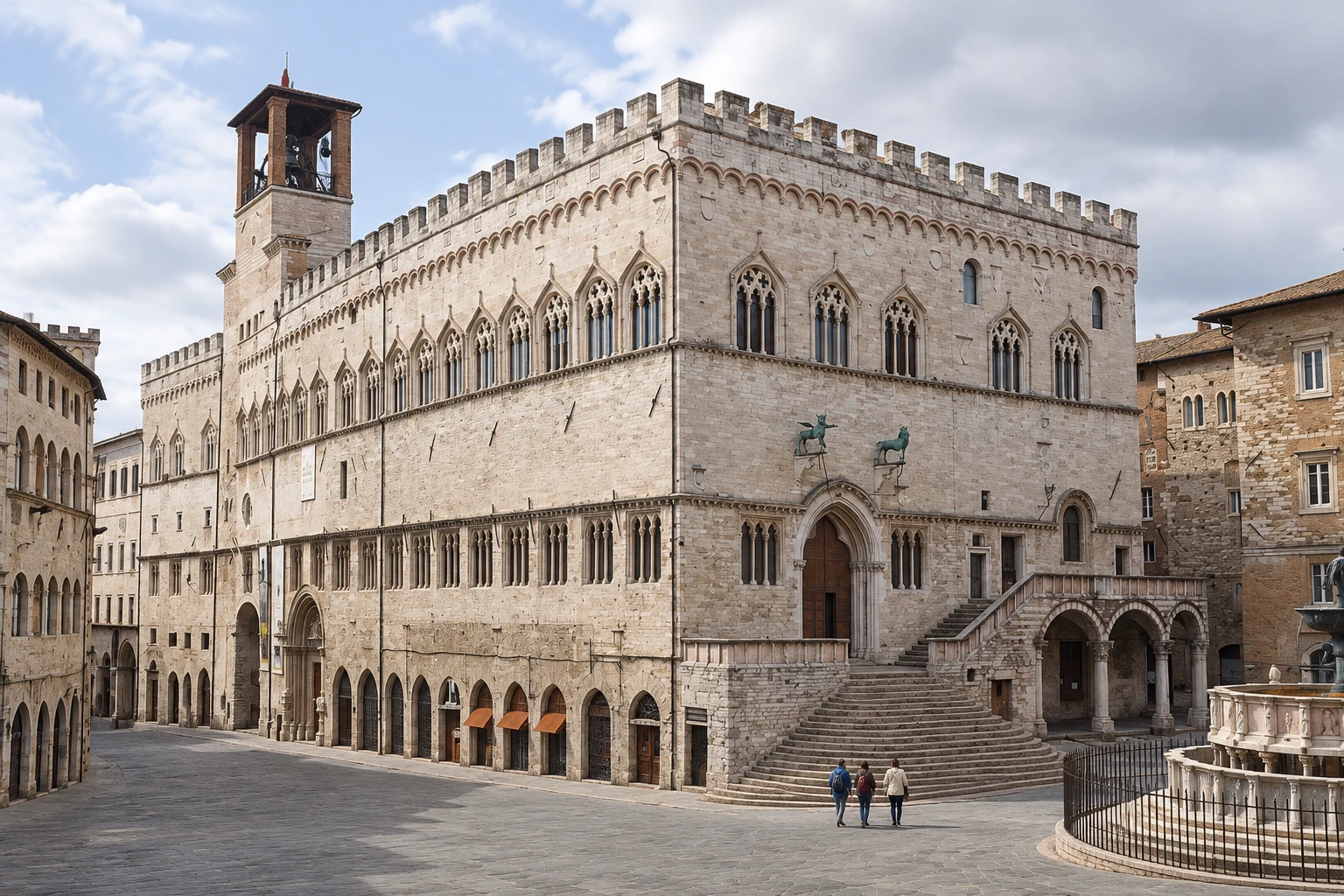
In the photo: Palazzo dei Priori and Piazza IV Novembre, Perúgia
Illustrative images. The pictures in this guide are illustrations based on the real place, not photographs, and may differ from it.

The city
Perúgia, capital of Úmbria, sits atop a hill about 450 metres above sea level, with views over the Tiber valley and Assis. It is a university city of Etruscan origin: the Arco Etrusco and the Pozzo Etrusco recall that past. In the centre, the Fontana Maggiore stands between the Cattedrale di San Lorenzo and the Palazzo dei Priori, which houses the Galleria Nazionale dell'Umbria and the Collegio del Cambio. Under the city, the Rocca Paolina shelters medieval streets.
Perugia, the capital of Umbria, sits on a hill above the Tiber valley. Its oldest part, which locals call the acropolis, preserves three layers of the same city. The Etruscans left travertine walls, monumental gates, and a 37-meter well. The free medieval commune built the Fontana Maggiore and Palazzo dei Priori. In the 16th century the popes built the Rocca Paolina over an entire neighborhood. You can explore all three within a few blocks on foot.
The center follows Corso Vannucci, the pedestrian street linking Piazza IV Novembre and Piazza Italia. At one end are the cathedral, the fountain, and the palace housing the Galleria Nazionale dell'Umbria. At the other, the Giardini Carducci overlook the valley and Assisi. Five historic neighborhoods branch off this main street, each descending along an old road to the gate that gives it its name: Porta Sole, Porta Sant'Angelo, Porta Santa Susanna, Porta Eburnea, and Porta San Pietro. To the north, Porta Sant'Angelo includes Corso Garibaldi, convents, and the round church of San Michele Arcangelo. To the south, Porta San Pietro follows Corso Cavour to San Domenico, the archaeological museum, and the Benedictine abbey. To the west, Via dei Priori leads downhill to the lawn of San Francesco al Prato.
Plan for hills and stairways. The Minimetrò links the Pian di Massiano parking lot and the train station area in the lower city to the center. Escalators also take you uphill through the Rocca Paolina. Once up top, the changes in elevation between neighborhoods are what tire you out. Sturdy shoes help more than any map.
Perugia is a university town, home to the University of Perugia, founded in 1308, and the University for Foreigners in Palazzo Gallenga opposite the Etruscan Arch. Students keep the center busy during the academic year, and August is quieter. Two events change the rhythm: Umbria Jazz in July, with stages in the squares and at the Arena Santa Giuliana, and Eurochocolate in October or November, depending on the year. Perugia has a tradition of chocolate making, with a cocoa museum downtown and factory visits at Perugina in San Sisto.
The inland climate has distinct seasons. Winter, from December to February, is cold and damp, with averages around 6°C and fog in the valley. Spring warms slowly, with showers in April and May. July and August are dry, with highs near 30°C and cooler nights. Fall is mild in September and October and rainy in November, the wettest month.
On a first visit, make time for Piazza IV Novembre and its buildings, the Sala delle Udienze at the Collegio del Cambio with its paintings by Perugino, the Galleria Nazionale, the walk through the Rocca Paolina, and the Etruscan Arch. With more time, add underground Perugia beneath the cathedral, the walkway on the medieval aqueduct, the Basilica di San Pietro, and the Ipogeo dei Volumni, an Etruscan tomb on the road to Assisi.
30 places to stay in Perugia.
30 places to eat in Perugia.
Hotéis e restaurantes da cidade no mapa.
Festivals and events
Dates change every year: check this year's date before you travel.
The local experience
Gothic palace of medieval government in Perúgia, between Piazza IV Novembre and Corso Vannucci. It houses the Sala dei Notari, the Galleria Nazionale dell'Umbria and the Collegio del Cambio.
The main art museum of Úmbria, in the Palazzo dei Priori, with paintings from the 13th to the 19th century: Perugino, Pinturicchio, Piero della Francesca, Beato Angelico and Duccio.
Headquarters of Perúgia's former bankers, in the Palazzo dei Priori, with the Sala delle Udienze entirely painted by Perugino around 1500, including a self-portrait of the artist.
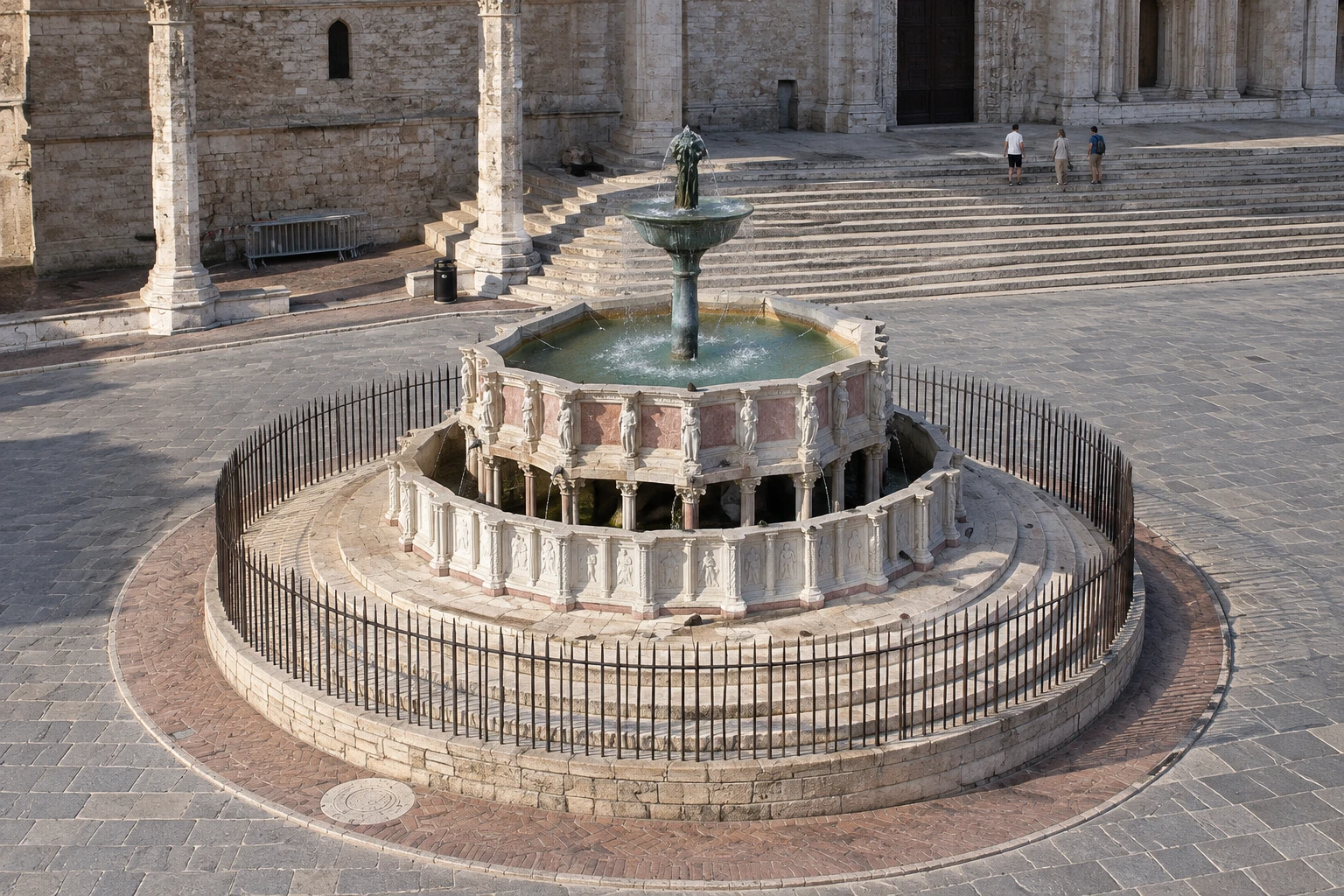
Medieval marble fountain in the center of the Piazza IV Novembre, a symbol of Perúgia, with reliefs by Nicola and Giovanni Pisano depicting the months, the arts and the history of the city.
To choose before you go
Where each tour starts, how long it takes, how it is done, what is included and the price range.
Piazza IV Novembre is the starting point for almost everything in Perugia. At its center stands the Fontana Maggiore, made between 1278 and 1280 by Nicola and Giovanni Pisano to celebrate the arrival of the aqueduct. Two stone basins, one above the other, carry 50 reliefs and 24 statues. The lower basin depicts farm work, the months and zodiac signs, the liberal arts, and scenes from the Bible and Roman history. A bronze bowl with three nymphs crowns the fountain. On one side of the square stands the Palazzo dei Priori, built in stages from 1293 and the seat of city government since the Middle Ages. Fan-shaped steps lead to the Sala dei Notari, a great hall supported by eight arches and covered in paintings and coats of arms. Bronze copies of the griffin of Perugia and the Guelph lion stand above the portal. The originals are in the palace atrium, entered from the Corso. Chains taken from Siena's gates after a battle in 1358 still hang from brackets on the facade. Opposite, the unfinished side of the Cattedrale di San Lorenzo has white and pink stone facing only along its lower section. Inside, the Gothic nave and two aisles rise to the same height. The cathedral holds the Santo Anello, traditionally believed to be the Virgin Mary's wedding ring. Follow Corso Vannucci, the city's pedestrian thoroughfare, to Piazza Italia, with the Palazzo della Provincia and other palaces. The Giardini Carducci and the descent into the Rocca Paolina begin here.
Stops: Fontana Maggiore, Palazzo dei Priori, Sala dei Notari, Cattedrale di San Lorenzo, Corso Vannucci, Piazza Italia.
Includes: The walk through the square and along the Corso is free. The Sala dei Notari usually opens in the morning and afternoon and closes for concerts or conferences.
Tip: Return to the square in late afternoon, when people gather on the cathedral steps. Saturdays usually bring a guided tour through the palace rooms, the two guild halls and the council chamber. Check and book ahead.
Best time: Year-round. The Corso gets very busy during Umbria Jazz in July and on Eurochocolate days.
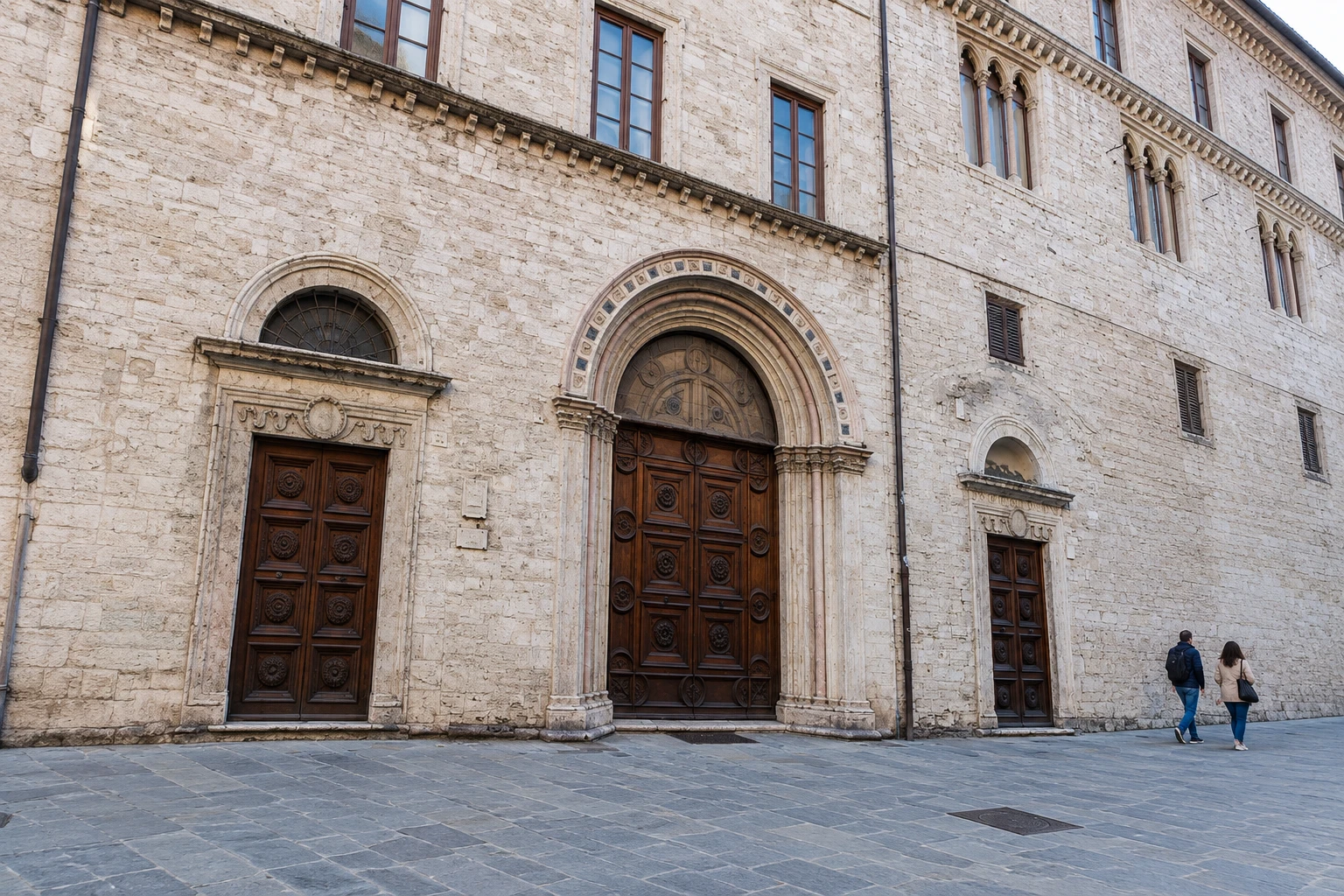
Three sights share this palace, each with a separate entrance on Corso Vannucci. The Galleria Nazionale dell'Umbria occupies the upper floors of the Palazzo dei Priori. Its 40 rooms, tower, and chapel display works from the 13th through the 19th century. It's the place to discover the region's painting, from medieval crucifixes and painted panels to Fra Angelico's polyptych for San Domenico and works by Piero della Francesca, Benozzo Gozzoli, Pinturicchio, and Perugino, the painter after whom the Corso is named. On the ground floor, the Nobile Collegio del Cambio was the headquarters of the money changers' guild, established here between 1452 and 1457. Enter through the Sala dei Legisti with its carved counters, then continue to the Sala delle Udienze, where the money changers received the public. Perugino and his workshop painted the walls and ceiling between 1498 and 1500. Look for his self-portrait in a painted imitation frame. The carved wooden furnishings date to the same period. Beside it stands the chapel of San Giovanni Battista, painted by Perugino's pupil Giannicola di Paolo. Also entered from the Corso, the Nobile Collegio della Mercanzia preserves the meeting room of the merchants, the city's first guild, based here since 1390. Inlaid wood paneling covers the walls and ceiling, and the pulpit and counter are from the same period. It's a short visit that complements the Cambio.
Stops: Galleria Nazionale dell'Umbria, Nobile Collegio del Cambio, Nobile Collegio della Mercanzia.
Includes: Each of the three sites has its own ticket. Check current prices and whether a combined ticket covers both guild halls.
Tip: Spend most of your time at the Galleria and save the guild halls for last. Each small room takes only a few minutes. Opening days and hours change throughout the year. Check ahead.
Best time: Year-round. A good choice on rainy days in April, May, and November and on cold days from December to February.
The Rocca Paolina was the papal fortress in Perugia, designed by Antonio da Sangallo the Younger and built between 1540 and 1543. Construction demolished part of a neighborhood and swallowed the rest. Medieval houses, towers, and streets became the fortress foundations. In the 19th century, its upper sections were torn down as a symbol of papal rule. Piazza Italia now stands in their place. Its underground passages survive, and local people walk through them every day. Take the escalators down beside the Palazzo della Provincia on Piazza Italia. Within a few flights you enter Via Bagliona, a covered stone street with doorways, arches, and intersections in a neighborhood that lost its sky. Some rooms host exhibitions. Along the route is Grande Nero, a kinetic sculpture donated by the artist Alberto Burri. Via Bagliona leads out to Porta Marzia, the main southern gate in the Etruscan walls, dating to the third century BC. Sangallo dismantled its upper section and set it into the face of the bastion. The arch has a gallery of five sandstone figures and the Roman inscriptions Colonia Vibia and Augusta Perusia. Inside, a few meters back, you can still see the original doorjambs. From here, the gardens of the Neptune fountain lead to the Chiesa di Sant'Ercolano, an octagonal tower-shaped church set against the Etruscan wall, and to Porta Cornea, where you can climb back to the center. Finish at the Giardini Carducci lookout at the end of Corso Vannucci.
Stops: Rocca Paolina, Porta Marzia, Giardini Carducci, Chiesa di Sant'Ercolano, Porta Cornea.
Includes: The route through the Rocca is a public passage. Exhibitions in its rooms may charge separate admission.
Tip: If you park at Piazza Partigiani, do the route in reverse, taking the escalators up to Piazza Italia. The passage through Porta Marzia usually opens only in daylight. The escalators run from early morning until the small hours.
Best time: Year-round. The halls usually host Christmas markets in December and early January.
Behind the cathedral, four nearby sights reveal what lies beneath and beyond the city center. Isola San Lorenzo includes the cathedral, the Museo del Capitolo, and the archaeological area known as Perugia Sotterranea. The descent starts in the cloister and takes you beneath both cloisters to the base of the apse. Here are a stretch of Etruscan-Roman street with cartwheel ruts, the remains of a Roman house, and an Etruscan travertine wall about 15 meters high and 40 meters long that still supports part of Piazza IV Novembre. Renovated for its centennial, the museum explores the city's ties with its cathedral and the history of the Santo Anello. On Piazza Danti is the entrance to the Pozzo Etrusco beneath Palazzo Sorbello. The well dates to the second half of the third century BC. Its upper 12 meters form a cylinder about 5.6 meters across, lined with large blocks. The shaft narrows below, reaching a depth of 37 meters. Travertine beams fitted without mortar form the roof. In the same palace, the Casa Museo Palazzo Sorbello displays rooms with painted ceilings, porcelain, and embroidery, and has a window overlooking the valley toward Assisi. Climb to Piazza Raffaello. The Cappella di San Severo holds the only work by Raphael still in the city, a fresco of the Trinity with saints painted between 1505 and 1508. Raphael was called to Rome before he could finish it, and Perugino painted the lower row of saints. A few steps away, Via delle Prome reaches the highest point in town, with steps facing the Sant'Antonio and Sant'Angelo neighborhoods. Descend Via Bontempi to the Arco dei Gigli, one of the five Etruscan gates.
Stops: Isola San Lorenzo, Museo del Capitolo, Etruscan Well, Casa Museo Palazzo Sorbello, Cappella di San Severo, Arco dei Gigli.
Includes: Perugia Sotterranea and Museo del Capitolo, the Etruscan Well, Palazzo Sorbello and Cappella di San Severo charge separate admission. Check current rates and combination tickets.
Tip: Ask about the archaeological area and book ahead. Cappella di San Severo usually closes on Mondays for much of the year and also closes at midday in several months. Check before you go.
Best time: Year-round. The underground passages are cool in summer and sheltered on rainy days.
Porta Sant'Angelo in the north is the longest of the five neighborhoods and the one that has changed the least. Start at the Arco Etrusco, or Arch of Augustus, on Piazza Fortebraccio. Built in the third century BC as the northern gate of the Etruscan walls, it stands 11 meters tall between trapezoidal towers of travertine blocks. The inscription Augusta Perusia was added two centuries later, when Augustus rebuilt the city. A Renaissance loggia tops one tower. To the right, Via Cesare Battisti follows one of the best-preserved stretches of wall. Palazzo Gallenga, home of the University for Foreigners, stands opposite. Via dell'Acquedotto starts nearby. Built between 1254 and 1280, the aqueduct used pressure to carry water uphill from Mount Pacciano to the Fontana Maggiore, a distance of about 4 km. After it went out of use in the 19th century, the final stretch became a narrow walkway along the arches, passing houses with front doors at walkway level. Climb to Corso Garibaldi, a street of churches and monasteries. Near its far end is the Chiesa di San Michele Arcangelo, one of Italy's oldest early Christian churches, dating to the fifth and sixth centuries. It's circular, with sixteen reused Roman columns and light entering through twelve windows. Just beyond is the Cassero di Porta Sant'Angelo, the largest medieval gate, fortified in 1326. Its terrace overlooks the entire city. Beyond the gate, a short uphill walk leads to the Convento di San Francesco al Monte, known as Monteripido, with cloisters and an 18th-century library. On the way back, the former church of San Francesco delle Donne houses the Giuditta Brozzetti weaving workshop, where 18th- and 19th-century handlooms are still in use.
Stops: Arco Etrusco, Acquedotto medievale, Chiesa di San Michele Arcangelo, Cassero di Porta Sant'Angelo, Museo-laboratorio Giuditta Brozzetti, Convento di San Francesco al Monte.
Includes: The walk is free. The Cassero terrace, Brozzetti workshop, and convent have specific visiting days or reservation requirements. Check ahead.
Tip: If the Cassero is closed, enter Parco di Sant'Angelo behind the tower for a similar view of the valley. Brozzetti workshop visits are by appointment.
Best time: April to October for longer days. In winter, go in the early afternoon.
Via dei Priori passes under the Palazzo dei Priori and descends west toward the old gate on the Lake Trasimeno road. Churches and house museums line this narrow medieval street, which links the Corso to the city's Franciscan complex. On the way down you'll see the Torre degli Sciri, about 42 meters tall. Of the dozens of towers that shaped the medieval skyline, this is the only one to survive intact, with four plain sides of pale stone pierced by a few narrow openings. It began as a family's private tower and later became part of a convent. Farther down stands Porta Trasimena, a gate in the Etruscan wall. The street ends at Piazza San Francesco, an open square with a lawn. Here the Franciscans built San Francesco al Prato between 1251 and 1253. The church was the burial place of leading local families and once had two works by Raphael on its altars, both now outside the city. Restored, it serves as an auditorium. Next door is the facade that makes the walk downhill worthwhile. Agostino di Duccio carved the delicate reliefs of the Oratorio di San Bernardino in different colored stones between 1457 and 1461. The facade is considered the high point of Renaissance art in Perugia. The Accademia di Belle Arti museum is nearby.
Stops: Via dei Priori, Torre degli Sciri, Porta Trasimena, San Francesco al Prato, Oratorio di San Bernardino.
Includes: Free walk. You can see the oratory facade from the square. Reserve ahead to visit the church auditorium and tower. The Accademia museum has its own ticket.
Tip: To get back downtown without climbing the entire slope again, use the escalators at the nearby Pellini parking garage.
Best time: Year-round. The square is livelier in the late afternoon from April through September.
The Porta San Pietro neighborhood runs south along a single street, Corso Cavour, which becomes Borgo XX Giugno beyond the gate. Start at the Basilica di San Domenico, the city's largest church. It was built in two phases between 1300 and 1458 and remodeled in the 17th century. Inside are the 14th-century tomb of Pope Benedict XI and a 23-meter-tall stained-glass window from 1411. The former convent next door houses the Museo Archeologico Nazionale dell'Umbria. Etruscan urns from Perugia's burial grounds line the cloister. The tomb of the Cai Cutu family and its contents have been reassembled in an underground space. Highlights include the Cippo perugino, one of the most important inscriptions in the Etruscan language, and bronzes from the princely tomb at San Mariano. Farther downhill, Porta San Pietro has two faces. The inner side dates to the 14th century. Agostino di Duccio and Polidoro di Stefano designed the outer side as a triumphal arch between 1475 and 1480. Its crowning section was never completed. At the end of the street stands the Basilica di San Pietro, part of a Benedictine complex founded in 966. Inside are ancient columns, a gilded coffered ceiling, a carved wooden choir, and paintings by Perugino and Vasari. The sacristy holds five predella panels from a Perugino altarpiece. The pointed bell tower, visible from afar, stands on a Roman mausoleum. Follow the cloisters to the Orto medievale, the monks' garden, planted with species chosen for their symbolism. Across the street are the Giardini del Frontone, the garden of the Arcadian poets, with a small outdoor theater.
Stops: Basilica di San Domenico, Museo Archeologico Nazionale dell'Umbria, Porta San Pietro, Basilica di San Pietro, Orto medievale, Giardini del Frontone.
Includes: Churches and cloisters are free during opening hours. The archaeological museum and San Pietro gallery charge separate admission.
Tip: San Domenico usually opens only in late afternoon, and San Pietro closes at midday. Start at the museum and San Pietro, then stop at San Domenico on the way back. The medieval garden usually opens weekday mornings.
Best time: Year-round. On summer evenings, Giardini del Frontone usually hosts outdoor film screenings.
On its hilltop, Perugia has views in every direction. Italy's official tourism guide suggests five terraces you can link on a walk up and down through the center. The first, at the end of Viale Indipendenza near Piazza Italia, is a stone terrace facing Assisi. Immediately below are the bell tower of San Pietro, the church of San Domenico, and Corso Cavour. Beside it are the Giardini Carducci, with a monument to Perugino and busts of notable Perugians. The gardens take their name from the poet Giosuè Carducci, who wrote Canto dell'amore here. Benches beneath the trees overlook the rooftops and valley. Return along Corso Vannucci and pass through the arch to Piazza Matteotti. An open terrace behind the Mercato Coperto overlooks Santa Margherita park just below, with Assisi and Monte Subasio in the distance. The bustle of the Corso immediately feels far away. Climb from here to Porta Sole. Via delle Prome marks the city's highest point. The adjoining steps face the neighborhoods of Sant'Antonio and Sant'Angelo, and from the top you can take in the whole city. The fifth stop is a longer walk: the terrace of the Cassero di Porta Sant'Angelo, the tower of the largest medieval gate at the end of Corso Garibaldi. If the tower is closed, the Parco di Sant'Angelo behind it overlooks the same valley.
Stops: Viale Indipendenza, Giardini Carducci, Mercato Coperto terrace, Via delle Prome (Porta Sole), Cassero di Porta Sant'Angelo.
Includes: The walk is free. Only the Cassero terrace has limited opening hours and may charge admission.
Tip: The Porta Sole steps and Giardini Carducci are the most popular sunset spots. Save the Cassero for another day with Corso Garibaldi.
Best time: April to October for long afternoons. In winter, fog often covers the valley in the morning.
Perugia has made chocolate for over a century, and the city treats it as part of its history. Explore that connection on two visits, one downtown and the other at the factory. The Città del Cioccolato is in the historic center by Piazza Matteotti. Its museum route follows the culture of cocoa from Mesoamerican civilizations to European courts, exploring where it grows, how a bitter drink became today's chocolate, and the history of Italian brands, particularly those of Perugia. In a small working factory inside the museum, you can watch cocoa beans become bars and, by reservation, make your own bar. The route ends in a large shop devoted entirely to cocoa and chocolate. A nearby tasting and demonstration space also offers access, by reservation, to Perugina's first workshop. The Casa del Cioccolato Perugina is inside the factory at San Sisto in the lower part of the municipality. Start at the historical museum, where wrappers and documents trace the brand back to its 1907 artisan workshop. A product tasting follows, along with a factory visit when the production schedule allows. There's also a chocolate school offering classes and a shop. Both pair well with Eurochocolate, the fair that takes over the city for about ten days in October or November, depending on the year.
Stops: Città del Cioccolato, Casa del Cioccolato Perugina.
Includes: Each visit has its own ticket. Classes, guided tastings and personalized chocolate bars cost extra. Check current rates.
Tip: Perugina visits have timed slots, and the production line isn't always running. Book ahead and ask about your date. San Sisto is a long walk from downtown.
Best time: Year-round. Both sites get busier during Eurochocolate.
Perugia's Etruscan burial grounds lay along the roads leading out of the city. Those open to visitors are within the municipality, a few kilometers from the center. The main site is the Ipogeo dei Volumni on Via Assisana in Ponte San Giovanni, on the road to Assisi. It's part of the Palazzone necropolis, where almost two hundred chamber tombs were dug between the fifth century BC and the Hellenistic period. A steep stairway descends to the entrance passage and the Volumni family chamber, laid out like a house with rooms around a central atrium. Travertine, terracotta, and sandstone urns from neighboring tombs stand at the building entrance. The Antiquarium displays finds from the necropolis. Across town on Via Enrico Dal Pozzo, heading toward the Tiber, is the Complesso templare di San Bevignate. One of the best-preserved Knights Templar complexes, the church has a plain exterior and walls painted in the 13th century. A fresco cycle on the inner entrance wall depicts the mission to the Holy Land, from the sea voyage to a battle in 1242. The apse features a Last Judgment. Restoration revealed a Roman laundry and dye works beneath the church, one of the few found in Italy. Next door, the Cimitero Monumentale, opened in 1849, has tombs that form an outdoor exhibition of 19th- and 20th-century Perugian sculpture. For one more tomb, visit the Ipogeo di San Manno, about 5 km from the center on the Lake Trasimeno road. It serves as the crypt of a small church and has a five-meter Etruscan inscription. Visits are by request.
Stops: Ipogeo dei Volumni, Necropoli del Palazzone, Complesso templare di San Bevignate, Cimitero Monumentale, Ipogeo di San Manno.
Includes: Ipogeo dei Volumni and San Bevignate charge separate admission. The cemetery is free. San Manno opens by appointment only.
Tip: San Bevignate usually opens only on Saturday and Sunday mornings, and also in the afternoons from April to October. If driving to Assisi, stop at Ipogeo dei Volumni on the way.
Best time: Year-round. The tomb is cool and damp in every season.
Città della Domenica is a family park founded in the late 1950s, one of the first of its kind in Italy. About 6 km from central Perugia, it occupies a 45-hectare hill covered in holm oaks, plane trees, and other oaks. It was created by Perugian businessman Mario Spagnoli, son of fashion designer Luisa Spagnoli. The park has two sides. One brings children's stories to life with Pinocchio's village, Little Red Riding Hood's house, Merlin's tower, Sleeping Beauty's castle, and Snow White's cottage. There's also a mini go-kart track, a fort, a maze, a Trojan horse you can enter, and a rocket that doubles as a lookout over the city and the Umbrian countryside. The other side is the wildlife. Many animals roam free in the woods, and the trails introduce European species and others adapted to the local climate. The park's symbol is the white Asinara donkey, a breed it has helped preserve in partnership with the University of Perugia's veterinary faculty. A route on higher ground takes you past kangaroos, reindeer, ostriches, llamas, and dromedaries. A tower near the exit houses the reptile collection. There are falconry demonstrations and a trail of about 300 meters where children can listen to the sounds of the woods. Explore on foot or ride the little train. The gentle pace suits young children and feels more like a walk in the woods than a day of thrill rides.
Stops: Città della Domenica.
Includes: Separate admission. Check current rates and what’s included.
Tip: Check opening dates before visiting. Wear closed-toe shoes, as the trails climb the hill.
Best time: Dry days from April to October. Check the park’s opening calendar.
Day by day
Suggestions to plan the trip. Change the order of the days according to the weather and tour availability.
Take the Minimetrò to Pincetto or ride the Rocca Paolina escalators up and begin at Piazza IV Novembre. See the Fontana Maggiore, the Palazzo dei Priori steps and Sala dei Notari, and the Cattedrale di San Lorenzo. While it's still morning, visit the Galleria Nazionale dell'Umbria, followed by the Sala delle Udienze at the Collegio del Cambio, painted by Perugino. Have lunch on one of the side streets off Corso Vannucci. In the afternoon, descend to the Pozzo Etrusco on Piazza Danti and follow Via Ulisse Rocchi to the Etruscan Arch. Return along Via Cesare Battisti beside the wall and then Via Maestà delle Volte. Late in the day, walk the Corso to Piazza Italia and take the escalators down through the Rocca Paolina to the Porta Marzia exit. Finish at the Giardini Carducci with the valley and Assisi in the distance. Save San Pietro, the aqueduct, and the Etruscan tombs for another day.
Take your time in the morning on Piazza IV Novembre and at the Galleria Nazionale dell'Umbria. Before lunch, visit the two guild halls on the ground floor: the Cambio with Perugino's frescoes and the wood-paneled Mercanzia. In the afternoon, explore behind the cathedral. Visit underground Perugia at Isola San Lorenzo, the Pozzo Etrusco, and the Cappella di San Severo with Raphael's fresco. Climb to Via delle Prome for the view from Porta Sole. Late in the day, walk along Corso Vannucci, cross the Rocca Paolina on Via Bagliona to Porta Marzia, and return to the Giardini Carducci for sunset.
Start at the Etruscan Arch and climb Via dell'Acquedotto, the walkway over the medieval aqueduct. Follow Corso Garibaldi to the round church of San Michele Arcangelo and the Cassero di Porta Sant'Angelo. Return to the center for lunch, then take the Sant'Ercolano steps down to Corso Cavour. Visit the Museo Archeologico Nazionale dell'Umbria in the convent of San Domenico, then continue to the Basilica di San Pietro and the Giardini del Frontone. Stop at San Domenico on the way back, when the church is usually open. If you have energy to spare, head down Via dei Priori to see the facade of the Oratorio di San Bernardino before dinner.
Start early on Piazza IV Novembre with the Fontana Maggiore, the Sala dei Notari, and the cathedral. Continue to the Galleria Nazionale dell'Umbria and the Cambio and Mercanzia guild halls. In the afternoon, visit Isola San Lorenzo and the archaeological area beneath the cathedral, followed by the Pozzo Etrusco and the Cappella di San Severo. End the day with a walk through the Rocca Paolina, leaving by Porta Marzia, and a stop at the Giardini Carducci.
Spend the morning in the north at the Etruscan Arch, Via dell'Acquedotto, Corso Garibaldi, San Michele Arcangelo, and the Cassero di Porta Sant'Angelo. If you've made an appointment, visit the Giuditta Brozzetti weaving workshop on the way down. Head south in the afternoon for the Museo Archeologico Nazionale dell'Umbria, Porta San Pietro, the Basilica di San Pietro, and the Giardini del Frontone. Stop at San Domenico on the way back, then follow Via dei Priori to San Francesco al Prato before dinner.
Spend the morning at the Ipogeo dei Volumni in Ponte San Giovanni on the road to Assisi. On Saturday or Sunday, add the Templar church of San Bevignate and the Cimitero Monumentale next door. Spend the afternoon exploring chocolate, either at the Casa del Cioccolato Perugina in San Sisto, by appointment, or at the Città del Cioccolato downtown. With young children, you could spend the whole day at Città della Domenica instead. Check the park's opening calendar first. If you'd prefer to go out of town, Assisi is about 25 minutes by train and Lake Trasimeno about 40 minutes by car. Both are covered in the Umbria guide.
Best time to go
The seasons shown are the most usual ones; nature doesn't always follow the calendar.
Winter · Valley fog · Christmas markets through January 6
The Perugia weather station's 1991–2020 averages show a temperature of 5.5°C, lows near 2°C, and about 53 mm of rain. Expect damp cold, short days, and morning fog over the valley. Snow sometimes falls in the upper city. Students set the pace in town, and the Palazzo dei Priori museums are quieter. The Rocca Paolina Christmas markets usually run through the 6th. Bring a heavy coat and shoes with good grip for the hills.
Winter · Clear, cold days
The Perugia weather station's 1991–2020 averages show a temperature of 6.5°C and about 57 mm of rain. It's still winter, with occasional clear days when you can see the snow-covered Apennines from the lookouts. It's a quiet month for the Galleria Nazionale, the archaeological museum, and the underground sites. Some places open for only part of the day in the colder months, so check before you go.
Early spring · Longer days
The Perugia weather station's 1991–2020 averages show a temperature of 9.4°C and about 54 mm of rain. Afternoons grow longer and the surrounding hills start to turn green. Sunny days alternate with cold winds. It's a good month for walks in the Sant'Angelo and San Pietro neighborhoods, with a warm layer in your bag.
Spring · International Journalism Festival · Easter
The Perugia weather station's 1991–2020 averages show a temperature of 12.4°C and about 72 mm of rain, mostly in showers. Perugia usually welcomes the International Journalism Festival in April, with events in the old town. Accommodations are in demand during the festival. Easter and the April 25 and May 1 holidays also draw Italian visitors. Bring a raincoat.
Spring in full bloom · Long afternoons
The Perugia weather station's 1991–2020 averages show a temperature of 16.6°C and about 76 mm of rain in brief storms. Temperatures are comfortable for walking all day, with breaks in museums when it rains. The Giardini del Frontone and Giardini Carducci fill up in the late afternoon. It's one of the best months for exploring the city on foot.
Early summer · Perugia 1416
The Perugia weather station's 1991–2020 averages show a temperature of 21°C and about 70 mm of rain. The days are long, and the upper city is still comfortable in the heat. Early in the month, Perugia 1416 usually brings the five neighborhoods together for a historical festival with parades and games in period costume. The squares fill up at night.
Summer · Umbria Jazz
The Perugia weather station's 1991–2020 averages show a temperature of 23.6°C, highs near 30°C, and about 37 mm of rain, making this the driest month. Umbria Jazz takes over for about ten days, with its main stage at the Arena Santa Giuliana and music in the squares and the Giardini Carducci. Book accommodations months ahead for those dates. Visit museums and churches in the morning.
Summer · Ferragosto · Outdoor movies at the Frontone
The Perugia weather station's 1991–2020 averages show a temperature of 23.9°C and about 50 mm of rain, with thunderstorms late in the month. Students leave town, and Ferragosto on August 15 is a public holiday. Evenings are cooler, and the Giardini del Frontone usually hosts outdoor movies.
Late summer · Students return
The Perugia weather station's 1991–2020 averages show a temperature of 19.4°C and about 88 mm of rain, concentrated in a few stormy days. The heat eases, the light falls at a lower angle, and students return. It's one of the most pleasant months for the lookouts and longer walks, such as Corso Garibaldi.
Fall · Eurochocolate in some years
The Perugia weather station's 1991–2020 averages show a temperature of 15.3°C and about 86 mm of rain. Fall is mild, with foggy mornings. Eurochocolate has taken place in both October and November. Check this year's dates before planning your trip, as prices rise and the center fills up during the fair.
Fall · Wettest month · Eurochocolate in some years
The Perugia weather station's 1991–2020 averages show a temperature of 10.2°C and about 95 mm of rain, the highest rainfall of the year. Short, damp days suit museums and underground visits. When Eurochocolate falls in November, the fair runs for about ten days, and the Minimetrò extends its weekend hours. Outside those dates, the month is quiet.
Winter · Christmas markets in the Rocca Paolina
The Perugia weather station's 1991–2020 averages show a temperature of 6.2°C and about 68 mm of precipitation, sometimes falling as snow. Christmas markets usually fill the rooms of the Rocca Paolina from early December through January 6. The city tends to fill up again between Christmas and New Year's.
Plan the journey
The nearest airport is Umbria International Airport – Perugia San Francesco d'Assisi (PEG), in Sant'Egidio within the municipality, about 12 km from the center. It handles a limited number of domestic and European flights, varying by season. Plan on a taxi or rental car from the terminal, or check whether a bus runs at your flight time.
Travelers coming from farther away often arrive at Rome Fiumicino (FCO), about 200 km away, and continue by train or car. Other options include Rome Ciampino, Florence, Pisa, and Ancona.
Before booking, check the route, connections, and seasonal operating dates with the airline.
Perugia is on the Foligno–Terontola line, which connects two major rail routes in central Italy. From Rome, take the Ancona line to Foligno and change for Perugia. The second leg takes about half an hour, for a total trip of about 2 to 2½ hours. From Florence, take the Rome line to Terontola and change there. Allow about 2 hours overall. Some trains run direct.
Assisi is on the same line, about 25 minutes away. For Lake Trasimeno, take a train toward Terontola.
The main station, Fontivegge, is in the lower city. Continue to the historic center on the Minimetrò, which stops near the station, or take a city bus. It's a long climb on foot. Regional trains have no assigned seats. Validate your ticket before boarding and check times and connections.
On the A1 from the north, exit at Valdichiana and follow the Perugia–Bettolle link road past Lake Trasimeno. From the south, exit at Orte and continue via Terni and the E45. From the Adriatic coast, take the E45 from Cesena. Rome is about 2 hours and 15 minutes away and Florence about 2 hours.
The historic center is a restricted traffic zone (ZTL), with access rules varying by street, day, and time. Check before driving in.
There are two main parking options. Pian di Massiano, at the Perugia-Madonna Alta exit, has about 3,000 free spaces next to the Minimetrò terminal. Closer to the center, paid lots include Piazza Partigiani and Piazzale Europa, both linked to the upper city by escalators, plus Mercato Coperto, Ripa di Meana, Pellini, and Viale Sant'Antonio. Use the Prepo or Piscille exit for the center and San Faustino for the train station.
Umbria's regional buses connect Perugia with Assisi, Gubbio, Todi, the villages around Lake Trasimeno, and towns without train service. Busitalia operates the routes, with fewer departures on Sundays and holidays.
Trains are usually simpler for Assisi and Lake Trasimeno. Buses are a good choice for Gubbio and Todi, which are off the main rail line.
Check the current timetable before setting out and buy a ticket before boarding.
The Minimetrò uses small cable-pulled cars to climb from Pian di Massiano to Pincetto at the edge of the historic center, passing close to the train station. It operates daily with a car every two or three minutes, and all stations have ramps and elevators. A single ticket is valid for 70 minutes. You can pay by tapping at the turnstile.
The same ticket, called UP, works on city buses and on regional trains between stations within the municipality, including Ponte San Giovanni. Always validate, including when transferring between forms of transportation.
Escalators fill the gaps. Those in the Rocca Paolina link Piazza Partigiani to Piazza Italia. Others serve the Pellini and Piazzale Europa parking areas and the Pincetto exit.
Once on the hill, you can walk everywhere, with slopes and stairways between neighborhoods. Take a bus, taxi, or car to San Sisto, the Ipogeo dei Volumni, or Città della Domenica. Tourist information is available on Via Oberdan and Via della Rupe near Corso Vannucci.
Your questions
By the Minimetrò, which departs near Fontivegge station and arrives at Pincetto station in the historic centre in a few minutes. There are also city buses.
Yes. The regional train takes about 20 minutes to Assis station in Santa Maria degli Angeli, and from there a bus goes up to the centre.
About 2h30 to 3h, usually with a change in Foligno or Terontola. Confirm times and connections before buying.
It is a chocolate festival that usually fills the centre of Perúgia in October. Perúgia has a tradition of chocolate production. Confirm dates and the programme.
No. The centre is a ZTL, closed to outside cars. Use the lower car parks and the escalators or the Minimetrò.
One day covers the main square, the Galleria Nazionale, Rocca Paolina, and the Etruscan Arch. With two days add the Sant'Angelo and San Pietro neighborhoods, the medieval aqueduct, and the abbey. Three days leave time for the Etruscan tombs outside the walls and chocolate visits, or a day in Assisi or at Lake Trasimeno.
May, June, and September usually combine mild temperatures with long days, good for walking the hills. April, May, and November are the rainiest months. July and August are hot and dry, with highs near 30°C. December through February is cold, with averages near 6°C and fog in the valley.
The festival usually takes over the city for about ten days in July. The main stage is at Arena Santa Giuliana near Piazza Partigiani, with more music in the central squares and Giardini Carducci. The Minimetrò usually runs later, and accommodation sells out early. Check dates for the year you're visiting.
It varies by year. The chocolate fair has taken place in both October and November and runs for about ten days across two weekends. Check the official calendar before booking, whether you're coming for the festival or hoping to avoid the crowds.
For free parking, leave your car at Pian di Massiano in the lower town and ride the Minimetrò up. For a closer option, use a paid lot near the center. Piazza Partigiani and Piazzale Europa have escalators up to the historic center. Check the limited traffic zone rules before driving into town.
Yes. Umbria International Airport in Sant'Egidio is about 12 km from downtown and has a small number of domestic and European flights. For long-haul flights, most travelers use Rome Fiumicino and continue by train or car. Confirm routes and seasonal availability with your airline.
Many sights are indoors. The Galleria Nazionale dell'Umbria and the Cambio and Mercanzia guild halls share one palace. Rocca Paolina has an underground medieval street. Explore the archaeological area beneath the cathedral and the nearby Etruscan Well. The archaeological museum in the San Domenico convent and the chocolate museum round out a full day under cover.
The highlight is the Sala delle Udienze at the Collegio del Cambio, painted by Perugino and his workshop between 1498 and 1500 and including a self-portrait. The Galleria Nazionale dell'Umbria has several works. The Basilica di San Pietro holds canvases and panels from an altarpiece, and he also painted the lower row of saints in the San Severo chapel fresco.
Yes, one work. The Cappella di San Severo on Piazza Raffaello in the Porta Sole district houses the Trinity with Saints fresco, painted by Raphael between 1505 and 1508. Called to Rome before finishing it, he left the lower section for Perugino to complete. The chapel usually closes on Mondays for much of the year.
Yes. The Casa del Cioccolato Perugina in San Sisto, in the lower part of the municipality, brings together a history museum, tasting, chocolate school, and shop. Production line visits depend on the factory schedule. Reserve ahead and ask whether the line will be running that day.
Yes, it's hilly. The center sits on a hilltop, with slopes and stairs leading down into the neighborhoods. The Minimetrò provides ramps and elevators at all stations, and the Rocca Paolina escalators offer another way up. Corso Vannucci is pedestrianized. Ask the tourist office about the most accessible routes to other neighborhoods.
In the historic center, you can explore on foot and spend evenings on Corso Vannucci right outside your door. Leave your car in a lot outside the limited traffic zone. The lower town near Fontivegge station and the Minimetrò is convenient for rail and car arrivals. The ride up to the center takes just a few minutes.
Yes. Nonresidents staying in hotels, guesthouses, and vacation rentals pay a city accommodation tax per person per night, for up to seven nights. The amount varies by type of accommodation. Pay the property directly at the end of your stay. Check current rates.
Inland Umbrian cooking features cured meats, cheeses, house-made pasta, and torta al testo, a griddled flatbread served with a filling. Fall and winter bring truffles and freshly pressed olive oil. Chocolate is the city's sweet specialty, and local wines accompany meals.
By car, the lake is about 40 minutes away on the Perugia–Bettolle expressway. Trains toward Terontola stop along the shore. Castiglione del Lago is one of the lakeside towns. Buses are less frequent on Sundays, so check the schedules.
Yes, with an itinerary suited to them. The Minimetrò and the escalators inside Rocca Paolina can be outings in themselves. The Etruscan Well and chocolate museum hold children's attention, and POST is a science center with interactive exhibitions. Outside the center, Città della Domenica is an animal and fairy-tale park. Check its opening calendar.
The city has two offices in the historic center within a few steps of Corso Vannucci: one on Via Oberdan and another on Via della Rupe beside the Biblioteca degli Arconi. Both provide maps and brochures and can help arrange guided visits.