

 Brazil
 Antarctica
 Argentina
 Bolivia
 Chile
 Colombia
 Ecuador
 Falkland Islands (Malvinas)
 French Guiana
 Guyana
 Paraguay
 Peru
 Suriname
 Uruguay
 Venezuela
 Albania
 Austria
 Belgium
 Croatia
 Denmark
 Finland
 France
 Germany
 Greece
 Iceland
 Ireland
 Italy
 Luxembourg
 Norway
 Poland
 Portugal
 Slovakia
 Slovenia
 Spain
 Sweden
 Switzerland
 the Czech Republic
 the Netherlands
 the United Kingdom
 Turkey
 Bermuda
 Canada
 Greenland
 Mexico
 Saint Pierre and Miquelon
 the United States
 the Dominican Republic
 Japan
 Egypt
 South Africa
 Australia
 Fiji
 New Zealand
 Papua New Guinea
Cultural and heritage travel
Museums in Hungary
An altarpiece designed to open before worshippers now stands in Budapest’s former throne room. In Pécs, ceramics have returned to the grounds of the factory where they were made. Some of the best museum visits in Hungary begin with this connection between what you see and where you’re standing. Knowing where an object came from changes the questions we ask when we stand in front of it.
For a first trip, let what catches your eye guide your choice. At the Hungarian National Gallery, you can explore centuries of art. Szentendre has museums devoted to individual artists. Miskolc tells the story of how objects and paintings made their way from private collections to public exhibitions.
Altarpieces in Budapest’s former royal palace
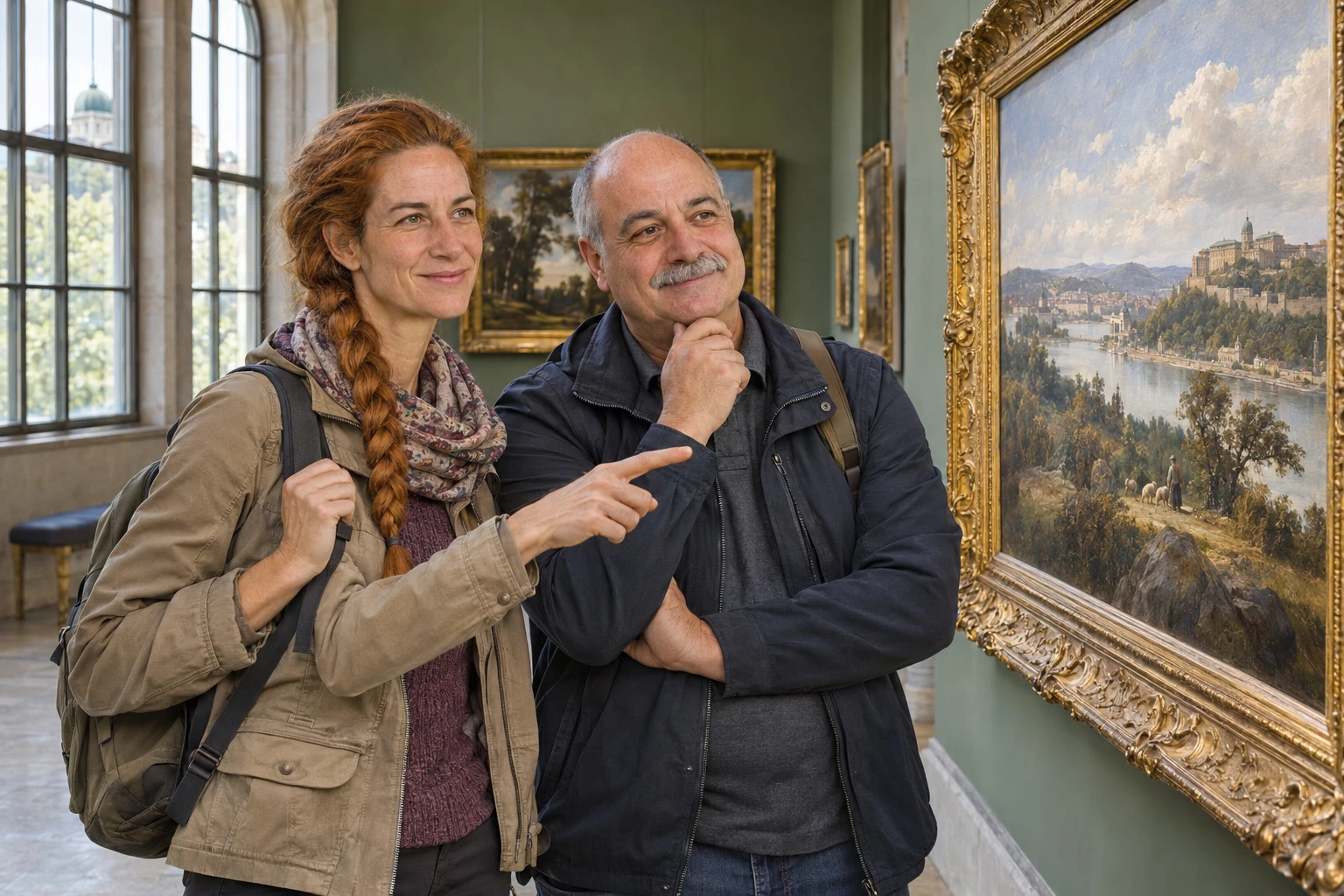
The Hungarian National Gallery’s setting in the Buda Castle District is an attraction in its own right. Inside the former royal palace, the collection of Gothic altarpieces fills the former throne room and adjoining spaces. An altarpiece stood at the altar of a church. On altarpieces with movable panels, the image worshippers saw could change depending on whether the wings were open or closed.
Start with an altarpiece whose central section is easy to distinguish from its wings. Then step closer to one panel to see how the wood was painted or carved. The spacious room makes it easy to move between these two viewpoints. If you prefer 19th-century art, you can choose that part of the collection as soon as you enter and plan your route through the palace around it.
From factory to display case in the Zsolnay Cultural Quarter
In Pécs, the former factory buildings and the places where the Zsolnay family lived now form a cultural quarter. The walk from one exhibition to the next is part of the visit. Some ceramics are on display outdoors, too. Notice the difference in scale between a piece made for a garden and tableware that would fit on a dining table.
The Gyugyi Collection showcases the period when the factory gained wide recognition for its artistry. The exhibition of pink ceramics offers a look at objects made for everyday use. Try picking a shape, such as a jug with a handle or a plate, and looking for it from one display case to the next. It’s a way to explore without getting lost in the sheer variety of designs. If you’re interested in the people who made these pieces, the exhibition on the history of the family and the factory provides context.
An encounter with two artists in Szentendre
The Margit Kovács Museum gives you a close look at studio ceramics. Rather than starting with what a figure represents, let your eye follow the way the artist shaped the clay. Notice where she stretched a form, joined pieces together, or let a raised detail catch the light. At the museum dedicated to Béla Czóbel, look at how he used paint to explore similar questions of volume and outline on a flat surface.
The two museums are at different addresses. If you only have time for one, the choice can be as simple as deciding between clay modeling and painting. If you’re visiting as a family, each person can pick a work and show the others a detail they might otherwise miss. Afterward, you can keep the conversation going as you walk through the streets of central Szentendre.
Private collections and the city’s past in Miskolc
At the Herman Ottó Museum’s gallery, the stories of collectors Sándor Petró and István Kövesi offer two ways into the painting collection. It’s worth reading the labels to see where the works came from. Two paintings that hang side by side today may have spent years in very different homes and collections. To get to know Miskolc itself, look for the exhibition on the city between the world wars and see if you can recognize the streets you’ve walked today in the old views of the city.
Frequently asked questions
Where can you see Hungarian art in the Castle District?
At the Hungarian National Gallery, housed in Budapest’s former royal palace. Check the floor plan to find works from the period that interests you.
Which museum should you visit to see ceramics in Pécs?
The Zsolnay Cultural Quarter has several exhibitions in the former factory. The Gyugyi Collection and the pink ceramics exhibition offer a choice between art pieces and everyday objects.
Are there ceramics museums outside Pécs?
In Szentendre, the Margit Kovács Museum is dedicated to the ceramic artist’s work. You can fit a visit into a walk through the old town.
How can you find a particular exhibition in Miskolc?
Look for the exhibition title in the Herman Ottó Museum’s listings and note the address shown. The museum has several venues.
Where to go: Museus
Pick a region or type what you are looking for to see the cities and who offers it in each.
-
Budapest BU
A Galeria Nacional Húngara ocupa o antigo palácio real no Bairro do Castelo.
-
Szentendre PE
A cidade reúne museus ligados a artistas como Margit Kovács e Béla Czóbel.
-
Miskolc BZ
O Museu Herman Ottó mantém coleções de arte e história regional.
-
Pécs BA
A antiga fábrica de cerâmica Zsolnay abriga exposições e espaços culturais.
More activities in Cultural and heritage travel


Beyond the guide


