Bajai halászlé
Baja fish soup from the banks of the Danube, made with carp, onion and ground paprika cooked together in a cauldron, without straining the broth. It’s served over a thin noodle, gyufatészta, with the fish on the side and hot pepper.
Antarctica
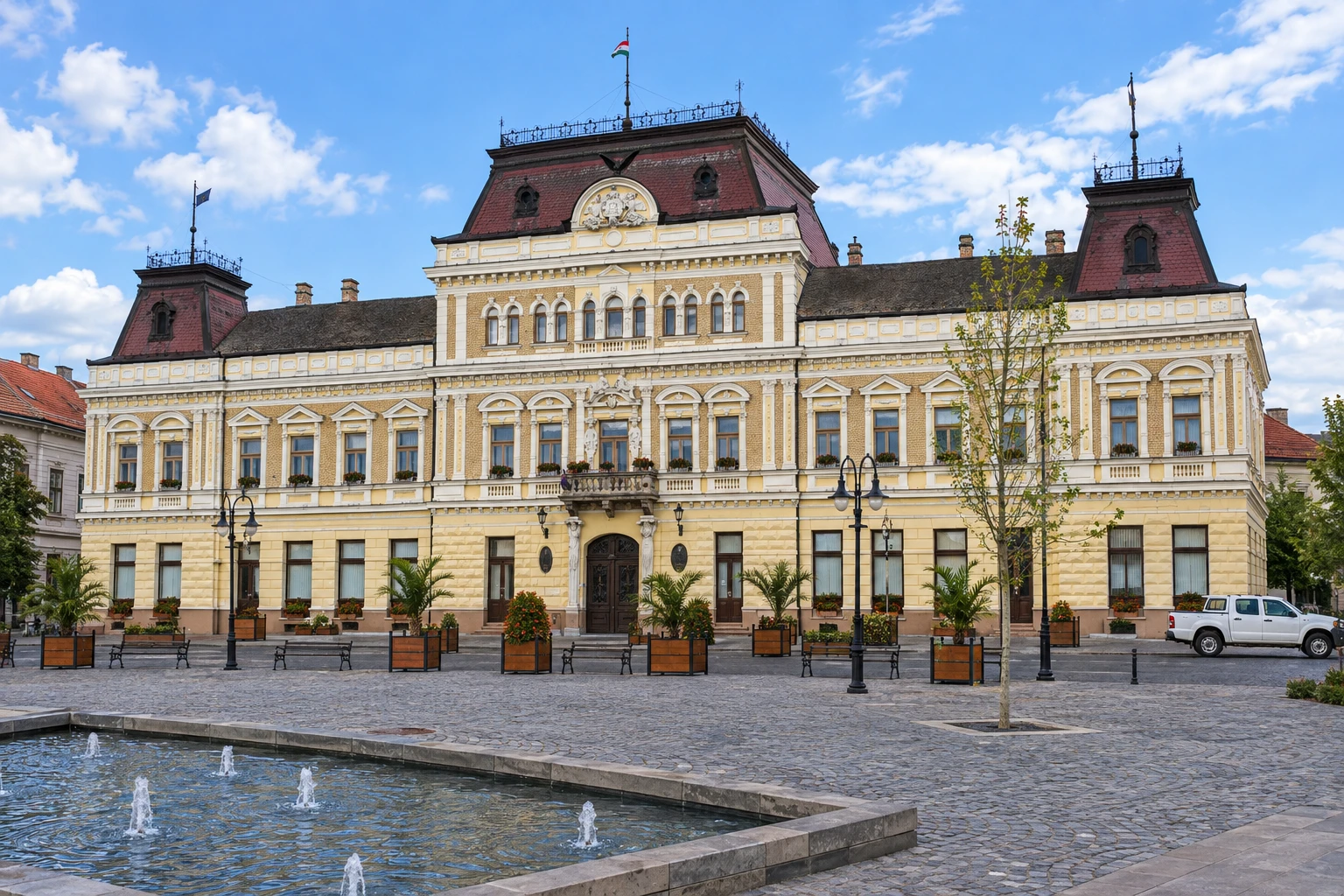
In the photo: Baja Town Hall, Szentháromság tér
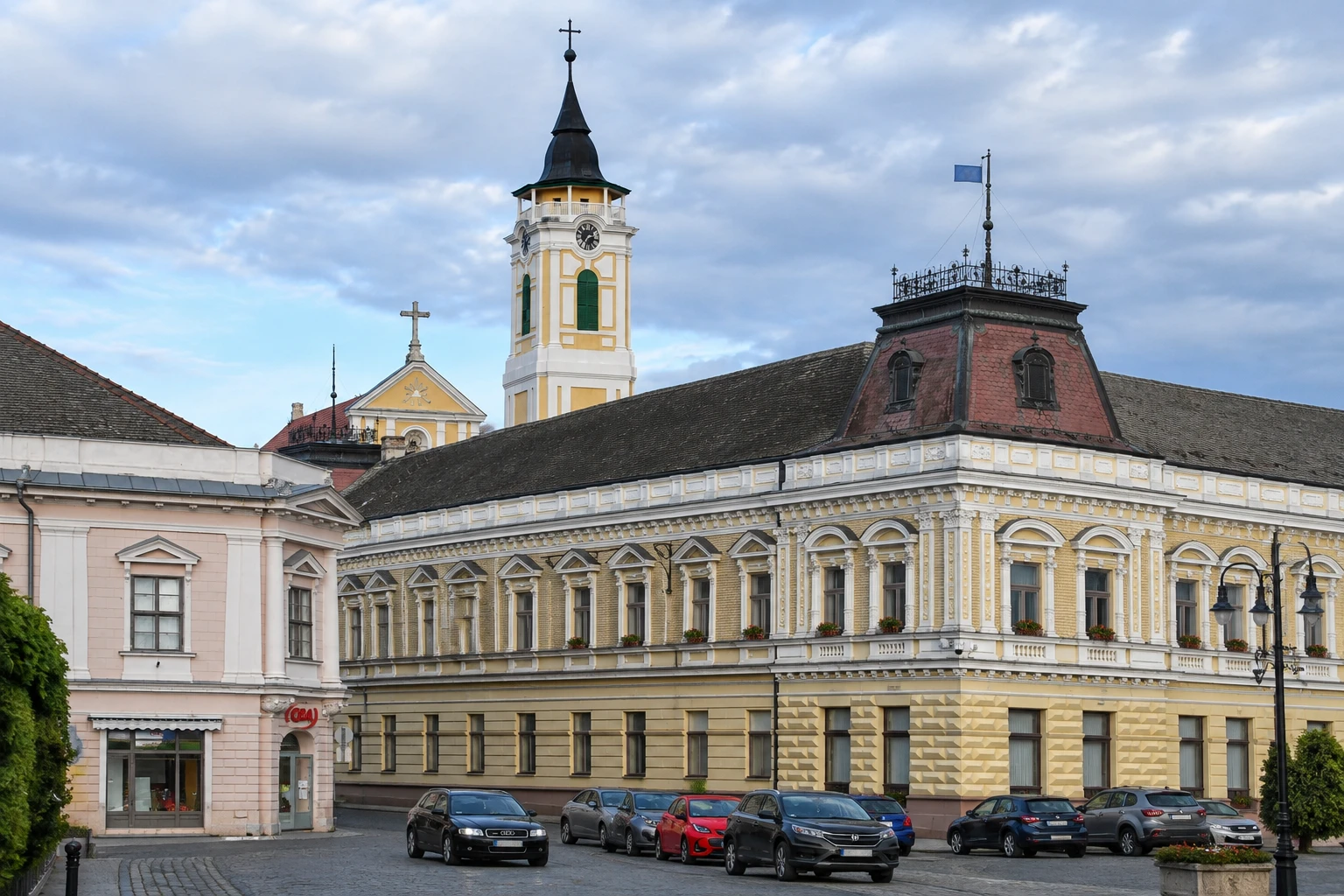
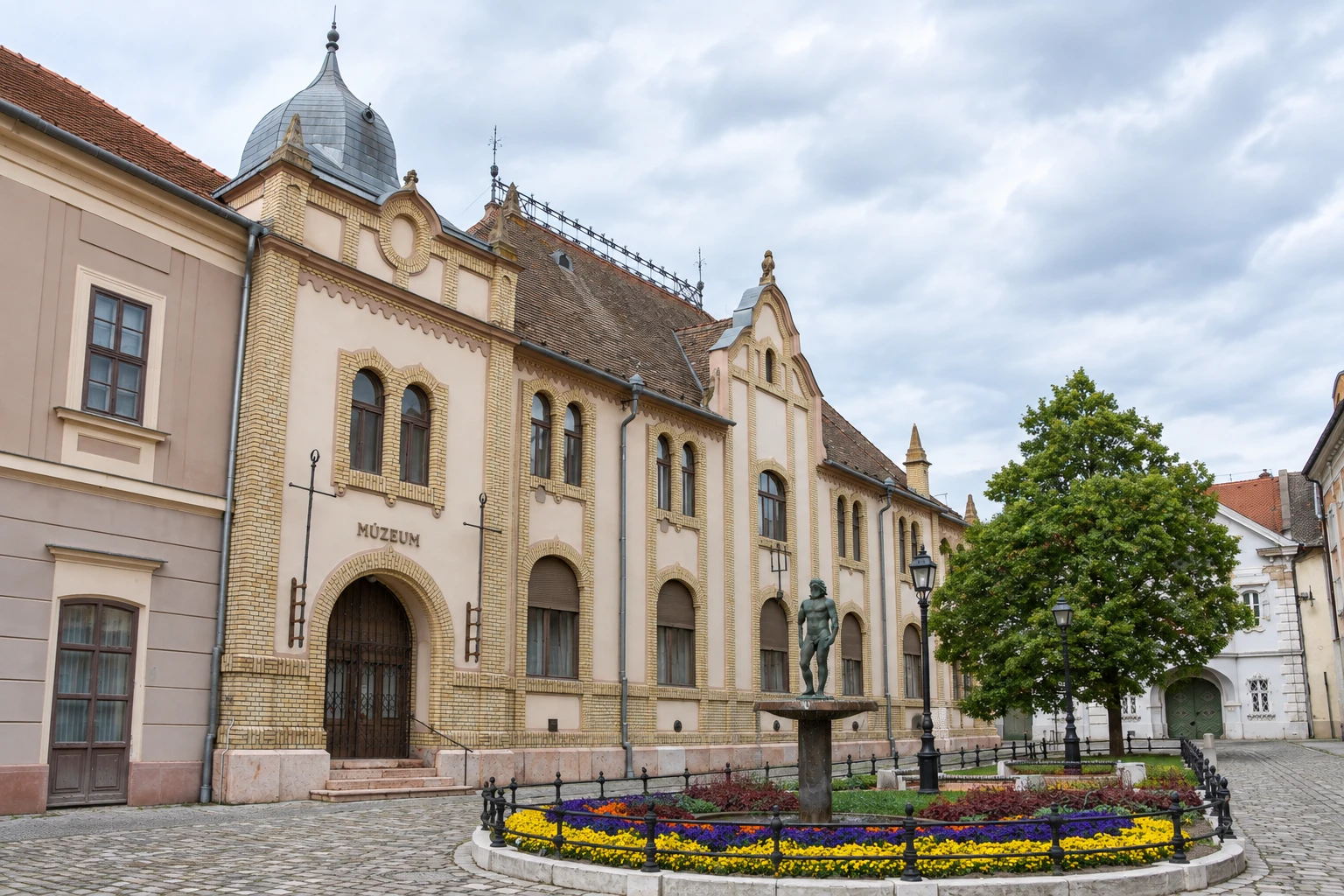
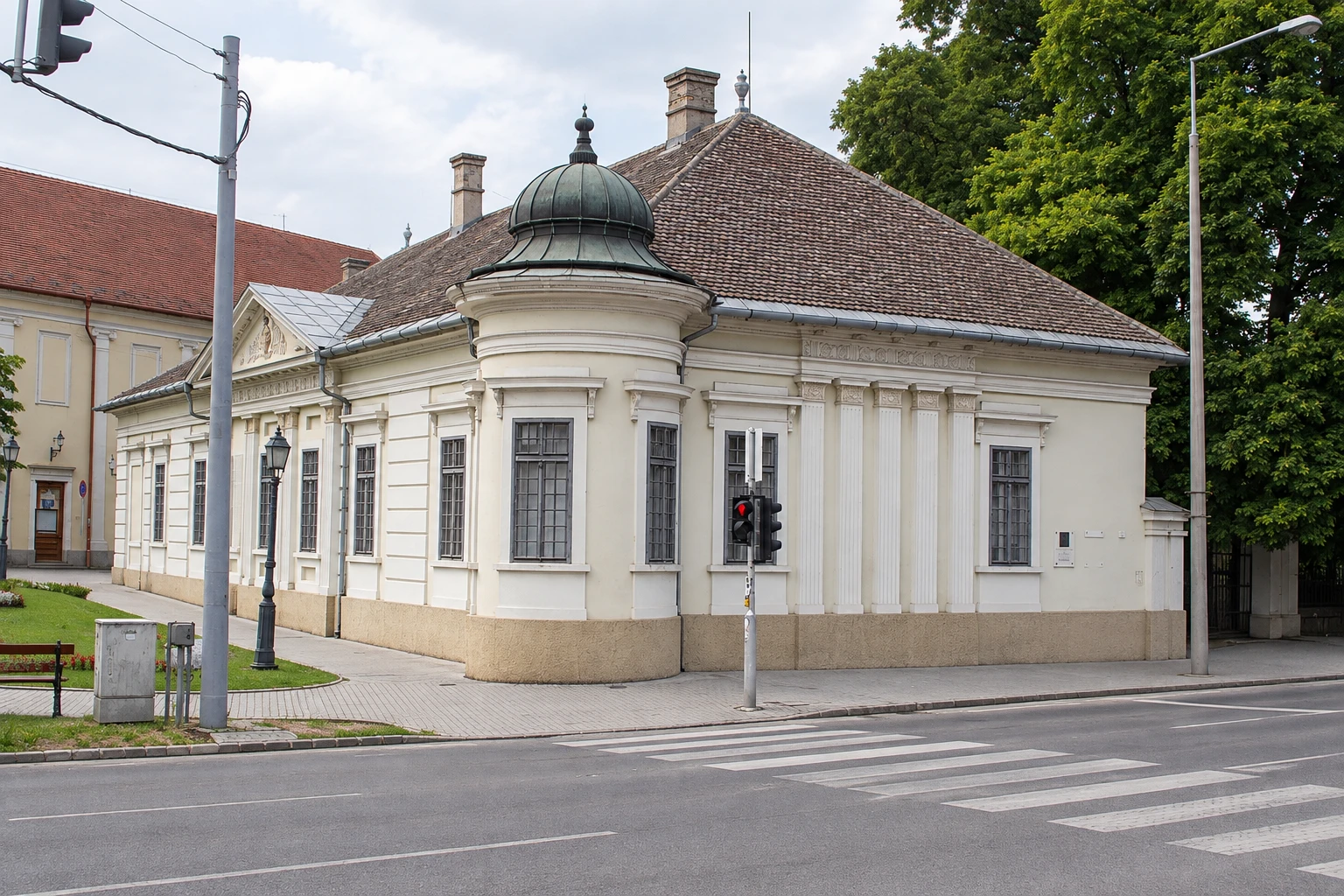
Illustrative images. The pictures in this guide are illustrations based on the real place, not photographs, and may differ from it.
The city
Port city on the left bank of the Danube beside the Sugovica arm, with a broad main square open to the river, Szentháromság tér. It had Hungarian, German, Serbian and Bunjevci populations, and its churches and museums tell that story. It is the city of Bajai halászlé, the local fish soup, and the gateway to the Gemenc floodplain forest.
Baja is in southern Hungary, on the left bank of the Danube, about 175 km by road from Budapest and about 90 km from Szeged. It is the second-largest city in Bács-Kiskun County, with just over 30,000 residents. The Türr István Bridge, on the way out of the city, is the country’s southernmost Danube crossing. It carries both the road and the railway linking the Great Hungarian Plain to western Hungary. Gemenc Forest begins on the other side of the river.
Water shapes the layout of the city. The center lies on the east bank of the Sugovica, a branch of the Danube, and is easy to explore on foot: Szentháromság tér, pedestrian-only Eötvös Street, Tóth Kálmán tér, and the museums are all within a few minutes’ walk of one another. On the west bank, Petőfi Island is linked to the center by a bridge. It has boathouses, sports courts, a swimming pool, and a stretch of sand where people go to swim in the river in summer. Farther on, a bridge for pedestrians and cyclists leads to Nagy-Pandúr Island, which is almost entirely wooded. Where the Sugovica rejoins the Danube, you’ll find the Türr István lookout and a small open-air fishing museum.
In the 18th and 19th centuries, Baja was a port for grain, wine, and timber. You can still see traces of the different communities of that time in its streets: Catholic churches, a Serbian Orthodox church, the former synagogue that now houses the city library, and a replica of a wooden barge like the ones that brought German settlers down the river. The museums preserve paintings by István Nagy and the history of fishing on the Danube. Fishing also gave Baja its signature dish, a fish soup with thin noodles that is celebrated at a festival in July.
The climate is continental. From December to February it’s cold, with average highs around 4 °C and nighttime temperatures below freezing. The city center is quiet then, and it’s a good time to visit the museums. Spring warms up quickly, and May and June are the wettest months, with rain coming in showers. July and August are hot, with average highs around 29 °C, and much of city life moves to the riverfront. September and October are mild and good for exploring the forest.
Don’t miss Szentháromság tér in the late afternoon, the Türr István Múzeum, a walk or boat ride to the lookout, and a bowl of fish soup. With an extra day, take the Gemenc Forest Railway, which departs from Pörböly, about 8 km away. One day is enough for the city center; two give you time for the forest as well.
12 places to stay in Baja.
14 places to eat in Baja.
Hotéis e restaurantes da cidade no mapa.
Flavors of Hungary
The local experience
Baja’s main square, open on one side to the Sugovica branch of the Danube. It houses the town hall in the old Grassalkovich Palace and the Holy Trinity column from the 18th century. It is the stage for the fish soup festival in July.
Baja Museum of History and Ethnography, with Hungary’s most renowned folk fishing collection. Exhibitions cover life on the Danube, the city’s 300 years and the region’s ethnic groups. It is named after General Türr István, who was born in Baja.
Gallery housed in the Vojnich manor, a classical building from around 1820. It brings together works by the painter Nagy István, who lived in Baja, and the sculptor Telcs Ede, as well as a collection of 20th-century Hungarian modern art.
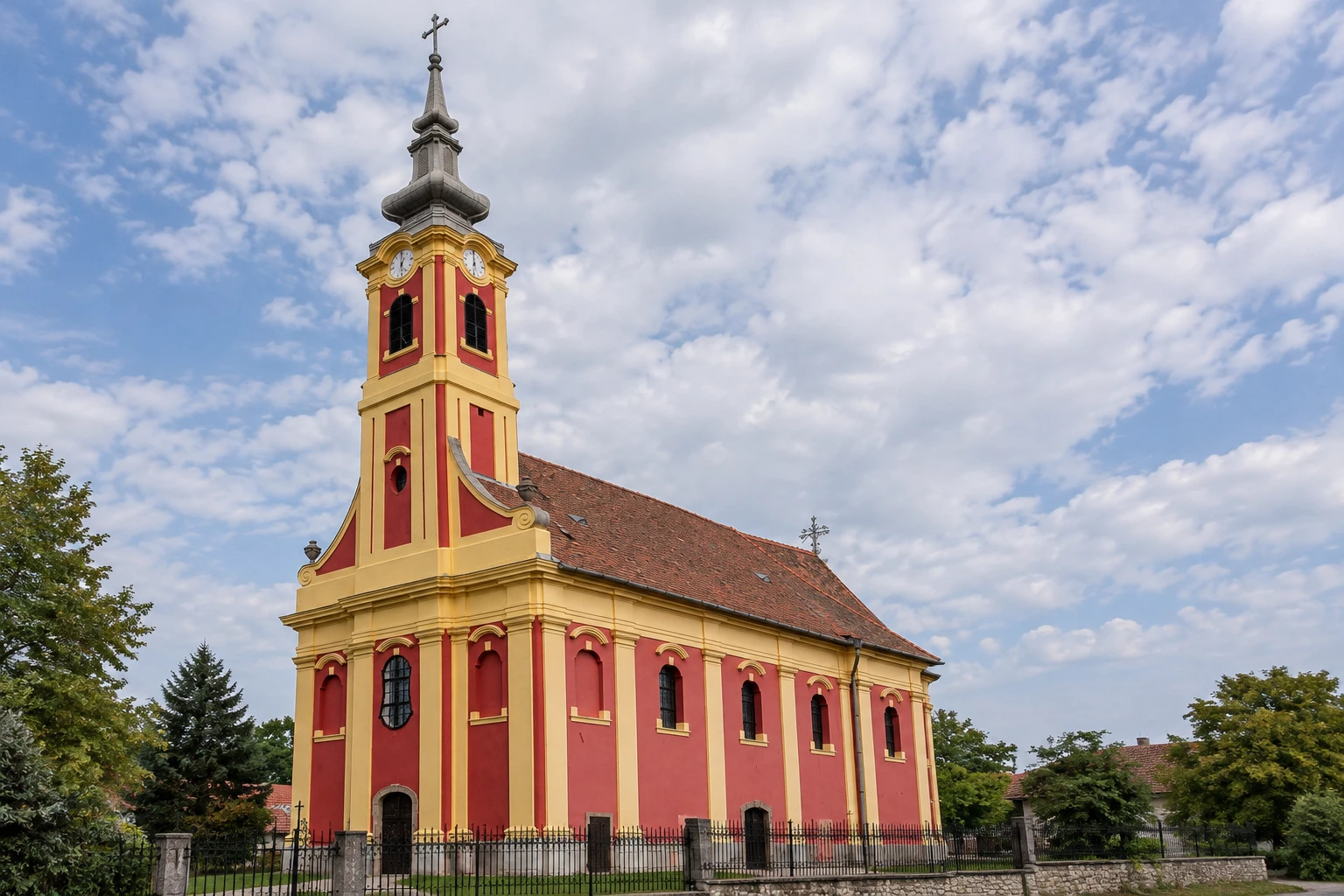
Serbian Orthodox Church of St. Nicholas, the oldest of the two surviving out of the three Serbian churches Baja once had. Completed in 1775 and remodeled in 1779 in late Baroque style, it preserves an iconostasis from the late 18th century.
Explore Serbian Orthodox Church of Saint Nicholas (Szent Miklós görögkeleti templom)
To choose before you go
Where each tour starts, how long it takes, how it is done, what is included and the price range.
Baja’s city center is small and flat, and the walk starts in the square that gives the center its shape. Buildings with light-colored facades line three sides of Szentháromság tér, while the fourth opens onto the Sugovica and Petőfi Island. The square’s basalt paving stones form a four-leaf clover. Once a venue for markets and fairs, the square now hosts city celebrations. At the center stands the Holy Trinity Column, a late Baroque monument erected in the 1750s to commemorate the plague epidemic. City Hall occupies the former Grassalkovich Palace, remodeled in the Neo-Renaissance style in the late 19th century. A stained-glass window on the staircase depicts Adam and Eve with the city’s coat of arms, a reminder that it was on December 24 that Baja was granted market town status. In summer, the City Hall courtyard hosts concerts at dusk. The same complex includes the Bácskai Kultúrpalota, whose three facades date from different periods between 1813 and 1907. The city’s first movie theater opened there in 1913. Just off the square is the small Rózsavölgyi Márk courtyard, named for the musician who lived in Baja and is considered the father of the csárdás. Eötvös utca is a stone-paved pedestrian street with cafés and ice cream shops on the ground floors of restored houses. It ends at Tóth Kálmán tér, where you’ll find a fountain and an 1894 bronze statue of the Baja-born poet. A plaque marks the site of the house where General István Türr was born. If you’d like a longer walk, continue to Déri-kert, a garden created in 1914 with a donation from Frigyes Déri, an industrialist and collector born in Baja. The garden has a 23-meter memorial to those who died in World War I.
Stops: Szentháromság tér, Holy Trinity Column, City Hall (former Grassalkovich Palace), Bácskai Kultúrpalota, Rózsavölgyi Márk courtyard, Eötvös utca, Tóth Kálmán tér, Déri-kert.
Includes: Self-guided walk. The sightseeing train and meals are paid for separately. Check the current prices.
Tip: The tourist information office is on the square itself and offers a game in which you follow clues to sights around the city center. A small sightseeing train takes you on a guided tour of the main sights in about 40 minutes. Ask at the office which days it runs. Head to the west side of the square for a view of the Sugovica.
Best time: Year-round. From May to September, tables are set up outside. In December, the square hosts Advent events.
Baja’s museum has several venues across the city center, all within a short walk of one another. It was founded in 1936 around a collection of modern Hungarian paintings. The main museum, the Türr István Múzeum, covers the northern part of Bačka, the historical region that includes Baja. Exhibits explore life on the Danube and traditional fishing, with a collection of fishing gear known in Hungary and abroad. They also trace the city’s history and display clothing and objects from the region’s Hungarian, Bunjevci, Šokci, and German communities. The archaeological collection is particularly strong in finds from the Migration Period and the Avar period. The Nagy István Képtár occupies the former Vojnich manor house, a single-story building in the classical style dating to around 1820. After 1947, the house was home to the free art school and artists’ colony of painter Gyula Rudnay. It has served as a gallery since 1985. The permanent exhibition is devoted to István Nagy, who settled in Baja in 1930. The gallery also displays works from the Oltványi collection and by artists in Rudnay’s circle, and hosts temporary exhibitions. Bagolyvár, the “owl tower,” is a Bauhaus-style house on the high bank of the Sugovica, below the main square. It was the home of painter Ferenc Miskolczy, one of the museum’s founders, who left it to the city. It tells the story of Baja’s cultural life from 1920 to 1990. The Éber-emlékház, on a narrow street in the city center, was the home of the Éber family, which included three painters across two generations. Alongside paintings, drawings, and sculptures, the house preserves a record of how a middle-class family lived in the early 20th century, with traditional objects from Bačka and Sárköz.
Stops: Türr István Múzeum, Nagy István Képtár, Bagolyvár (Ferenc Miskolczy Memorial House), Éber-emlékház.
Includes: Admission is charged separately. You can buy a ticket for an individual venue or a day pass covering all four. Check the current prices.
Tip: Opening days vary by venue. The main museum is open Tuesday through Saturday. The gallery and Bagolyvár are usually open Wednesday through Saturday, and the Éber House is open Tuesday through Friday. All four are closed on Sundays and Mondays. The gallery closes for a few days between exhibitions. Check before you go.
Best time: Year-round. The museums are a good choice for cold or rainy days. In June, the venues usually host events for the Night of Museums.
After Ottoman rule ended, people of several backgrounds resettled Baja: the Bunjevci and Šokci, who were South Slavic-speaking Catholics, as well as Orthodox Serbs and, in the 18th century, Germans and Hungarians. This route connects the sites that remain from that history. Of the three churches the Serbian community once had in Baja, two survive. The Serbian Orthodox Church of St. Nicholas is the older of the two. It was completed in 1775 and took on its present late Baroque form in 1779. It retains its late 18th-century iconostasis and furnishings. The church is still in use and opens to visitors only on certain days. The former synagogue is one of the most striking buildings in the city center. It was built between 1842 and 1845 in the late Neoclassical style, after the great fire of 1840 destroyed the previous synagogue. The city bought the building from the Jewish community in the 1970s and converted it into a municipal library, which opened in 1985. The renovation preserved the interior space and both galleries. The Torah ark, the washbasin in the vestibule, and the red stone alms box were all restored. You can visit during the library’s regular opening hours. The Ulm barge (Ulmi dereglye) is a full-size replica of an "Ulmer Schachtel," the type of wooden boat German settlers used to travel down the Danube in the 18th century. It is the national memorial commemorating the arrival of Germans in Hungary and the starting point of an accessible trail with eight stops about the life of this community. At the entrance to the city center, where Routes 51 and 55 meet, stands the statue of András Jelky, a tailor’s apprentice from Baja who went on to travel the world. The bronze figure stands on a globe, staff in hand.
Stops: St. Nicholas Orthodox Church, Former synagogue (Ady Endre Municipal Library), Ulmi dereglye (Ulm barge), Statue of András Jelky.
Includes: Self-guided tour. No ticket is needed to view the buildings from the outside.
Tip: At the Serbian church, wear clothing that covers your shoulders and knees, and don’t take photos during services. The Bunjevac farmhouse in Bajaszentistván, which is part of the city museum, is not open to visitors. Check before planning a visit.
Best time: Year-round. You’re more likely to find the library open on weekdays.
The Sugovica, officially called the Kamarás-Duna, is the branch of the Danube that flows just below the city center. Local legend traces its name to a wealthy miller’s daughter and her poor sweetheart, who are said to have drowned there. The more widely accepted explanation is that the name comes from a Slavic expression for murky water. From the Ottoman period onward, the Sugovica served as an important port and a winter haven for boats. From the edge of Szentháromság tér, you can walk down to the riverbank. Beside the market stands Árpád-kút, an ornamental fountain built to mark the city’s 300th anniversary. Its spouts are named after the chieftains who led the Magyar conquest. Sugovica’s free public beach is a sandy stretch of riverbank with willow trees, just steps from the city center. It is open for swimming during the day from June to August, and admission is free. There are showers, changing rooms, wide steps down to the water, a wheelchair-accessible sun terrace, tactile signs in braille, and a floating deck. Outside the summer season, the restrooms and other facilities are closed. The road bridge, built in 1982, leads to Petőfi Island, which longtime residents still call Kis-Pandúr. The island was separated from the neighboring island in the 1870s, when a canal was dug to extend the Sugovica. This is Baja’s recreation area, with restaurants, a row of boathouses along the bank, tennis courts, a soccer field, a playground with accessible equipment, a pool for lap swimming, and an event venue that rents out bikes. You can walk or cycle around the island, and several places rent out kayaks and canoes.
Stops: Sugovica (Kamarás-Duna), Sugovica Public Beach, Petőfi Sándor Bridge, Petőfi-sziget, Árpád-kút.
Includes: This is a self-guided outing. Bike, kayak, and canoe rentals and pool admission are charged separately. Check the current rates.
Tip: If you’ve never paddled here, start by circling Petőfi Island on the calm waters of the Sugovica before considering the Danube. City bus route 5 passes near the beach, as does route 7 on weekends. Check before you go. Bring insect repellent for the late afternoon.
Best time: June to August is best for swimming in the river. April to October is a good time to walk around the island.
About 2 km from the city center, where the Sugovica rejoins the Danube, stands a memorial to General István Türr. Born in Baja in 1825, Türr served in the Austrian army in Lombardy, joined the Italian side, organized a Hungarian legion, and fought alongside Garibaldi. Back in Hungary, he devoted himself to water engineering projects. He was responsible for the canal linking the Sugovica to the Ferenc Canal and was involved in the early stages of construction of the Corinth Canal. The memorial is a circular stone structure with columns supporting a terrace. From the top, you can see the Danube, the bridge that also bears Türr’s name, and Gemenc Forest on the opposite bank. Built between 1906 and 1908, the bridge is the southernmost on the Hungarian stretch of the Danube and the only railway bridge across the river in Hungary downstream from Budapest. There is a playground next to the lookout. Beside the memorial is the Halászati Mini Skanzen, a small fishing village built in 2011 by a local residents’ association. The wattle-and-daub huts house the fishing gear most commonly used on the Danube, while nets and fish traps hang outside. Two wood-fired ovens are used on festive occasions. Moored at the riverbank is the Hajómalom, a reconstruction of the kind of floating mill that used the current to grind grain for centuries. When the water level allows, the Danube’s current turns the wheel. The walking route follows the Sugovica toward the Danube. If you come by car, park a few hundred meters away and continue on foot along a tree-lined path.
Stops: Türr István-kilátó, Halászati Mini Skanzen, Bajai Hajómalom (floating mill), István Türr Bridge.
Includes: Admission to the open-air lookout is free. Visits that include a demonstration at the fishing village are arranged separately.
Tip: Arrive before sunset, when the late-afternoon light falls on the river and the forest. Bring insect repellent in the warmer months, as there are mosquitoes along the Danube at dusk. The village and the mill welcome groups with advance notice. You can view both from the outside at any time.
Best time: April to October. If the river level is very high or very low, the mill may not operate.
From the water, Baja takes on a different scale: the main square comes into view high on the riverbank, the boathouses on Petőfi Island slip past one by one, and the forest lines both banks as soon as you reach the Danube. Guided tours leave from the fishermen’s cove on Petőfi Island in motorboats that hold about ten people. There are three main routes. The Sugovica loop circles Petőfi Island, continues to the Türr István lookout, and returns to the dock. The Danube route takes you from the Sugovica onto the main river and upstream to the mouth of the Vén-Duna, above the Türr István Bridge. The third route follows the Vén-Duna, a side channel of the Danube in Gemenc Forest, and only runs when the water level allows. Rowboat trips are also available. They require advance reservations and a minimum number of participants. If you want to explore deeper into the forest, an operator in Dunafürdő, Baja’s summer resort district on the Gemenc side of the river, offers a guided motorboat trip around Koppány Island. The trip takes about 2 to 2½ hours: it starts on the bank of the Vén-Duna, passes the mouth of the Cserta, stops at a sandbar, and returns along the Danube. There is no fixed daily departure schedule. Trips are arranged by phone, and the route depends on the river level.
Stops: Sugovica, Petőfi-sziget, Türr István-kilátó, Danube, Türr István Bridge, Vén-Duna.
Includes: Motorboat tours include the boat, a boat operator, and a guide. Meals and extras are arranged and paid for separately. Check the current prices.
Tip: Book a few days ahead and ask which languages the guides speak. The Vén-Duna route gives you a close-up view of the forest. Ask about the water level when you book. Bring a hat, water, and insect repellent.
Best time: May to September. Floods and periods of low water on the Danube affect which routes are possible.

Nagy-Pandúr Island lies southwest of the city center, between the Danube, the Türr István Canal, and a cutoff branch of the river. It takes its name from a village that once stood there and was abandoned after the floods of the 18th century. The last residents were relocated to nearby settlements, one of which is now a neighborhood in Baja. The northern tip has summer homes and farmland. The rest of the island is woodland and managed forest. You can get there without a car: a bridge for pedestrians and cyclists crosses the canal from Petőfi Island. The island is home to Pandúr Ökopark, a woodland recreation park where locals spend the day and cook outdoors in cauldrons. An interpretive trail with eight stops introduces you to the plants and animals of Gemenc Forest. Information panels explain fishing on the Danube and how fish soup is made. The park also has a barefoot trail and an observation tower. On the top level, a panoramic telescope lets you look out over the forest and watch the birds. This is the easiest nature outing from the city center, with no train or boat schedules to plan around. It pairs well with a loop around Petőfi Island and a late afternoon on the banks of the Sugovica.
Stops: Petőfi-sziget, Pedestrian and bicycle bridge, Nagy-Pandúr-sziget, Pandúr Ökopark.
Includes: Self-guided outing. Bike rental costs extra.
Tip: Rent a bike on Petőfi Island or at one of the places to stay that offer bike rentals. Bring water, a snack, and insect repellent. Don’t count on finding shops inside the park. The dirt paths can be muddy after rain or flooding.
Best time: April to October. In summer, go in the morning or late afternoon.
EuroVelo 6, the Danube cycle route, passes through Baja. North of the city, it follows the top of the flood levee, a flat, elevated path between the river and the plain with no through traffic. For a first ride, Baja’s tourism office suggests Érsekcsanád, the neighboring village to the north. It’s about 30 km round trip. Follow the levee to the river crossing at Érsekcsanád, where there’s a roadside tavern, then continue to the village recreation park, which has a playground and a place to build a fire. Return the same way. If you’re up for a longer ride, the same guide lists routes of about 70 km: one to the archbishops’ Baroque palace in Hajós, where there’s also a street lined with wine cellars, and another of the same length heading south to Karapancsa, near the border. These are full-day rides rather than short trips around the city. Cyclists and pedestrians can cross the Türr István Bridge to reach the other bank of the Danube and Pörböly, the gateway to Gemenc Forest.
Stops: Danube levee (EuroVelo 6), Érsekcsanád river crossing, Érsekcsanád recreation park.
Includes: Self-guided ride. Bicycle rental costs extra; check the current rates.
Tip: You can rent bicycles on Petőfi Island and at some places to stay. There’s no shade on the levee, so set out early in summer and bring water. A headwind can make the ride slower than the distance suggests.
Best time: April to October. In July and August, ride only in the early morning.
Gemenc is a floodplain forest on the Danube between Baja and Szekszárd, within Danube-Drava National Park. The river shapes life here: floods, most common in spring, fill the side branches and channels that run through the woods. Red deer, wild boar, roe deer, otters, and beavers live in the forest. Birds include white-tailed eagles and black storks. The gateway from Baja is the ecotourism center in Pörböly, a village across the Danube on the far side of the Türr István Bridge. The center is on Route 55, next to Pörböly train station. It has a ticket office, a snack bar, a shop, and an interactive exhibition on life in the floodplain forest. Also on the grounds is Archduke Frederick’s restored exhibition pavilion, built to resemble a hunting lodge. It houses an exhibition on the red deer of Gemenc and is the starting point for a trail about hunting. The narrow-gauge forest railway is the only one in the country that runs through a floodplain forest. Scheduled trains run from Pörböly to Malomtelelő, with several stops along the way. A few minutes’ walk from the center is a wildlife viewing area where you may see red deer and wild boar. Near the Nagyrezét stop, local beekeepers present a beekeeping collection that includes glass-sided hives. Lassi has a wooden playground and a fishing exhibition that opens only by prior arrangement. At Malomtelelő, you’ll find the start of an interpretive trail and a birdwatching tower. The simplest route is to take the train to Lassi, walk about 1.5 km along the marked trail to Malomtelelő, and return by train. An alternative route replaces one leg of the train ride with an 8.5 km walk and takes about 3.5 hours. During the summer schedule, steam trains also run on weekends and holidays. The train cars can carry bikes, and a wheelchair-accessible car is available.
Stops: Pörböly Ecotourism Center, Treasures of Gemenc Exhibition, Nagyrezét Wildlife Viewing Area, Gemenc Beekeeping Collection, Lassi, Malomtelelő.
Includes: Forest train tickets and exhibition admission are charged separately. Check the current rates.
Tip: Check the forest train schedule before leaving Baja. Outside summer, trains usually run only on weekends and holidays, and service stops for part of the winter. Plan your day around the return train. Bring insect repellent and wear closed-toe shoes. The trails get muddy after floods.
Best time: May to September, when trains run more frequently. Fall brings colorful foliage and the sound of stags calling during the rut.
If you want to do more than ride the train, Pörböly offers three ways to explore the forest. The ecotourism center rents bikes and recreational canoes and can recommend a guide on request. By bike, follow the Danube levee, which runs right past the center. Head north along the levee for just under 6 km to reach the trail marked with a blue cross. It leads to Malomtelelő, where you’ll find Gemenc’s oldest interpretive trail and a birdwatching tower. The route is 12 km and takes about 3 hours. You can return the same way or take the forest train, which carries bikes. To the south, the levee leads to Báta. This 21 km route takes 4 to 5 hours and includes a detour to the trail and observation tower at Nyéki-Holt-Duna, a cutoff branch of the river. The walking routes combine a ride on the forest train with sections of the National Blue Trail, the long-distance hiking route that crosses Hungary. One route starts in Malomtelelő, passes through Lassi, and follows the banks of three branches of the river to Dunafürdő, a summer vacation neighborhood in Baja. From there, you can take a regular train back to Pörböly. The trip includes about 9 km of walking and takes 4 hours and 30 minutes in all. Canoeing in Gemenc has an unusual feature: the forest train takes the canoes to the water. The train ride to the Nyárilegelő stop, on the bank of the Rezéti-Duna, takes about 20 minutes. The half-day route includes 7 km of paddling and takes about 4 hours and 30 minutes, including the train ride. This river branch runs between strictly protected areas, so you can only go ashore at designated points. The center provides paddlers with life jackets, paddles, and watertight barrels. Your chances of seeing deer, wild boar, and birds depend on the time of day and the season. Early morning and dusk are usually the best times.
Stops: Pörböly Ecotourism Center, Danube levee, Nyéki-Holt-Duna trail, Malomtelelő, Nyárilegelő, Rezéti-Duna.
Includes: Bicycle or canoe rental, forest railway tickets, and guide fees are charged separately. Canoe rental includes a life jacket and paddle. Check the current rates.
Tip: Reserve your canoe and guide in advance, and check whether the train can carry canoes that day. There are no docks at the launch sites, and the riverbank can be muddy depending on the water level. Access to strictly protected areas is restricted; stay on the marked trails.
Best time: May to September for canoeing. For walking and cycling in cooler weather, go in April, May, September, or October.
Day by day
Suggestions to plan the trip. Change the order of the days according to the weather and tour availability.
Start at Szentháromság tér while the square is still empty in the morning. See the Holy Trinity Column and City Hall, then take in the view over the Sugovica from the west side of the square. Continue to the Türr István Múzeum and allow an hour to an hour and a half for the exhibits on Danube fishing, the city's history, and the traditional dress of the region's communities. Walk back along pedestrian-only Eötvös Street to Tóth Kálmán tér and have lunch in the center or by the river. This is a good time to try Baja's fish soup, served with thin noodles, with the fish on the side. In the afternoon, choose between the Nagy István Gallery, if it's open that day, and a visit to the Serbian church and the former synagogue. Then cross the bridge to Petőfi Island and walk along the riverbank. Save the late afternoon for the Türr István Lookout, about 2 km from the center, with the fishing village and floating mill beside it. The walk along the Sugovica takes about half an hour; driving or cycling gives you more time there.
Spend the morning in the center: Szentháromság tér, City Hall, Eötvös Street, and Tóth Kálmán tér. Visit the Türr István Múzeum and, if it's open that day, Bagolyvár, the Bauhaus-style house on the riverbank. After lunch, explore the heritage of Baja's different communities: visit the Serbian Orthodox Church of St. Nicholas, the former synagogue, now a library, and the Ulm barge. In midafternoon, cross over to Petőfi Island. In summer, head to the beach on the Sugovica. At other times of year, rent a bike and cross the footbridge to Nagy-Pandúr Island and Pandúr Ökopark. End the day at the Türr István Lookout, with views of the Danube and Gemenc Forest on the far bank.
Check the forest railway timetable the day before and plan your day around it. Set out early for Pörböly, about 8 km from Baja. Drive via Route 55 or take the train that crosses the Türr István Bridge; the station is next to the ecotourism center. Before boarding, see the exhibit on life in the floodplain forest and the one on the deer of Gemenc. Take the narrow-gauge train to Lassi, walk about 1.5 km along the marked trail to Malomtelelő, climb the birdwatching tower, and return by train. If you have time to spare, get off near the Nagyrezét wildlife viewing point and see the beekeeping collection. Back in Baja in midafternoon, there's still time for a boat trip on the Sugovica if you've booked one, or for coffee on Eötvös Street.
Take your time exploring the center: Szentháromság tér, City Hall, Bácskai Kultúrpalota, and Eötvös Street. Use the museum day pass to visit the main building, the Nagy István Gallery, and Bagolyvár, depending on which are open that day. In the afternoon, visit the Serbian church, the former synagogue, and the Ulm barge. At the end of the day, head to the Türr István Lookout and the fishing village, about 2 km from the center.
Spend the day in Pörböly. In the morning, take the forest train to Lassi, walk to Malomtelelő, and return by train. Bring your own lunch or eat at the ecotourism center's snack bar. In the afternoon, rent a bike at the center and ride south along the Danube levee to the Nyéki-Holt-Duna trail and its observation tower. If you'd rather paddle, swap the bike ride for a half-day canoe trip on the Rezéti-Duna. It requires a reservation and takes up most of the day. Dusk is when animals tend to appear in the clearings. The Nagyrezét wildlife viewing point is just a few minutes' walk from the center.
Set aside the morning for a boat trip: follow the Sugovica around Petőfi Island or, if the water level allows, head into the forest along the Vén-Duna. Afterward, stay on Petőfi Island. In summer, you can easily spend the afternoon at the beach on the Sugovica. At other times of year, cycle to Pandúr Ökopark on Nagy-Pandúr Island or follow the Danube levee north toward Érsekcsanád. If you have a car, you can spend the afternoon at the nearby thermal baths in Nagybaracska or Dávod instead. They're open during the warmer months. Say goodbye to the city over a fish dinner by the river.
Best time to go
The seasons shown are the most usual ones; nature doesn't always follow the calendar.
The city symphony orchestra’s New Year’s concert, usually early in the month
The coldest month, with average highs of 4 °C, lows of -3.5 °C, and about 32 mm of precipitation as rain or snow. The days are short and the humidity is high. It’s a good time for a bowl of fish soup and a visit to the museums, which remain open Tuesday through Saturday. The Gemenc forest railway usually takes a winter break, and Sugovica Beach is out of season.
Maszkajárás, the masked Carnival parade, usually in February
It’s still cold, with average highs near 7 °C, lows of -3 °C, and about 37 mm of precipitation. The city center is quiet, and the museum houses are the main attraction. If you’re heading to the forest, check first to see whether the forest train is running. The trails may be icy or muddy.
Spring begins, with average highs of 12.5 °C, lows near freezing, and about 34 mm of rain. The days are getting longer, and with a warm layer you can now walk along the Sugovica and visit the Türr István lookout. The Danube can rise in Gemenc in spring, so check trail conditions.
A mild month, with average highs of 19 °C, lows of 4.5 °C, and about 40 mm of rain. The Gemenc forest is coming into leaf, and the birds are active. It’s a good time to cycle along the Danube levee or visit Nagy-Pandúr Island. Flooding is more common in spring than at any other time of year and can close off parts of the forest.
The days are long and pleasant, with average highs near 24 °C, lows of 9.5 °C, and about 65 mm of rain, mostly in showers. The Gemenc forest railway usually adds more departures, and boat trips run regularly again. Bring a raincoat and insect repellent for the forest and the riverbank.
Night of Museums, usually in June · start of the season at Sugovica Beach
Summer begins, with average highs of 27 °C, lows of 13 °C, and about 76 mm of rain, the highest monthly total of the year. Most of it falls in showers and thunderstorms. The season begins at Sugovica Beach, and Petőfi Island becomes the center of city life. It’s a good month for canoeing in Gemenc, while the river is still high.
Community fish soup festival (Bajai Halfőző Fesztivál), around the second Saturday in July
A hot month, with average highs of 29 °C, lows of 14.5 °C, and about 64 mm of rain. Temperatures rise above 35 °C during heat waves. At the fish soup festival, fires are lit under more than 2,000 cauldrons on Szentháromság tér and in the streets. Events run for several days in the square and on Petőfi Island. The city fills up that weekend, so book your accommodations early.
The heat continues, with average highs of 29 °C, lows of 14 °C, and about 57 mm of rain. This is the last month of the swimming season on the Sugovica. Visit the museums and the city center in the morning, go for a swim in the afternoon, and save the Türr István lookout for sunset.
Gemenc Forest Railway Day, on the third Saturday in September · stags begin to bellow
The heat eases, with average highs of 23.5 °C, lows of 10 °C, and about 64 mm of rain. It’s one of the best times to walk and cycle in Gemenc. Visitors come to the forest at dawn and dusk to hear the stags bellow. Sugovica Beach is already out of season, but the terraces in the city center are still open.
Fall is well underway, with average highs of 18 °C, lows of 5.5 °C, and about 55 mm of rain. The forest changes color, and the forest railway usually runs on weekends and holidays. The days are getting shorter, so start early and bring a warm layer for the riverbank.
Last forest train departures before the winter break
It gets cold quickly, with average highs of 10.5 °C, lows near 2 °C, and about 46 mm of rain. Fog is common and the humidity is high. The city center and museums are once again the main places to visit. The Gemenc forest railway usually ends its fall season this month, so check the schedule before heading to Pörböly.
Advent on Szentháromság tér · outdoor New Year’s Eve celebration in the square
Winter brings average highs of 4 °C, lows of -2.5 °C, and about 48 mm of precipitation, sometimes as snow. The main square hosts Advent events, including candle lighting in front of city hall. People also gather outdoors in the square to welcome the new year. The museums close on some holidays, so check the calendar.
Plan the journey
Baja has no airport with scheduled flights. The airport serving the city is Budapest Ferenc Liszt International Airport (BUD), about 166 km away. If you’re flying from another continent, you’ll usually have at least one connection in Europe. Check the available connections before booking.
From the airport, the simplest option is to rent a car and drive south. It’s about 175 km by road to Baja. Without a car, you can take a train from the airport stop on the Budapest–Kecskemét line and change in Kecskemét for Baja. The other option is to go into central Budapest and take a train or bus from there. Both options involve a transfer, and services are infrequent, so use the Hungarian railway’s journey planner to map out your route before you travel.
On the return trip, allow plenty of time between leaving Baja and your flight, especially if you need to change trains.
Baja train station (Baja vasútállomás) is about 2 km from the main square and around 450 meters from the bus station. It’s on a single-track, non-electrified line that connects Bátaszék and Kiskunhalas, crossing the Danube on the Türr István Bridge.
From Budapest, you can take a direct train or change in Sárbogárd or Kiskunhalas, depending on the departure. The trip takes roughly 2 hours 40 minutes to 3 hours 40 minutes, depending on the connection.
Direct regional trains from Kecskemét, the county seat, run about every two hours. Westbound trains via Szekszárd and Sárbogárd continue to Székesfehérvár. At Sárbogárd, you can change to express trains on the Pécs line. There are also trains to Dombóvár, where you can connect to Pécs and Kaposvár. If you’re coming from Szeged, change in Kiskunfélegyháza.
You can take the same line for a trip to Gemenc: Pörböly is a stop just beyond the bridge, and the station is next to the ecotourism center. Check the days and times trains run before you travel.
Baja’s bus station is near the city center, about 450 meters from the train station. It has scheduled bus services to Budapest and Szeged.
For Szeged, about 90 km away on Route 55, the bus is the most direct option because the train journey requires a transfer. For Budapest, compare bus and train options for your travel date.
Weekday and weekend schedules differ. Check the journey planner before you set out.
Baja is at the junction of Routes 51 and 55. From Budapest, there are two routes, both about 175 km. The first follows the M6 motorway south along the right bank of the Danube to the Bátaszék exit, then takes Route 55 across the Türr István Bridge. You need a toll pass to use the motorway. The second follows Route 51 along the left bank through Dunavecse and Kalocsa, avoiding the motorway.
From Szeged, Route 55 crosses the plain for about 90 km to Baja. From Kecskemét, it’s about 108 km via Route 54, which joins Route 51 at Sükösd, just north of Baja. From Pécs or Szekszárd, you approach from the west and cross the bridge.
Route 51 continues south to the Serbian border, in the direction of Sombor.
In the center, park the car and explore on foot. There’s parking a few hundred meters from the Türr István lookout, and the museum houses report that they have parking spaces right by their entrances. Pörböly and Gemenc Forest are about 8 km away via Route 55.
You can explore central Baja on foot: the museums, the Serbian church, and the former synagogue are all just a few minutes’ walk from Szentháromság tér. Petőfi Island is just across the bridge. The Türr István lookout is about 2 km away, roughly a half-hour walk along the Sugovica.
Cycling is the most practical way to explore the islands and levees. You can rent a bike on Petőfi Island and at some places to stay. A pedestrian and bicycle bridge connects Petőfi Island to Nagy-Pandúr, and EuroVelo 6, the Danube cycling route, passes through town.
City buses leave from a terminal near the center and serve the train station and the beach on the Sugovica. A small sightseeing train offers a guided tour of the main sights in about 40 minutes.
A car gives you more flexibility for a trip to Gemenc, but you don’t need one: you can take a regular train from Baja to Pörböly, then the forest railway into the woods. Without a car, you’ll need to plan your day around both train schedules.
Your questions
Szentháromság tér, with the town hall and the Holy Trinity column, the Türr István Museum, the Nagy István gallery, the Serbian Orthodox Church of St. Nicholas and the Türr István lookout at the meeting point of the Sugovica and the Danube.
A branch of the Danube that runs alongside Baja’s center. The main square opens onto it, and on the opposite side is Petőfi Island, a leisure area with river beaches.
It usually takes place in July, with thousands of cauldrons lit in the main square and the downtown streets. Dates change each year; check the program before you go.
The Pörböly ecotourism center, where the forest train departs, is about 8 km from Baja via route 55.
Baja is in southern Hungary, in Bács-Kiskun County, on the left bank of the Danube. It’s about 175 km by road from Budapest and about 90 km from Szeged. The Türr István Bridge, on the outskirts of the city, is Hungary’s southernmost crossing of the Danube.
Liszt Ferenc Airport is about 166 km from Baja. If you rent a car, head straight south. Without a car, you have two options: take the train from the airport stop to Kecskemét and change there for Baja, or go into central Budapest and take a train or bus. Services are infrequent, so plan your connections before you travel.
Take a regular passenger train on the line that crosses the Danube on the Türr István Bridge. Pörböly station is next to the ecotourism center, where the Gemenc forest train departs. There are only a few trains a day, so check that both your outbound and return trains fit the forest train schedule before you set out.
Not always. The schedule varies by season. In summer, trains run more often, with steam trains on weekends and holidays. In fall, trains usually run only on weekends and holidays. In winter, service may be suspended. Flooding on the Danube can also interrupt service. Check the current schedule before you go.
Yes. The public beach on the Sugovica, just steps from the city center, is open for swimming during the day from June through August. Admission is free. It has showers, changing rooms, and accessible entry. Outside the season, the sandy beach is still there, but there are no services. Petőfi Island also has a lap pool, though it usually closes at the height of summer.
You can try it at fish restaurants in the city center, along the Sugovica, and on Petőfi Island. In the local recipe, carp, onion, and paprika are cooked together in a cauldron. The broth is served unstrained over thin noodles, with the fish on the side. During the July festival, families cook the soup in cauldrons in the square and along the streets.
No. The Türr István Múzeum is open Tuesday through Saturday. The Nagy István Gallery and Bagolyvár are usually open Wednesday through Saturday, and Éber House is usually open Tuesday through Friday. All are closed on Sundays and Mondays. The Bunjevac country house is not open to visitors. Opening days can change on holidays and between exhibitions, so check before you go.
Yes, by reservation. Guided motorboats with room for about ten people leave from Petőfi Island. Routes include a trip along the Sugovica to the Türr István lookout, a trip on the Danube, and, when water levels allow, a trip into the Vén-Duna, a branch of the river in Gemenc Forest. There are no fixed daily departures.
Yes. The city center is flat, and the pedestrian street is traffic-free. Petőfi Island has a playground with accessible equipment, and in summer there’s also the beach on the Sugovica. A sightseeing train makes a circuit of the city in about 40 minutes. In Gemenc, the forest train, the wildlife viewing area, and the playgrounds at the stops can easily fill half a day.
The forest is home to deer, wild boar, roe deer, otters, beavers, white-tailed eagles, and black storks. There’s a wildlife viewing area a few minutes’ walk from the Pörböly ecotourism center, as well as birdwatching towers. Early morning and dusk are usually the best times to look. What you see depends on the day and the season.
He was a general born in Baja in 1825. He served in the Austrian army in Lombardy, switched to the Italian side, organized a Hungarian legion, and fought alongside Garibaldi. Back in Hungary, he devoted himself to canals and other water projects, including the canal linking the Sugovica to the Ferenc Canal. He was also involved in the early stages of construction of the Corinth Canal. The museum, the lookout, and the bridge over the Danube all bear his name.
If you’re staying for one night, the city center around Szentháromság tér and Eötvös Street is a good choice, with museums, churches, and restaurants within walking distance. Petőfi Island, across the bridge, has guesthouses and campgrounds by the water and is a good choice if you’re visiting in summer with a bicycle or canoe. In Pörböly, there’s simple accommodation next to the ecotourism center if you want an early start in the forest.
There are no thermal baths in Baja itself, but two villages to the south, Nagybaracska and Dávod, both have them. The baths in Dávod are about a 15-minute drive away and open during the warmer months, usually from May to September, with pools and a children’s area. Check opening dates and hours before you go.
Yes. The Türr István Bridge is open to cyclists and pedestrians. You can cross it to reach Pörböly and the levee on the right bank, which runs along Gemenc Forest. The Danube Cycle Route, EuroVelo 6, passes through the city.