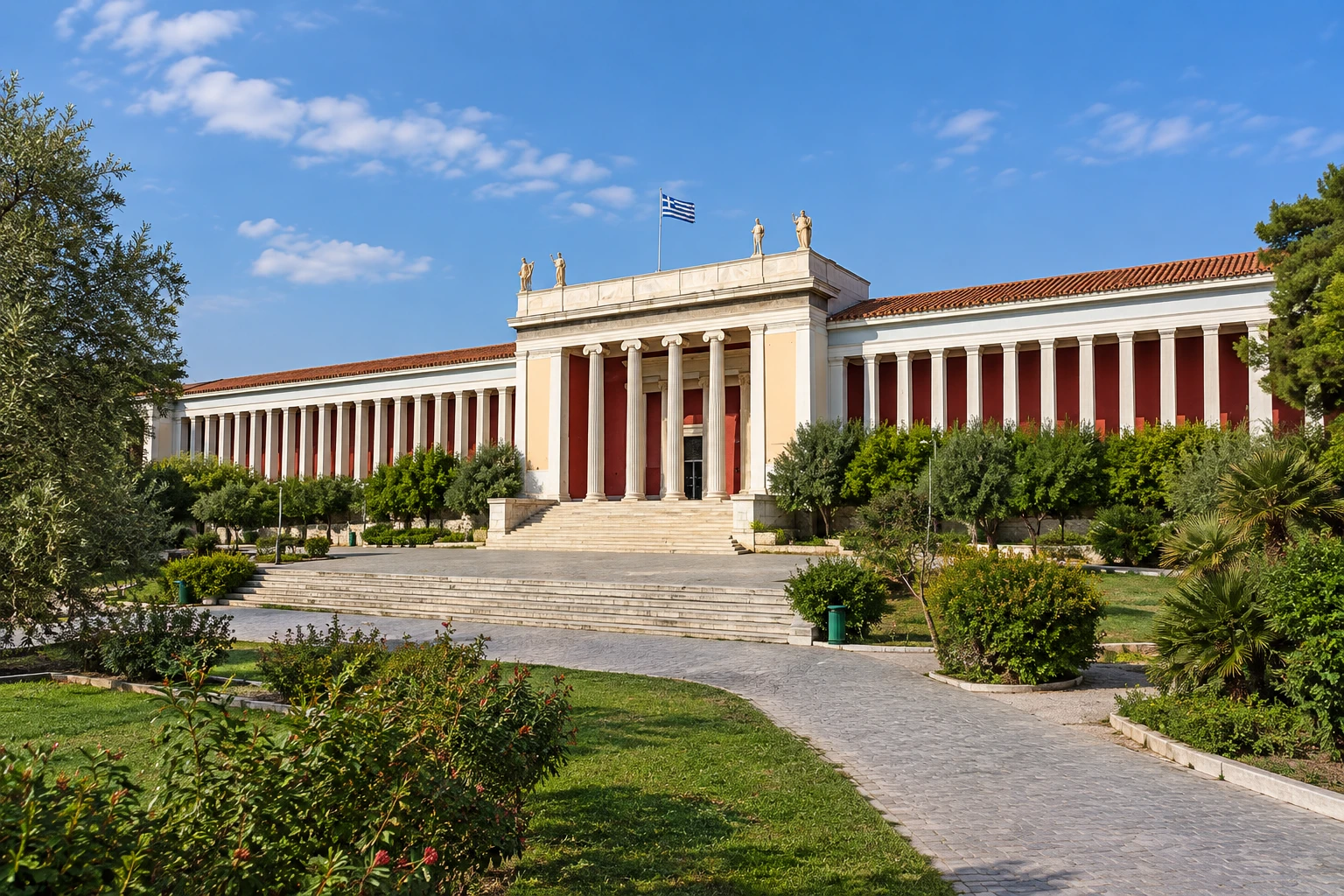
Illustrative images. The pictures in this guide are illustrations based on the real place, not photographs, and may differ from it.
The city
What to expect from Athens.
Capital of Greece and of the Attica periphery, Athens has a historic center that fits into a walk: the Acrópole and the Partenon, the Ágora Antiga and the Ágora Romana, Hadrian's Library, the Temple of Olympian Zeus and the Panathenaic Stadium lie between praça Syntagma and the neighborhoods of Plaka and Monastiraki. The museums of the Acrópole, the National Archaeological, Benaki, Cycladic and Byzantine complete the old part; Licabeto and Colina de Filopapo are the viewpoints. Pireu, 10 km away, is the port for boats to the islands.
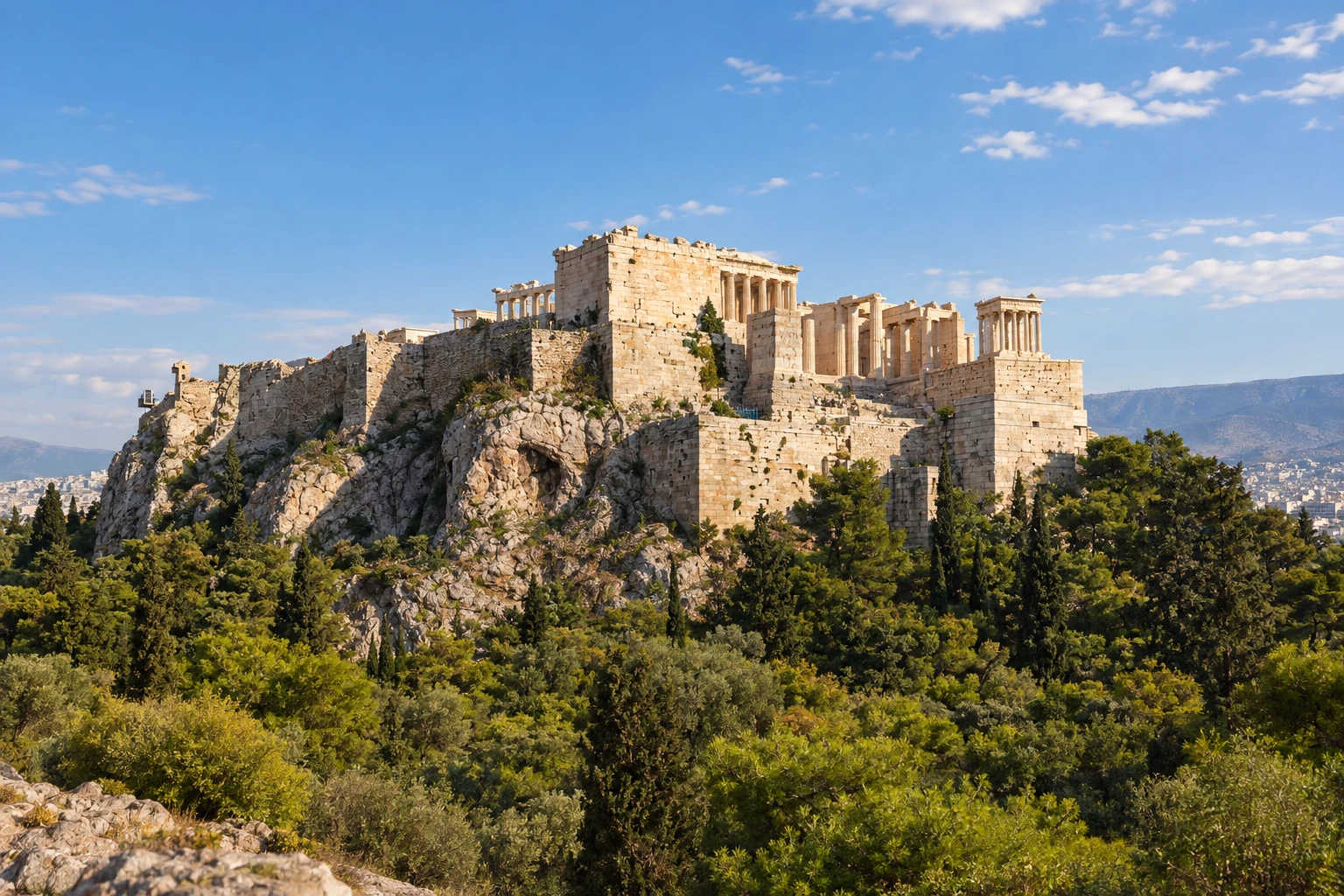
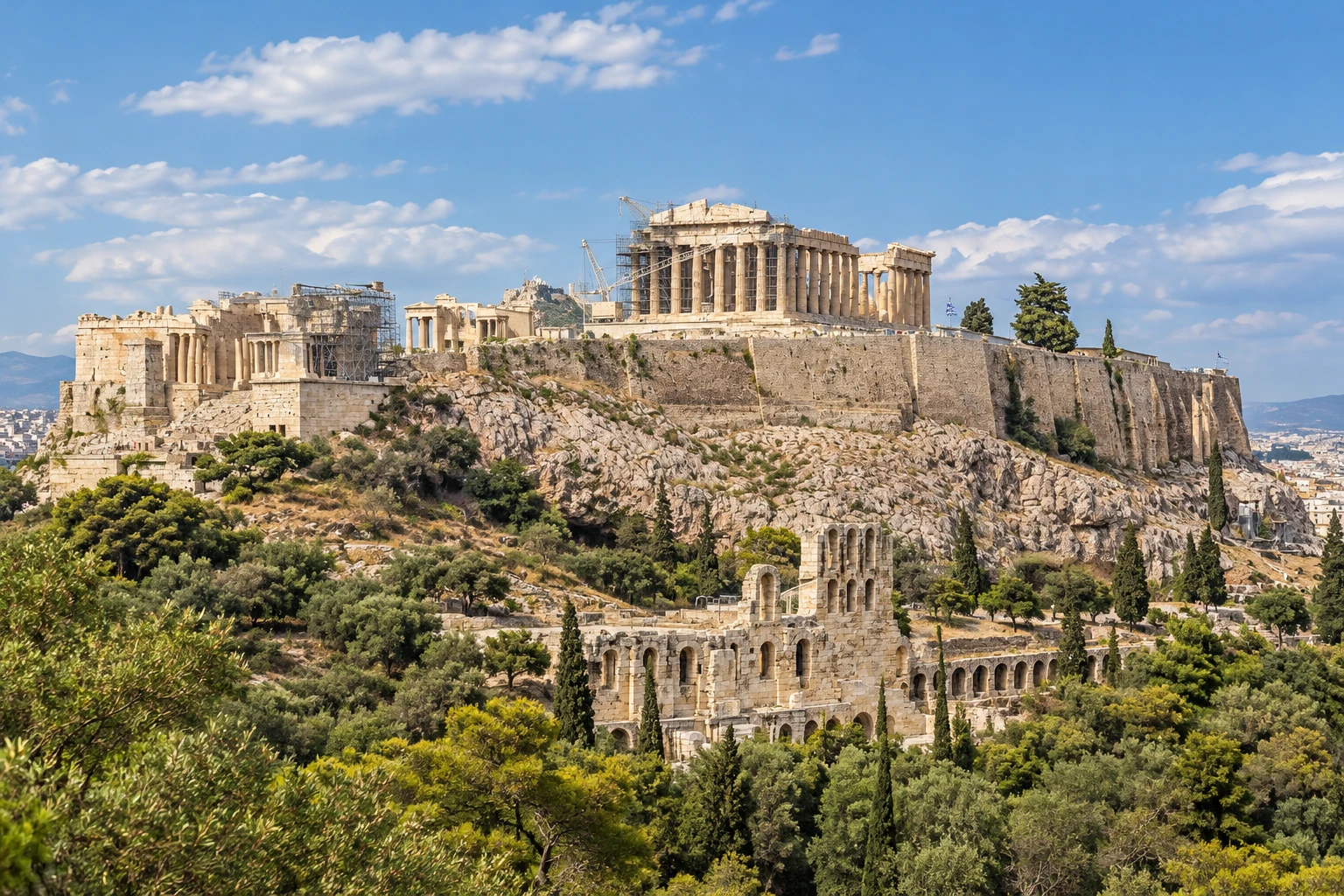
The sacred hill of Athens, with the Partenon, the Erecteion, the Propileus and the Templo de Atena Nike on top, and the Teatro de Dioniso and the Odeon of Herodes Ático on the south slope. UNESCO World Heritage Site.
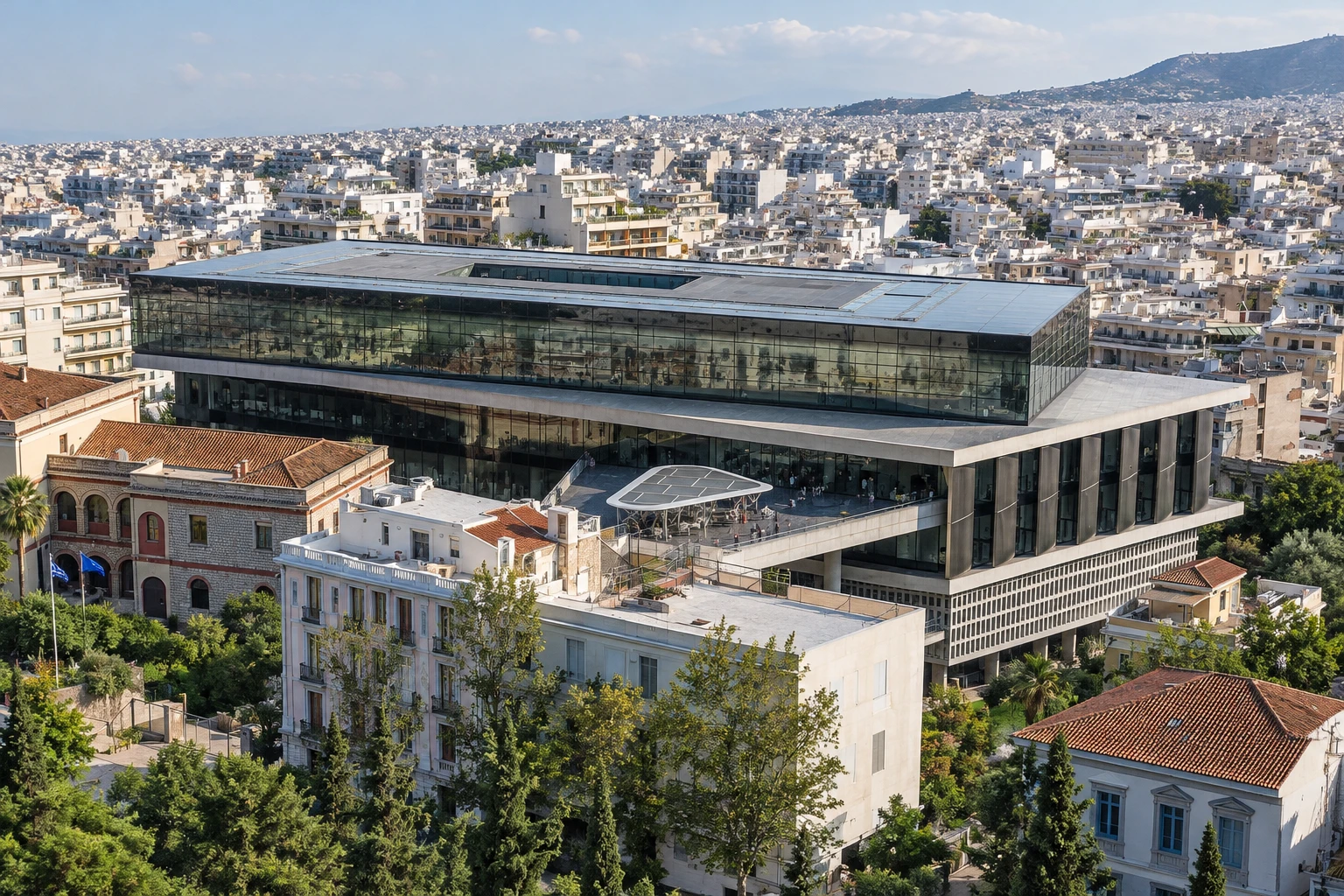
Museum at the foot of the rock housing the original sculptures of the Acrópole, including the Caryatids and the Parthenon friezes, in a glass building aligned with the temple above.
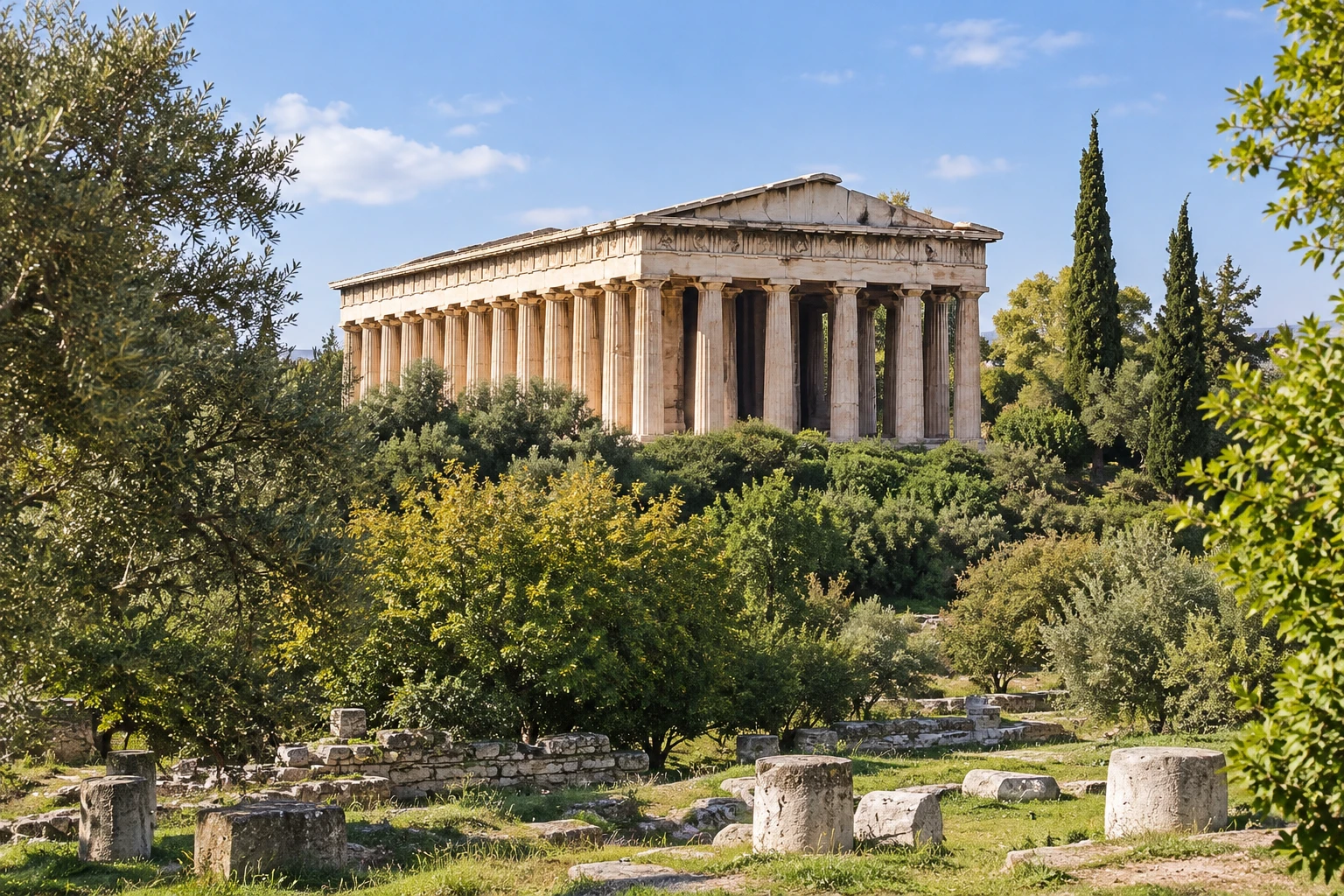
The public square of classical Atenas, at the foot of the Acrópole, with the Templo de Hefesto, one of the best-preserved Greek temples, and the reconstructed Stoa de Átalo, which houses the site's museum.
The largest archaeological museum in Grécia, with the Mask of Agamemnon, the Anticítera mechanism, the Artemísion bronzes and the frescoes from Santorini, housed in a neoclassical building near praça Omonia.
Aeroporto Internacional de Atenas Eleftherios Venizelos (ATH)Spata · 33 km
Estação Athina (Larissa Station)2 km
Porto do Pireu (Limani Pireos)Pireu · 10 km
Approximate distances. Check flights and bus, train or boat schedules before you travel.
Flights from Brazil usually connect via another city in Europe or the Middle East. Check before buying. The airport is about 33 km away and is linked to the center by metro (line 3), the suburban train, buses X95 and X96 and by taxi with a fixed fare. Trains from Thessaloniki arrive at Athina (Larissa) station on metro line 2. KTEL buses from other regions arrive at the Kifissou and Liossion terminals. Island ferries arrive at Pireu, with metro (line 1) to the center.
How many days
Three days: one for the Acrópole, the Museo da Acrópole and Plaka; one for the ágoras, Monastiraki, Kerameikos and the National Archaeological Museum; one for the museums on Vasilissis Sofias, Licabeto and the Panathenaic Stadium. With a fourth day, Cape Sounion or the Fundação Stavros Niarchos and the waterfront.
When to go
From April to June and from September to October, with long days and bearable heat. July and August often exceed 35 °C and the sites have little shade: start at 8 am and return late afternoon. From November to March it rains more and archaeological sites often close in the middle of the afternoon, but museums remain open and queues disappear. Remember seasons are reversed relative to Brazil.
The seasons shown are the most usual ones; nature doesn't always follow the calendar.
Do you need a car?
No. The historic center is largely pedestrian and the metro (three lines), the coastal tram and buses cover the rest. Parking in the center is difficult and traffic is heavy. A car only makes sense to leave the city, for example to Cabo Sunião or the Peloponnese, and even then there are regional buses. For the airport and Pireu, metro or taxi.
Suggested itinerary
An order that works
Built with the places on this page. No rush: it's paced so you have time to see them.
One day in Athens
manhã
Acrópole and Museo da Acrópole
Enter the Acrópole at the first time slot, through the main entrance or the one by the Theatre of Dionysus, with a timed ticket. See the Partenon, the Erecteion and the city view. Walk down Dionysiou Areopagitou street to the Museo da Acrópole and see the original sculptures on the Parthenon level.
tarde
Plaka, Anafiotika and the Ágora Antiga
Have lunch in Plaka and climb the white alleys of Anafiotika, clinging to the rock. Descend to the Ágora Romana and the Tower of the Winds, pass Hadrian's Library and enter the Ágora Antiga to see the Temple of Hephaestus and the museum in the Stoa of Attalos.
fim de tarde
Monastiraki and Colina de Filopapo
Cross Monastiraki square and the flea market. Then follow Apostolou Pavlou to Thissio and climb Colina de Filopapo by the stone path: it is the classic viewpoint of the Acrópole at the end of the day.
noite
Dinner in Psiri or Plaka
Psiri, between Monastiraki and Athinas street, has tavernas and mezedopolia (small-plate places) that only fill up after 9 pm. Plaka is more touristy and has outdoor tables with the Acrópole lit up in the background.
2 days in Athens
Day 1
manhã
Acrópole and Museo da Acrópole
Same start as the one-day itinerary: Acrópole at the first time slot and Museo da Acrópole afterwards, taking time for the Parthenon level and the Caryatids.
tarde
Templo de Zeus, Estadio Panatenaico and Jardim Nacional
From the museum exit, a 10-minute walk to the Arco de Adriano and the Templo de Zeus Olímpico. Continue to the marble Estadio Panatenaico and return via the Jardim Nacional and the Zappeion to praça Syntagma.
fim de tarde
Changing of the guard and Plaka
See the changing of the guard in front of the Parliament, which takes place every hour, and walk down Ermou to Plaka and Anafiotika, at the time when the alleys are quieter.
noite
Dinner in Plaka
Tavernas on Adrianou street and the steps of Mnisikleous, with outdoor tables in the warm months.
Day 2
manhã
Ágoras and Biblioteca de Adriano
Start at the Ágora Antiga, with the Temple of Hephaestus and the museum in the Stoa of Attalos. Continue to the Ágora Romana and the Tower of the Winds and to the Biblioteca de Adriano, all a few minutes from Monastiraki.
tarde
Mercado Varvakios and Museu Arqueológico Nacional
Have lunch at the tavernas inside or around Mercado Varvakios on Athinas street. Then walk or take the metro (Omonia or Viktoria) to the Museu Arqueológico Nacional to see the Mask of Agamemnon, the Antikythera mechanism and the bronzes.
fim de tarde
Monte Licabeto
Ascend Licabeto on foot from Kolonaki or by funicular along Aristippou street, and see the entire city to the sea with the Acrópole in the middle.
noite
Kolonaki or Psiri
Kolonaki has more formal restaurants and bars on the streets around praça Kolonaki; Psiri is more informal and noisy.
3 days in Athens
Day 1
manhã
Acrópole and Museo da Acrópole
Acrópole at the first time slot, with a timed ticket, and Museo da Acrópole afterwards.
tarde
Templo de Zeus, Estadio Panatenaico and Jardim Nacional
Arco de Adriano, Templo de Zeus Olímpico, Estadio Panatenaico and the return through Jardim Nacional and the Zappeion.
fim de tarde
Syntagma and Plaka
Changing of the guard at the Parliament, Ermou street and the alleys of Plaka and Anafiotika.
noite
Dinner in Plaka
Tavernas on Adrianou and the steps of Mnisikleous.
Day 2
manhã
Ágoras, Biblioteca de Adriano and Kerameikos
Ágora Antiga, Ágora Romana with the Tower of the Winds, Biblioteca de Adriano and, at the end of Ermou street, the ancient cemetery of Kerameikos with its small museum.
tarde
Varvakios and Museu Arqueológico Nacional
Lunch around Mercado Varvakios and an afternoon at the Museu Arqueológico Nacional.
fim de tarde
Monte Licabeto
Ascent on foot or by funicular for the end-of-day view.
noite
Psiri
Mezedopolia and live music in the streets around praça Iroon.
Day 3
manhã
Museums of Vasilissis Sofias
Choose two among Museu Benaki, the Cycladic Art Museum and the Byzantine and Christian Museum, neighbors on the same avenue, 10 minutes from Syntagma.
tarde
Fundação Stavros Niarchos or Cabo Sunião
To stay in the city, the park, the canal and the terrace of Fundação Stavros Niarchos in Kallithea, with the coastal tram on the return. To go out of town, the Temple of Poseidon at Cabo Sunião, about 70 km away, by KTEL bus or car, with time to return in the evening.
fim de tarde
Colina de Filopapo
If you stayed in the city, climb the Colina de Filopapo from Thissio for the final view of the Acrópole.
noite
Thissio or Koukaki
Cafés and restaurants on Apostolou Pavlou street in Thissio, facing the Acrópole, or the neighborhood tavernas in Koukaki.
Check before you go. Opening hours and days change, and places may close for renovations, holidays or events. This itinerary is a suggestion from Cidade Turismo, not a commitment: plan yours by checking directly with each place you intend to visit.
Before you go
Frequently asked questions
How does the Athens metro work for tourists?
There are three lines. Line 1 (green) links Pireu with Monastiraki and Omonia; line 2 (red) goes through Akropoli, Syntagma and the Larissa train station; line 3 (blue) runs from Monastiraki and Syntagma to the airport. The urban ticket is valid for 90 minutes on metro, bus and tram; the airport ticket is separate. Several stations, such as Syntagma, Monastiraki and Akropoli, display archaeological finds from the excavations.
Is the Acrópole accessible for people who have difficulty walking?
There is a wheelchair lift on the north face of the rock, which is used with prior notice, and an adapted path at the top, but the surface is uneven and slippery stone. Visitors with reduced mobility should choose the main entrance, which has fewer steps than the Teatro de Dioniso entrance, and avoid midday in summer.
What to bring when visiting Athens' archaeological sites?
Hat, sunscreen, water and closed shoes with rubber soles: polished marble is slippery and there is no shade on the Acrópole or in the Agora. Large backpacks are not allowed in the Acrópole. On extreme heat days, the sites may close during the hottest hours; check before you go.
Where to catch the boat to the islands?
In Pireu, 10 km from the center, reachable by metro (line 1) and suburban train to the port station. Boarding gates are numbered and far apart; arrive with an hour to spare. For some Cyclades islands, boats also depart from Rafina and Lavrio, ports east of Athens, linked to the center by KTEL buses.
Is it worth seeing Pireu beyond the port?
If you have time. The Kastella neighborhood, on a hill, and the Mikrolimano marina, with seafood restaurants facing the boats, are the nicest parts. The Museu Arqueológico do Pireu houses ancient bronzes found in the port. The rest of Pireu is an ordinary port city.


 Brazil
 Antarctica
 Argentina
 Bolivia
 Chile
 Colombia
 Ecuador
 Falkland Islands (Malvinas)
 French Guiana
 Guyana
 Paraguay
 Peru
 Suriname
 Uruguay
 Venezuela
 Austria
 Belgium
 Croatia
 Denmark
 Finland
 France
 Germany
 Hungary
 Iceland
 Ireland
 Italy
 Luxembourg
 Norway
 Poland
 Portugal
 Slovakia
 Slovenia
 Spain
 Sweden
 Switzerland
 the Czech Republic
 the Netherlands
 the United Kingdom
 Turkey
 Bermuda
 Canada
 Greenland
 Mexico
 Saint Pierre and Miquelon
 the United States
 the Dominican Republic
 Japan
 Egypt
 South Africa
 Australia
 Fiji
 New Zealand
 Papua New Guinea