Bordeaux and Its Vineyards

Nouvelle-Aquitaine

Bordeaux and Its Vineyards

Bordéus, an 18th-century city on the banks of the Garonne, and the vineyards of Saint-Émilion and the Médoc, about 2 hours by TGV from Paris.

West

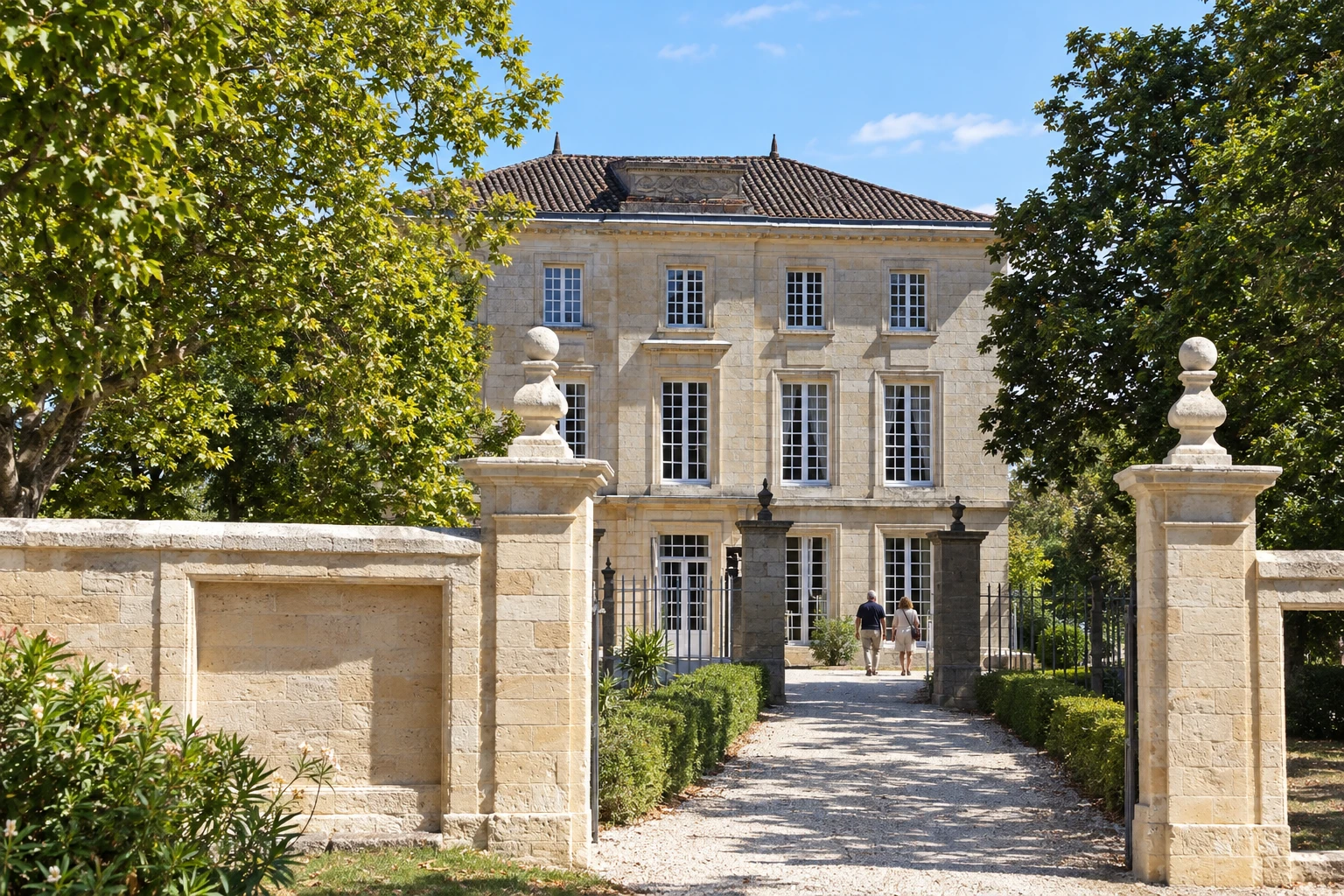
In the photo: Château Figeac · Saint-Émilion

Illustrative images. The pictures in this guide are illustrations based on the real place, not photographs, and may differ from it.

Get it on Google Play

Get to know the place

A region to enjoy
at your own pace.

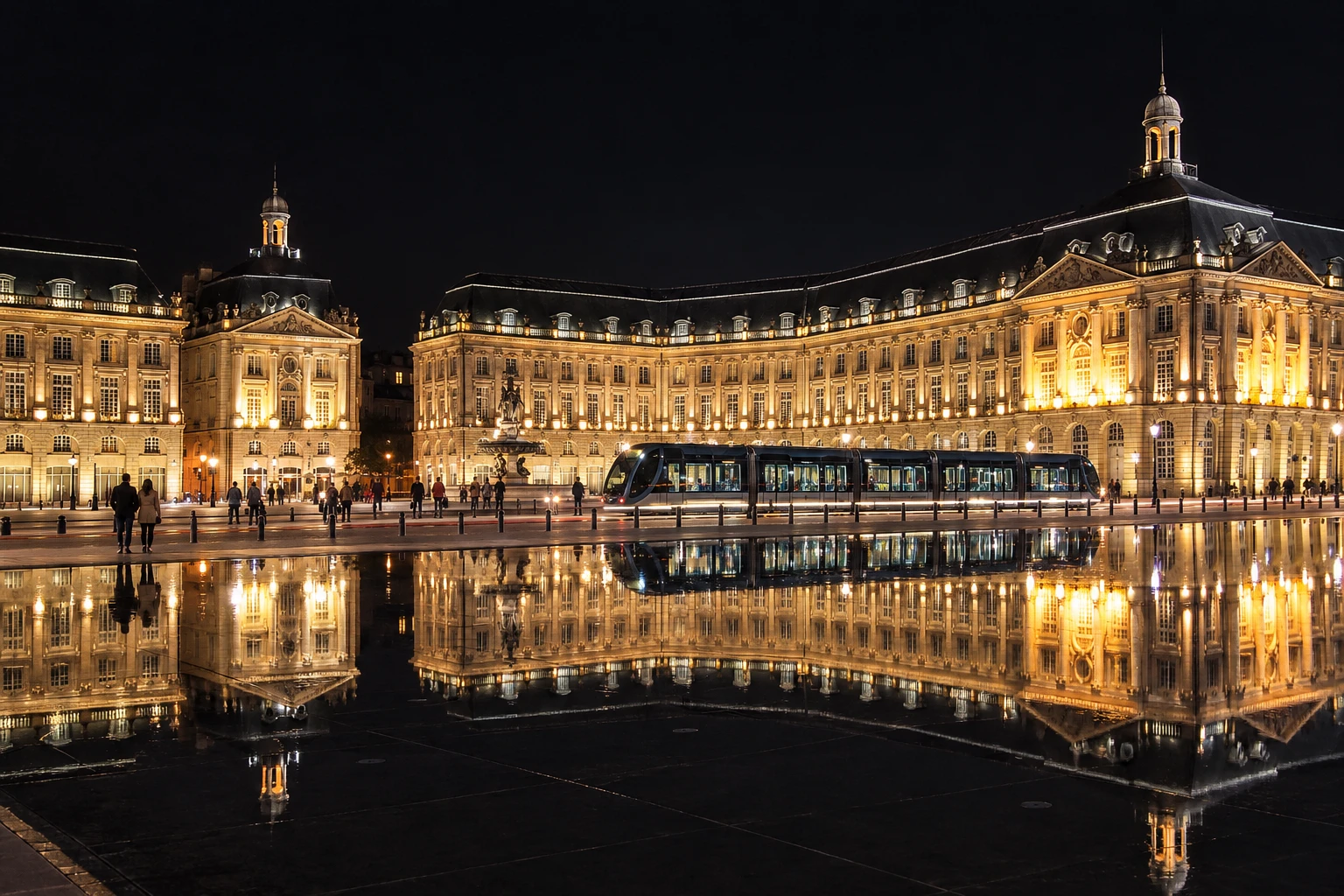
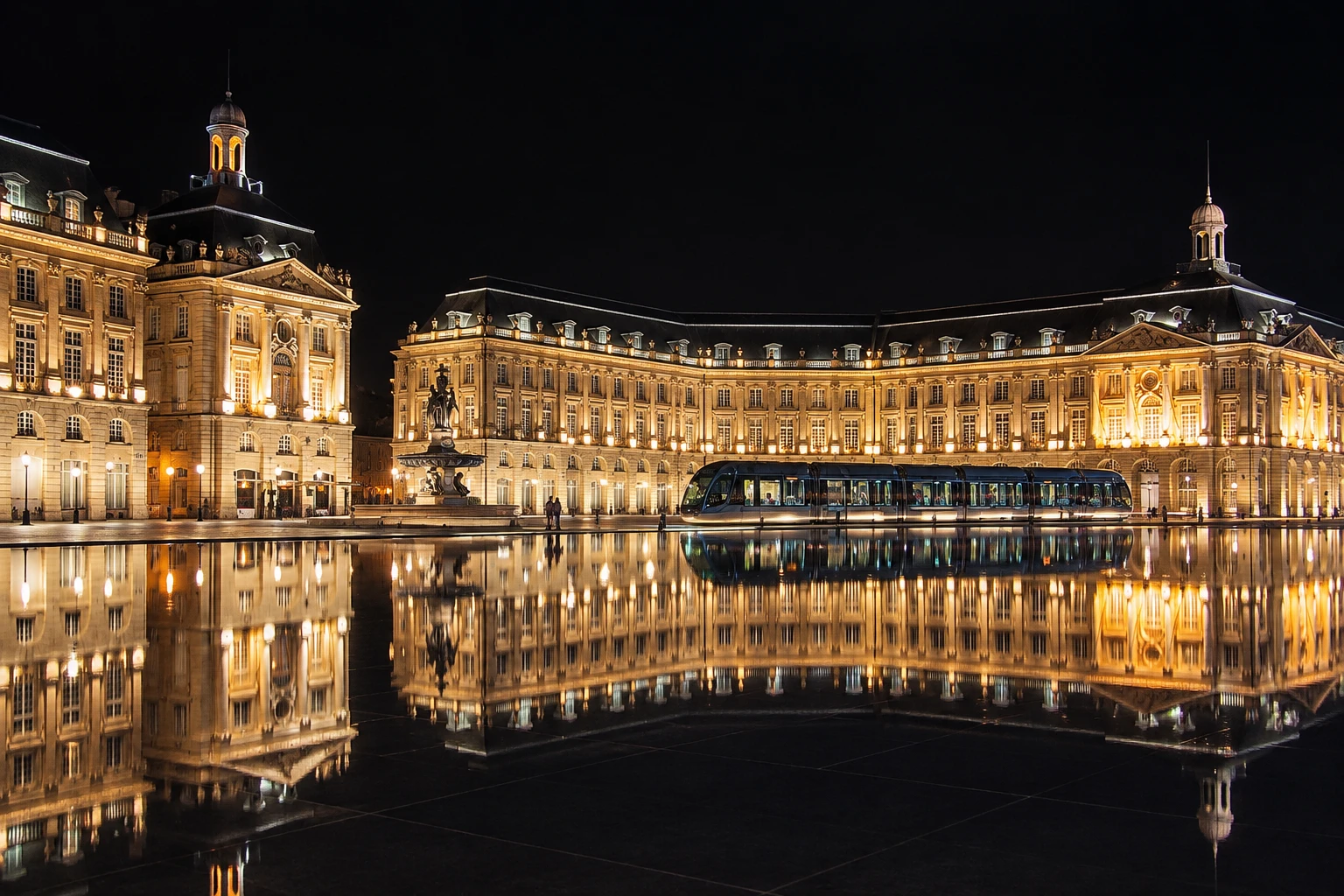
Bordéus (Bordeaux, in French) is the capital of Nova Aquitânia, in southwestern France, and developed on a crescent-shaped bend of the Garonne river. For that reason the port earned the nickname Port de la Lune, the name of the urban ensemble inscribed as a UNESCO World Heritage Site in 2007. The pale stone façades of the 18th century, the Place de la Bourse and the Miroir d'eau form the city's best-known image.

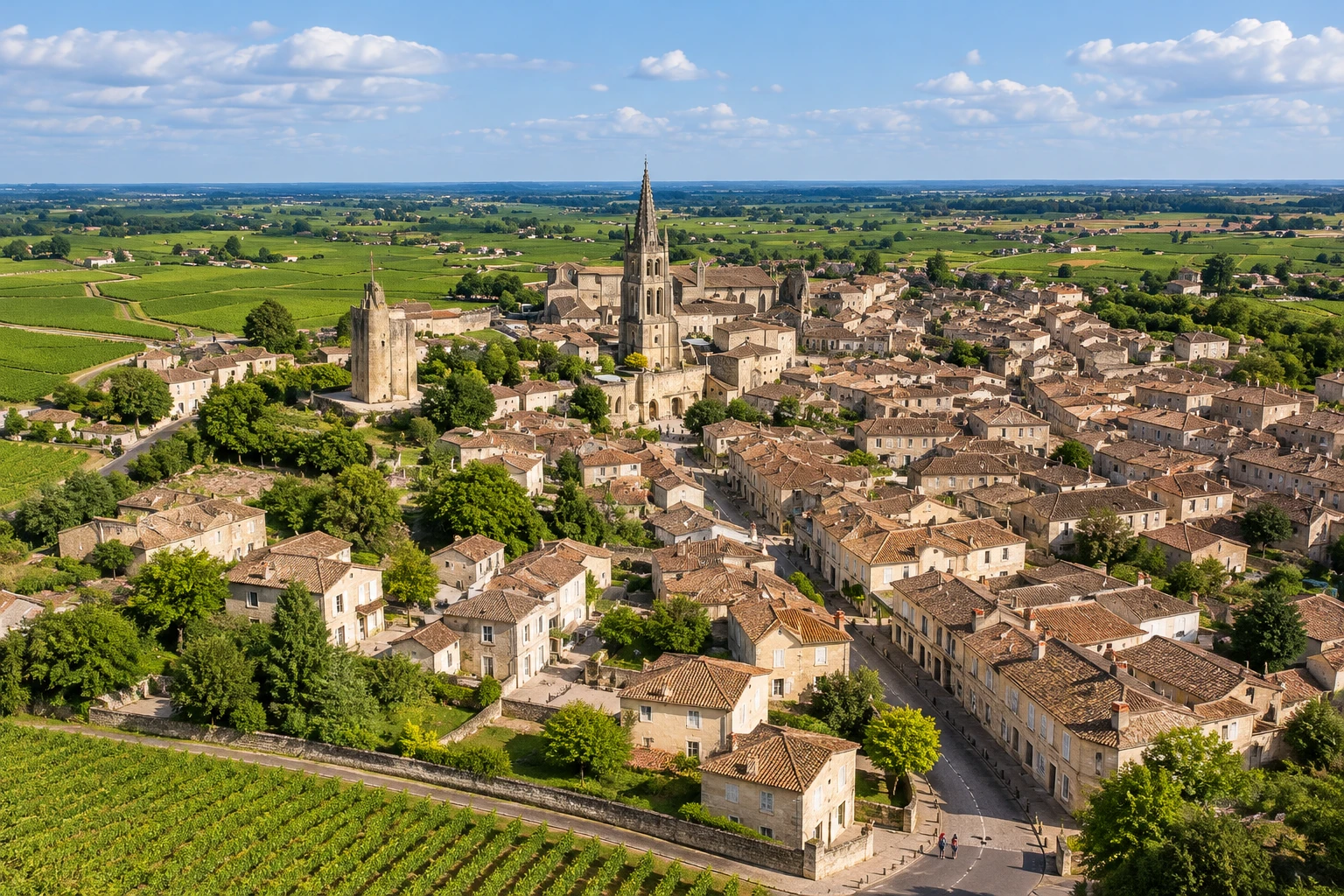
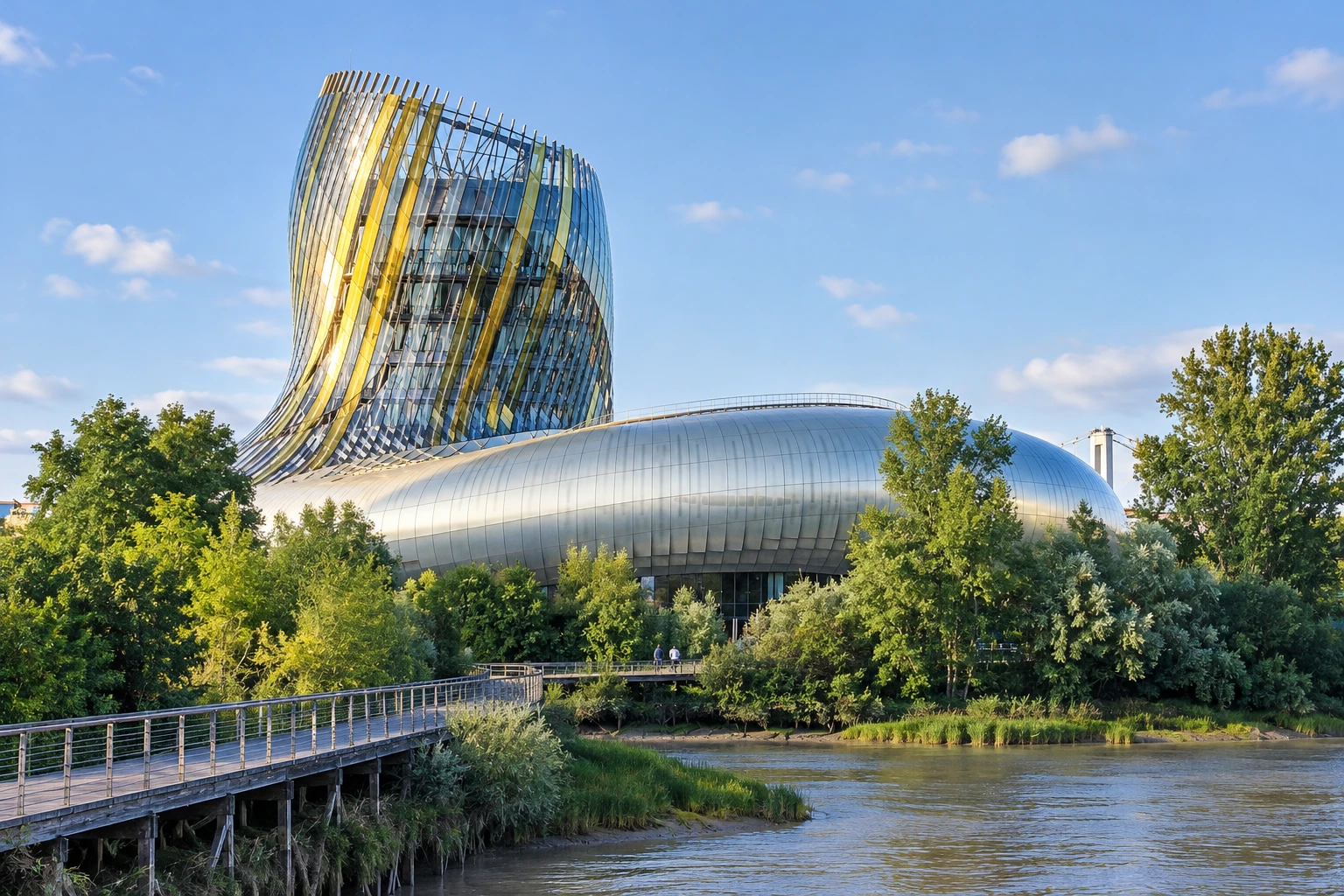
Wine is everywhere. The Cité du Vin, in the Bacalan district, tells the story of the drink worldwide, and roads and trains depart from the city to the wine regions: the Médoc to the north, with Pauillac and Margaux on the Route des Châteaux, and Saint-Émilion to the east, a medieval village surrounded by vineyards whose jurisdiction is also a World Heritage Site since 1999.

On signs and labels the word château always appears. For wine, it does not mean a castle: it denotes the wine estate, including vineyard, cellar and brand. Many estates welcome visitors, almost always by prior reservation. The grape harvest usually takes place in September and October.

For Brazilians, Bordéus is an easy base: the TGV reaches it from Paris in about 2 hours, the city has an international airport and a tram network that links the station, the center and the museums. From here you can do day trips to Saint-Émilion, the Médoc and the Dune du Pilat, the sand dune on the Atlantic coast.

This destination brings together 2 cities: Bordeaux, Saint-Émilion.

Share: WhatsApp
Traveler, share your experiences through photos Up to 5 photos of each place you visited.

One destination, many paths

The cities on this trip

Start with one city or combine several in your itinerary.

Where Bordeaux and Its Vineyards is The star marks the capital, Bordeaux.
BordeauxSaint-Émilion

Outlines: © IGN, ADMIN EXPRESS, Licence Ouverte 2.0. Adapted by Cidade Turismo.

How to get there: Bordeaux and Its Vineyards

Aéroport de Bordeaux-Mérignac (BOD), in Mérignac · 12 km to Bordeaux

Aéroport Paris-Charles-de-Gaulle (CDG), in Roissy-en-France · 610 km to Bordeaux

Connections from Brazil are usually via another city. Check before booking. Some fly to Paris and continue by TGV: from Paris-Montparnasse to the Gare de Bordeaux-Saint-Jean is about 2 hours. Aéroport de Bordeaux-Mérignac (BOD) receives flights from other European cities.

Suggested arrival point: Bordeaux

The local experience

Things to do in Bordeaux and Its Vineyards

Bordeaux · Nouvelle-Aquitaine · Museum

La Cité du Vin

Cultural centre dedicated to wine worldwide, on the banks of the Garonne, with an interactive permanent exhibition, tasting workshops and a belvedere on the 8th floor.

Explore La Cité du Vin

See 14 more places in Bordeaux and Its Vineyards

To choose before you go

Tours in Bordeaux and Its Vineyards

Where each tour starts, how long it takes, how it is done, what is included and the price range.

Place de la Bourse, Miroir d'eau and the pontoons of the Port de la Lune

From Place de la Bourse, in the center of Bordeaux On foot, from the Garonne pontoons about 1 hour and a half morning, afternoon or end of day easy

This is the scene that opens any visit to Bordeaux. The Place de la Bourse was built between 1735 and 1755 by architects Jacques Gabriel and his son, in the service of Louis XV, and marked the opening of the old walled town toward the river. The façades have sculpted mascarons and worked ironwork; in the center is the Fontaine des Trois Grâces, installed in 1869. Opposite, across the avenue and the tram, is the Miroir d'eau: a huge granite slab covered by about 2 cm of water, which alternates a mirror effect—where the square is reflected entirely on the ground—with a mist effect produced by some 900 nozzles. People walk barefoot on the water and children play. From there, the quais of the Garonne form a continuous riverside promenade, with the light stone 18th-century façade that gave Bordeaux the UNESCO World Heritage title as Port de la Lune (Port of the Moon), a name taken from the crescent curve the river makes in front of the city. Head south to the Pont de pierre, the stone bridge, to see the ensemble from afar, or north toward the Chartrons.

Stops: Place de la Bourse et Miroir d'eau, Fontaine des Trois Grâces, Quais de la Garonne, Pont de pierre.

Includes: The square, the Miroir d'eau and the pontoons are public spaces: there is no admission fee. In summer, there are paid guided visits to the Miroir d'eau underground areas, with the reservoir and pumps, sold by the Office de Tourisme.

Tip: The Miroir d'eau is switched off for maintenance from November to April. For photos with the square’s reflection, go at the end of the day when the façade is lit. Bring a small towel if you plan to walk in the water with children.

Best time: From May to October, when the Miroir d'eau operates. In summer the days are long and late afternoon stays bright until late.

Historic center on foot: Grand-Théâtre, Porte Cailhau and Grosse Cloche

From Place de la Comédie, in front of the Grand-Théâtre On foot along the pedestrian streets of the center about 2 to 3 hours, including the visits morning or afternoon easy

The starting point is the Grand-Théâtre de Bordeaux, designed by architect Victor Louis and inaugurated in 1780. The façade has a portico of 12 Corinthian columns with 12 statues on top — the nine Muses and three goddesses. Inside, the auditorium has a painted dome and the colors blue, white and gold, the same as the opera at the palace of Versailles. The guided tour goes through the foyer, the grand staircase and shows the box seating of one of the private boxes. From the Grand-Théâtre, walk down the pedestrian streets of the Saint-Pierre quarter, the medieval core of the city, to the Porte Cailhau, a former fortified gate facing the river that can also be visited. The route continues to the Grosse Cloche, a 15th-century belfry that is the only remaining trace of the old city walls. The bell, cast in 1775, weighs 7,750 kg and rings on dates such as January 1, July 14 and November 11, and on the first Sunday of each month. The gate also served as a prison: on the guided visit a guide takes you to the old cells.

Stops: Grand-Théâtre de Bordeaux, Place de la Comédie, Porte Cailhau, Grosse Cloche, Quartier Saint-Pierre.

Includes: The streets and façades can be seen without an entrance fee. The guided visit of the Grand-Théâtre, the Grosse Cloche tour and entry to the Porte Cailhau are paid separately; check the current price list at the Tourist Office.

Tip: The Grand-Théâtre offers guided visits in the afternoon, Tuesday to Saturday, and is closed Sunday and Monday: book in advance. The visit to the Grosse Cloche is in French. If you only have half a day, combine this walk with the Place de la Bourse, which is a few minutes away.

Best time: All year. In rain, the indoor visits cover much of the itinerary.

Cité du Vin: permanent exhibition and Belvédère

From Quai de Bacalan, on the banks of the Garonne Tram B to the La Cité du Vin stop about 2 to 3 hours morning or afternoon easy

La Cité du Vin is a museum about wine as culture across eras and countries, housed in a curving building on the banks of the Garonne. First, it’s worth explaining a word Brazilian visitors will hear all the time in the region: in Bordeaux, “château” means the estate that produces wine, with vineyards, cellars and a winery, and it does not always include a castle. The permanent exhibition is interactive and multisensory, with headphones and screens. The modules cover vineyards around the world, including an aerial tour of wine landscapes; the vine and the winemaker’s year; how wine is made; history, from ancient civilizations to trade via rivers and oceans; table culture and aromas, with a five-senses buffet; and finally the vineyards of Bordeaux and their history. The visit ends at the Belvédère on the 8th floor, with 360° views over Bordeaux, the river and the bridges, beneath a chandelier made from thousands of bottles. The ticket includes one drink there: a glass of wine from a region of the world or a non-alcoholic beverage. There is also the Via Sensoria, a timed sensory tasting route, and introductory workshops.

Stops: La Cité du Vin, Belvedere of La Cité du Vin.

Includes: The permanent exhibition ticket includes access to the Belvédère with one drink, alcoholic or non-alcoholic. The Via Sensoria and the workshops are sold separately. Check the current price table.

Tip: Buy your ticket in advance and reserve the Via Sensoria, which has limited availability. The Cité du Vin is open every day but usually closes for one week at the end of January: check in advance. The tasting is optional, and the visit is worthwhile for both the exhibits and the view.

Best time: All year; it’s a good option for rainy days.

Cathédrale Saint-André and climb of the Tour Pey-Berland

From Place Pey-Berland, in central Bordeaux On foot; tram A to the Hôtel de Ville stop about 1 hour and a half morning or afternoon moderate (233 steps in the tower)

The Cathédrale Saint-André of Bordeaux stands on Place Pey-Berland, in front of the Palais Rohan, which houses the city hall. It was the setting for royal weddings: in 1137, that of Aliénor d'Aquitaine (Eleanor of Aquitaine) with the future king Louis VII, and five centuries later that of Anne d'Autriche with Louis XIII. On the north side of the nave, the Portail Royal displays 13th-century Gothic sculpture; restoration revealed that the figures were painted in bright colors. The cathedral has its bell tower separate from the church body: the Tour Pey-Berland, begun in 1440, because the original structure could not bear the weight of the bells. At the top sits a statue of Notre-Dame d'Aquitaine, placed in 1863, and the bell tower holds an 11-ton bell. The climb has 233 steps to the top, at 50 m high, with views over the roofs of the center, the cathedral, the river and the Flèche Saint-Michel.

Stops: Cathédrale Saint-André de Bordeaux, Tour Pey-Berland, Place Pey-Berland, Palais Rohan.

Includes: Entry to the cathedral is free. The climb of the Tour Pey-Berland requires a ticket, paid separately; check the current price list.

Tip: The tower staircase is narrow and spiral. The tower is open year-round, with reduced hours from October to May and closed on January 1, May 1 and December 25. The Musée d'Aquitaine is a few minutes' walk away.

Best time: All year. On clear days, the view from the top of the tower reaches farther.

Saint-Michel: basilica, Flèche Saint-Michel and the Capucins market

From Place Meynard, in the Saint-Michel neighborhood On foot from the historic center about 2 hours morning moderate (230 steps in the tower)

The Basilique Saint-Michel of Bordeaux, in flamboyant Gothic style, was built between the 14th and 17th centuries and is part of the UNESCO World Heritage for the Ways of St. James in France. Beside it, separated from the church as in the cathedral, stands the bell tower, the Flèche Saint-Michel, completed in 1492. At 114 m, it is the fourth-tallest bell tower in France and can be seen from almost the entire city. The spire survived an earthquake in 1759 and a hurricane in 1768, which removed the top; it was rebuilt by architect Paul Abadie between 1860 and 1869. The ascent has 230 steps and reaches a lookout with views over the city centre roofs, the Garonne, the Pont de pierre, and the hills of the right bank. The surrounding neighborhood is popular and mixed, with studios, antique shops and terraces at Place Meynard, where there is a food market and a flea market on some days of the week. A few minutes away is the Marché des Capucins, the covered market known as "the belly of Bordeaux", good for seeing products from the southwest.

Stops: Basilique Saint-Michel de Bordeaux, Flèche Saint-Michel, Place Meynard, Marché des Capucins.

Includes: Entrance to the basilica is free. The ascent of the Flèche Saint-Michel requires a ticket, sold on site or online, without reservation; there is a combined ticket with the Porte Cailhau. Check the current schedule.

Tip: The spire is open every day from April to October, with a midday break; the last ascent is half an hour before closing. On site, payment is card only. Go in the morning to combine it with the Capucins market.

Best time: From April to October, when the spire ascent is open.

Chartrons, quays and Jardin public

From Place de la Bourse or Esplanade des Quinconces On foot along the quays; return by tram about 2 to 3 hours morning or afternoon easy

The Chartrons, north of the historic center, began as a suburb in the 14th century around a Carthusian convent, which gave the neighbourhood its name, and became the district of wine merchants: in houses and former warehouses, the chais, wine was stored before being shipped from the port. The simplest route is to follow the quays of the Garonne from the Place de la Bourse, passing the Esplanade des Quinconces, where cruise ships dock. In the neighborhood, Rue Notre-Dame is the main axis: antique shops and thrift stores, wine merchants, restaurants and new shops, in the shadow of the Gothic towers of the Église Saint-Louis des Chartrons. Place des Chartrons has a 19th-century octagonal iron covered market, surrounded by terraces. On the other side of the neighborhood is the Jardin public de Bordeaux, a public park good for a break. On the riverfront, the Chartrons market brings together food stalls facing the Garonne.

Stops: Quartier des Chartrons, Rue Notre-Dame, Église Saint-Louis des Chartrons, Place des Chartrons, Jardin public de Bordeaux.

Includes: Walk-through with no ticket required. Guided neighborhood tours are sold separately by the Office de Tourisme.

Tip: To return to the center or continue to the Cité du Vin, take tram B, which runs along the quays.

Best time: All year; from April to October the terraces and quays are livelier.

See 11 more tours

Bassins des Lumières in the former Base sous-marine

From Bacalan neighborhood, north of the center Tram C to Ravezies and bus 9, or bus 5 about 1 hour and a half morning or afternoon easy

Les Bassins des Lumières are a digital art center installed in the former submarine base of Bordeaux, built by German forces from 1940 during the occupation, in the Bacalan neighborhood. The project employed more than 6,500 workers, a third of them Spanish Republican prisoners, and the reinforced concrete structure has a roof 9 m thick. Inside that block, 360° projections cover walls and pillars, accompanied by music, and are reflected in the water of four monumental basins where the submarines were housed. The programs change throughout the year and usually feature a long exhibition dedicated to a painter, such as Matisse, and a shorter one on another theme. There is also the Cube, a space for contemporary creation. The visit is self-guided and follows the sequence of projections. The place has historical weight, and it is worth reading the panels about the base before entering the dark rooms.

Stops: Bassins des Lumières, Base sous-marine de Bordeaux, Bassins à flot.

Includes: There is a timed-entry ticket; buy in advance. Check the current price list and the program for your travel dates.

Tip: The projections may pose a risk for people with epilepsy or photosensitivity and are not recommended for children under 2. Bus 5 departs from the Tourny stop, near Les Quinconces. Combine with the Cité du Vin, on the same side of the city.

Best time: Year-round; a good option for rainy days or very hot weather.

Musée d'Aquitaine: from prehistory to the port of Bordeaux

From Cours Pasteur, in central Bordeaux Tram B to the Musée d'Aquitaine stop about 2 hours morning or afternoon easy

The Musée d'Aquitaine tells the history of Bordeaux and the region from prehistory to the 21st century. On the ground floor are the prehistoric collections, including the Vénus de Laussel, a female figure carved in stone, and objects from the Bronze Age; these are followed by Roman Bordeaux, the Middle Ages and the Renaissance. The upper floor covers the 18th to 21st centuries. The 18th-century rooms show the period when Bordeaux's port grew wealthy from Atlantic trade and from the trafficking of enslaved people, with ship documents and portraits; the subject is presented directly and requires a careful visit. The same building houses the Centre d'interprétation Bordeaux Patrimoine Mondial, with models and maps explaining why the Port de la Lune urban ensemble was inscribed as a World Heritage site. A visitor app, accessed by a QR code at the entrance, offers a route of about 1 hour and a half through the main works, in several languages.

Stops: Musée d'Aquitaine, Centre d'interprétation Bordeaux Patrimoine Mondial.

Includes: There is an admission ticket for the collections; guided tours carry an extra charge. Payment is made at reception, with no reservation required for individual visitors. Check the current prices.

Tip: The museum is open Tuesday through Sunday and closed on Mondays and public holidays. It is a few minutes from Cathédrale Saint-André: you can do both in the same morning.

Best time: All year; a good option for rainy days.

Boat ride on the Garonne in front of the Port de la Lune

From Pontoons from which, near the Place de la Bourse Commented cruise boat or the Bato boat of the TBM network about 1 hour and a half afternoon or evening easy

From the river you can understand Bordeaux’s layout: the continuous light-stone 18th-century façade along the curve of the Garonne, the Port de la Lune. Several boats run short commented cruises of about 1 hour and a half, departing from pontoons in the center. The route usually passes under the city’s bridges, from the Pont de pierre to the Pont Jacques-Chaban-Delmas, which has a movable deck to let ships pass, and shows the Place de la Bourse with the Miroir d'eau, the Esplanade des Quinconces and the Cité du Vin. Some companies offer formats with a meal on board, at lunch or dinner, or a ride with a canelé, Bordeaux’s typical pastry. To cross the river on your own, there is the Bato, the line boats of the TBM transport network: four lines link the two banks, for example to Lormont or to the right bank in the Bastide neighborhood, where the Darwin cultural space is located.

Stops: Garonne, Port de la Lune, Pont de pierre, Pont Jacques-Chaban-Delmas, Esplanade des Quinconces.

Includes: On the cruises, generally: a guided commentary in French and sometimes in English. Meals and drinks, when offered, depend on the chosen format. The Bato uses the standard ticket of the TBM network. Check the current schedule.

Tip: Book the cruise in advance in summer. Late afternoon is good for seeing the façade lit up. On the right bank, the Chantiers de la Garonne, near Darwin, face the Place de la Bourse.

Best time: From April to October, with long days; in winter the schedule options are usually fewer.

Saint-Émilion: the medieval village, the Tour du Roy and the cloisters

From Gare de Bordeaux-Saint-Jean Regional TER train to Saint-Émilion station about 8 hours, round trip full day moderate (steep stone streets)

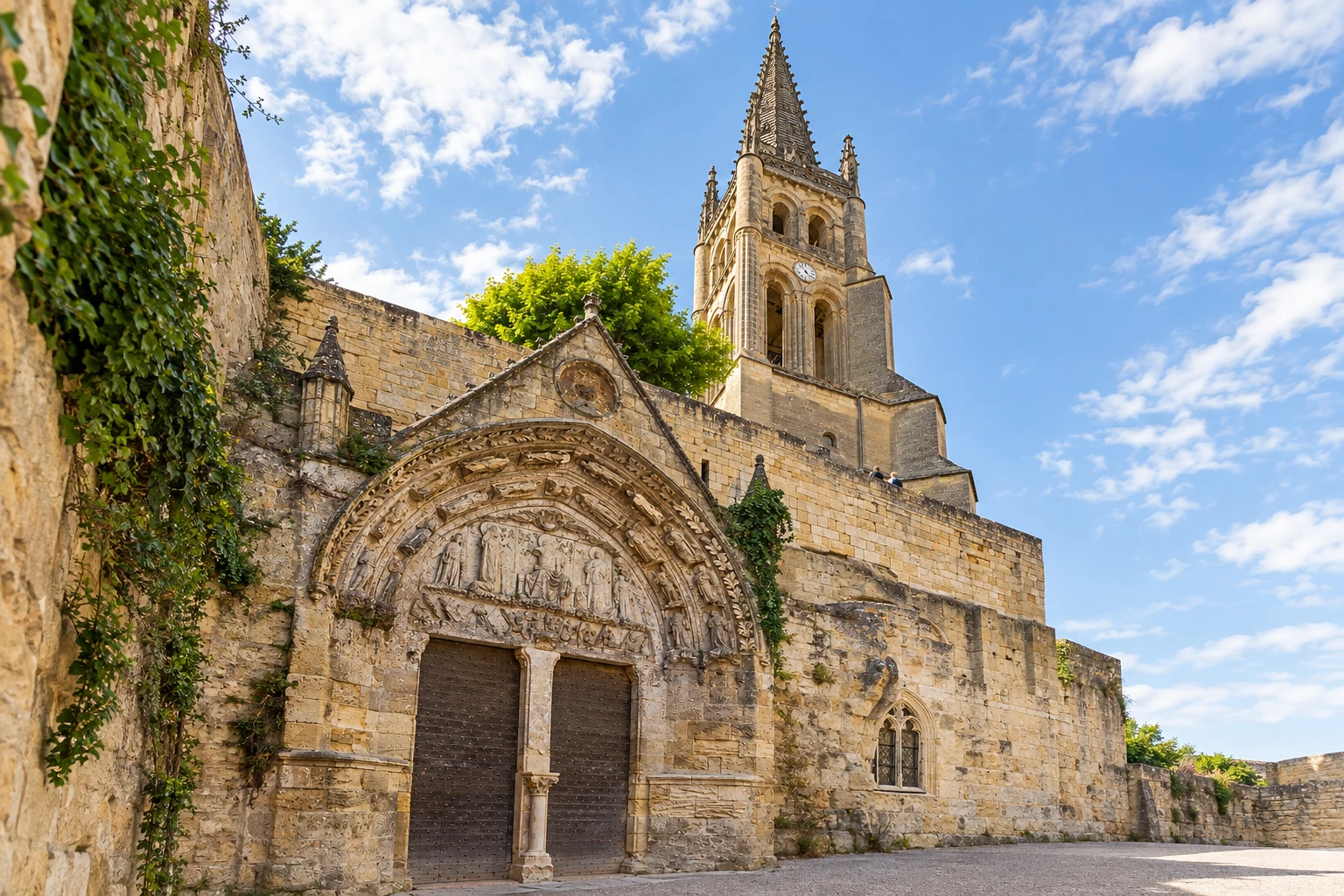
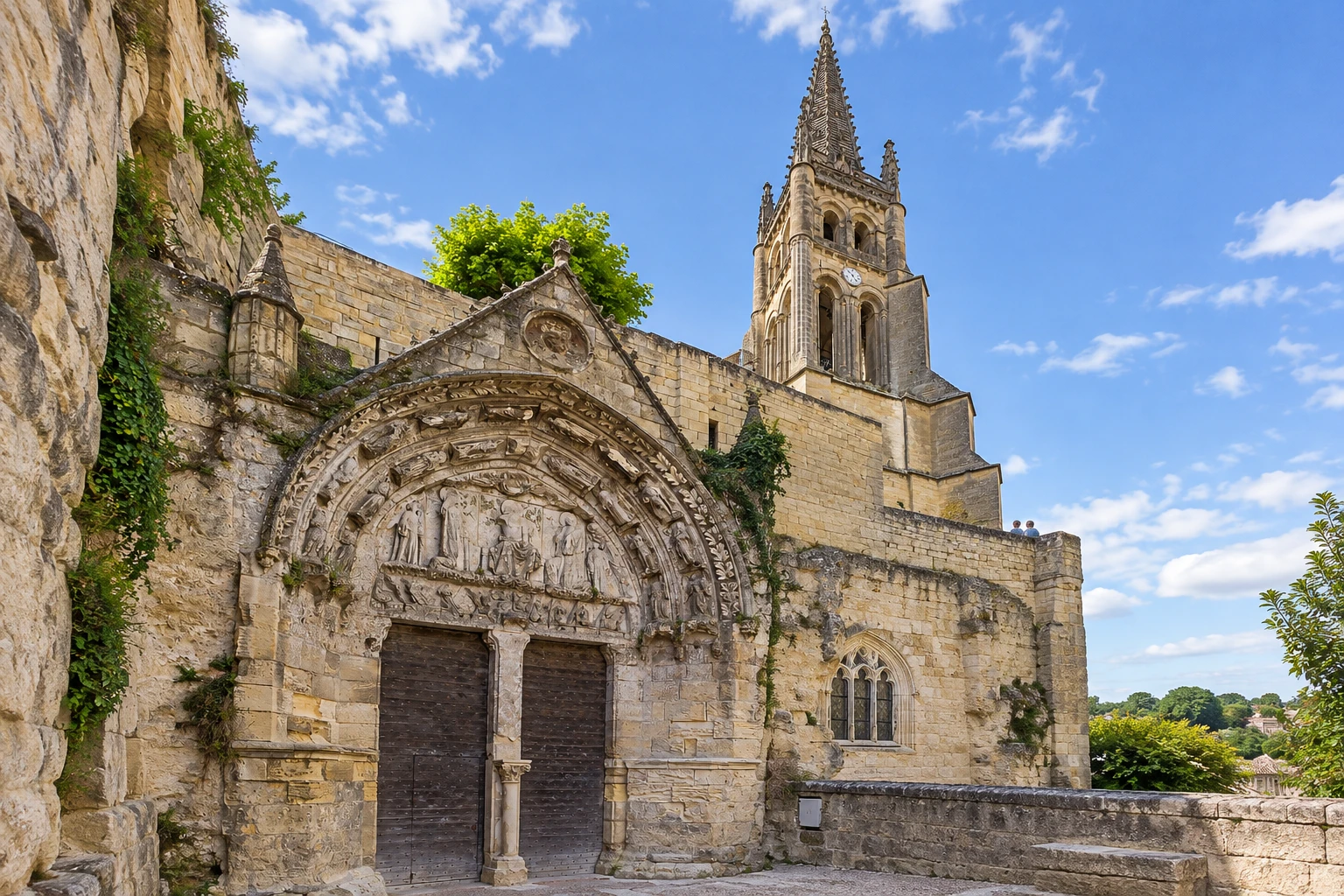
Saint-Émilion is a medieval village of limestone east of Bordeaux, on top of a slope surrounded by vineyards. In 1999, the Juridiction of Saint-Émilion, including the village and seven other communes and about 5,000 hectares of vineyards, became the first vineyard to be inscribed on the UNESCO World Heritage list as a cultural landscape. The TER departs from Bordeaux-Saint-Jean and arrives in about 35 to 45 minutes; the station is located roughly 1.5 km below the village, on an uphill path. At the top, the Collégiale, a Romanesque and Gothic church with its first stone laid in 1110, has a cloister that now houses the Office de Tourisme. The Tour du Roy, a 13th‑century tower on a mass of rock, is the only intact Romanesque keep in the Gironde; there are 118 steps to the terrace, from which the Jurade, the local wine brotherhood, proclaims the Ban des Vendanges, the start of the harvest, in September. The bell tower of the Église monolithe, at 68 m, has 196 steps and the widest view over the village and the Juridiction. In the Cloître des Cordeliers are the ruins of a 14th‑century cloister and cellars dug to 17 m deep, where Crémant de Bordeaux, the region’s sparkling wine, is made, with a guided visit. Between points, the streets descend in stone slopes, the tertres, down to the square of the Église monolithe.

Stops: Cité médiévale de Saint-Émilion, Tour du Roy, Collégiale de Saint-Émilion, Cloître des Cordeliers, Clocher de l'Église monolithe.

Includes: Walking around the village is free. The climb of the Tour du Roy, the bell tower (ticket at the Office de Tourisme) and the visit to the Cloître des Cordeliers are paid separately. Check the current price list.

Tip: Wear low shoes: the stone slopes are slippery when it rains. From the station, the walking route climbs and has pavement only in part; there is a tuk‑tuk that makes the trip. Book the visit to the Église monolithe in advance and plan your day around its schedule.

Best time: From April to October. September and October are usually the harvest period, with activity at the estates.

Saint-Émilion underground: Église monolithe with guided tour

From Place de l'Église Monolithe, in Saint-Émilion Guided tour sold by the Office de Tourisme about 45 minutes to 1 hour morning or afternoon easy (stairs and uneven pavement)

The Église monolithe of Saint-Émilion was carved into limestone at the beginning of the 12th century: it is 38 m long by 12 m high and is the largest underground church in Europe. The name comes from Greek and means "one stone", because the whole structure forms a single block. Entry is only possible with a guide. The visit, called Saint-Émilion Souterrain, passes through four monuments: the Ermitage, the grotto where the monk Émilion is said to have lived, who gave the village its name in the 8th century; the Chapelle de la Trinité, with medieval paintings; the catacombs; and the church itself, with naves hewn in the rock. The guide tells the story of the monk, the pilgrimage that grew around his tomb, and how the church was carved, painted, looted and restored over the centuries. The church remains consecrated and hosts ceremonies, including those of the Jurade.

Stops: Église monolithe de Saint-Émilion, Ermitage de Saint-Émilion, Chapelle de la Trinité, Catacombs of Saint-Émilion.

Includes: Guided‑tour ticket, purchased at the Office de Tourisme or online. The tour is in French, with a paper translation in several languages, including Portuguese, available on request at reception before it starts. The climb of the bell tower is charged separately.

Tip: Arrive before the scheduled time: once the group enters, you cannot catch up with it or request a refund, and parking in the village can take time. Photos are not allowed in the underground monuments. Small children also need a ticket.

Best time: All year; in summer book in advance because groups fill up.

Saint-Émilion wineries: visit châteaux by reservation

From Saint-Émilion or Bordeaux Car, taxi, tour or bicycle from the village about 3 to 4 hours morning or afternoon easy

The Saint-Émilion vineyard has more than 900 producers and is a mosaic of small estates. The main grape is merlot, supplemented by cabernet franc and cabernet sauvignon, on clay and limestone soils. For Brazilians, a practical rule is: each château is one estate, and visits almost always require a reservation. A typical visit walks the vineyard, explains the annual cycle, goes through the cuvier (the vat room where fermentation happens), and the chai, where the wine ages in barrels, finishing with a guided tasting. Some estates feature contemporary architecture: Château Faugères has a monumental chai designed by architect Mario Botta, and Château La Dominique a chai by Jean Nouvel with a red cuvier and a terrace overlooking the vineyards of Saint-Émilion and Pomerol. The Office de Tourisme compiles the visit options, lists which châteaux are open that day and sells short vineyard excursions departing from the village. During harvest time, the estates are in full picking and the pace of visits may change.

Stops: Vignoble de Saint-Émilion, Juridiction de Saint-Émilion, Château Faugères, Château La Dominique, Pomerol.

Includes: On visits, in general: guided tour of the property and a guided tasting. Each château has its own price list; tours with transportation are sold separately. Check the current rates.

Tip: Book in advance and confirm the tour language. If you will be driving, do not drink: at tastings you can just sip and spit, as professionals do, or stick to the explanation only. Tours that include transport solve this issue.

Best time: From April to October. Harvest usually takes place in September and October.

Médoc and the Route des Châteaux: Margaux, Saint-Julien and Pauillac

From Bordeaux Drive along the D2 road or half-day or full-day tour about 5 to 9 hours full day easy

The Médoc is the strip of land north of Bordeaux, between the Gironde estuary and the pine forest that separates it from the Atlantic. The Route des Châteaux, the Médoc wine route, runs about 100 km along the D2 road, from Blanquefort at the exit of Bordeaux to Saint-Vivien-de-Médoc. It crosses the communes of the Haut-Médoc: Margaux, Saint-Julien, Pauillac, Saint-Estèphe, Moulis-en-Médoc and Listrac-Médoc. There are 60 of the Grands Crus Classés from the 1855 classification there, including Lafite-Rothschild, Latour, Margaux and Mouton-Rothschild. Along the road the châteaux follow one after another at the roadside and display very different styles: classic manor houses, Château Beychevelle—called the “Versailles of the Médoc”—and Cos d'Estournel, with an oriental-inspired façade. In Pauillac, on the estuary, the Maison du Tourisme et du Vin arranges visits at partner estates and distributes a map of the architecture of the crus classés. A walk through the vineyards to the village of Bages also starts there. The Odyssée de la Rose in Pauillac offers a multimedia visit about the vine cycle, also designed for children.

Stops: Pauillac et la Route des Châteaux, Margaux, Saint-Julien, Saint-Estèphe, Château Beychevelle, Cos d'Estournel, Maison du Tourisme et du Vin de Pauillac.

Includes: On organized tours, typically: transportation, guide, and visits to two estates with tastings. Meals are usually paid separately. For self-guided visits, each château has its own price list and booking procedure. Check the current prices.

Tip: The top grands crus only accept visits by reservation: book in advance. Without a car, there is a TER from Bordeaux to Pauillac in just over 1 hour, but the estates are spread out: a tour is the simplest option. If you’re driving, don’t drink.

Best time: From April to October. In September and October the harvest is often underway.

Graves and Sauternes: the oldest vineyard and the sweet wines

From Bordeaux Car or organized tour of southern Gironde about 5 to 8 hours full day easy

South of Bordeaux lie the Graves, where the region's first vines were planted more than 2,000 years ago. The area closest to the city is the Pessac-Léognan appellation, with crus classés just minutes from the center. At Château Smith Haut-Lafitte the visit includes the cooperage, where barrels are made, and the Forêt des Sens, a 10-hectare land art trail. Further south, the Sauternes area is crossed by the Ciron, a cold-water river. In autumn it creates morning mists that favor a fungus, Botrytis cinerea, called “noble rot”: it concentrates the sugar in the grapes and gives rise to the sweet white wines of Sauternes, such as those of Château d'Yquem. The region also has real medieval castles, the châteaux clementins, linked to the family of Pope Clement V: Roquetaillade and Villandraut can be visited and work well for children.

Stops: Graves, Pessac-Léognan, Sauternes, Château Smith Haut-Lafitte, Château de Roquetaillade, Château de Villandraut.

Includes: On excursions, typically: transport, guide and tastings included. Medieval castles have separate admission. Check the current price table.

Tip: For those who have already done Saint-Émilion and the Médoc, it is the natural complement: a different landscape and another type of wine. Book the estates in advance. Without a car there are trains to Cérons and Podensac, from which you can reach Cadillac, but the châteaux are spread out.

Best time: From April to October. In autumn, the morning mists over the Ciron are part of the Sauternes landscape.

Dune du Pilat: climb to the dune between the ocean and the forest

From Gare de Bordeaux-Saint-Jean TER to Arcachon and Baïa bus line 3, or car about 6 hours round trip full day moderate (ascent on sand)

The Dune du Pilat is the tallest dune in Europe: a hill of about 55 million cubic meters of sand accumulated over 4,000 years at the outlet of the Bassin d'Arcachon, between the Atlantic Ocean and the Landes pine forest. It is a protected Grand Site, publicly owned. The visit begins at the welcome area, with parking, snack outlets and restrooms, and continues along a path through the woods to the base of the dune. The climb takes about 15 minutes; from April to October stairs are installed in the sand. At the top, the crest stretches to both sides: on one side, the ocean, the Banc d'Arguin and the tip of Cap Ferret; on the other, a sea of pines to the horizon. Many people walk along the crest and descend on the ocean side down to the beach. The dune keeps advancing inland, pushed by the wind, gradually swallowing the forest. To get there without a car, take the TER from Bordeaux to Arcachon, about 50 minutes, and the Baïa bus line 3 to the Dune du Pilat stop, about 25 minutes.

Stops: Dune du Pilat, Grand Site de la Dune du Pilat, Banc d'Arguin, Bassin d'Arcachon.

Includes: Access to the dune is free; the Grand Site parking is paid and the revenue goes to site maintenance. There are guided activities with mediators throughout the year.

Tip: At the top there is no shade, water, or snack bar: bring water, a hat, and sunscreen. In summer the sand gets very hot, so go early in the morning or late afternoon, and wear shoes. Bus line 3 does not run on Sundays and holidays; in July and August there is line 101 Express. Parking on the roadside is prohibited.

Best time: From April to October, with stairs installed. In July and August it is very busy: arrive early.

Arcachon: Ville d'Hiver, oysters and boat to Cap Ferret

From Gare de Bordeaux-Saint-Jean TER to Arcachon and UBA boat to Cap Ferret about 9 hours round trip full day easy

Arcachon is Bordeaux’s seaside town, on the edge of an almost closed bay, the Bassin d'Arcachon, about 50 minutes by TER. The town grew in the 19th century as a summer resort established by the Pereire brothers. Above, the Ville d'Hiver covers 110 hectares of 19th- and early-20th-century villas in styles ranging from Swiss chalet to Moorish, with Place Fleming and its white bandstand from 1893. Below, on the waterfront, is Jetée Thiers, where UBA boats depart for Cap Ferret: the crossing to Jetée Bélisaire takes 30 minutes and runs year-round, except on December 25 and January 1. In Cap Ferret, the 53 m lighthouse has 258 steps and views over the Bassin, the oyster parks, Île aux Oiseaux and the Dune du Pilat. In the oyster-farming villages on the peninsula, such as Le Canon and L'Herbe, producers open their huts for on-site oyster tasting. Another option from Arcachon is the boat trip to Île aux Oiseaux to see the cabanes tchanquées, two wooden houses on stilts in the middle of the bay; boats only approach them at high tide.

Stops: Arcachon, Ville d'Hiver d'Arcachon, Jetée Thiers, Cap Ferret, Phare du Cap Ferret, Île aux Oiseaux, Cabanes tchanquées.

Includes: The Arcachon–Cap Ferret boat and trips to Île aux Oiseaux require tickets, sold at the piers or online. The climb of the lighthouse and oysters at the huts are paid separately. Check the current price list.

Tip: Check the tidal table before the trip to Île aux Oiseaux. In summer there is also a sea bus between Petit Port, Jetée Thiers and Le Moulleau. You can combine Arcachon and Dune du Pilat in one day, but it’s rushed: choose one of the two if you want time for Cap Ferret.

Best time: From May to September, for beach and boat. Oysters are available year-round.

Entre-deux-Mers by bike on the Roger Lapébie piste

From Bordeaux, right bank of the Garonne Bicycle along the greenway; return by bus or bicycle about 6 to 8 hours full day moderate (25 to 30 km per section)

The Entre-deux-Mers is the vineyard region between the Garonne and Dordogne rivers, the largest wine region of the Bordelais, producing dry whites, reds, rosés and crémants. The piste cyclable Roger Lapébie is a greenway of about 47 km built on an old railway between Latresne, near Bordeaux, and Sauveterre-de-Guyenne, almost flat and separated from cars. The most common day ride goes from Bordeaux to Créon, about 25 km: a bastide, a planned medieval town with a square and arcades at the Place de la Prévôté, with a market on Wednesday morning. After roughly 30 km of track you leave the greenway to reach the Abbaye de La Sauve-Majeure, a Romanesque abbey founded in 1079, with capitals carved with animals and human figures. It is part of UNESCO World Heritage for the Routes of Santiago de Compostela. It was the monks of that abbey who cleared the surrounding forest to plant vines. Along the way there are vineyards, mills and Romanesque churches, and some estates welcome visitors.

Stops: Entre-deux-Mers, Piste cyclable Roger Lapébie, Créon, Abbaye de La Sauve-Majeure, Sauveterre-de-Guyenne.

Includes: The greenway has no entrance fee. Bicycle rental, abbey admission and visits to estates are paid separately. Check the current price table.

Tip: Rent the bicycle in Bordeaux, preferably electric if you are not used to long distances. To return without pedaling, express bus 470 connects Créon to Bordeaux in about 40 minutes, and 473 serves La Sauve. Bring water and check in advance whether the bus accepts bicycles.

Best time: From April to June and in September and October, with mild temperatures. In summer, start early.


Day by day

2, 3 and 5-day itinerary in Bordeaux and Its Vineyards

Suggestions to plan the trip. Change the order of the days according to the weather and tour availability.

2 days · Bordeaux in 2 days: historic center, Cité du Vin and Saint-Émilion

For Someone who fits Bordeaux into a trip through France and wants to see the city and a wine village · Based in Bordeaux, near the historic center or Gare Saint-Jean
  1. Day 1 · Arrival and historic center

    If you come from Brazil you arrive in Paris in the morning on the overnight flight. From Charles de Gaulle there are some direct TGVs to Bordeaux, about 3 hours and 40 minutes; the other option is to go to Paris-Montparnasse and take a direct TGV, about 2 hours. Arriving in the early afternoon, leave your bags and do the walk at Place de la Bourse, Miroir d'eau and the quays of the Port de la Lune. Continue on foot through the historic center to the Grand-Théâtre and the Grosse Cloche. At the end of the day, return to the quays to see the façade lit up. Sleep early: the time difference hits on the first day.

  2. Day 2 · Saint-Émilion and Cité du Vin

    Take an early TER to Saint-Émilion. Do the guided visit of the Église monolithe, booked in advance, and walk through the medieval village, with the Tour du Roy and the Collégiale. If time allows, visit a château by reservation or just walk the vineyards around the village. Return to Bordeaux in the early afternoon and take tram B to the Cité du Vin for the exhibition and the view from the Belvédère at the end of the day.

3 days · Bordeaux in 3 days: city, Saint-Émilion and Médoc
For Someone who wants to explore the city at a relaxed pace and both sides of the vineyard, the right and left banks · Based in Bordeaux, near the historic center or Gare Saint-Jean
  1. Day 1 · Arrival and Port de la Lune

    Overnight flight from Brazil arriving in Paris in the morning. Continue by TGV: direct from Charles de Gaulle airport, about 3 hours and 40 minutes, or from Paris-Montparnasse, about 2 hours. In the afternoon, walk Place de la Bourse, Miroir d'eau and the quays of the Port de la Lune and, if you have the energy, take a boat ride on the Garonne at the end of the day.

  2. Day 2 · Historic centre, cathedral and Cité du Vin

    In the morning, explore the historic centre on foot, from the Grand-Théâtre to the Grosse Cloche, and climb the Tour Pey-Berland next to Cathédrale Saint-André. From April to October, swap the tower for the Flèche Saint-Michel and stop by the Marché des Capucins. In the afternoon, walk through the Chartrons and take the tram to the Cité du Vin.

  3. Day 3 · Saint-Émilion or Médoc

    Choose a side of the wine region. Without a car, Saint-Émilion is the simplest: TER, visit the Église monolithe and the village, and one château by reservation. With a tour or a car, do the Médoc and the Route des Châteaux, including Margaux and Pauillac. Doing both in one day is rushed.

5 days · Bordeaux and the vineyards in 5 days, with the Dune du Pilat and Arcachon
For Someone who wants city, vineyards and the Atlantic coast, with time for museums · Based in Bordeaux, with day trips by train, tour or car
  1. Day 1 · Arrival and quays of the Garonne

    Morning arrival in Paris on the overnight flight from Brazil and TGV to Bordeaux: direct from Charles de Gaulle, about 3 hours 40 minutes, or from Paris-Montparnasse, about 2 hours. Late afternoon at the Place de la Bourse and the Miroir d'eau, with a walk along the quays of the Port de la Lune.

  2. Day 2 · Bordeaux on foot and museums

    Historic centre on foot, from the Grand-Théâtre to the Grosse Cloche; Cathédrale Saint-André and Tour Pey-Berland; in the afternoon, Musée d'Aquitaine. From April to October, ascend the Flèche Saint-Michel. In the evening, a boat trip on the Garonne.

  3. Day 3 · Saint-Émilion

    Full day in Saint-Émilion by TER: guided visit of the Église monolithe, medieval village, Tour du Roy and one or two châteaux by reservation. Return to Bordeaux late in the afternoon.

  4. Day 4 · Médoc or Entre-deux-Mers

    Do the Médoc and the Route des Châteaux on a tour or by car, with visits reserved in Margaux and Pauillac. For those who prefer exercise and scenery, the alternative is the Entre-deux-Mers by bike along the piste Roger Lapébie to Créon and La Sauve-Majeure.

  5. Day 5 · Dune du Pilat and Arcachon

    Early TER to Arcachon and bus to the Dune du Pilat, to climb before the heat. In the afternoon, Arcachon: Ville d'Hiver and, if time permits, the boat to Cap Ferret to see the oyster-farming villages. Return by TER to Bordeaux. If you have half a day left before departure, visit the Bassins des Lumières or the Cité du Vin.

Best time to go

When to go: Bordeaux and Its Vineyards month by month

From April to October, with long days and winery visits in full swing. The grape harvest usually takes place in September and October. In the European summer, from June to August, it is warm and there are more people. In winter, from December to February, days are short and some visits have reduced hours.

The seasons shown are the most usual ones; nature doesn't always follow the calendar.

January High rain

cold and damp · Cité du Vin with few people

Winter. In Bordeaux, averages range from 3.7 °C to 10.5 °C, with rain on about 12 days in the month; snow is rare. Days are short. The Miroir d'eau is turned off, the Flèche Saint-Michel is closed, and the stairs on the Dune du Pilat are removed. Museums, Bassins des Lumières and the Cité du Vin remain open, but the Cité du Vin often closes for a week at the end of the month. Many estates reduce visits. New Year’s Day holiday on January 1.

February Some rain

cold · quiet city

Winter. Averages range between 3.6 °C and 12 °C, with rain on about 10 days. Days begin to lengthen. Good month for museums and for the city without lines; in the vineyards it is pruning season and visits depend on reservations. The Miroir d'eau remains turned off. French winter school holidays bring a bit more activity to the region.

March Some rain

early spring · pruning in the vineyards

Spring. Averages range from 5.8 °C to 15.5 °C, with rain on about 11 days. Days get longer and estates begin to extend visiting hours. The weather changes quickly: bring a coat and an umbrella. There are still few people on tours.

April Some rain

spring · Flèche Saint-Michel open

Spring. Averages range between 8 °C and 18 °C, with rain on about 11 days. The Flèche Saint-Michel opens for climbing, and the stairs on the Dune du Pilat are usually installed during spring break. The vines begin to bud. Easter and Easter Monday are holidays, and spring school holidays increase activity.

May Some rain

long days · green vineyards

Late spring. Averages range from 11.4 °C to 21.7 °C, with rain on about 10 days. A good month for vineyards, cycling in the Entre-deux-Mers and boat trips. The Miroir d'eau usually starts working again. Holidays on May 1 and 8, Ascension Day and sometimes Whit Monday create long weekends and more visitors.

June Low rain

early summer · Miroir d'eau on

Early summer. Averages range between 14.6 °C and 25 °C, with rain on about 8 days, and days are the longest of the year, light lasting late into the night. A good month for everything: the city, the vineyards and Arcachon. In Saint-Émilion, the Jurade proclaims in June the Jugement du Vin Nouveau atop the Tour du Roy.

July Low rain

hot · European holidays

Summer. Averages range from 16.2 °C to 27.1 °C, with rain on about 7 days; heat waves are possible. European holidays begin: the Dune du Pilat, Arcachon and Cap Ferret get crowded, and traffic to the coast becomes heavy. Go to the dune early or late in the day. Book trains, tours and visits in advance. National holiday on July 14.

August Low rain

hot · crowded coast

Summer. Averages range between 16.3 °C and 27.6 °C, with rain on about 7 days and some very hot days. A month for the beach and high activity on the coast. Some estates and smaller restaurants close for holidays. In the city, prefer museums and the Cité du Vin during the hottest hours. Holiday on August 15.

September Some rain

harvest · Ban des Vendanges

End of summer and start of autumn. Averages range from 13.3 °C to 24.2 °C, with rain on about 9 days. The grape harvest usually begins in September, and in Saint-Émilion the Jurade proclaims the Ban des Vendanges, the start of the harvest. Estates are in full activity, and some change the pace of visits: book in advance. With the end of the holidays, the coastline becomes quieter.

October Some rain

harvest · autumn colours

Autumn. Averages range between 10.7 °C and 19.6 °C, with rain on about 11 days. The harvest usually finishes, the vines take on yellow and red tones, and visitor numbers fall. It’s the last month to climb the Flèche Saint-Michel, and the stairs on the Dune du Pilat are usually removed after the All Saints’ holiday. Days shorten, and European daylight saving time ends at the end of the month.

November High rain

rainy · museums and cellars

Autumn. It is the rainiest month: averages range from 6.7 °C to 14.1 °C, with rain on about 13 days. The Miroir d'eau is turned off for maintenance. Good for the Cité du Vin, Musée d'Aquitaine, Bassins des Lumières and wine cellars. Holidays on November 1 and 11.

December High rain

cold · Christmas lights

Winter. Averages range between 4.4 °C and 11 °C, with rain on about 13 days. Days are the shortest of the year. The city has Christmas decorations and year-end programming. Many places close on December 25 and operate reduced hours on the 24th and 31st.

Plan the journey

How to get there: Bordeaux and Its Vineyards

From Brazil by plane

There are direct flights from Brazil to Paris at Charles de Gaulle Airport (CDG) from São Paulo (Guarulhos) and Rio de Janeiro (Galeão), and also from Fortaleza and Salvador, with frequencies that vary by season. From other cities, travel is via connection. Confirm before booking. From Charles de Gaulle to Bordeaux there are a few direct TGVs per day departing from the airport station, taking about 3 hours 40 minutes; at other times you need to change trains. An alternative is to go from the airport into Paris and take the TGV from Paris–Montparnasse, with about 2 hours on direct services. There are also connecting flights through European cities to Bordeaux–Mérignac Airport (BOD).

By train from Paris

The TGV departs from Paris–Montparnasse and arrives at Bordeaux–Saint-Jean. There are more than 30 trains a day, from early morning to night. The fastest direct services take about 2 hours; others, with stops or operated by the low-cost OUIGO, take about 3 hours. Some TGVs stop at Libourne, about 7 km from Saint-Émilion. Gare Saint-Jean is south of the center and has a tram stop at its entrance. Buy in advance via SNCF Connect, especially on holidays and in summer.

By plane to Bordeaux–Mérignac

Bordeaux–Mérignac Airport (BOD) receives flights from several cities in France and Europe, which allows arriving from Brazil with a European connection without passing through Paris. Between Paris and Bordeaux, the TGV is often more convenient than flying. From the airport to the center, a branch of tram A runs to the Hôtel de Ville stop, near Place Pey-Berland, in about 35 minutes. The 30'Direct shuttle links the airport to Gare Saint-Jean in about 45 minutes. There are also taxis and car rental companies.

By car

From Paris, the A10 motorway goes to Bordeaux in about 5½ hours of driving. There are tolls. A car is helpful for the vineyards: in the Médoc, the Route des Châteaux follows the D2 road from Blanquefort; for Saint-Émilion, the nearest exit is Libourne on the A89, about 12 km from the village; for the Dune du Pilat, take the A630 and A660 toward the Bassin d'Arcachon. In Bordeaux, the center has paid on-street parking and public garages; parcs-relais (park-and-ride lots) next to the tram let you leave the car and continue by public transport. In Saint-Émilion and at the Dune du Pilat, parking lots fill up in summer.

How to get around Bordeaux and the surrounding area

Bordeaux city center is done on foot. For longer distances, the TBM network has trams (identified by letters), buses and the Bato, a regular boat that crosses the Garonne. Tram B goes to the Cité du Vin, and tram A goes to the airport. Outside the city, the regional TER train departs from Gare Saint-Jean: Saint-Émilion is about 35 to 45 minutes away, with the station about 1.5 km below the village; Arcachon about 50 minutes, with more than 20 trains a day; Pauillac a little over 1 hour. From Arcachon, the Baïa bus line 3 goes to the Dune du Pilat, and UBA boats cross to Cap Ferret in 30 minutes. There are regional buses to Créon and La Sauve in the Entre-deux-Mers, and the Roger Lapébie route is done by bicycle. For the Médoc and Sauternes, where estates are spread out, a car or an organized tour works better.

Documents and time zone

Brazilians enter France with a valid passport. entry requirements for Europe may change: confirm before traveling. For minors, check requirements before you go. Time difference: France is 4 or 5 hours ahead of Brasília, depending on the time of year (it changes with European daylight saving time, from the end of March to the end of October).

Tickets and reservations

Wineries: in Bordeaux, château refers to the estate that produces wine, and visits almost always require a reservation, with specific pricing; the grands crus of the Médoc may require weeks' notice. In Saint-Émilion, the Église monolithe can only be visited with a guide, with tickets bought at the Office de Tourisme or online. At the Cité du Vin, buy your ticket in advance and reserve the Via Sensoria, which has limited spots. The Flèche Saint-Michel sells tickets on site or online, without reservation. At the Dune du Pilat, access is free, but parking is paid. There is a Bordeaux CityPass for 24, 48 or 72 hours that includes transport, the Cité du Vin, the Bassins des Lumières and several museums: compare it with your itinerary.

Before you go

Practical information

A little planning leaves more time to enjoy the journey.

When to go

From April to October, with long days and winery visits in full swing. The grape harvest usually takes place in September and October. In the European summer, from June to August, it is warm and there are more people. In winter, from December to February, days are short and some visits have reduced hours.

The seasons shown are the most usual ones; nature doesn't always follow the calendar.

How many days to stay

Two days cover Bordéus's center, the Cité du Vin and one museum. With three days, add Saint-Émilion. With four or five, include the Médoc, with Pauillac and the Route des Châteaux, and the Dune du Pilat near Arcachon. Those with only one day stay in the historic center and on the quais (riverfront quays) of the Garonne.

Which city to stay in

In Bordéus, the historic center—between the Place de la Bourse, Place Pey-Berland and the Grand-Théâtre—leaves almost everything within walking distance. The Chartrons, the former wine traders' neighborhood, is quieter and close to the CAPC and the tram to the Cité du Vin. Near the Gare Saint-Jean is convenient for those arriving or departing by train. In Saint-Émilion there is accommodation inside the village and on wine estates in the surroundings, with fewer options and advance booking.

Respect the place

Take your trash with you, follow the signs and support local businesses. In natural areas, follow the visiting guidelines.

Beyond the guide

Your questions

Frequently asked questions about Bordeaux and Its Vineyards

What is the best way to get to Bordéus from Brazil?

Connections from Brazil are usually via another city. Check before booking. A common route is to fly to Paris and take the TGV from Paris-Montparnasse, which reaches the Gare de Bordeaux-Saint-Jean in about 2 hours. Another option is to connect through a European city and land at Aéroport de Bordeaux-Mérignac (BOD), which is linked to the center and the station by tram.

How many days should I set aside for Bordéus and the vineyards?

At least three: two for Bordéus and one for Saint-Émilion. With four or five days you can include the Médoc, with Pauillac and the Route des Châteaux, and the Dune du Pilat on the Atlantic coast.

Do I need a car to visit the vineyards?

Not for Saint-Émilion or Pauillac, which have regional trains (TER) from Bordéus, though with limited schedules. To travel between several estates in a single day, a car or a guided tour with a driver is very helpful. Anyone who will be drinking at tastings should leave the driving to someone else: France enforces drink-driving rules.

What does château mean on a wine label?

In Bordéus, château means the wine estate: the vineyard, the cellar and the brand. Some have an actual stately house, others just a farmhouse. Visits and tastings usually require advance booking, made directly with the estate or through tourist offices.

Can you do a day trip to Saint-Émilion from Bordéus?

Yes. The village is about 40 km from Bordéus. The regional train departs from the Gare de Bordeaux-Saint-Jean and stops at the Saint-Émilion station, a little below the village; there are also half-day and full-day excursions. Check return times before you go.

What is the best time to see the grape harvest?

The grape harvest usually takes place in September and October, depending on the year and the grape variety. At that time estates are busier and some reduce visits. For a calmer visit, May, June and early September are often good choices.

Explore other destinations Search by state and city