Blejska kremna rezina
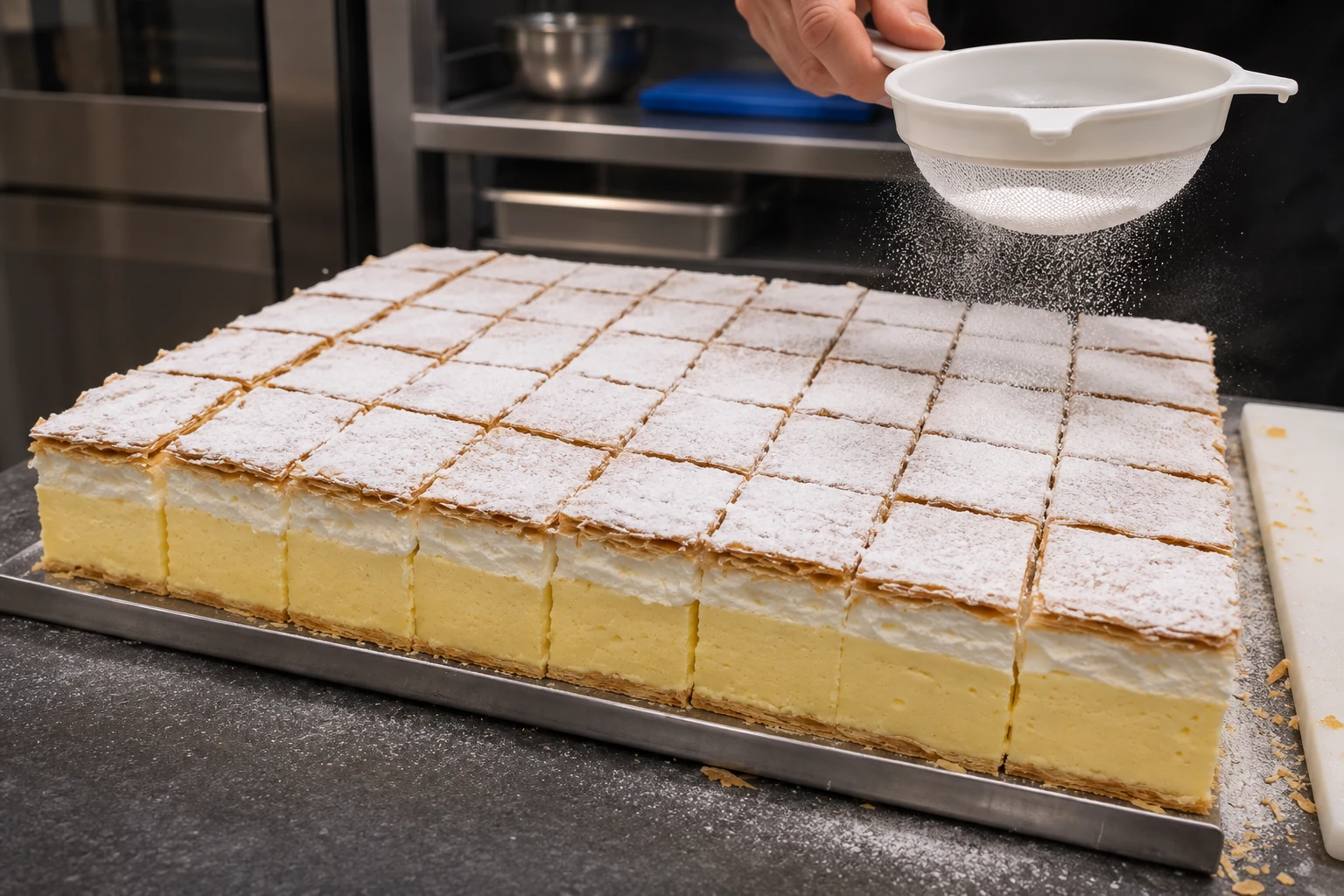
Sweet square from Bled: a puff pastry base, a tall layer of vanilla custard, another of whipped cream, and a thin pastry sheet on top, dusted with powdered sugar. It has been made by the lakeside since 1953.
Antarctica
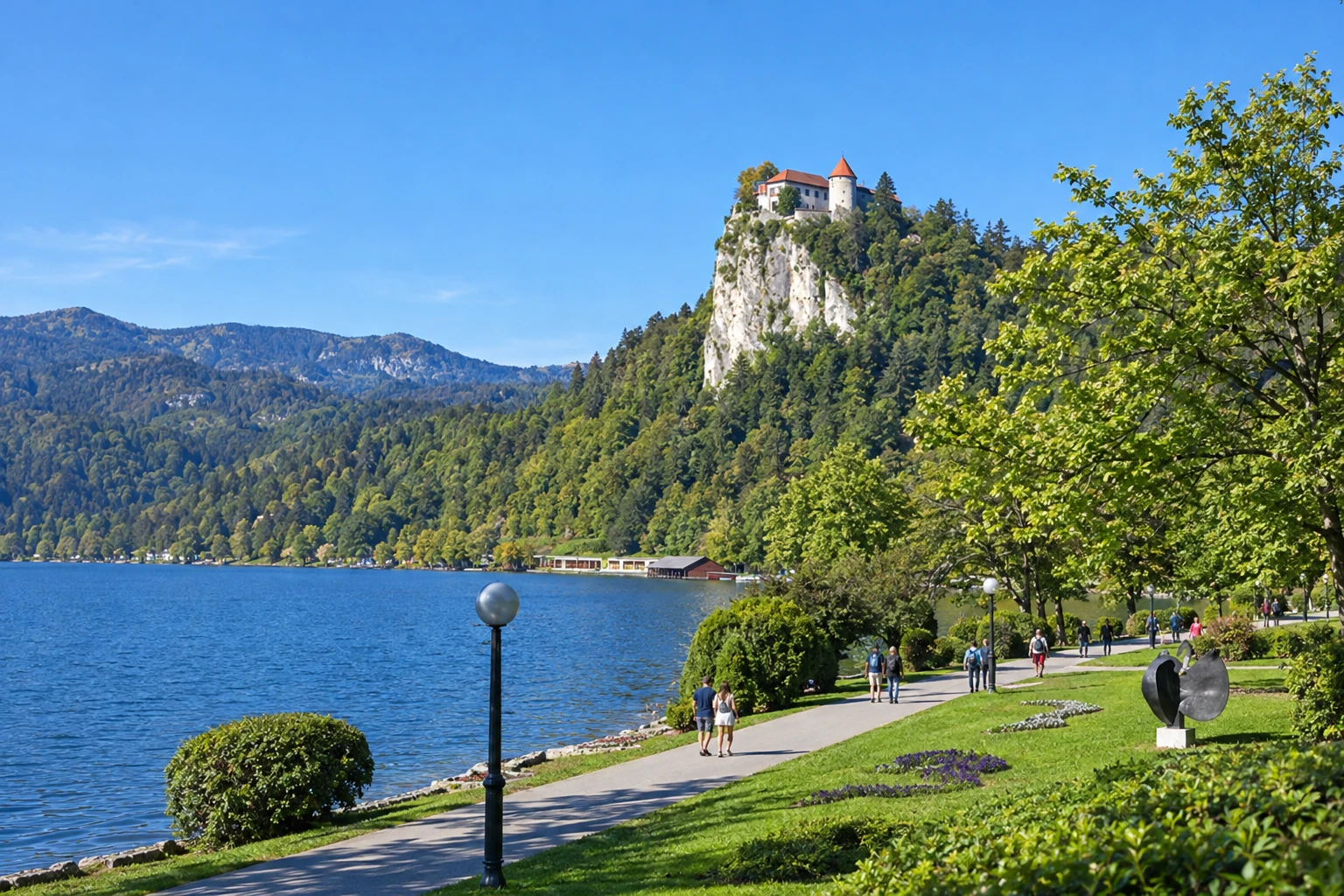
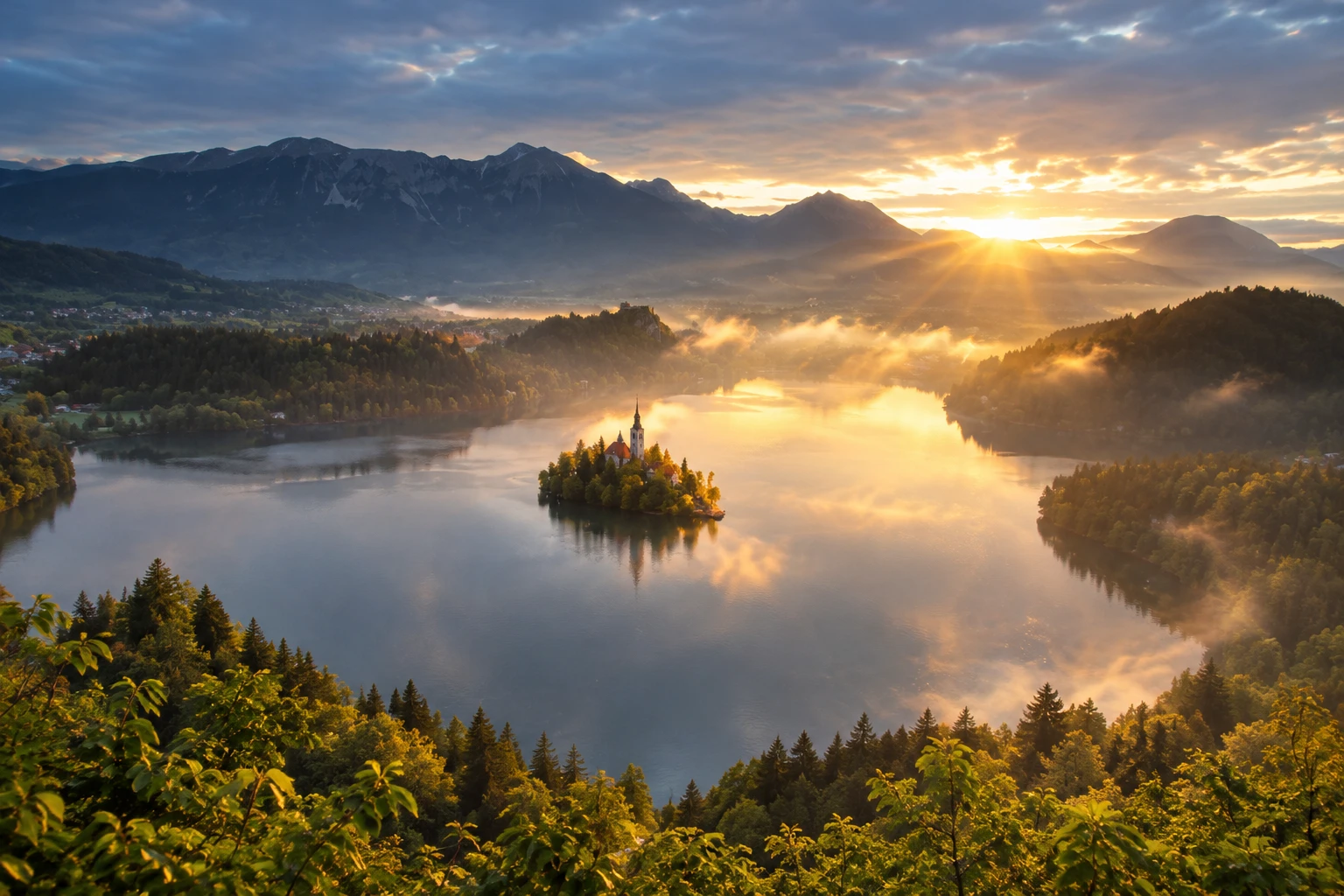
In the photo: Lake shore and Bled Castle.
Illustrative images. The pictures in this guide are illustrations based on the real place, not photographs, and may differ from it.
The city
A resort town on the east shore of the lake, at the foot of the Julian Alps. From the center you can walk to the lakeside path, the pletna docks and the castle on the cliff, and the Vintgar Gorge is a short distance to the north. There are bakeries famous for kremšnita and a park by the water.
Bled is a small summer resort town in Upper Carniola, the Alpine region of northwestern Slovenia. It sits on the shore of a glacial lake at the foot of the Julian Alps and the Karawanks, just over 50 km from Ljubljana and about 34 km from the capital’s airport. The lake fills a basin carved by the Bohinj Glacier and is up to 30 m deep. On the island in the middle, a stone staircase leads up to a church. On the north shore, the castle stands atop a cliff about 130 m high and is considered the oldest in the country.
The town is laid out around the lake. The center is at the eastern end, where you’ll find the bus station, the lakeside promenade, the Spa Park and its pavilion, and the neo-Gothic St. Martin’s Church. This is also where Bled’s traditional wooden rowboats, called pletnas, dock and where pastry shops serve kremšnita, the town’s cream pastry. Following the south shore brings you to the village of Mlino, another departure point for boats to the island, and to summer villas from the 19th and 20th centuries, including one that served as Tito’s residence. At the western end are the bays of Mala Zaka and Velika Zaka, the Olympic rowing center, the campground, and the trails leading up to the Ojstrica and Osojnica viewpoints. The Grajsko kopališče swimming area is on the north shore, below the castle.
A flat 6 km path circles the entire lake, and you can reach almost everything on foot: the castle, Straža Hill with its chairlift and summer toboggan run, the viewpoints, and the boat docks. Bled became a resort in the 19th century, when Arnold Rikli, from Switzerland, opened an institute here that used walking, sunlight, fresh air, and bathing as natural treatments. Thermal springs on the eastern side of the lake still feed swimming pools.
The municipality includes several rural villages a few kilometers from the lake: Zasip, on the slope of Hom Hill; Ribno, Bodešče, Koritno, and Selo, near the Sava Bohinjka River; and Bohinjska Bela, with Iglica Waterfall and rock faces for climbing. The villages offer short walks, medieval churches, and farms that welcome visitors.
Summer, from June to September, is the season for swimming and boating. The lake water reaches 20 to 24 °C, daytime highs exceed 25 °C, and thunderstorms occur in the late afternoon. Spring and fall are quieter, and in October the trees along the shore change color. In winter, daytime highs are around 0 to 5 °C, morning fog is common, and snow is possible. In colder years, the lake freezes over. The island and castle welcome visitors year-round, and in December the Winter Fairytale lights and stalls line the shore.
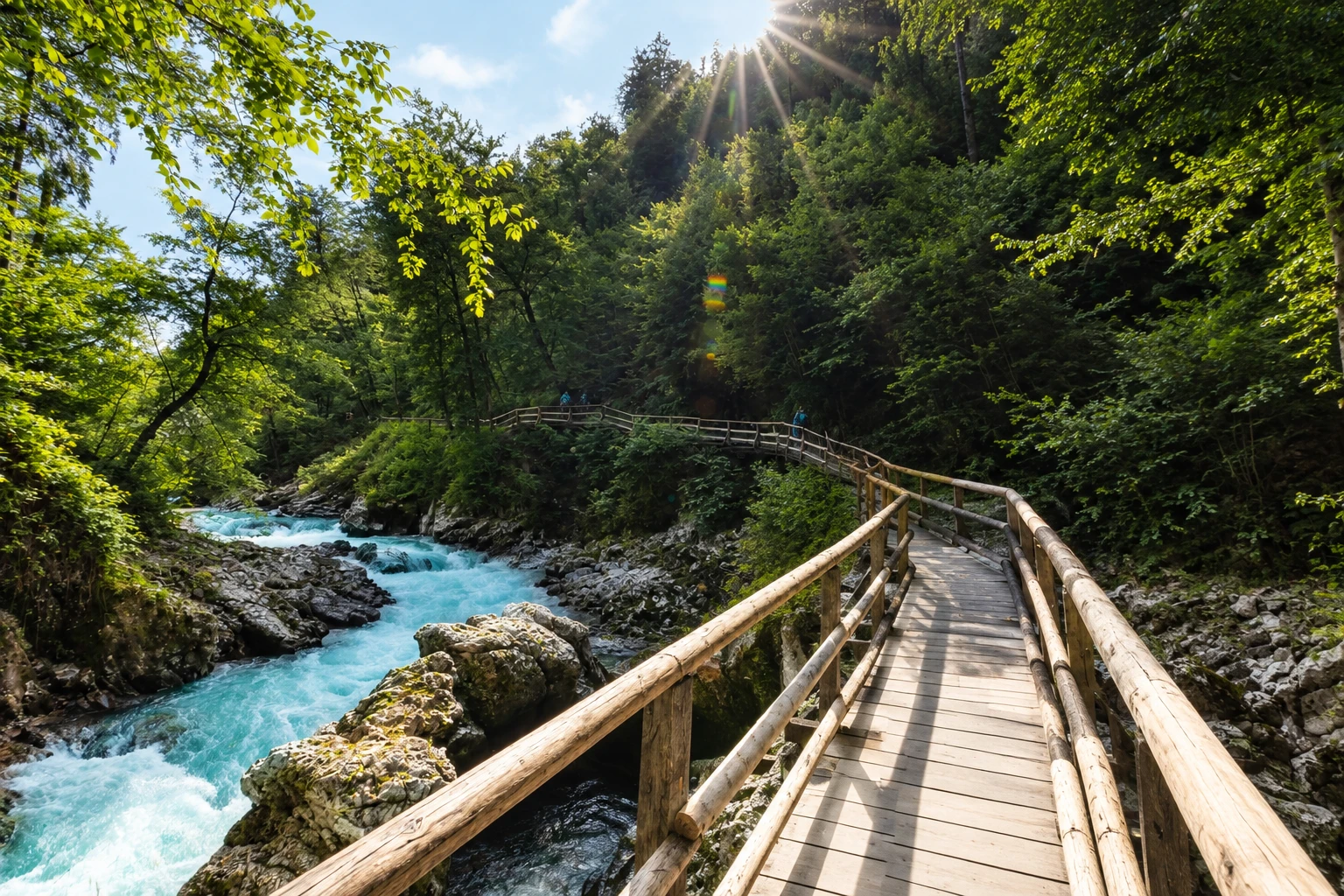
Vintgar Gorge, with its walkways above the Radovna River, is 4 km away in the neighboring municipality of Gorje. A seasonal shuttle runs there from the bus station from April to October. Radovljica, with its medieval center and Museum of Apiculture, is about 7 km away, and Bohinj is about 28 km away. A tourist bus serves the Pokljuka Plateau in Triglav National Park in summer and winter.
55 places to stay in Bled.
18 places to eat in Bled.
34 places on the map: where to stay and where to eat, by neighborhood.
Routes in Slovenia
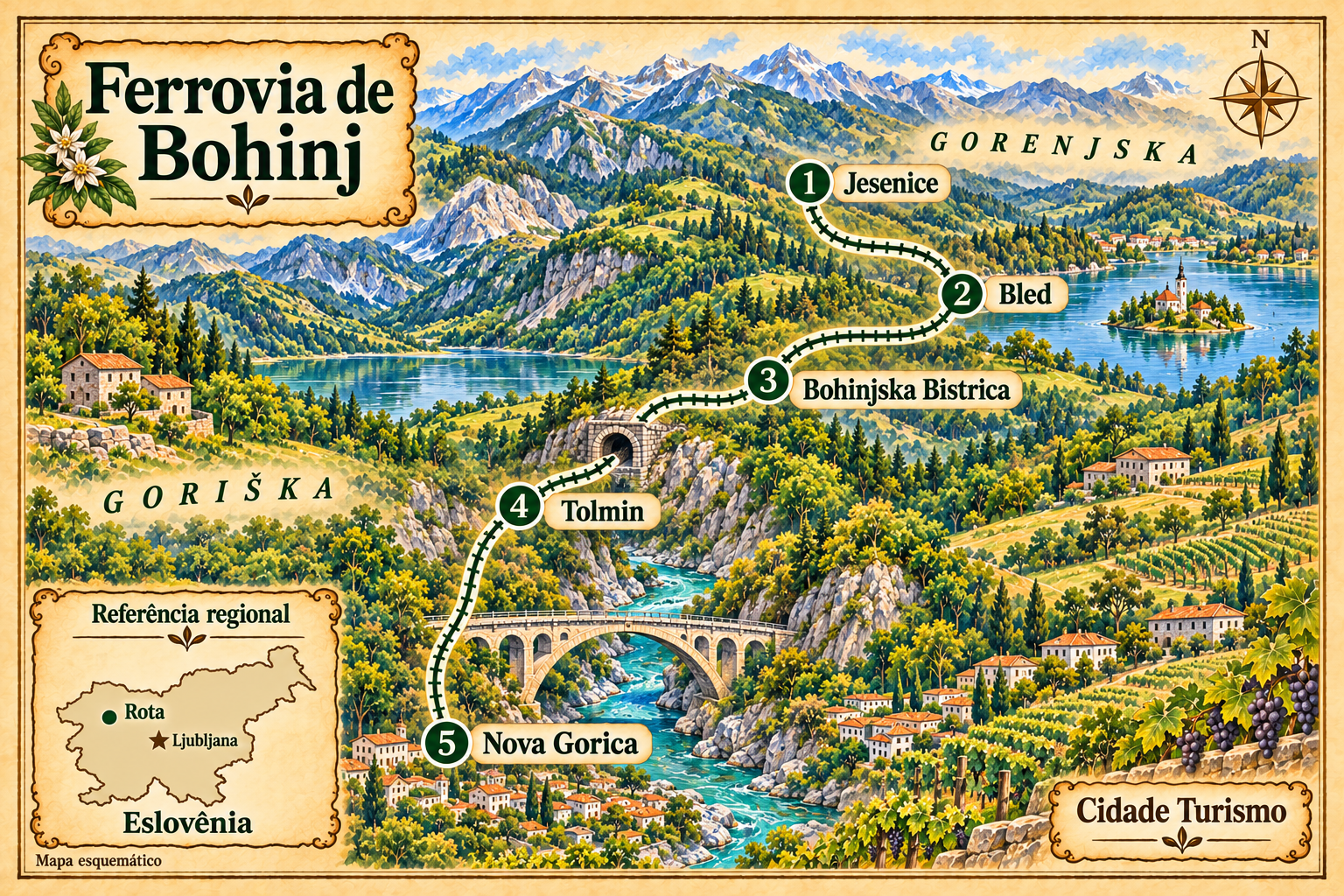
From Jesenice to Nova Gorica by train, along the shore of Lake Bled, through the Bohinj Tunnel and the Soča Valley.
Flavors of Slovenia
Festivals and events
Dates change every year: check this year's date before you travel.
The local experience
The glacial lake at the foot of the Julian Alps, with a church-topped island in the middle and a castle on the cliff. A flat path of about 6 km circumnavigates the shore, with small beaches and access to viewpoints.
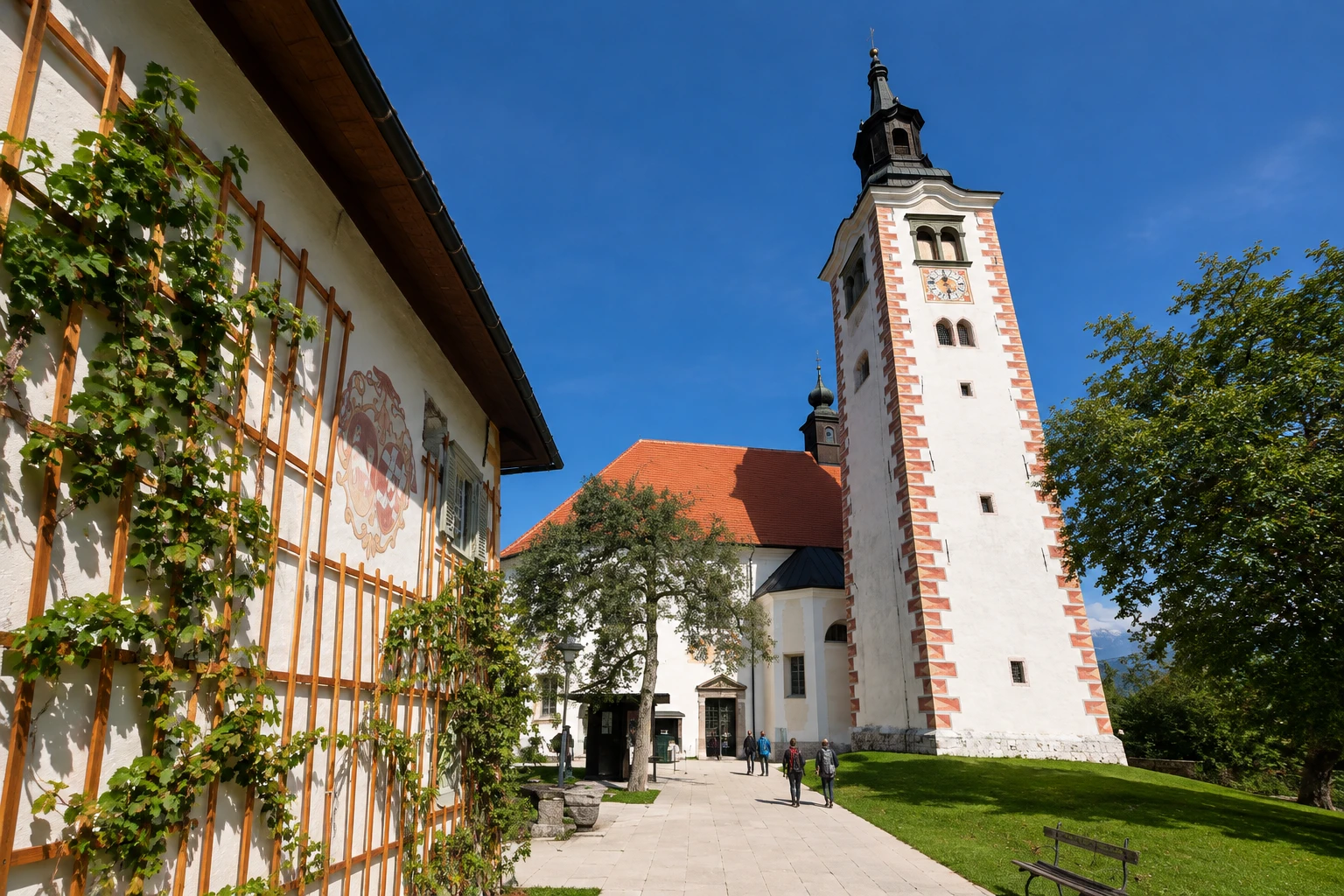
The only natural island in Slovenia, in the middle of the lake, with the Church of the Assumption atop a staircase of 99 steps and the bell that — according to tradition — answers wishes. You reach it by pletna or by rowboat.
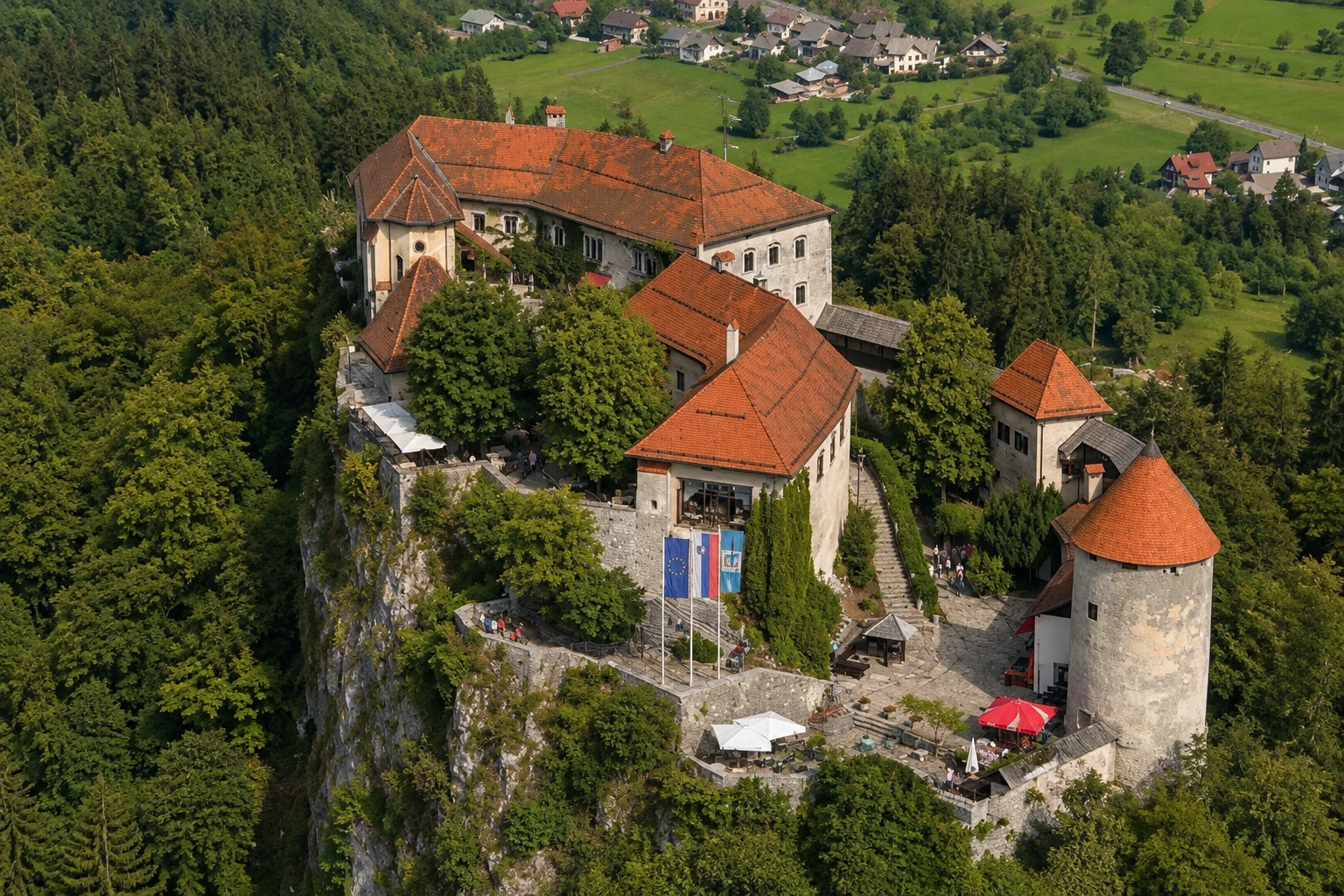
The castle on a cliff about 130 meters above the lake, mentioned in a document from 1011. It has a museum, a chapel, a printing workshop with an old-style press, a wine cellar and terraces overlooking the island.
The Radovna River gorge, north of Bled, traversed by 1.6 km of wooden walkways attached to the rock, ending at the Šum waterfall. The visit is one-way and requires a ticket purchased in advance.
To choose before you go
Where each tour starts, how long it takes, how it is done, what is included and the price range.
The lakeside path makes a full 6 km loop around the lake, partly on asphalt and partly on packed dirt, with no climbs. Without stops, the walk takes about an hour and a half; with stops for photos and coffee, it takes half a day. From the town center, follow the southern shore past the docks for the pletna boats to the village of Mlino, where boats also leave for the island. Farther along are the summer villas. Bled once had 135 of them, built in the 19th and 20th centuries, some with their own park and boathouse. The largest is Vila Bled. The site was once home to a manor belonging to the Windisch-Grätz family, which later became a summer residence of the Yugoslav royal family. The building you see today was built after World War II for Josip Broz Tito, who hosted heads of state there. Next to it, on pillars 30 meters high, stands the Belvedere pavilion, designed by Jože Plečnik and known as Tito’s teahouse. At the western end of the lake, Velika Zaka Bay is home to the campground, the stands for rowing events, and the trailheads for Ojstrica and Osojnica. Mala Zaka is home to the Olympic Rowing Center, with monuments to figures in the sport and in Bled’s history. The lake has hosted four World Rowing Championships. The route back along the northern shore takes you below the castle cliff and past the Grajsko kopališče swimming area before returning to the town center. Along the way, you’ll find benches facing the island.
Stops: Lake Bled, Mlino, Vila Bled, Velika Zaka, Mala Zaka, Olympic Rowing Center.
Includes: The walk is free. Horse-drawn carriage rides (fijaker), tourist train rides, and boat rentals cost extra.
Tip: If you’d rather not walk the 6 km, you can go around the lake in a horse-drawn carriage with a driver in traditional uniform, or take the tourist train, which runs during the warmer months. Early in the morning, the path is quieter and the water is calmer for photos.
Best time: Year-round. From June to September, you can combine the walk with a swim. In October, the fall colors are reflected in the water.
Bled Island is accessible only by water, and there are three ways to get there. The traditional way is by pletna, a flat-bottomed wooden boat with a colorful canopy whose origins date back to 1590. Each boat is 7 m long, carries up to 18 passengers, and is rowed by a boatman who stands and uses two oars. The craft passes from father to son within the same families, and there are 23 pletnas on the lake. The boatmen wait for passengers in central Bled, Mlino, and Velika Zaka. The second option is a wooden electric boat that runs on a fixed schedule between the dock in central Bled and the island. The third is to rent a rowboat on the shore and make the crossing at your own pace. On the island, the southern staircase leads up 99 stone steps to the Church of the Mother of God on the Lake. An ancient Slavic temple once stood on the site. The church was rebuilt in the Gothic style in 1465 and took on its Baroque appearance in the mid-17th century, when the staircase was also built. Inside, visitors ring the wishing bell as they make a wish. The 52 m bell tower beside the church has a restored mechanical clock and offers views of the lake and mountains. By tradition, a groom getting married on the island carries his bride up all 99 steps. At Potičnica, you can try potica, a rolled sweet bread served on Slovenian holidays, with fillings such as walnuts or tarragon. On the north shore, beside a spring, stands a stone chapel dedicated to Our Lady of Lourdes.
Stops: Bled Island, Church of the Mother of God on the Lake, Potičnica, Lake Bled.
Includes: All three options have a separate charge for the crossing. There is also a charge to visit the church and bell tower. Check the current prices.
Tip: The pletna waits at the island for an agreed length of time and returns with the same passengers. Ask the boat operator how long you’ll have before you set out. The scheduled boat does not run in strong winds or very bad weather, so check before you go.
Best time: Year-round; there are fewer departures per day in winter.
Bled Castle (Blejski grad) stands atop a cliff on the north shore, about 130 m above the water. Its history begins in 1004, when the German king Henry II granted the Bled estate to Bishop Albuin of Brixen. Around 1011, the bishops built the first castle there for defense. They never lived there, so there are no lavish halls. What you visit today is a fortress with two courtyards, one below the other. The walk up is part of the experience. The paths on Grad Hill are lit and have handrails. For a longer walk, you can follow the trails through the Višce woods, which pass a monument to Adolf Muhr, a former owner of the castle. The lower courtyard has a print shop where you can print a souvenir on an old-fashioned press, a wine cellar, a tower gallery, a room dedicated to Arnold Rikli, a well cut up to 12 m deep into the rock, and the castle apiary. In the upper courtyard, you’ll find the museum, which tells the story of Bled, a 16th-century Gothic chapel with illusionistic frescoes, and terraces overlooking the island, lake, and mountains. A grapevine descended from the world’s oldest vine, in Maribor, grows here. Earthquakes in 1511 and 1690 damaged the castle complex. After a fire in 1947, it was restored between 1951 and 1961. In the warmer months, the courtyard hosts events including Medieval Days, with knights and artisans.
Stops: Bled Castle, Grad Hill, Višce woods.
Includes: Castle admission is charged separately and includes the courtyards, museum, and chapel. There is paid parking next to the entrance. Check current rates.
Tip: The castle is open every day of the year, with shorter hours in the colder months. Check the hours before you go. Walking up saves you the trouble of finding a parking spot, and late afternoon light is ideal for the views from the terraces.
Best time: Year-round. In December, the castle has holiday decorations and a nativity scene in the chapel.
Central Bled is small enough to explore on a short walk, a good choice for the day you arrive or an afternoon when the weather is unsettled. Above the lakeside promenade lies the Spa Park (Zdraviliški park), designed in 1891 when the bathhouse was built. A pavilion in the middle hosts concerts and other events. In one corner, an apiary with hand-painted beehive panels recalls Slovenia’s beekeeping tradition, and a plaque honors Arnold Rikli, the Swiss man who made Bled a destination for natural healing. The park hosts a craft fair in the warmer months and during the holidays. As you walk toward the castle, you come to the 1883 monument to France Prešeren. It was the first monument erected in honor of Slovenia’s greatest poet, who was born in Vrba, near Bled. Just uphill stands St. Martin’s Parish Church, a Gothic Revival church built in 1905 on the site of a 15th-century church. Inside are frescoes painted by Slavko Pengov between 1932 and 1937. Jože Plečnik designed the shrine in the garden in front of the church. On the way back, you pass through the historic center of the settlement and by Vila Zora. Built in 1853, it is the oldest of Bled’s villas and now serves as the town hall. The Infocenter Triglavska roža, headquarters of Triglav National Park, has a permanent exhibition on the Upper Carniola region and the park, including a film shot from the air. The walk ends at a lakeside pastry shop with a slice of kremšnita (kremna rezina): a puff pastry base topped with vanilla cream, whipped cream, and a sheet of pastry dusted with sugar. The dessert has been made in Bled since 1953.
Stops: Zdraviliški park, St. Martin’s Church, France Prešeren Monument, Vila Zora, Infocenter Triglavska roža.
Includes: The self-guided walk is free. The guided tour, admission to the exhibition, and any food or drinks at the pastry shops cost extra.
Tip: From April to October, the information center offers a one-hour guided walk in Slovenian and English once a week. Sign up no later than the day before the walk. Confirm the day and meeting point before you go.
Best time: Year-round; in December, the Winter Fairytale stalls line the lakeside promenade.
The hills on the western shore offer the view seen on postcards of Bled: the island in the foreground, the castle on its cliff, and the Karawanks ridge in the background. At 611 m, Ojstrica is the shortest climb. Its name means “sharp peak.” The trail starts on the south side of Velika Zaka, to the left of the campground. Take the marked path into the woods, turn right onto a wider path, and follow the signs. The climb is short and steep, taking about 20 minutes. At the top, a wooden bench faces the lake, with views of Straža, the castle cliff, Mount Stol, and the peaks of Vrtača, Begunjščica, and Dobrča. The climb to Mala Osojnica, at 685 m, takes about 45 minutes on a more demanding forest trail. If you have the energy, you can continue for another 20 minutes to Velika Osojnica, at 756 m. There are benches at the top, and the view also takes in the Kamnik–Savinja Alps and the Ljubljana Basin. Like all marked trails in Bled, these have signs showing the destination and walking time. Velika Zaka is at the end of the lake opposite the town center, halfway around the lakeshore circuit.
Stops: Ojstrica, Mala Osojnica, Velika Osojnica, Velika Zaka.
Includes: The trails are free to use.
Tip: Wear shoes with sturdy soles: roots and rocks get slippery after rain. Bring water and, if you plan to hike up before sunrise or down after sunset, a flashlight.
Best time: April to October. In snow or ice, you need equipment and experience to hike these trails.
Straža is a 646-meter hill on the southern edge of Bled’s town center. From the top, you can see the southeastern shore and the whole lake, as well as the castle, the Jelovica plateau, and Mount Stol. There are two ways up. The chairlift takes you to the top without any effort. If you walk, the route starts in the meadows and follows the Bled fitness trail into the woods, past spruce, oak, linden, and birch trees. It’s an easy climb. The hill is part of the town’s history. In the mid-19th century, Arnold Rikli, a native of Switzerland, founded a natural healing institute in Bled. Guests followed a strict regimen: getting up early, walking, breathing fresh air, sunbathing, and swimming. On their morning walks, they climbed Straža barefoot, carrying breakfast in their backpacks. A monument to Rikli stands at the top. On the first Sunday in July, the Rikli Walk starts at the monument and retraces those routes. In summer, the main attraction on the slope is the rail toboggan, which descends a 520-meter track. There are other sports and recreational activities at the base of the hill.
Stops: Straža, Arnold Rikli Monument.
Includes: The chairlift and toboggan run cost extra. Walking up is free. Check the current prices.
Tip: The chairlift and toboggan run operate seasonally and only when weather permits, so check before you go. The visit is short enough to fit in on the same day you walk around the lake.
Best time: May to September for the toboggan run; the walk is worthwhile year-round.
In summer, the lakeshore doubles as a beach. The water temperature is usually between 20 and 24 °C, and swimming is allowed in marked areas around the shore. The main one is Grajsko kopališče, the castle swimming area, on a sunny stretch just below the cliff. The enclosed area is 260 m long, with water slides, four outdoor pools, a diving board, play equipment for children, changing rooms, lockers, and sun umbrellas for rent. Large chestnut trees provide shade. The site has earned the Blue Flag, an award that recognizes environmental standards. It is usually open from June to mid-September. The lake is also a place to row. After World War II, Bled became one of the world's best-known rowing centers. It has hosted four world championships and holds regattas every year, including the May 1 regatta, the international regatta in June, and the national championship in September. You can rent a rowboat at several places along the shore to visit the island or simply row around the lake. Stand-up paddleboards are also available for beginners and experienced paddlers alike. If you bring your own equipment, you must follow the lake's navigation rules and use the marked entry and exit points. On cold or rainy days, an alternative is to swim indoors at one of three hotel pools filled with water from the thermal springs on the east side of the lake.
Stops: Grajsko kopališče, Lake Bled.
Includes: There are separate fees for swimming area admission and for boat, paddleboard, and sun umbrella rentals. Check the current rates.
Tip: On weekends in July and August, the swimming area fills up in the early afternoon, so arrive in the late morning. Summer thunderstorms are common late in the day; get out of the water if the weather starts to turn.
Best time: June to mid-September for swimming; the rowing season runs from spring through fall.
Zasip lies 2 km north of Bled on the sunny southern slope of Hom Hill, on moraines left by the Bohinj Glacier. The village was first mentioned in 1075 and has had its own parish since 1296. The poet France Prešeren called it the altar of Upper Carniola for its sweeping view of the region. At the top of Hom stands St. Catherine’s Church, a Gothic church dating to around 1400, with a bell tower clad in wooden shingles. Above the doorway are frescoes of St. John the Evangelist, St. Nicholas, and St. Catherine of Alexandria, attributed to traveling painters from Friuli. The chancel dates to the 17th century, and the altar is Baroque. You can still see remnants of the wall that once surrounded the fortified enclosure. An old pilgrimage route known as God’s Path leads to the church. On the saint’s feast day, November 25, pilgrims used to come from across the country. The village has two other churches: St. John the Baptist and Holy Trinity. The people of Zasip were known as prgarji because they dried a variety of pear called tepke and ground the fruit into a flour called prga, which they mixed with wheat flour to make bread. The tradition lives on in dishes such as prgini štruklji, rolls of dough filled with dried pear and served at the village inn. The return trail from Vintgar Gorge passes right by St. Catherine’s Church, so you can visit both places in one day.
Stops: Zasip, Hom, St. Catherine’s Church.
Includes: Self-guided walk. Meals are paid for separately.
Tip: Check with the Bled information center to find out when the church is open. Even if it’s closed, the walk is worthwhile for the path itself and the view.
Best time: April to October; in the fall, the pear trees and meadows change color.
South and east of the lake, the municipality of Bled gives way to countryside. The Ribno area is home to four quiet villages: Ribno, Koritno, Bodešče, and Selo. Ribno is the hub, with houses clustered around St. James’s Church. On the southern edge of the village, above the Sava Bohinjka River, there is a small natural lake and an open view of the valley. A walking route starts here, crosses the bridge over the river, and climbs to the Talež hunting lodge, which serves regional food and has views of Bled and the Karawanks. Bodešče is known for the Gothic Church of St. Leonard, built in the mid-15th century on the rocks known as Bodške peči. Koritno stretches along the edge of a terrace above the Sava and is the closest village to Bled, just 1.5 km away. Selo, west of Ribno, relies on rural tourism. Several farms in the area welcome visitors, show them the work that goes on in the fields, and serve home-cooked food. Some supply the milk for Bled cheese, which is sold under the town’s label for local products. Between villages, the route passes fields, old farmhouses, and chapels. The Sava Bohinjka flows out of Lake Bohinj and ends near Radovljica, where it joins the Sava Dolinka. You can fish for trout and grayling in the river or go rafting, kayaking, and canoeing in the warmer months. Walking and cycling trails follow its banks.
Stops: Ribno, Bodešče, Koritno, Selo, Talež, Sava Bohinjka River.
Includes: The walk is free. Carriage rides, the summer bus, meals, and river activities cost extra.
Tip: In summer, Bled Bus runs a service through the countryside. Check the route and schedule for the year you plan to visit. You can also tour the villages in one of Bled’s horse-drawn carriages; arrange the details with the driver.
Best time: May to October.
Bohinjska Bela lies southwest of Bled, on the left bank of the Sava Bohinjka River, on the way to Bohinj. The oldest part of the village, Spodnja vas, dates back to the year 1000 and is home to St. Margaret’s Church. Zgornja vas, which has the most houses, grew up at the foot of the Iglica cliffs. Podklanec, the newest part, developed over the past hundred years around the train station and bus stop. The 24 m Iglica Waterfall is hidden among the cliffs just above the village. At the back of a natural rock amphitheater, the Suha stream plunges down a vertical limestone face into a pool. A small dam has enlarged the pool to form an artificial lake where the water stays very cold year-round. Beside the waterfall are sport climbing routes for both beginners and experienced climbers. The sunny Stara Bela sector dries quickly after rain and is used in spring, in fall, and during dry winters. The village is the starting point for longer hikes to Galetovec (1,256 m) and Babji zob (1,128 m), both with views over the Sava Bohinjka Valley and Lake Bled. On the other side of the river, the village of Kupljenik is home to St. Stephen’s Church. Nearby is the entrance to the cave beneath Babji zob, the largest stalactite cave in the Julian Alps. It contains calcite crystals and can only be visited with a local guide.
Stops: Bohinjska Bela, Iglica Waterfall, St. Margaret’s Church, Kupljenik.
Includes: The walk to the waterfall is free. Transportation, the guided cave visit, and climbing equipment cost extra.
Tip: The cave is open only for visits arranged in advance, from May to October. The temperature inside is about 8 °C, and visitors are asked to wear hiking shoes and bring warm clothing. To go climbing, you need your own equipment or you must hire a guide.
Best time: April to October; the waterfall usually has a stronger flow in spring and after rain.
Day by day
Suggestions to plan the trip. Change the order of the days according to the weather and tour availability.
Start early from the bus station and follow the marked trail up Grad Hill to the castle. Visit the museum, chapel, and print shop, then head out to the terraces for a clear view of the lake’s outline. Walk down to the shore and turn right toward Mlino, following the town center promenade and passing through Spa Park. At the dock, take a pletna to the island. Allow about an hour for the 99-step staircase, the church with its wishing bell, and the bell tower. Try the potica on the island or save your appetite for later. Back on shore, complete the 6 km loop around the lake, passing the villas, Velika Zaka, the rowing center at Mala Zaka, and the stretch below the cliff. If you have the energy, add the 20-minute climb to the Ojstrica viewpoint. Finish with a slice of kremšnita at a pastry shop in the town center before catching the bus back.
Walk up Grad Hill and spend the morning at Bled Castle. On the way down, explore the town center, stopping at St. Martin’s Church, the monument to Prešeren, and Spa Park. After lunch, cross to the island by pletna, scheduled boat service, or rented rowboat. In the late afternoon, walk along the south shore to Mlino and the lakeside villas, and finish the day with a slice of kremšnita.
Head out early to Velika Zaka and hike up to Ojstrica or Mala Osojnica while the light is still coming from the east and the trails are empty. Follow the north shore back to the town center to complete the loop around the lake. In summer, spend the early afternoon at the Grajsko kopališče swimming area or out on a paddleboard. Then take the chairlift up Straža and ride the alpine coaster down. Outside the swimming season, spend the afternoon at Vintgar Gorge in the neighboring municipality of Gorje instead. Buy your pass in advance and take the shuttle from the bus station. The gorge is usually open from April to October.
Visit Bled Castle in the morning, explore the town center and Spa Park on the way down, then cross to the island after lunch. Spend the late afternoon on the south shore between Mlino and the lakeside villas.
Walk all the way around the lake, climbing to either Ojstrica or Mala Osojnica from Velika Zaka. In the afternoon, go for a swim at the Castle Bathing Area during the warmer months, or take the Straža chairlift and see the Rikli monument at the top.
Choose one part of the municipality to explore. To the north, visit Zasip and St. Catherine’s Church on Hom Hill, 2 km from the town center. You can combine this with Vintgar Gorge, since the return trail passes the church. To the south, explore Koritno, Bodešče, and Ribno, then hike up to the Talež mountain hut above the Sava Bohinjka. To the southwest, you can reach Bohinjska Bela and Iglica Falls by bus or train. If you prefer a historic town, spend the day in Radovljica instead. It’s about 7 km away by bus on the Ljubljana route.
Best time to go
The seasons shown are the most usual ones; nature doesn't always follow the calendar.
winter · morning fog on the lake
Winter. Highs average 3 °C and lows average -6 °C. There’s little precipitation, and it often falls as snow. The lake is foggy in the morning and can freeze over in very cold years. Skating on the lake is not recommended; the place to skate is the indoor ice rink in the town center. The island and castle remain open, though there are fewer boat departures each day. Bring snow gear and waterproof footwear for the walk around the lake.
winter · longer days
Winter. Highs average 5 °C and lows average -5 °C. On average, more fresh snow falls this month than in any other. The days are already longer and sunnier than in December and January, making it a good time to walk around the lake or up to the castle. The trails to Ojstrica and Osojnica can be icy. The indoor thermal pools and the castle museum are good options on overcast days.
late winter · trails still icy in the morning
Late winter. Highs average 10 °C and lows are near 0 °C. Snow is still possible in the first half of the month. The town is all but empty, and boats to the island run less often. The trails to the viewpoints can be icy in the morning. The indoor ice rink usually stays open to skaters until the end of the month.
spring · guided walks begin
Spring. Highs average 14 °C and lows average 3 °C, with a mix of sunshine and showers. The lakeside trees start to bud, and the lower trails dry out. The scheduled boat service to the island runs more often, and weekly guided walks around the town center begin. Vintgar Gorge in Gorje usually reopens this month. Bring a raincoat.
spring · May 1 regatta · accordion weekend
Spring. Highs average 20 °C and lows average 8 °C. The meadows are in bloom and the days are long. It’s a good month to walk around the lake, enjoy the viewpoints, and explore the villages before the summer crowds arrive. The traditional May 1 regatta takes place on the rowing course at Zaka, and accordion weekend brings musicians and traditional costumes to the lakeside promenade. The sightseeing train runs around the lake on weekends in good weather.
early summer · international regatta · swimming area opens
Early summer. Highs average 23 °C and lows 12 °C, with most rain coming in thunderstorms. The Grajsko kopališče swimming area opens, and the Bled Bus, the summer sightseeing bus, starts running. The international rowing regatta takes place this month. The sightseeing train around the lake begins running daily.
summer · Rikli's Walk · lights on the lake
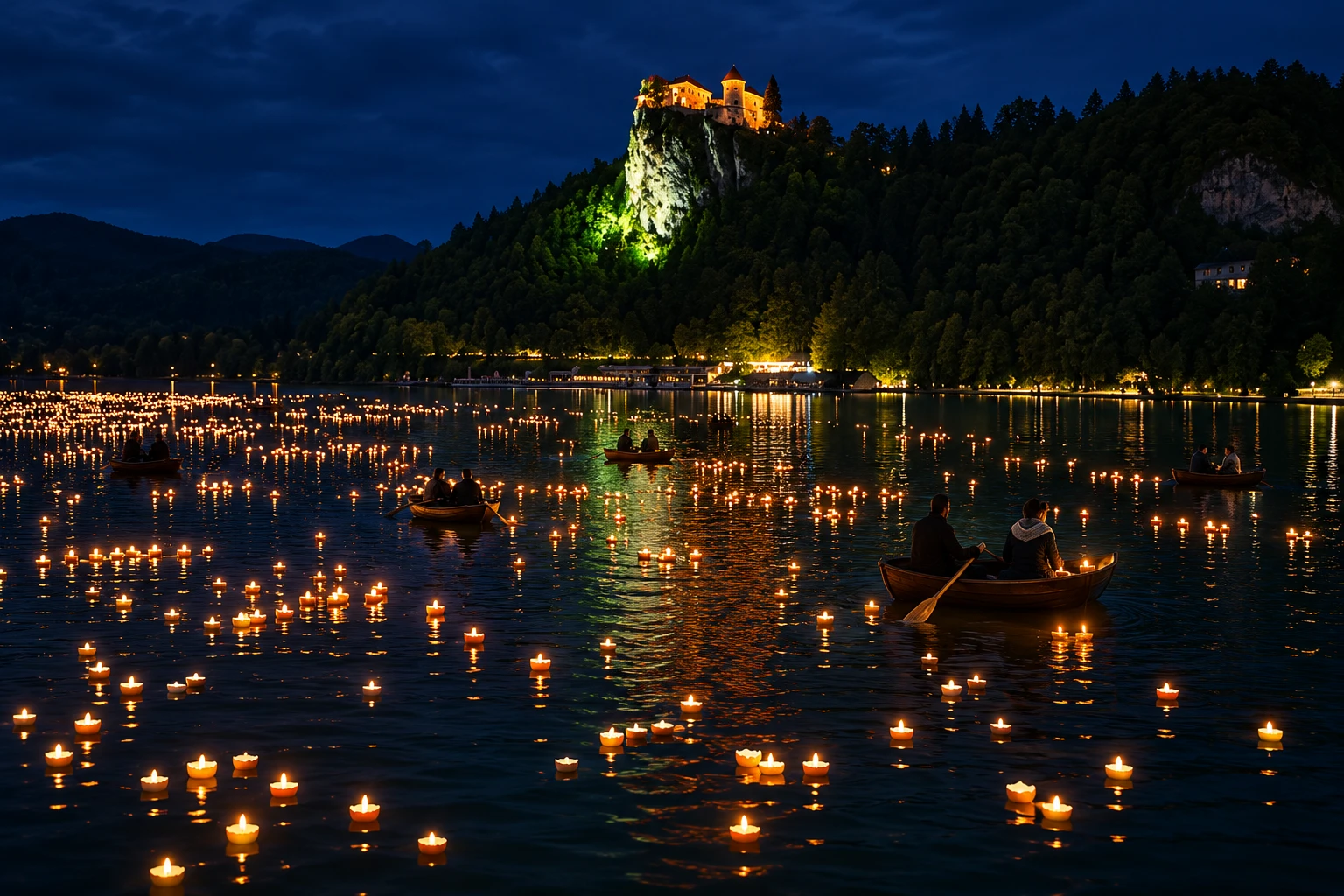
Summer. Highs average 25 °C and lows 13 °C; the lake water reaches 20–24 °C. This is the busiest month, so aim to reach the parking lots and boat docks early. Early in the month, Rikli's Walk follows the routes once taken by the pioneer of natural healing. On the second-to-last Saturday of the month, thousands of candles in eggshells are set afloat on the lake, a tradition that began in 1972. There's also a craft fair in the Spa Park.
summer · music on the lakeside promenade and in Zaka
Summer. Highs average 25 °C and lows 13 °C, with thunderstorms late in the day on some days. The water is still warm enough for swimming, and the lakeshore, island, and castle are all busy. Bled's summer program brings music and food to the lakeside promenade and the rowing grandstands at Velika Zaka. Book your accommodations in advance and visit the castle in the late afternoon.
early fall · national rowing championships
Early fall. Highs average 20 °C and lows 9 °C. There's more rain overall than in summer, but fewer rainy days. You can usually still swim early in the month; Grajsko kopališče closes in mid-September. The crowds thin out after the summer vacation season, the Bled Bus usually runs through the end of the month, and the rowing course hosts the national championships. It's a good time to visit the viewpoints.
fall · color along the shore · fog over the lake
Fall. Highs average 15 °C and lows average 5 °C, with about 12 rainy days. The trees along the shore turn yellow and red, and morning fog often settles over the lake. You can see it from the top of Ojstrica or from the castle. Rafting, kayaking, and the toboggan run are usually available until midmonth, and skating resumes at the indoor ice rink. The days are getting shorter, so bring a warm layer and a raincoat.
late fall · Alpine folk music festival
Late fall. Highs average 8 °C and lows are near 0 °C, with the first snowfalls. It’s one of the cloudiest and least crowded months of the year, and Vintgar Gorge is already closed. The ice arena hosts an Alpine folk music festival featuring groups from Slovenia and neighboring countries. It’s a good time to explore the castle and town center, relax in the thermal pools, and visit the pastry shops.
winter · Winter Fairy Tale · legend of the sunken bell
Winter. Highs average 4 °C and lows average -4 °C, with some precipitation falling as snow. From early December to early January, the lakeside promenade hosts the Winter Fairy Tale, with lights, stalls serving food from Upper Carniola, and music on weekends. On December 25, divers reenact the legend of the sunken bell in the lake. The castle is decorated for the holidays, with a nativity scene in the chapel.
Plan the journey
The nearest airport is Ljubljana Jože Pučnik Airport in Brnik, about 34 km from Bled, with flights to several European cities.
A direct bus runs from the terminal to Bled. Alternatively, take the airport bus to Ljubljana's bus station and transfer there to a bus to Bled. The terminal also has shared transfers that you can book in advance, taxis, and rental car companies. If you're driving, take the A2 highway toward Jesenice.
Other airports you can use to reach Bled, with distances by road, include Klagenfurt in Austria (80 km), Trieste in Italy (170 km), Zagreb in Croatia (200 km), Salzburg (230 km), Venice (290 km), and Vienna (380 km).
If you're traveling from Brazil, there are no nonstop flights to Slovenia. You'll need to connect in a European city. Check routes and schedules before booking.
The bus is the most direct option if you’re traveling without a car. Regular buses leave Ljubljana’s bus station, pass through Kranj and Radovljica, and reach Bled in about an hour. From Radovljica, about 7 km away, the trip takes just a few minutes on the same route. There are also regular buses from Bohinj and Jesenice.
Bled has two arrival points. The central bus station is on the northeast side of the lake, at the intersection of Cesta svobode and Grajska cesta, a 3-minute walk from the shore. The Bled Union stop is at the entrance to town, 5 minutes from the lake. Get off there if you’re staying on that side of town.
Long-distance buses connect Bled with Zagreb, Salzburg, Munich, Budapest, Prague, and Milan, among other cities. Confirm schedules before you travel, especially on Sundays and public holidays.
Two stations serve the town, each on a different rail line.
Lesce-Bled is on the main line between Ljubljana, Jesenice, and Villach in Austria. International trains stop here. It’s 4 km from central Bled. You can cover the rest of the distance by bus from the stop in front of the station, by taxi, or on foot along a paved path for pedestrians and cyclists. This is the station to use if you’re coming from Ljubljana.
Bled Jezero is on the Bohinj Railway between Jesenice and Nova Gorica, 1.5 km from the town center, on high ground above the lake’s western shore. From there, you can walk downhill, take a taxi, or ride the sightseeing train. Sightseeing buses also stop there in summer. Use this station if you’re coming from Bohinjska Bistrica, the Soča Valley, or Nova Gorica. The same line also stops at Bohinjska Bela, a village in the municipality.
Check schedules on the Slovenian Railways website before you travel.
From Ljubljana, it’s just over 50 km to Bled via the A2 highway toward Jesenice. Take the Bled exit at Lesce. Alternatively, take the regional road through Medvode, Kranj, Naklo, and Radovljica. Bled is 47 km from both the Austrian border via the Wurzen Pass and the Italian border at Rateče. Slovenian highways require an electronic vignette linked to your license plate. Buy it before entering the highway.
In town, you can park only in marked areas. Almost all charge by the hour. The ones closest to the lake and the bus station have a 2-hour limit, while larger lots a little farther away have no time limit. Parking is checked frequently. The castle has its own parking lot next to the entrance, and there’s a designated area for motorhomes.
In summer, parking spaces near the lakeshore fill up early. The easiest option is to leave your car where you’re staying or in one of the larger lots and get around on foot, by bus, or on the sightseeing train.
Bled is small: you can explore the town center and lakeshore, reach the boat docks, and climb to the castle on foot. A network of marked paths connects the lake to the hills and villages.
In the warmer months, a sightseeing train circles the lake. The schedule is posted at the stops. It runs daily from June through September and, weather permitting, on weekends in May and October. Horse-drawn carriages (fijakerji) offer rides around the lake, up to the castle, and out to the villages.
In summer, generally from June through September, the Bled Bus sightseeing service runs on three routes: one to Pokljuka, one through the countryside, and one around the lake. During the season, a shuttle runs from the central bus station to the Vintgar LIP parking lot and Vintgar Gorge. In winter, the Winter Bled Bus connects the town with Pokljuka, Bohinj, Kranjska Gora, and ski resorts in the area. Book no later than the day before you travel.
On the lake, traditional pletna boats and a scheduled electric boat service take passengers to the island. Rowboats and paddleboards are available to rent, as are bikes and e-bikes.
Tinček, the town's electric minibus, mainly serves older passengers and people with reduced mobility. It has no fixed route: just wave it down when you see it. The ride is free.

Your questions
A vanilla cream and whipped‑cream cake between layers of puff pastry, served in squares at the town’s bakeries.
Lesce station, on the Jesenice railway, is about 4 km from the center, with buses and taxis. Bled Jezero station, on the Bohinj line, sits above the west shore.
Yes. Regular lines run to Lake Bohinj, about 28 km away, in roughly 40 minutes.
Yes — there are paid parking lots near the town center and along the shores, which usually fill up on summer weekends.
It’s about 4 km from Bled, in the neighboring municipality of Gorje, at the entrance to Triglav National Park. During the season, from April to October, a shuttle bus runs from Bled’s central bus station to the visitor center. The trip takes about 20 minutes. You need to buy a timed-entry ticket in advance.
Only in very cold winters. The water temperature can drop to 4 °C in winter, and the surface sometimes freezes, but for safety reasons, walking or skating on the lake is not recommended. If you want to skate, the indoor ice rink in the town center has scheduled public skating sessions from October to March and offers skate rentals.
The castle’s museum, chapel, print shop, and wine cellar are all indoors. The Triglavska roža Information Center has a permanent exhibition on Upper Carniola and Triglav National Park, including a film shot from the air. Three hotels have indoor pools fed by thermal springs, and the pastry shops in the town center serve kremšnita. The traditional pletna boats have canopies and still take passengers to the island unless the weather is very bad.
Allow an hour and a half to two hours in total, including the boat ride both ways and time on the island for the staircase, church, bell tower, and Potičnica. The pletna waits for passengers for an agreed length of time. If you rent a boat, you can decide how long to spend on the island.
Yes. You can rent rowboats at several spots along the shore. If you bring your own boat, you can use it free of charge as long as you follow the lake’s boating rules and use the marked entry and exit points.
It’s Bled’s traditional boat: a flat-bottomed wooden boat, 7 meters long, with a colorful canopy and room for up to 18 passengers. The boatman, known as a pletnar, rows standing up with two oars. The tradition dates back to 1590, and the right to operate the boats passes from one generation to the next within the same families. There are 23 pletna boats on the lake.
On the island, try potica, a rolled sweet bread with fillings such as walnuts or tarragon. Restaurants serve Slovenian dishes such as ričet (a barley and bean stew), jota (beans with sauerkraut), Carniolan sausage with sauerkraut, ajdovi krapi (buckwheat dumplings), and štruklji. There’s also Bled cheese, made with milk from farms in the municipality. In Zasip, you can try štruklji filled with dried pears.
The town center, at the eastern end of the lake, is the busiest area and is close to the bus station, pastry shops, and boat docks. Mlino and the southern shore are quieter and within walking distance of the center. Velika Zaka, at the western end, has a campground close to the trails leading to the viewpoints. Villages in the municipality, such as Ribno, Selo, Zasip, and Bohinjska Bela, offer stays on farms and rooms in family homes. A car or bicycle is useful there.
It is if you don’t mind cold weather and short days. The island and castle stay open, you can still walk around the lake, and there are fewer visitors. In December, the lakeside promenade hosts the Winter Fairytale, with lights and stalls. If you want to ski, the winter bus connects the town with Pokljuka and ski resorts in the region. Vintgar Gorge and the swimming area are closed.
On the second-to-last Saturday in July. At dusk, volunteers in boats set thousands of handmade candles in eggshells afloat on the lake, a tradition that began in 1972. That evening, there’s music on the lakeside promenade and a craft fair in Spa Park. Check the date for the year you plan to visit before you travel.
It’s about 34 km. There’s a direct bus from the airport to Bled. Alternatively, you can take a bus to Ljubljana’s main bus station and change there for Bled. Check the schedules. Other options include a prebooked shared shuttle, a taxi, or a rental car. If you’re driving, take the A2 highway toward Jesenice.
Yes. It’s a 4 km walk along a paved path for pedestrians and cyclists. If you have luggage, it’s easier to take the bus, which stops right outside the station, or a taxi.
The path around the lake is level and suitable for strollers, with some sections paved and others surfaced with packed dirt. The scheduled electric boat service to the island can accommodate passengers with disabilities if you give advance notice, but the island’s main staircase has 99 steps. The town’s Tinček electric minibus has a wheelchair ramp, and you can flag it down along its route. The climb to the castle is steep, but you can drive to the parking lot next to the entrance.
Yes. A travel agency at the main bus station stores luggage during its opening hours and charges per bag, per day. It’s useful if you want to explore the town between buses.