

 Brazil
 Argentina
 Bolivia
 Chile
Chile Colombia
 Ecuador
 Guyana
 French Guiana
 Falkland Islands (Malvinas)
 Paraguay
 Peru
Peru Suriname
 Uruguay
 Germany
 Belgium
 Denmark
 Spain
Spain France
 Greece
 the Netherlands
 Ireland
 Italy
Italy Luxembourg
 Norway
 Portugal
 the United Kingdom
 Sweden
 Switzerland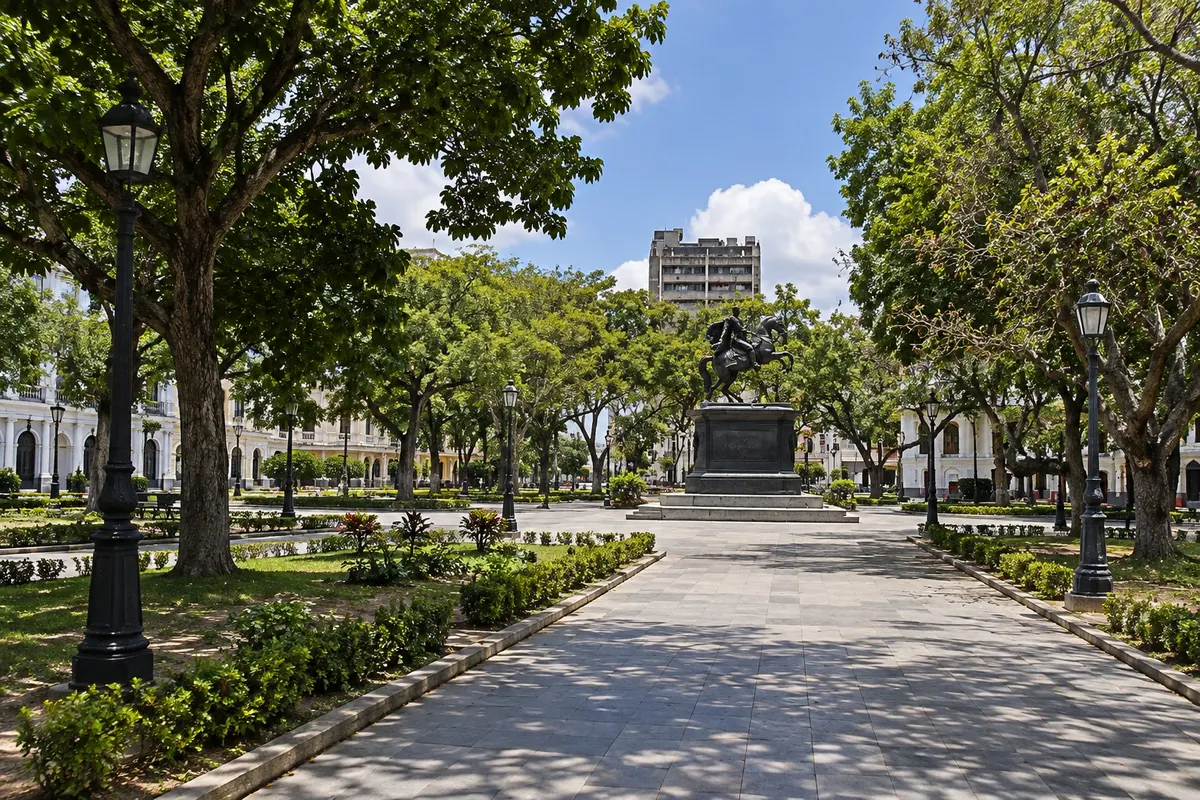
Square · Caracas, Distrito Capital
Plaza Bolívar de Caracas
The main square of Caracas since its founding in 1567, featuring Bolívar's equestrian statue from 1874 and the Cathedral, where the Liberator's parents and wife are buried. Around it are the Capilla de Santa Rosa de Lima and the Palacio Municipal.
Illustrative images. The pictures in this guide are illustrations based on the real place, not photographs, and may differ from it.

Discover
About Plaza Bolívar de Caracas
Plaza Bolívar is the starting point of Caracas. It was laid out as the main square when the city was founded in 1567, and for centuries it served as a parade ground and market. In 1810 it was the stage for the movement that began Venezuela's independence. The square's current name comes from the Liberator, whose remains arrived in the city in 1842, and the square gained its present design at the end of the 19th century, with gardens, fountains, iron lamp posts and the trees that shade the benches.
In the center stands the equestrian statue of Simón Bolívar, inaugurated in 1874, a copy of the one the Italian sculptor Adamo Tadolini made for Lima, with the horse rearing on the pedestal. Around it, caraqueños meet to chat, play dominoes and feed the squirrels and pigeons.
On the east side is the Catedral de Caracas, built between 1666 and 1674 after the 1641 earthquake destroyed the previous church. The façade dates from 1771 and the interior has five naves separated by columns. In the right nave is the Bolívar family chapel, where the Liberator's parents and wife are buried. The collection of sacred art includes a Resurrection attributed to Rubens and an unfinished Last Supper by Arturo Michelena.
On the other sides of the square are the Palacio Municipal, with the Capilla de Santa Rosa de Lima, where the declaration of independence was approved in 1811, the Palacio Arzobispal and the Casa Amarilla. The Casa Natal del Libertador is two blocks to the southeast.
Before you go
Practical information
Cidade Turismo reviews its information regularly, but something may have changed. Check with the place before planning your trip.
How much time to set aside
Half an hour for the square and another half hour for the Cathedral. Adding the Casa Natal and the Panteón, the historic center takes a morning.
Best time
In the morning, when the Cathedral is open and the square still has shade. On weekends the center is quieter. Cathedral hours change with mass schedules; check before you go.
How to get there
Capitolio station on metro line 1 is one block from the plaza. By taxi, ask to go to Plaza Bolívar in the city center. From the eastern neighborhoods, the metro takes 15 to 25 minutes.
Tip
Go into the Cathedral to see the Bolívar family chapel in the right nave. Then walk around the surrounding corners: the downtown streets are named by intersections, like San Jacinto and Traposos, and that's how people from Caracas give addresses there.
Get your questions answered
Frequently asked questions about Plaza Bolívar de Caracas
Who is buried in the Catedral de Caracas?
In the Bolívar family chapel, in the right nave, are the parents of Simón Bolívar and his wife, María Teresa del Toro. Bolívar's own remains are in the Panteón Nacional.
Is the Bolívar statue original?
It is a copy of the equestrian statue that the Italian Adamo Tadolini made for Lima. The Caracas one was inaugurated in 1874 and became the model for the plazas Bolívar throughout the country.
Can you enter the Cathedral outside of masses?
Generally, yes, during the day, wearing modest clothing and keeping quiet. Hours change with religious celebrations; check before you go.
What is near the square?
The Casa Natal del Libertador, two blocks away; the Capilla de Santa Rosa de Lima and the Palacio Municipal on the south side; and about 1 km to the north, the Panteón Nacional.