

 Brazil
 Argentina
 Bolivia
 Chile
Chile Colombia
 Ecuador
 Guyana
 French Guiana
 Falkland Islands (Malvinas)
 Paraguay
 Peru
Peru Suriname
 Uruguay
 Germany
 Belgium
 Denmark
 Spain
Spain France
 Greece
 the Netherlands
 Ireland
 Italy
Italy Luxembourg
 Norway
 Portugal
 the United Kingdom
 Sweden
 Switzerland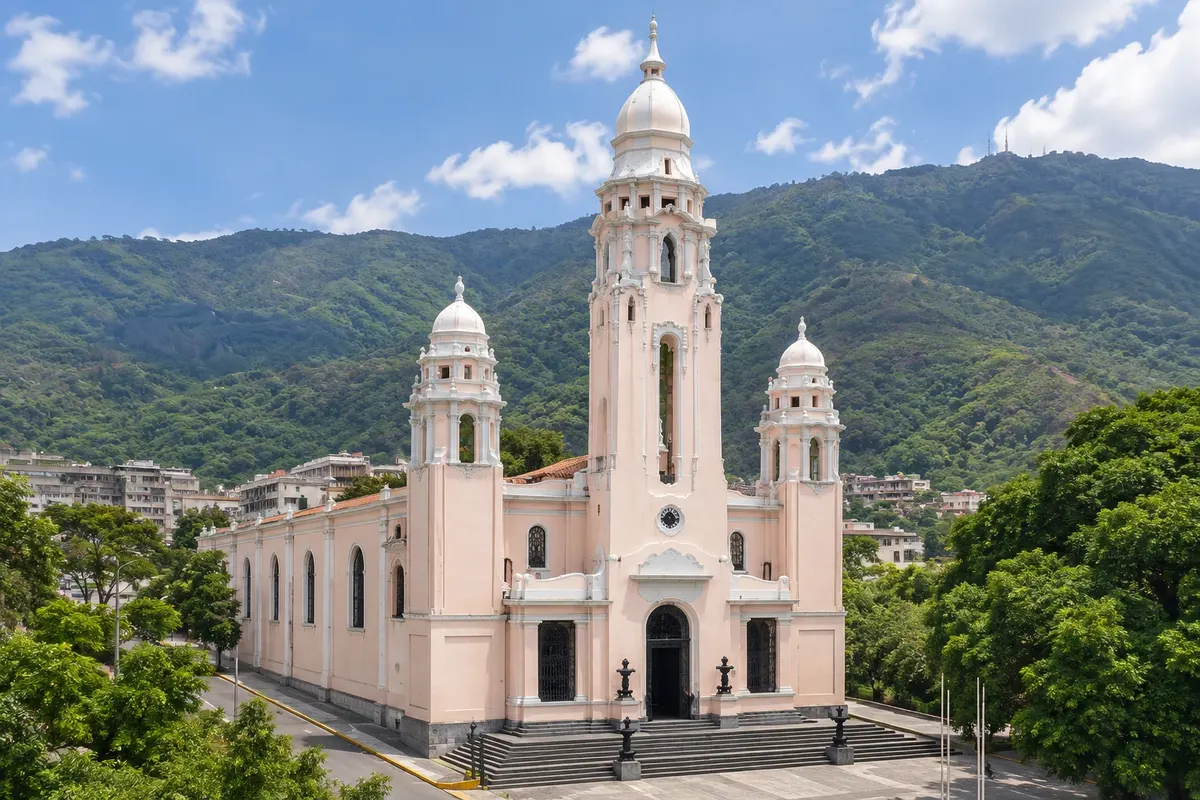
Monument · Caracas, Distrito Capital
Panteón Nacional de Venezuela
The former church of the Santísima Trinidad, converted into a pantheon in 1874, houses Simón Bolívar's bronze sarcophagus in the central nave, a ceiling painted with scenes from his life, and the tombs and cenotaphs of other figures in Venezuelan history.
Illustrative images. The pictures in this guide are illustrations based on the real place, not photographs, and may differ from it.

Discover
About Panteón Nacional de Venezuela
The Panteón Nacional is at the northern end of Caracas's historic center, in the Altagracia neighborhood, where the church of the Santísima Trinidad once stood; it was built from 1744 and damaged by the 1812 earthquake. In 1874 the church was converted into a pantheon, and the following year it received the first remains of independence heroes. The remains of Simón Bolívar, brought from Santa Marta, Colombia, to the Cathedral in 1842, were moved here in 1876.
Bolívar's bronze sarcophagus occupies the altar space at the end of the central nave. The side naves hold the tombs and cenotaphs of military figures, writers, musicians and scientists, among them Andrés Bello, Rómulo Gallegos and the pianist Teresa Carreño. Luisa Cáceres de Arismendi, heroine of Margarita Island, was the first woman buried there. Francisco de Miranda has an empty tomb because his remains were never found.
The vaulted ceiling was painted in the 1930s with scenes from Bolívar's life under the direction of Tito Salas, and a large crystal chandelier installed in 1883, on the centenary of the Libertador's birth, hangs from the center. Next to the church a modern annex with tall white lines was built, visible from afar in the square in front.
The visit is silent and follows the order of the naves. From the Panteón's plaza, with the neo‑Gothic façade in the background, you can see the Ávila just behind.
Before you go
Practical information
Cidade Turismo reviews its information regularly, but something may have changed. Check with the place before planning your trip.
How much time to set aside
30 to 45 minutes.
Best time
In the morning, combined with Plaza Bolívar and Casa Natal, which are about 1 km to the south. The Panteón usually closes on Mondays; check before you go.
How to get there
It is about 1 km north of Plaza Bolívar, up Avenida Norte, a 15-minute walk. By taxi, ask to go to Plaza del Panteón.
Tip
Look up: the painted ceiling tells Bolívar's life in panels. The visit requires modest clothing and silence, and photos may have specific rules; ask at the entrance.
Get your questions answered
Frequently asked questions about Panteón Nacional de Venezuela
Are Bolívar's remains in the Panteón?
Yes, in the bronze sarcophagus at the end of the central nave, in the spot where the altar of the former church stood. They were moved there in 1876.
Who else is buried in the Panteón?
Independence military figures, writers, musicians and scientists, such as Andrés Bello, Rómulo Gallegos and Teresa Carreño. Luisa Cáceres de Arismendi was the first woman. Francisco de Miranda has a symbolic tomb.
How long does the visit take?
About 30 to 45 minutes. You can combine it in the same morning with Plaza Bolívar, the Cathedral and the Casa Natal.
Can you walk from Plaza Bolívar?
Yes, it's about 1 km uphill along avenida Norte, roughly a 15-minute walk.