

 Brazil
 Argentina
 Bolivia
 Chile
Chile Colombia
 Ecuador
 Guyana
 French Guiana
 Falkland Islands (Malvinas)
 Paraguay
 Peru
Peru Suriname
 Uruguay
 Germany
 Belgium
 Denmark
 Spain
Spain France
 Greece
 the Netherlands
 Ireland
 Italy
Italy Luxembourg
 Norway
 Portugal
 the United Kingdom
 Sweden
 Switzerland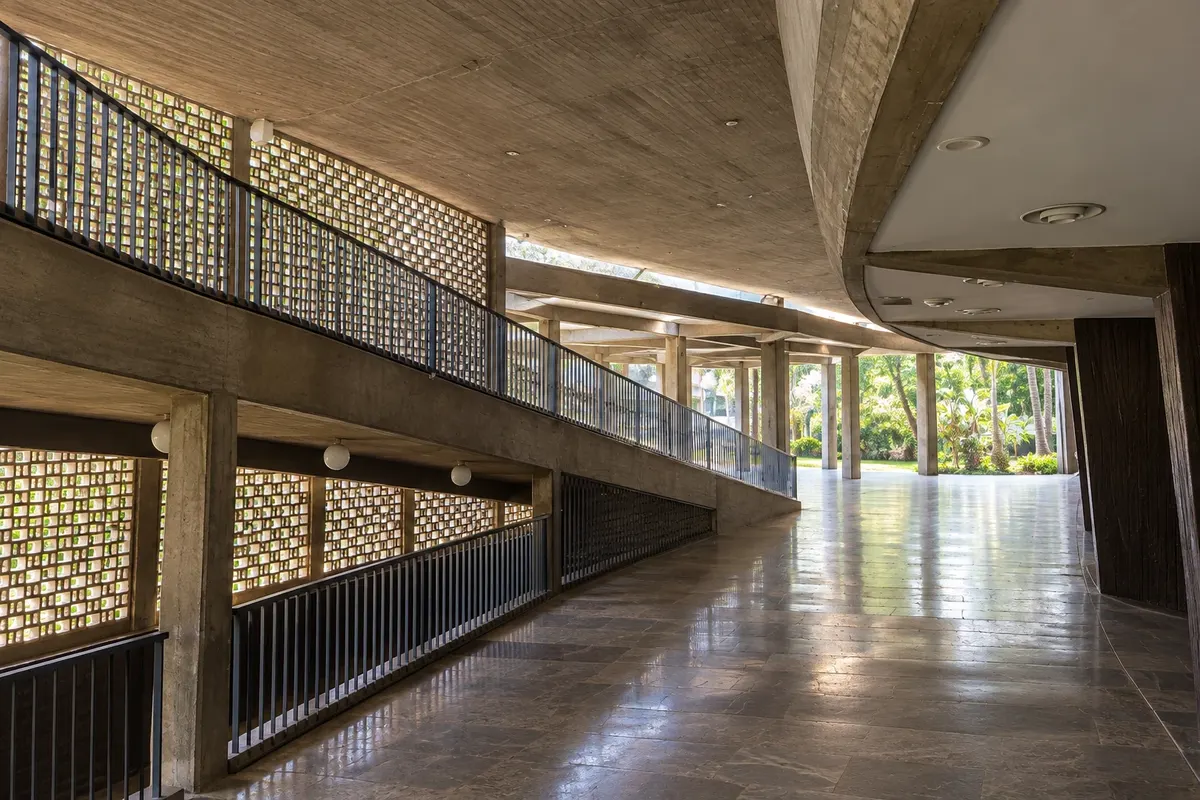
Architectural heritage · Caracas, Distrito Capital
Ciudad Universitaria de Caracas
The campus of the Universidad Central de Venezuela, designed by Carlos Raúl Villanueva and a UNESCO World Heritage Site since 2000, combines modern architecture and art: Alexander Calder's Clouds in the Aula Magna, stained glass by Fernand Léger and works by Vasarely, Arp and Pevsner.
Illustrative images. The pictures in this guide are illustrations based on the real place, not photographs, and may differ from it.

Discover
About Ciudad Universitaria de Caracas
Ciudad Universitaria de Caracas is the campus of the Universidad Central de Venezuela, the oldest in the country, and one of the most complete works of modern architecture in Latin America. It was designed by the Venezuelan architect Carlos Raúl Villanueva, who oversaw construction from the early 1940s through the 1960s. In 2000 it was added to the UNESCO World Heritage list as an example of the integration of architecture, urban planning and the visual arts.
Villanueva called this idea the synthesis of the arts. Instead of placing works in museums, he spread murals, stained glass and sculptures by Venezuelan and European artists across the campus, such as Fernand Léger, Victor Vasarely, Jean Arp, Antoine Pevsner, Henri Laurens, Mateo Manaure and Alejandro Otero. The works are located in corridors, on façades, in plazas and in the gardens, within reach of passersby.
The heart of the complex is the Plaza Cubierta, inaugurated in 1954, a large area that is both covered and open, with pierced walls, ramps and murals that link the central buildings. From there you enter the Aula Magna, the main auditorium, where Alexander Calder's Nubes Flotantes, large colorful panels hung from the ceiling, also function as acoustic reflectors. Beside it, the central library has a Léger stained-glass window on its façade.
Covered walkways connect the faculties in the shade, with tropical trees from the gardens between them. The Jardim Botânico, created in 1952, lies next to the campus, and the Olympic stadium and the baseball stadium, also by Villanueva, complete the ensemble.
Before you go
Practical information
Cidade Turismo reviews its information regularly, but something may have changed. Check with the place before planning your trip.
How much time to set aside
About 1h30 to 2 hours for the Plaza Cubierta, the Aula Magna, the library and the corridors with artworks.
Best time
On weekday mornings, when the campus is active and there are better chances of seeing the Aula Magna open. Entry to the auditorium depends on the schedule and may require a guided tour; check before you go.
How to get there
The Ciudad Universitaria station on metro line 3 is next to the campus; Plaza Venezuela station on line 1 is about a 15-minute walk away. By taxi, ask to be taken to the entrance of the Plaza del Rectorado.
Tip
Start at the Plaza del Rectorado, with its clock tower, and follow the covered walkways to the Plaza Cubierta. If the Aula Magna is closed, ask at the university about guided visits; it's worth it to see Calder's Nubes Flotantes up close.
Get your questions answered
Frequently asked questions about Ciudad Universitaria de Caracas
Why is Ciudad Universitaria a World Heritage Site?
Because of the integration of architecture, urban planning and art that Carlos Raúl Villanueva created on the campus, with works by artists such as Calder, Léger, Vasarely and Arp in the plazas and corridors. It was recognized by UNESCO in 2000.
What are Calder's clouds?
Large colorful panels suspended from the ceiling of the Aula Magna, created by Alexander Calder. Besides being works of art, they function as acoustic reflectors for the auditorium.
Can tourists enter the campus?
In general, yes, on weekdays, to walk through the corridors and plazas. The Aula Magna depends on programming and may require a guided visit; check before going.
How to get there by metro?
Via Ciudad Universitaria station on line 3, next to the campus, or via Plaza Venezuela station on line 1, about a 15-minute walk.