

 Brazil
 Antarctica
 Argentina
 Bolivia
 Chile
 Colombia
 Ecuador
 Falkland Islands (Malvinas)
 French Guiana
 Guyana
 Paraguay
 Peru
 Suriname
 Uruguay
 Venezuela
 Albania
 Austria
 Belgium
 Denmark
 Finland
 France
 Germany
 Greece
 Hungary
 Iceland
 Ireland
 Italy
 Luxembourg
 Norway
 Poland
 Portugal
 Slovakia
 Slovenia
 Spain
 Sweden
 Switzerland
 the Czech Republic
 the Netherlands
 the United Kingdom
 Turkey
 Bermuda
 Canada
 Greenland
 Mexico
 Saint Pierre and Miquelon
 the United States
 the Dominican Republic
 Japan
 Egypt
 South Africa
 Australia
 Fiji
 New Zealand
 Papua New Guinea
Cultural and heritage travel
Roman monuments and sites in Croatia
If you could step into a Roman city, where would you start? In Croatia, you can get a sense of three very different experiences. In Pula, crowds gathered in the amphitheater to watch a show. In Split, you can still cross the threshold of an emperor’s residence. In Zadar, a walk around the peninsula takes you through part of the ancient public square.
A good place to start is to trace the shape of each site on the ground. The curve of the Arena, the main routes that cut across the palace, and the open space of the forum all tell you something about the people who passed through. With that picture in mind, it’s easier to see what purpose a gate or column served, even if it now seems to stand alone.
The curve of Pula Arena
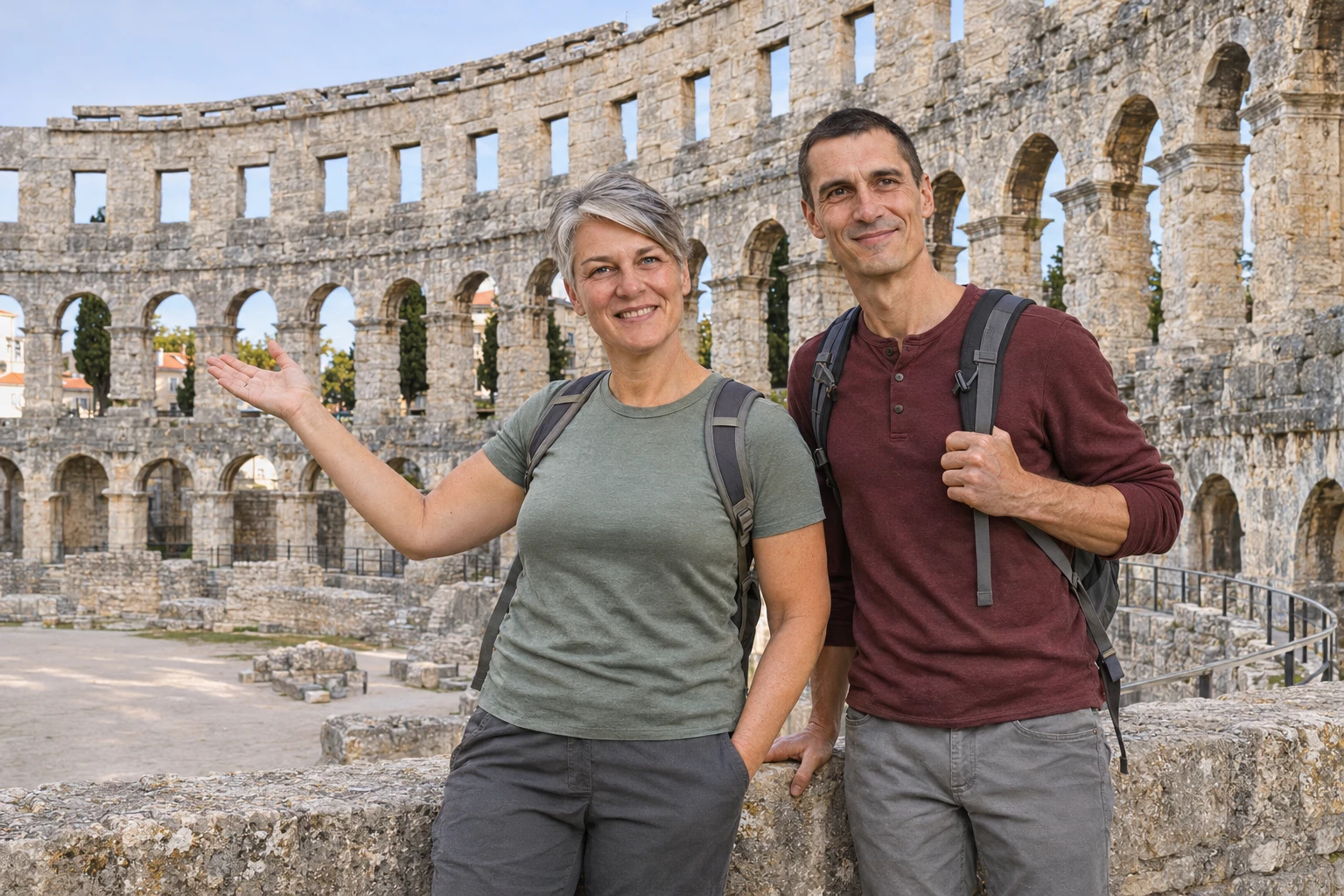
The Arena’s row of arches comes into view as you walk through central Pula. Follow the outer wall and notice how its height seems to change with the slope of the ground. As you walk, the oval shape becomes clearer. It’s one way to begin picturing the size of the crowd that gathered around the central space.
Inside, try looking at the amphitheater from the spectators’ perspective. Look out over the performance space from the spectator area, then see if you can trace the routes people used to get around. A photo taken at an angle, showing several arches in a row, usually gives a better sense of the amphitheater’s scale than a head-on shot of a single arch. The Archaeological Museum of Istria manages the monument.
An imperial address on the streets of Split
Diocletian’s Palace is one of the few places where you can switch from the floor plan of an imperial residence to a modern street map without leaving the spot. Find one of the gates and make your way to the Peristyle. In this courtyard, look first at the columns, then at the passages leading out between the buildings. People still use these passages to get around central Split.
Nearby, the Cathedral of Saint Domnius occupies Diocletian’s former mausoleum. You can see how the building’s two uses come together in its shape and its relationship to the courtyard. You can see the exterior on a walk through the neighborhood. To go inside the cathedral or visit an area with separate access, check the entry arrangements for that particular site.
Zadar’s ancient public square
The Roman Forum is on the peninsula that is home to Zadar’s historic center. Expect an open space with remains scattered across the site. Walk along one edge first to get a sense of the square’s size. Then take a closer look at a fragment and see if you can find clues to how it fit into a larger structure.
What the Romans once saw as a standing structure is often visible today only as a line of stones. A site plan helps you distinguish the areas people walked through from the outlines of buildings. As you leave, look back at the space from one of the surrounding streets. The contrast in scale between the street and the square gives you a sense of the forum’s public role.
How to plan a route that takes in all three sites
On a trip through Istria, you can focus your visit to Pula on a single monument. In Dalmatia, you can see the forum on a walk through central Zadar and return to the palace at different points during a stay in Split. You might set aside one walk to get a sense of the layout, then come back just for the mausoleum or the Peristyle.
If archaeology is the theme of your trip, take the same question about access to each stop: Where did spectators enter in Pula, who could move through the different parts of the palace in Split, and from which sides could people reach the square in Zadar? Looking for answers in the architecture brings out the differences between an amphitheater, a palace, and a forum, even if you’ve never visited a Roman site before.
Frequently asked questions
Where is Croatia’s Roman amphitheater?
The Arena is in Pula, in Istria. You can follow its outline from the outside and plan a visit inside to see the central space.
Is Diocletian’s Palace outside Split?
The palace complex is part of the present-day city center. Streets run through the ancient gates, connecting the palace interior to other parts of the city.
What was Zadar’s forum?
It was the Roman city’s public square. The remains help you make out the space that served as a hub of civic life.
Where to go: Monumentos e sítios históricos
Pick a region or type what you are looking for to see the cities and who offers it in each.
More activities in Cultural and heritage travel



Beyond the guide


