

 Brazil
 Antarctica
 Argentina
 Bolivia
 Chile
 Colombia
 Ecuador
 Falkland Islands (Malvinas)
 French Guiana
 Guyana
 Paraguay
 Peru
 Suriname
 Uruguay
 Venezuela
 Albania
 Austria
 Belgium
 Denmark
 Finland
 France
 Germany
 Greece
 Hungary
 Iceland
 Ireland
 Italy
 Luxembourg
 Norway
 Poland
 Portugal
 Slovakia
 Slovenia
 Spain
 Sweden
 Switzerland
 the Czech Republic
 the Netherlands
 the United Kingdom
 Turkey
 Bermuda
 Canada
 Greenland
 Mexico
 Saint Pierre and Miquelon
 the United States
 the Dominican Republic
 Japan
 Egypt
 South Africa
 Australia
 Fiji
 New Zealand
 Papua New Guinea
Cultural and heritage travel
Churches and Sacred Art in Croatia
A figure made of tiny pieces of mosaic comes into focus when you take a few steps back. At a carved portal, the opposite is true. Moving closer lets you make out gestures that disappear when you look at the façade as a whole. Croatia’s historic churches invite you to vary your viewing distance and look for the spot from which each work was meant to be seen.
Between Istria and Dalmatia, you’ll find an early Christian basilica, a Roman mausoleum turned cathedral, and a medieval portal worth a visit in its own right. At each stop, pick out a detail before you go inside. It might be the joint between two stones or the way a square draws your eye toward a doorway.
The Mosaics of the Euphrasian Basilica in Poreč
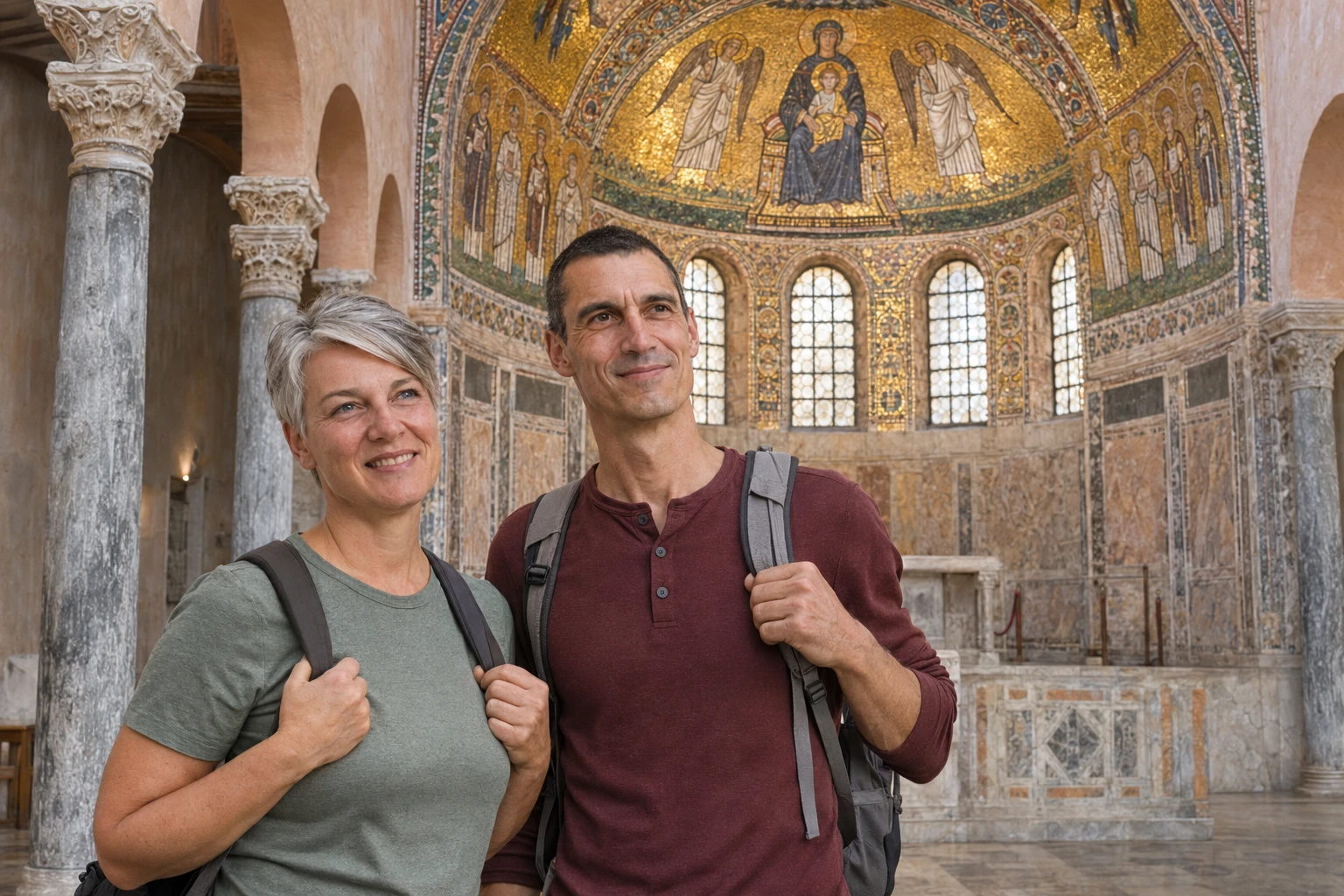
The basilica is part of an early Christian episcopal complex. Once inside, let your gaze follow the curve of the apse, the part of the church that forms the end wall near the altar. Start by noticing where the figures are placed in relation to one another. Then look for the differences in color and sheen that distinguish a face or a robe from the background.
The small pieces of the mosaic reflect light in different ways. Shift your position slightly within the area open to visitors and see which details stand out. As you return to the entrance, look at the scene again from a distance. It’s easier to see how people standing in the nave could recognize an image set so high above them.
The Stonework of Šibenik and the Portal in Trogir
At the Cathedral of St. James in Šibenik, it’s worth starting with a walk around the outside. Look for the heads carved on the exterior of the apses and compare their expressions and features, noting which way each one looks. Then step back until you can see the building as a whole again. The same stone that lends itself to the fine detail of the faces also forms the walls and roof.
In Trogir, Radovan’s medieval portal marks the entrance to the Cathedral of St. Lawrence. Choose one side of the doorway and follow the carved figures with your eyes up to the arch. Do the same on the other side. Stand a little to one side of the entrance so you can take your time looking while people come and go.
The Mausoleum That Became a Cathedral in Split
The Cathedral of St. Domnius occupies Diocletian’s former mausoleum within the palace. Before you go inside, look at the building from the Peristyle to see how it fits into the Roman complex. A floor plan can help you distinguish the ancient structure from later additions to the cathedral.
Inside, look for what changed when a space built for burial became a place of worship. The position of the altar and the layout of the space around it help you picture where worshippers enter, where they look, and where they gather. As you plan your visit, check the access arrangements for each part of the complex.
Approaching St. Stephen’s Cathedral in Hvar
In Hvar, start at the end of the square facing the harbor. The cathedral façade frames the view at the far end. As you walk toward it, the tower stands out against the outline of the hillside, and the square begins to take on the proportions of a church forecourt. When you reach the church, turn around to see how the entrance relates to the town stretching down to the water.
As at the other cathedrals on this route, access depends on when the church is in use for worship. If a service is underway, take the time to explore the exterior and return when the interior is open to visitors. Before photographing a work of art, check the photography guidelines and keep passageways clear.
Frequently asked questions
Where can you see early Christian mosaics in Croatia?
At the Euphrasian Basilica in Poreč, in Istria. The composition in the apse is a good place to start looking at how the figures relate to the architecture.
Which Croatian cathedral occupies a Roman mausoleum?
The Cathedral of St. Domnius in Split. It’s part of the Diocletian’s Palace complex, and you can use the Peristyle as a reference point to find it.
Is Radovan’s Portal in Šibenik or Trogir?
It’s at the Cathedral of St. Lawrence in Trogir. In Šibenik, the Cathedral of St. James is known for its stone construction and the carved heads on its exterior.
Where to go: Visitar igrejas e arte sacra
Pick a region or type what you are looking for to see the cities and who offers it in each.
-
Poreč IS
A Basílica Eufrasiana conserva mosaicos do conjunto episcopal paleocristão.
-
Šibenik SK
A Catedral de São Tiago se destaca pela construção em pedra e pelo conjunto escultórico.
-
Hvar ST
A Catedral de Santo Estêvão fecha a praça principal da cidade histórica.
-
Split ST
A Catedral de São Dômnio ocupa o antigo mausoléu de Diocleciano.
-
Trogir ST
A Catedral de São Lourenço faz parte do conjunto histórico e preserva o portal medieval de Radovan.
More activities in Cultural and heritage travel

Beyond the guide


