Piz Nair: Corviglia funicular and cable car up to 3,056 m
From Funicular station at St. Moritz Dorf Funicular to Corviglia and cable car to Piz Nair about 2 to 4 hours morning or afternoon easy (high at 3,056 m)
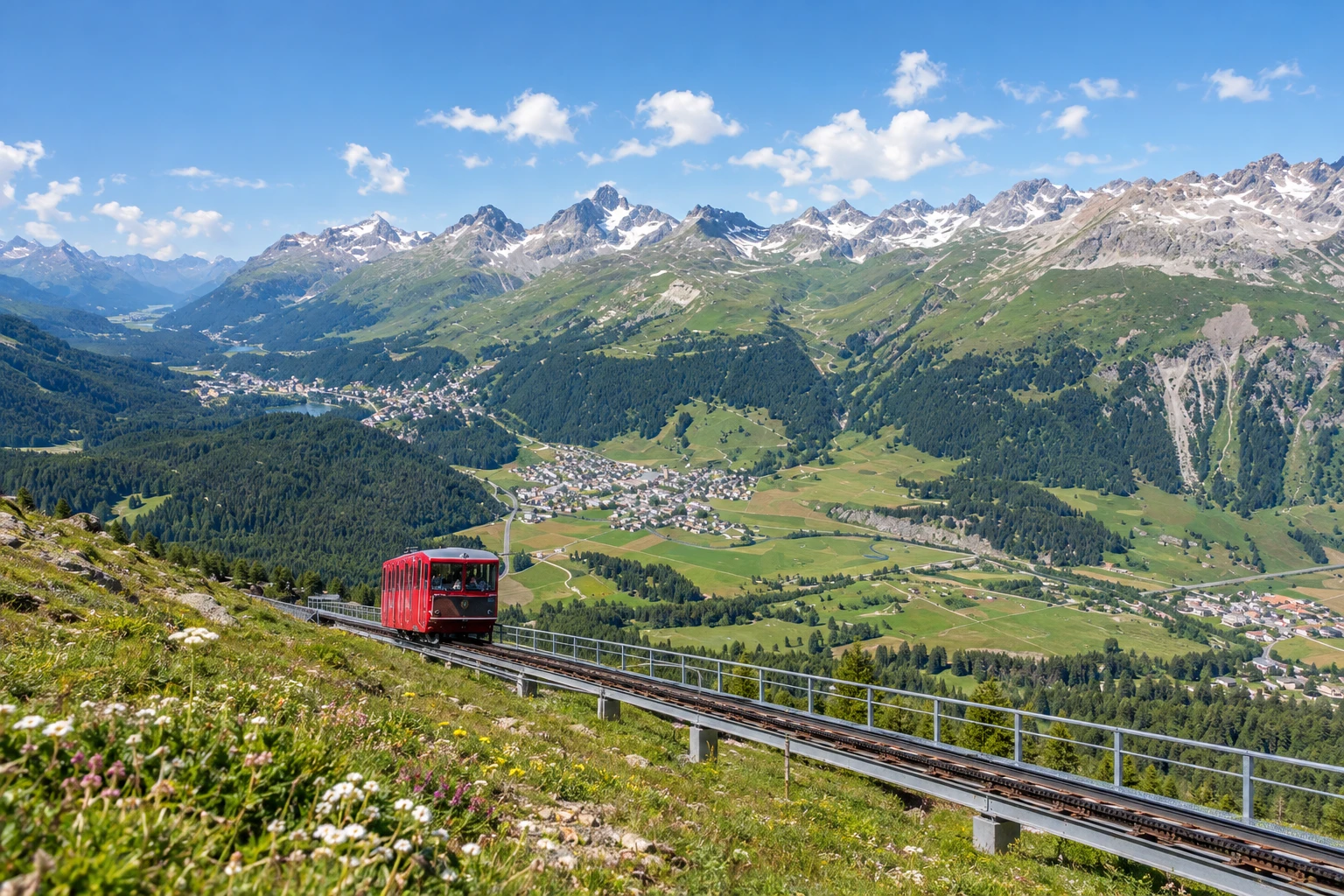
Piz Nair is St. Moritz's mountain. The funicular departs from central St. Moritz Dorf, stops at the intermediate station Chantarella and reaches Corviglia (2,489 m) in about 7 minutes. Opened in 1928, it was the first funicular in Switzerland to go directly to a ski area. From Corviglia, a cable car climbs about 5 more minutes to the summit of Piz Nair at 3,056 m. From the top you can see the Engadine lakes and the Albula Alps. In summer, Corviglia is a starting point for hiking trails and mountain bike routes, and the Signal cable car, departing from St. Moritz Bad, is another way up the mountain. In winter, Corviglia is St. Moritz's main ski area. There is also a sunrise program on Piz Nair, with an ascent before dawn and breakfast at the summit restaurant, with limited places and advance reservation.
Stops: Piz Nair, Corviglia, Chantarella, St. Moritz Dorf, Signal.
Includes: Tickets for the funicular and the cable car are paid separately (check the current fares). The sunrise program is charged separately and requires a reservation.
Tip: To save time, combine the ascent with a visit to the Segantini Museum, which is in St. Moritz. The cable car does not operate in storms; bring warm clothing.
Best time: Summer: usually runs from June to October. Winter: ski season from late November to April. Outside these periods it is often closed for maintenance; confirm.
Segantini Museum and the Triptych of the Alps
From St. Moritz town centre On foot or bus 605 from the station (3 stops) about 1 to 2 hours afternoon easy
The museum dedicated to Giovanni Segantini, an Alpine painter who spent his final years in the Engadine and died in 1899 in a hut on the Schafberg above Pontresina, is located on Via Somplaz between St. Moritz town centre and the Suvretta area. The building, opened in 1908 and designed by architect Nicolaus Hartmann, is round, built of local stone, with a large dome; it resembles the pavilion Segantini planned for the 1900 Paris Exposition. In the dome room on the upper floor is the main work: the Triptych of the Alps, with the panels Werden, Sein and Vergehen (to become, to be and to pass), depicting landscapes of Soglio, the Schafberg and Maloja. The collection also includes the artist’s oil paintings and drawings, and the museum mounts temporary exhibitions in the summer season. It’s a short visit, good for an afternoon or for a cloudy day in the mountains.
Stops: Segantini Museum, St. Moritz, Via Somplaz.
Includes: Separate paid admission (check current rates). Bags and backpacks are stored in lockers at the entrance; strollers are not allowed inside the galleries.
Tip: The museum is closed on Mondays and between seasons. Combine it with the Atelier Segantini in Maloja and the trail to Chamanna Segantini on Muottas Muragl to follow the painter’s footsteps.
Best time: Open in two seasons: typically from late May to October and from December to April. Confirm the dates.
Sils/Segl, Val Fex and Nietzsche-Haus
From St. Moritz, by bus to Sils/Segl Maria Bus and walk or horse-drawn carriage about 5 hours full day easy to moderate
Sils (Segl, in Romansh) lies between the lakes of Silvaplana and Sils, on the way to Maloja, and is divided into Sils Maria and Sils Baselgia. In Sils Maria, on the main street, a 5-minute walk from the square, is the Nietzsche-Haus, the house where the philosopher Friedrich Nietzsche spent summers in the 1880s and wrote part of his work; the renewed exhibition shows his life and work in the Engadine.
From Sils Maria the Val Fex departs, a side valley with restricted car access, between about 1,800 and 2,000 m, which ends at the Fex glacier. The most common trail climbs through a gorge to Platta and continues along the valley beside the access road to the Fex Curtins hotel and Alp Muot Selvas: it is 6.8 km, about 2 hours of walking, with 265 m of ascent. Those who do not want to walk can do the route by horse-drawn carriage (Pferdekutsche), which leaves from Sils Maria and takes about 20 minutes to Fex Platta, 30 to Fex Crasta and 50 to Fex Curtins. You can go up by carriage and return on foot, or vice versa. In winter, the valley is usually covered in snow and the trail becomes a winter route.
Stops: Sils/Segl Maria, Sils/Segl Baselgia, Silsersee, Val Fex, Fex Platta, Fex Crasta, Fex Curtins, Nietzsche-Haus.
Includes: Buses and carriages require separate payment (check fares). Nietzsche-Haus admission is paid separately.
Tip: The Nietzsche-Haus is open only in the afternoons, Tuesday through Sunday, during the summer and winter seasons; plan your visit for after the hike. Wear sturdy footwear: the initial climb through the gorge is steep.
Best time: From June to October for the hike; the Nietzsche-Haus usually open from June to October and from December to April.
Pontresina and the Val Roseg, on foot or by carriage
From Pontresina train station Train from St. Moritz to Pontresina and walk or carriage about 4 to 5 hours all day easy
Pontresina is the village next to St. Moritz, at the entrance to the Bernina valley, a few minutes by train. From Pontresina station the trail to Val Roseg starts—a side valley that rises gently through larch and pine forests to views of the Roseg and Sella glaciers. The round trip is 13.8 km and about 3 hours 30 minutes of walking, with little elevation change (between 1,774 and 2,001 m). At the valley bottom is the Roseggletscher hotel-restaurant, known for its dessert buffet, where most people stop before returning. For those who prefer not to walk the entire route, horse-drawn carriages go up the valley from Pontresina; you can go up by carriage and return on foot. Above the village is Alp Languard, the endpoint of the Panoramaweg coming from Muottas Muragl.
Stops: Pontresina, Val Roseg, Rosegletscher, Sellagletscher, Alp Languard.
Includes: Self-guided walk. Train, carriage and meals are paid separately (check current fares).
Tip: Combine with the Morteratsch glacier trail or with Diavolezza, which are on the same rail line a few minutes after Pontresina.
Best time: From June to October; in winter, the valley trail is often used for snow hiking and cross-country skiing.
Albula line (UNESCO), Bergün and the Bahnmuseum Albula
From St. Moritz train station RhB regional train on the Albula line about 5 to 7 hours full day easy (optional trail of medium difficulty)
The Albula line links the Engadine with Chur and, together with the Bernina line, has been a UNESCO World Heritage site since 2008. From St. Moritz, the regional train reaches Bergün/Bravuogn in about 40 minutes: it passes Samedan, enters the Albula tunnel and descends to Preda (1,789 m) and Bergün (1,373 m) via spiral tunnels and viaducts, turning over itself to lose altitude. Next to Bergün station is the Bahnmuseum Albula, a railway museum with more than 800 objects across four floors covering over 135 years of rail history in Graubünden: station clocks, documents and original plans from the line’s construction. The museum is also the RhB UNESCO visitor centre. For walkers, the Bahnerlebnisweg Albula has informational panels about the railway along the tracks: the Preda to Bergün stage is 7 km, taking about 2 h 15 min to 2 h 45 min, with roughly 480 m of descent and some narrow sections. A third, short stage runs from Filisur to the Landwasser Viaduct and back in about 1 h 30 min.
Stops: Albulabahn, Bergün/Bravuogn, Bahnmuseum Albula, Preda, Filisur, Landwasser Viaduct.
Includes: Train tickets and museum admission paid separately (check the current rates). The museum has a shop and a café.
Tip: Do the Preda to Bergün trail in the morning and leave the museum for the afternoon. Tourist transport passes are usually valid on RhB regional trains; check in advance.
Best time: Museum open year-round, with a break during part of November and December. Trail open from June to October, without snow.
Glacier Express from St. Moritz to Zermatt
From St. Moritz railway station Glacier Express panoramic train, reservation required about 8 hours (one way) full day easy
The Glacier Express connects St. Moritz with Zermatt, at the foot of the Matterhorn, in about 8 hours, passing 291 bridges and 91 tunnels. Departing St. Moritz, the train descends on the Albula line, reaches Chur, climbs the anterior Rhine valley (Vorderrhein), including the Rhine Gorge section, passes Disentis/Mustér, crosses the Oberalp pass to Andermatt and descends the Rhône valley to Brig before ascending the Zermatt valley. The carriages have panoramic windows and meals are prepared on board and served at your seat. This is a point-to-point journey between two destinations, not a same-day round trip: use it to travel from St. Moritz to Zermatt (or do the reverse). In Zermatt private cars do not circulate; arrival by train solves that.
Stops: St. Moritz, Samedan, Filisur, Chur, Disentis/Mustér, Andermatt, Brig, Zermatt.
Includes: Train ticket and seat reservation mandatory, paid separately. Meals on board are paid separately. Holders of tourist transport passes pay only the reservation.
Tip: Book in advance, especially in summer. Dispatch large luggage via the railways' baggage service if you do not want to carry it during transfers on the rest of the trip.
Best time: Almost year-round; it usually does not run between mid-October and early December. Check the timetable.
Maloja: Atelier Segantini, Belvedere Tower and Gletschermühlen
From St. Moritz, by bus to Maloja Posta Bus along the lake shores and walk around 4 hours afternoon easy
Maloja sits at the end of the Engadine, at the pass that links the valley to the Bergell (Bregaglia in Italian), which descends toward Italy. The bus leaves St. Moritz and passes the lakes of Champfèr, Silvaplana and Sils. Giovanni Segantini lived in Maloja with his family from 1894 until his death. The Atelier Segantini, a small round wooden pavilion in front of the Schweizerhaus hotel, is a reduced version of the pavilion he designed for the 1900 Paris Exposition. From there a gravel path leads to the Belvedere Tower, owned by Pro Natura, hosting exhibitions and offering views over the Bergell and the Engadine. Around the tower are the Gletschermühlen, the glacial potholes: rounded hollows carved in the rock by meltwater, discovered in 1882; 36 of them are on display, some dry, others with water. The potholes trail is 3 km and about 1 h 30 min, easy. Return to St. Moritz is by bus.
Stops: Maloja, Atelier Segantini, Belvedere Tower, Gletschermühlen, Silsersee, Bergell/Bregaglia.
Includes: Bus paid separately. Admission to the Atelier Segantini paid separately. The glacial potholes trail is freely accessible.
Tip: The Atelier Segantini opens only late in the afternoon on a few days each week: check before you go. Wear sturdy trainers or hiking boots.
Best time: From June to October for the trail; the atelier also opens on winter weekends.
Museum Engiadinais: historic houses and rooms of the Engadine
From St. Moritz Bad Bus 601 or 605 from the station, or on foot about 1 hour 30 minutes morning or afternoon easy
The Museum Engiadinais, on Via dal Bagn, was built in 1906 by architect Nicolaus Hartmann to house Riet Campell’s collection, who gathered historic interiors to prevent them being sold outside the region. The building reproduces the concept of the typical Engadine house, with elements of local architecture. Inside are 21 rooms, the heart of the museum, with interiors from five centuries: Stuben (wood-paneled rooms) of the Engadine and neighboring regions, a Valtellina ceremonial hall, a manor kitchen and a bedroom. There are no texts on the walls, to preserve the original atmosphere of the rooms; the history of each is told by an electronic guide that speaks seven languages. There is also a section about Romansh, Switzerland’s fourth language, still spoken in the Engadine. For Brazilians, it’s a way to see how the old houses of the valley villages looked inside.
Stops: Museum Engiadinais, St. Moritz Bad, Via dal Bagn.
Includes: Separate paid admission (check current rates), with an electronic guide in seven languages. Young people up to 16 years old are free.
Tip: The museum is open only Thursday to Sunday and in seasons; check the calendar before you go. It has no on-site parking.
Best time: Summer season, from June to October; confirm the winter dates.
Mili Weber Museum: the house painted by an artist
From St. Moritz Bad On foot or local bus, with guided visit booked about 1 hour afternoon easy
Mili Weber (1891–1978) was a painter who lived and worked in St. Moritz, in a house built in 1917 by her brother, architect Emil Weber, who worked with Nicolaus Hartmann. Over her lifetime she turned the house into a complete work of art: painted walls and ceilings, oil paintings, watercolors, handmade dollhouses and the original furniture. There are also flower paintings by her half-sister, painter Anna Haller. The house, on Via Dimlej, is a cultural property of national importance and is protected as an ensemble. Visits are always guided, in small groups, and show the rooms as she left them.
Stops: Mili Weber Museum, St. Moritz, Via Dimlej.
Includes: Guided tour, paid separately (check current rates). Entry only with a confirmed reservation.
Tip: Book in advance: visits take place in the afternoon at a few times per day, and in low season on fewer days of the week. A good option for a day with poor weather.
Best time: Year-round, on visiting days; check the schedule.
Olympia Bob Run St. Moritz–Celerina: bobsled run with pilot
From Track start in St. Moritz Four-person bobsled run, with pilot and brakeman about 2 hours, including wait morning intense (nearly 5 G force on the curves)
The bobsled track from St. Moritz to Celerina has existed since 1904 and hosted the Winter Olympic events in 1928 and 1948. It is made of natural ice: every year a team rebuilds it in about three and a half weeks using only snow, water and manual labor. The official track is 1,722 m long and has 19 curves; the most famous is the Horse Shoe, where the force on the sled reaches nearly 5 G. On the public descent (Gästefahrt), an experienced pilot rides in front, a brakeman at the back and two passengers in the middle. The run lasts about 75 seconds and the speed exceeds 130 km/h on the final stretch. Each passenger receives a certificate. If you prefer to just watch, you can attend trainings and races along the track, and the track's Walk of Fame is open year-round.
Stops: Olympia Bob Run St. Moritz–Celerina, Horse Shoe, Celerina.
Includes: Run paid separately, with mandatory advance reservation (check current rates).
Tip: Book months in advance: spots fill up early. Not suitable for people with back or heart problems or who are pregnant; check the required health and age conditions.
Best time: Winter only: the season usually runs from late December to March, depending on the ice.
Winter on the frozen lake: White Turf, Snow Polo and Engadin Skimarathon
From St. Moritz Bad and lakeside On foot, in areas of the lake open to the public about 3 hours afternoon easy (severe cold)
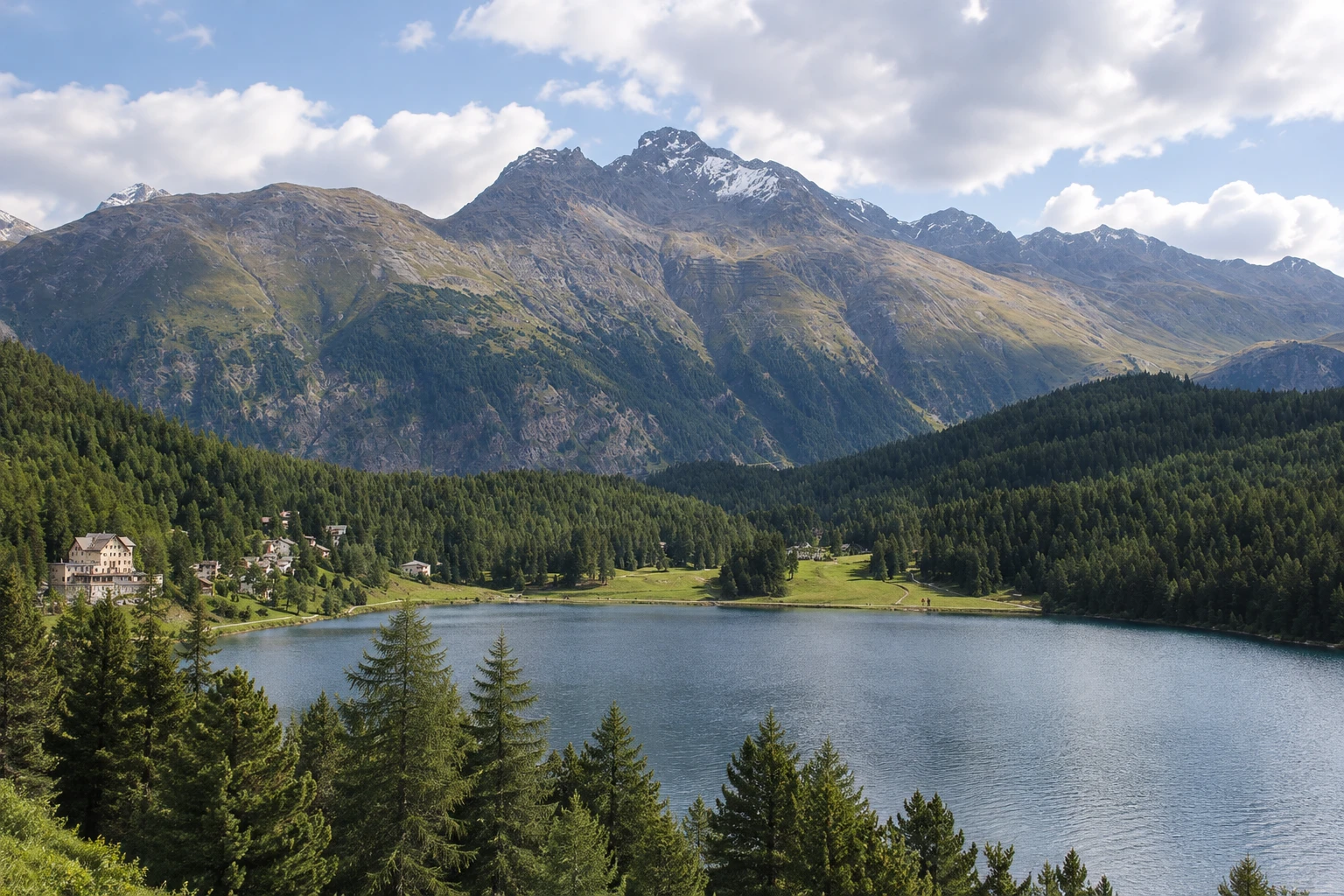
The lake at St. Moritz usually freezes from December, and the ice is only used after load tests carried out by the event organizers. When it is authorized, the lake hosts a natural ice skating rink, cross-country ski trails and pedestrian routes. Typically in late January the Snow Polo tournament is held, a polo competition on snow. In February comes the White Turf, horse races on ice held since 1907, over three consecutive Sundays, featuring gallop races, trotting and skikjöring, where a horse pulls a skier. On the second Sunday in March the Engadin Skimarathon usually takes place, a 42 km cross-country ski race from Maloja to S-chanf that crosses the frozen lakes and gathers about 14,000 skiers; it’s worth watching the start in Maloja or the passage by the lakes. On event days there are spectator areas.
Stops: St. Moritzersee, White Turf, Snow Polo, Engadin Skimarathon, Maloja, S-chanf.
Includes: At events there are public areas with separately paid admission; check the current price list and each year’s program.
Tip: Walk on the lake only in areas that are open and signposted, and never near the shores at the beginning or end of winter. Wear boots with rubber soles and thermal clothing: temperatures are often below 0 °C all day.
Best time: From January to March, depending on ice conditions and event dates.
Crossing of the glacier from Diavolezza to Morteratsch, with a mountain guide
From Diavolezza summit (Berghaus Diavolezza) Glacier hike in a group, with a mountain guide about 6 hours full day difficult (descent of 1,100 m)
For those with good fitness, the crossing goes from Diavolezza (2,978 m) to Morteratsch station, descending on foot over two glaciers. The group departs from Berghaus Diavolezza, descends to the Pers glacier, crosses to the Morteratsch glacier and finishes via a moraine trail to Morteratsch. It is about 6 hours, with roughly 1,100 m of descent, always with a mountain guide, ropes and equipment. Along the way the guide explains crevasses, moulin features in the ice and glacier retreat. Groups of 5 to 10 people run daily in season; children from 8 years old can participate. In stormy or very bad weather the departure is cancelled.
Stops: Diavolezza, Persgletscher, Morteratschgletscher, Morteratsch.
Includes: On group departures, generally: mountain guide and safety equipment. Cable car and train back are usually charged separately. Check the current schedule/table.
Tip: Requires sure-footedness and fitness for 6 hours of walking. Bring waterproof trekking boots, layered clothing, gloves, sunglasses and a snack. Never enter the glacier without a guide.
Best time: Group departures from June to October; private departures from May to November.


 Brazil
 Antarctica
 Argentina
 Bolivia
 Chile
 Colombia
 Ecuador
 Falkland Islands (Malvinas)
 French Guiana
 Guyana
 Paraguay
 Peru
 Suriname
 Uruguay
 Venezuela
 Austria
 Belgium
 Croatia
 Denmark
 Finland
 France
 Germany
 Greece
 Hungary
 Iceland
 Ireland
 Italy
 Luxembourg
 Norway
 Poland
 Portugal
 Slovakia
 Slovenia
 Spain
 Sweden
 the Czech Republic
 the Netherlands
 the United Kingdom
 Turkey
 Bermuda
 Canada
 Greenland
 Mexico
 Saint Pierre and Miquelon
 the United States
 the Dominican Republic
 Japan
 Egypt
 South Africa
 Australia
 Fiji
 New Zealand
 Papua New Guinea