Lucerne and the Mountains

Lucerne · Obwalden

Lucerne and the Mountains

Lucerna, with wooden bridges over the Reuss River and the Lake of the Four Cantons, and the surrounding mountains: Pilatus, Rigi and, in Engelberg, the Titlis with a glacier at 3,020 m.

German-speaking Switzerland

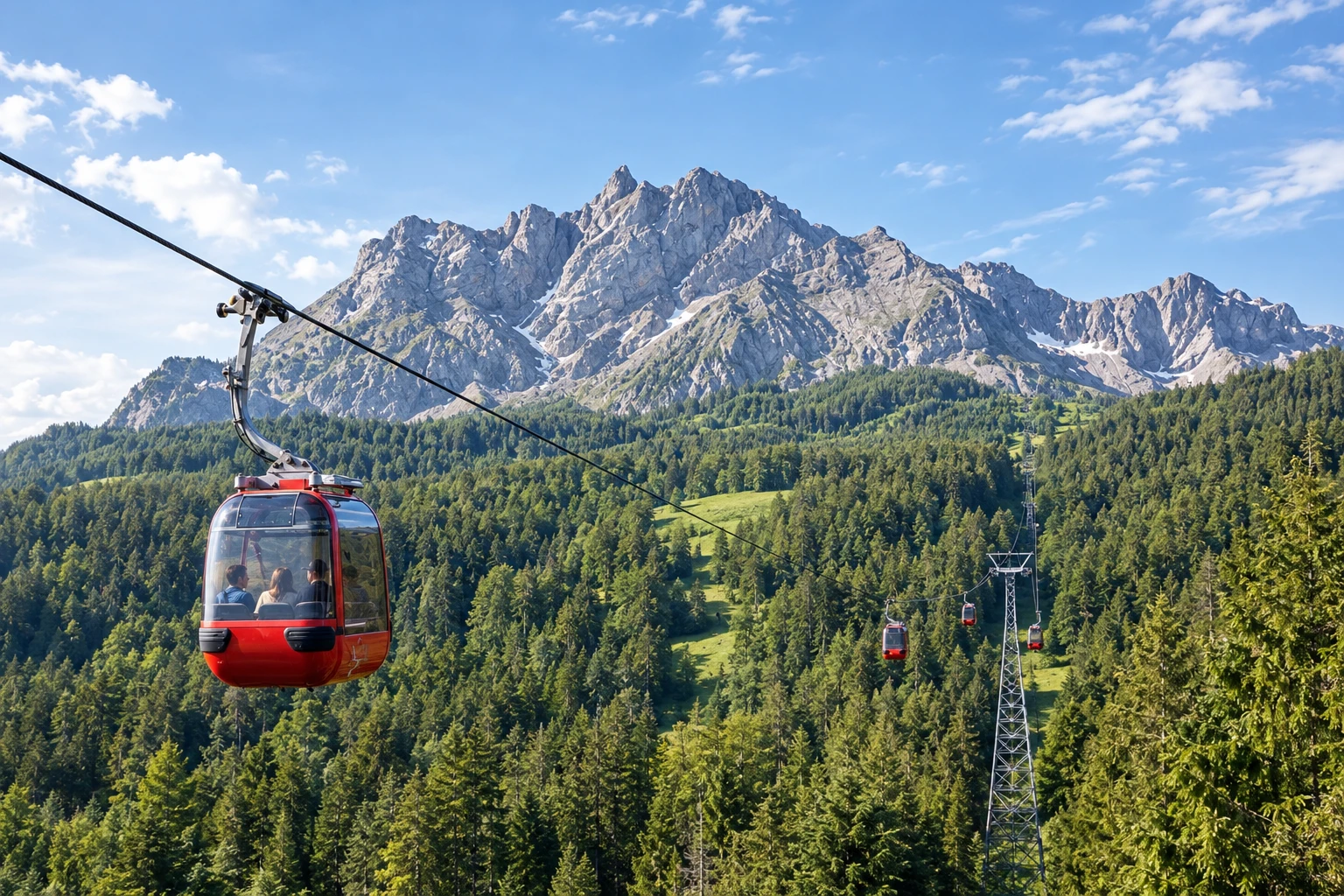
In the photo: Pilatus, Lucerna region

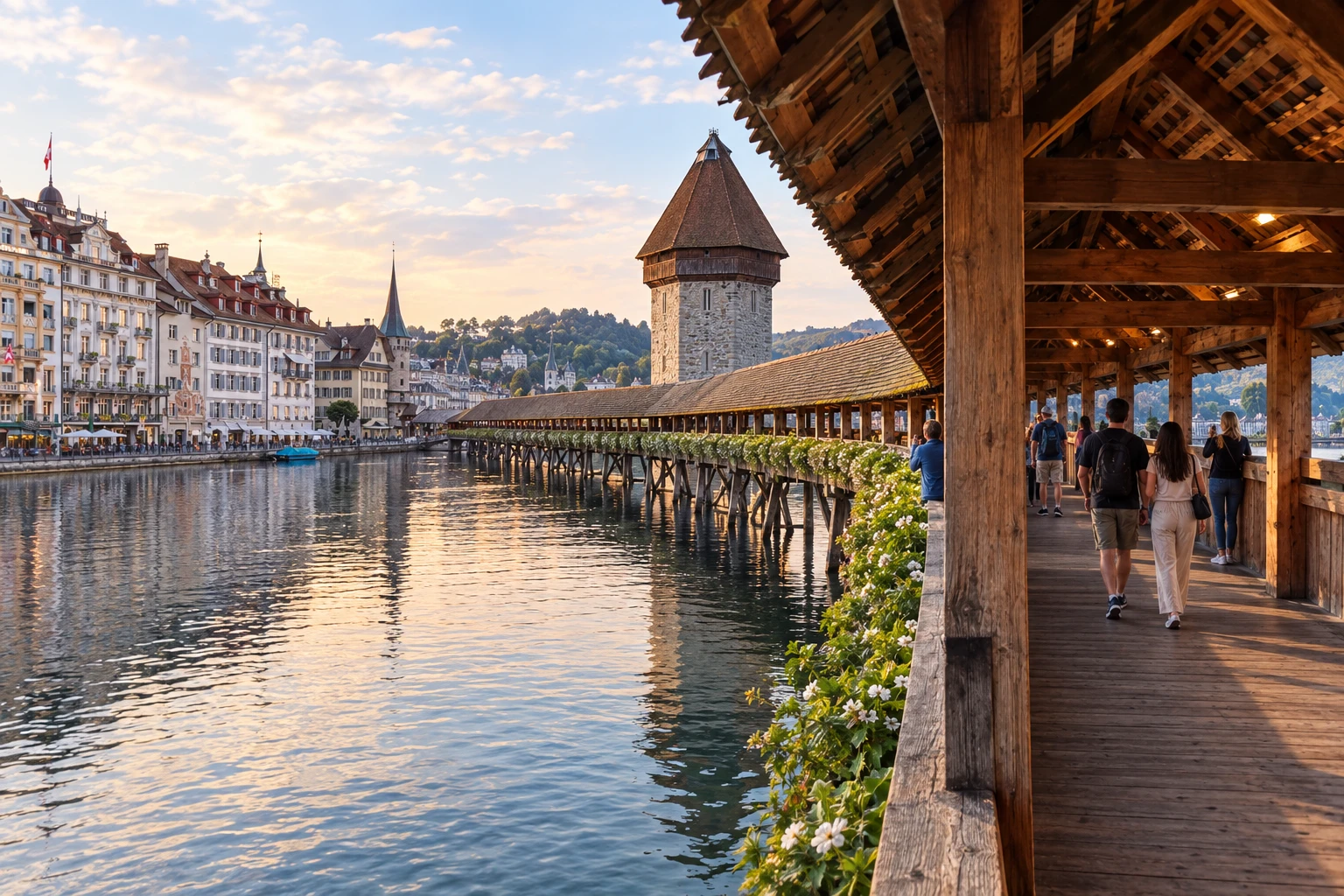
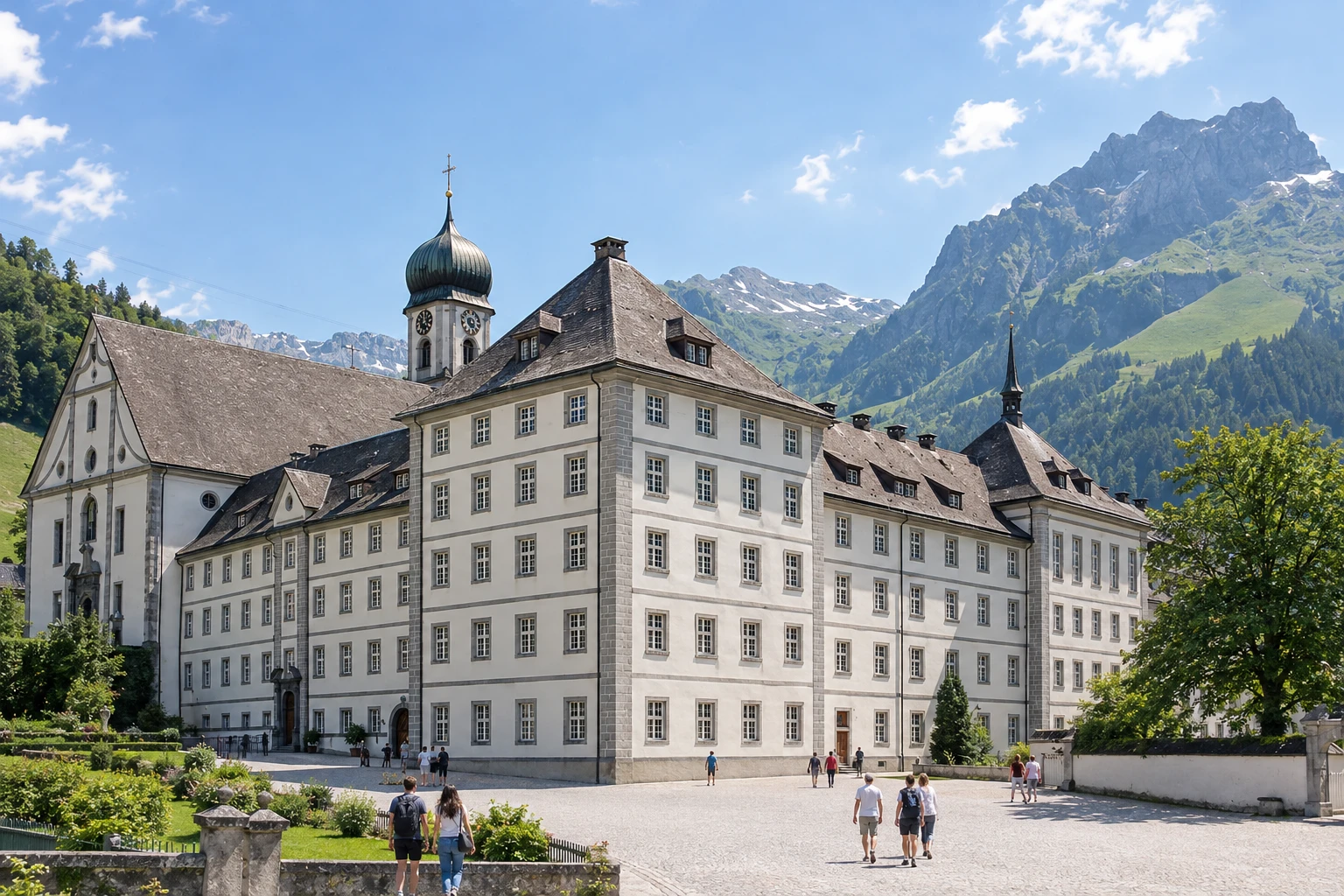
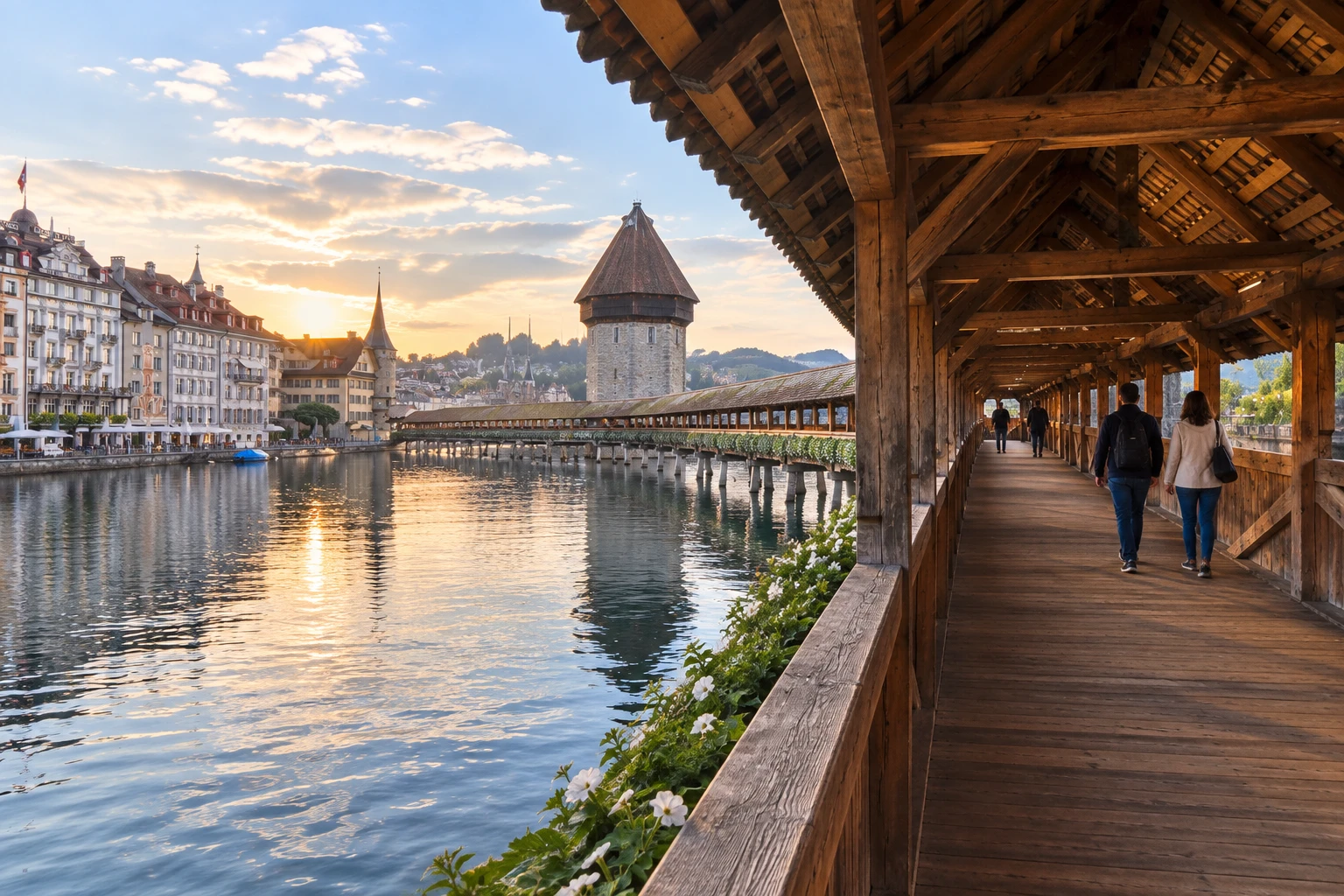
Illustrative images. The pictures in this guide are illustrations based on the real place, not photographs, and may differ from it.

Get it on Google Play

Get to know the place

A region to enjoy
at your own pace.

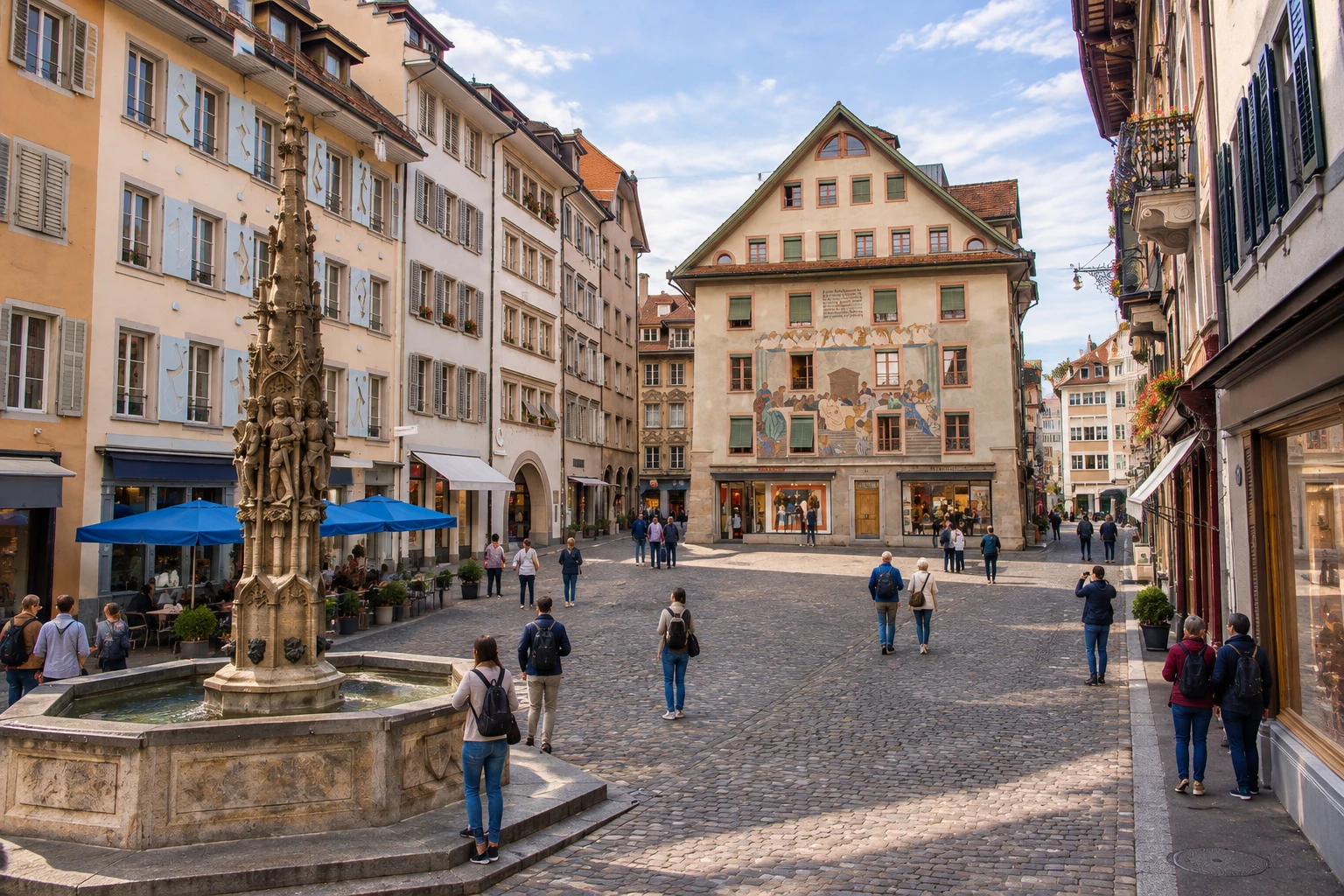
Lucerna is in central Switzerland, at the point where the Reuss River flows out of the Vierwaldstättersee, the Lake of the Four Cantons. The city joined the Swiss Confederation in 1332 and grew as a stop on the Gotthard trade route. The medieval center preserves the Kapellbrücke, the Spreuerbrücke, the Musegg wall and squares with painted façades.

Around the lake rise the mountains that made the region famous as a tourist destination in the 19th century. The Pilatus, to the south, has a cogwheel railway with gradients of up to 48%. The Rigi, on the other side of the lake, received Europe's first mountain railway in 1871. Closer to Stans are the Stanserhorn and the Bürgenstock, with the Hammetschwand elevator.

Engelberg is a mountain village about 45 minutes by train from Lucerna, in a valley of the canton of Obwalden. It grew around a Benedictine monastery founded in 1120 and is the base for ascending the Titlis, which has a year-round glacier, the Cliff Walk and the ice cave. On the other side of the valley are Lake Trübsee and the Brunni area.

German is spoken, and in daily life the Swiss-German dialect; English is widely used in tourism. The currency is the Swiss franc, and Switzerland does not use the euro. The time difference is 4 hours ahead of Brasília in the European winter and 5 hours in the European summer. Lunch is usually in the late morning and dinner starts earlier than in Brazil.

This destination brings together 2 cities: Lucerne, Engelberg.

Share: WhatsApp
Traveler, share your experiences through photos Up to 5 photos of each place you visited.

One destination, many paths

The cities on this trip

Start with one city or combine several in your itinerary.

Where Lucerne and the Mountains is The star marks the capital, Lucerne.
LucerneEngelberg

Outlines: ©swisstopo. Adapted by Cidade Turismo.

How to get there: Lucerne and the Mountains

Aeroporto de Zurique (ZRH), in Zurique · 70 km to Lucerne

The nearest airport is Zurich (ZRH), about 70 km from Lucerna, with a train to the main station. Flights to Brazil usually involve a connection in another city. Confirm before purchasing. From Zurich, Bern and Interlaken there are direct trains to Lucerna; from Lucerna, Zentralbahn trains continue to Engelberg.

Suggested arrival point: Lucerne

The local experience

Things to do in Lucerne and the Mountains

Lucerne · Lucerne · Historic monument

Chapel Bridge

Covered wooden bridge over the river Reuss, built around 1365, with 17th-century paintings on the ceiling and the octagonal Wasserturm tower beside it.

Explore Chapel Bridge

Engelberg · Obwalden · Mountain

Mount Titlis

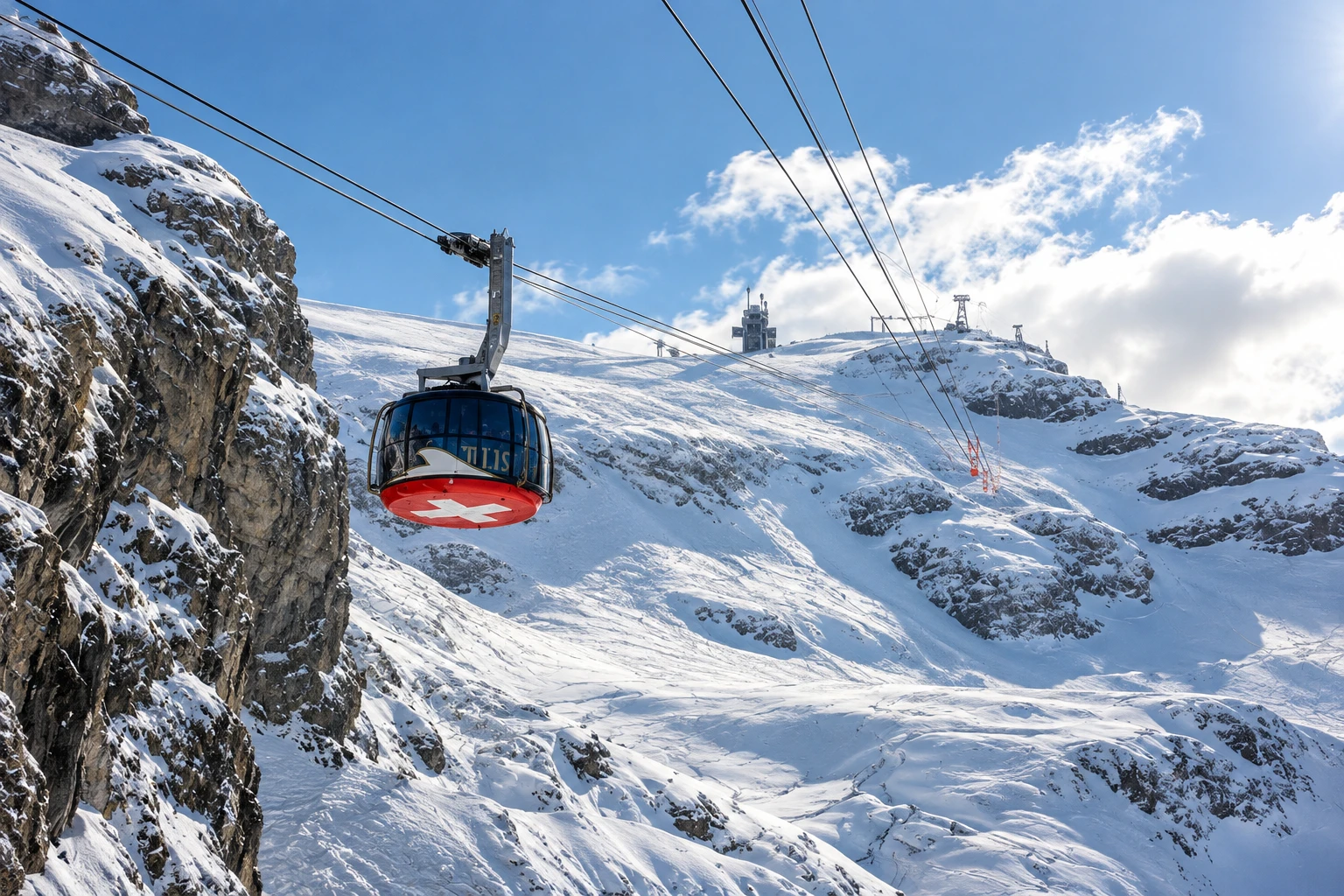
Mountain of 3,238 m above Engelberg, with a year-round glacier, a station at 3,020 m reached by the rotating Titlis Rotair cable car, the Cliff Walk, the Glacier Cave and the Ice Flyer.

Explore Mount Titlis

Lucerne · Lucerne · Historic center

Lucerne Old Town

The medieval centre on the right bank of the Reuss, with the Kornmarkt and the old Rathaus, the Weinmarkt and its 1481 fountain, the Hirschenplatz and streets of painted façades.

Explore Lucerne Old Town

Engelberg · Obwalden · Monastery

Engelberg Abbey

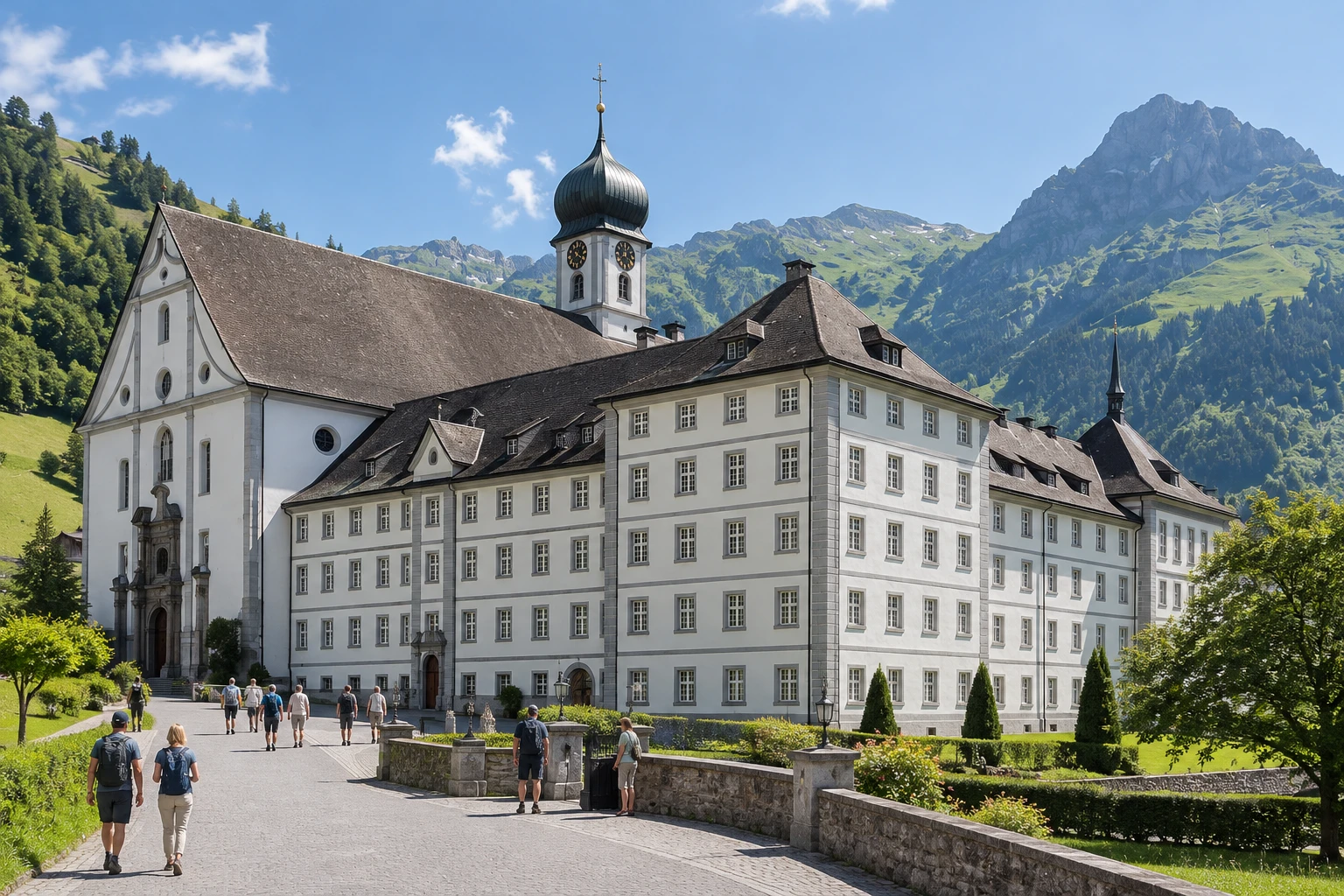
Benedictine monastery founded in 1120, rebuilt after the 1729 fire, with a baroque church, an organ with 137 stops and a cheese dairy open to visitors in the courtyard.

Explore Engelberg Abbey

See 18 more places in Lucerne and the Mountains

To choose before you go

Tours in Lucerne and the Mountains

Where each tour starts, how long it takes, how it is done, what is included and the price range.

Old town of Lucerne: Kapellbrücke, Wasserturm, Spreuerbrücke and the squares of the Altstadt

From Luzern Bahnhof (Lucerne station) On foot about 2 to 3 hours morning or afternoon easy

Lucerne (Luzern) sits where the river Reuss exits the Vierwaldstättersee (Lake of the Four Cantons), and the old town (Altstadt) is walkable from the station. A few minutes from the exit is the Kapellbrücke, a 204 m covered wooden bridge built in the 14th century that crosses the Reuss diagonally. Under the roof, painted panels from the 17th century tell scenes from the history of Lucerne and of Switzerland. A fire in August 1993 destroyed much of the bridge and the panels; it was rebuilt in about eight months, and some burned panels remain visible. Beside it stands the Wasserturm, an octagonal stone tower 34.5 m high, dating from around 1300, which has served as watchpost, archive, treasury and prison; it is not open to visitors. On the other side of the river the narrow streets of the Altstadt begin, with painted facades and the squares Kornmarkt, where the Rathaus (town hall) is, and Weinmarkt. Following the Reuss downstream you reach the Spreuerbrücke, the other covered bridge, slightly smaller, with its south section from 1408. Its panels form the Dance of Death, painted by Caspar Meglinger between 1625 and 1635, and there is a small chapel in the middle of the bridge. From there you can return along the left bank to the station.

Stops: Kapellbrücke, Wasserturm, Altstadt Luzern, Rathaus am Kornmarkt, Weinmarkt, Spreuerbrücke, Reuss.

Includes: The bridges and squares are open to the public and there is no entrance fee. There are paid guided walking tours of the old town; check the current rates.

Tip: Start early to see the Kapellbrücke with fewer people. In the evening the bridges and the Musegg wall are lit, and the walk back along the Reuss is worth doing as a second stroll. The walk pairs well with the Museggmauer, which sits above the old town.

Best time: All year round. From May to September the days are long and there are flowers on the bridges; in winter it gets dark early, in the late afternoon.

Museggmauer: the medieval wall and towers above Lucerne

From Lucerne old town On foot, with uphill sections and stairs about 1 hour morning or afternoon easy to moderate (narrow stairs)

The Museggmauer is the remaining section of Lucerne’s city wall: about 800 m of wall, built around 1400, on the hilltop north of the Altstadt. Of the original towers, nine still stand and are illuminated at night. Four of them can be visited in season: Männliturm, Zytturm, Wachtturm and Schirmerturm. From the top you can see the old town roofs, the Reuss, the lake and, in clear weather, Pilatus and Rigi. The Zytturm, from 1442, has the large clock face visible from the city; its bell strikes the hour one minute before Lucerne’s other clocks, and inside there is a collection of old tower clocks. Walking the wall takes 30 to 45 minutes, and the Zytturm another 15 to 20 minutes. The path along the wall is narrow and has stairs, so it is not accessible for wheelchairs or strollers.

Stops: Museggmauer, Männliturm, Zytturm, Wachtturm, Schirmerturm.

Includes: The wall and the four towers open to visitors are open during the day in season, and there is no admission charge. Guided tours are arranged separately.

Tip: Go up one end of the wall and descend the other so you don’t retrace your steps. Wear sturdy shoes because of the wooden and stone steps.

Best time: The season runs from April 1 to November 1; outside that period the towers are closed.

Löwendenkmal, Gletschergarten and Bourbaki Panorama

From Lucerne city centre (Löwenplatz) On foot or by local bus about 3 hours morning or afternoon easy

Three visits are side by side, about a 10-minute walk from the Altstadt. The Löwendenkmal (Lion Monument) is a wounded lion carved into the rock on a cliff above a small pond, roughly 10 m by 6 m. It commemorates the Swiss guards who died defending King Louis XVI during the attack on the Tuileries Palace in Paris on August 10, 1792. The design is by Danish sculptor Bertel Thorvaldsen, and the monument was unveiled in 1821. The visit takes only a few minutes. Next door is the Gletschergarten (glacier garden), featuring potholes carved into the rock by a glacier about 20,000 years ago. The route goes past the rock formations, a mirror maze, a park with alpine plants, a small museum in the former house of the founding family, and an observation tower with views of the town and the mountains. On the other side of Löwenplatz is the Bourbaki Panorama, a circular painting 112 m long and 10 m high created in 1881. It depicts the arrival in Switzerland in 1871 of about 87,000 French soldiers from General Bourbaki’s army, who sought refuge in the country and were received there.

Stops: Löwendenkmal, Gletschergarten Luzern, Bourbaki Panorama, Löwenplatz.

Includes: The Löwendenkmal is in an open area and admission is free. The Gletschergarten and the Bourbaki Panorama require tickets; check the current schedule/pricing.

Tip: Do the Löwendenkmal early, before the tour groups arrive. Allow about 1½ hours for the Gletschergarten and about 1 hour for the Bourbaki Panorama.

Best time: All year round. The Gletschergarten and the Bourbaki Panorama are good options for rainy days.

Churches of Lucerne: Jesuitenkirche and Hofkirche St. Leodegar

From Center of Lucerne On foot about 1.5 hours morning or afternoon easy

The two most visited churches in Lucerne lie on opposite sides of the center and can be connected on foot along the lake and Reuss shores. The Jesuitenkirche, on the left bank of the Reuss near the Kapellbrücke, was begun in 1666 and consecrated in 1677, inspired by the church of the Gesù in Rome. It is considered the first major Baroque church in Switzerland. The interior features Baroque and Rococo stucco, a high altar, an organ and a treasury; its acoustics also make it a concert venue. The Hofkirche St. Leodegar stands on a small hill near the lake shore, a few minutes' walk from the quay. A monastery existed on the site from the 8th century; the present church was rebuilt after a fire in 1633 and is one of the country's most important Renaissance churches, with two pointed towers. The organ from 1640 now has 7,374 pipes, and the tallest pipe on the façade measures 10.7 m.

Stops: Jesuitenkirche, Hofkirche St. Leodegar, Reuss.

Includes: The churches are places of worship and entrance is not charged. During masses and ceremonies visits are limited.

Tip: Discreet clothing and silence inside churches. Organ concerts are often announced on the door; check the program.

Best time: Year-round.

Verkehrshaus der Schweiz: the Swiss Museum of Transport

From Luzern Bahnhof Train S3, bus 6, 8 or 24, or boat from 3 hours to a full day full day easy

The Verkehrshaus der Schweiz is Switzerland’s transport museum, on the lakeshore east of the town center. There are about 20,000 m² of exhibition space divided into areas: rail transport, road transport, aviation and space, navigation, cable cars and tourism, energy and media, plus an outdoor area with aircraft, historic locomotives and playgrounds. The visit is interactive: you can pilot a helicopter simulator, change the tire of a Formula 1 car and go inside a submarine. There are also three attractions with separate admission: the planetarium, with sessions of about 45 minutes; the cinema, with Switzerland’s largest fixed screen; and the Swiss Chocolate Adventure, a ride through the history of Swiss chocolate in a small vehicle. On the same site is the Hans Erni Museum, dedicated to the Swiss painter. From Luzern station, the S3 train reaches Luzern Verkehrshaus stop in about 8 minutes, and buses 6, 8 and 24 take around 10 minutes. The boat calls at the Verkehrshaus-Lido pier, and it’s about a 30-minute walk along the lakeside.

Stops: Verkehrshaus der Schweiz, Planetarium, Swiss Chocolate Adventure, Hans Erni Museum.

Includes: There is a ticket for the museum and separate tickets for the planetarium, the cinema and the Swiss Chocolate Adventure; there is also a day ticket that combines the attractions. Check the current schedule.

Tip: The museum itself suggests 2 to 3 hours for a short visit and 6 hours or more to see everything. It’s a good option for a rainy day and for families with children.

Best time: All year round; on rainy days and during European school holidays visitor numbers increase.

KKL Luzern and Sammlung Rosengart: architecture and modern art near the station

From Luzern Bahnhof On foot about 3 hours morning or afternoon easy

Next to the station, on the lakefront, is the KKL Luzern (Culture and Convention Centre), designed by French architect Jean Nouvel. The concert hall opened in 1998 and the whole building in 2000. The hall seats 1,898 and its acoustics were designed for classical music by American acoustician Russell Johnson. The most striking exterior feature is the roof: a 113 m by 107 m canopy that cantilevers 45 m over the square and the lake without supports. On the station side is the Kunstmuseum Luzern, an art museum with temporary exhibitions. The KKL is home to the Lucerne Festival, which typically takes place at the end of summer, from mid‑August to mid‑September. A few minutes’ walk from the station is the Sammlung Rosengart, a private collection open to the public with works by Pablo Picasso and Paul Klee and about 25 other impressionist and modern artists, including Monet, Cézanne, Matisse, Chagall and Miró. Visiting the collection takes about 1 to 2 hours.

Stops: KKL Luzern, Kunstmuseum Luzern, Sammlung Rosengart, Europaplatz.

Includes: Strolling around the square and under the KKL roof is free. There are tickets for the Kunstmuseum Luzern, the Sammlung Rosengart, guided tours of the KKL and the concerts; check the current schedule.

Tip: To see the concert hall interior without attending a concert, look for guided tours of the building. Tickets for the Lucerne Festival often sell out early.

Best time: All year. From mid‑August to mid‑September is the Lucerne Festival season.

See 10 more tours

Boat on the Vierwaldstättersee: paddle steamers and the lakeside villages

From Luzern Bahnhofquai (pier in front of the station) Scheduled lake boat (SGV) from 1 hour to about 6 hours round trip morning or afternoon easy

The Vierwaldstättersee (Lake of the Four Cantons) is bordered by the cantons of Luzern, Uri, Schwyz and Unterwalden and has arms that extend between mountains. Scheduled boats depart from the pier in front of the Luzern station and operate as transport: they call at villages and mountain railway stations. The fleet includes 20 vessels, among them five historic paddle steamers: Uri, Unterwalden, Schiller, Gallia and Stadt Luzern. The most common legs are: Luzern–Weggis, about 40 minutes; Luzern–Vitznau, about 1 hour, where the Rigi railway departs; Luzern–Alpnachstad, about 1 h 10 min to 1 h 30 min, where the Pilatus railway starts; and Luzern–Kehrsiten‑Bürgenstock, about 25 minutes. The full trip to Flüelen, at the head of the lake, takes about 2 h 45 min and passes Brunnen and the Urnersee, the narrowest arm, with rock faces and places linked to Swiss history. To return without repeating the same route, you can take the train from Flüelen or Brunnen back to Luzern.

Stops: Vierwaldstättersee, Weggis, Vitznau, Brunnen, Flüelen, Urnersee.

Includes: Single-ride boat ticket or transport pass; the Swiss Travel Pass and the Tell Pass are valid on scheduled lake boats. Onboard restaurant paid separately. Check the current fare table.

Tip: To ride a paddle steamer, check the timetable to see which departures use them. The boat trip pairs well with Pilatus or Rigi on the same day.

Best time: The boats operate year‑round; the winter timetable runs from mid‑October to mid‑April with fewer departures. The paddle steamers run mainly from spring until mid‑October.

Pilatus via the Golden Round Trip: boat, rack railway and cableways

From Lucerne Bahnhofquai (quay 2) Boat, rack railway, aerial cableway and bus about 5 to 6 hours full day easy (elevation 2,132 m)

Pilatus is the mountain you see from Lucerne to the southwest, with the Pilatus Kulm viewpoint at 2,132 m. The Golden Round Trip is the complete circuit, done in one day in either direction. Clockwise, you depart by boat from quay 2, in front of the station, to Alpnachstad, about 1 hour 10 minutes to 1 hour 30 minutes across the lake. An underground passage links the quay to the rack‑railway station, considered the steepest in the world: maximum gradient 48%, operating since 1889. The ascent takes about 27 minutes and gains 1,635 m of elevation. At the top, besides viewpoints, there are a restaurant, a hotel and the Drachenweg (Dragon Path), a roughly 20‑minute loop among rock formations that starts at the end of the panorama gallery. A short trail leads to the Tomlishorn, at 2,128 m. The descent is on the other side: the Dragon Ride cable car to Fräkmüntegg, where in summer there is a ropes park and a summer toboggan, and the panoramic gondola to Kriens. From Kriens station it is 5–10 minutes on foot to the bus 1 stop, which returns to Lucerne center. If you prefer train, you can replace the boat with Lucerne’s S5 line to Alpnachstad, about 16 minutes.

Stops: Pilatus, Pilatus Kulm, Alpnachstad, Fräkmüntegg, Kriens, Drachenweg, Tomlishorn, Vierwaldstättersee.

Includes: The Golden Round Trip ticket includes the boat, rack railway, cableway, gondola and the Kriens–Lucerne bus; holders of a Swiss Travel Pass pay only the mountain sections at a reduced rate. Meals are extra. Check the current timetable.

Tip: Reserve a seat on the rack railway on fine-weather days so you don’t queue. Check the weather at the summit before you leave: low clouds mean no views. Bring a jacket: at the summit it’s about 10 °C colder than in Lucerne.

Best time: The Golden Round Trip season runs from May to October. In winter you ascend only from the Kriens side; the cableways often close for maintenance from late October to late November.

Rigi: Europe’s first mountain railway and the view over three lakes

From Lucerne Bahnhofquai or Luzern Bahnhof Boat to Vitznau and rack railway about 5 to 6 hours full day easy (elevation 1,797 m)

The Rigi is a massif almost entirely surrounded by water: the Vierwaldstättersee, the Zugersee and the Lauerzersee. The highest point is Rigi Kulm, at 1,797 m. On May 21, 1871 the Vitznau rack railway began operating, the first mountain railway in Europe; today there are nine trains and cable cars on the mountain. The most common circuit from Lucerne: boat to Vitznau, about 1 hour; rack railway to Rigi Kulm, about 30 minutes; descent on foot or by train to Rigi Kaltbad, where there is a mineral water spa; cable car to Weggis; and boat back to Lucerne, about 40 minutes. On the summit there are viewpoints, restaurants and several easy routes between the Kulm, the Staffel and Kaltbad. The other ascent is from the Arth‑Goldau side: train from Lucerne to Arth‑Goldau, about 30 minutes, and rack railway to the Kulm, about 40 minutes. You can ascend on one side and descend the other. In winter there are sled runs and sleds to rent at Rigi Kulm, without reservation.

Stops: Rigi, Rigi Kulm, Rigi Kaltbad, Vitznau, Weggis, Arth‑Goldau, Vierwaldstättersee.

Includes: There is a day ticket for the Rigi trains and cable cars and round‑trip tickets that include the boat; the Swiss Travel Pass is valid on Rigi trains. The Kaltbad spa and meals are paid separately. Check the current fares table.

Tip: Go up early to catch the view before the afternoon clouds. On selected dates there are trips on historic steam trains; check the timetable.

Best time: The Vitznau train runs year‑round, with winter and summer timetables. The sledging season usually runs from December to March, depending on snow.

Stanserhorn: 1893 funicular and the open‑roof CabriO cable car

From Luzern Bahnhof Train to Stans, funicular and cable car about 4 hours morning or afternoon easy (elevation 1,898 m)

The Stanserhorn, at 1,898 m, lies south of the lake in the canton of Nidwalden. From Luzern, the train reaches Stans in 14 to 21 minutes, and the funicular station is close to the train station. The ascent has two parts. First, the 1893 funicular, with restored wooden carriages, climbs in about 10 minutes to Kälti. There you transfer to the CabriO, a two-level cable car opened in 2012, with the upper level open to the sky: 30 of the 60 passengers travel outdoors, and the climb takes under 10 minutes. Altogether, about 25 minutes from Stans. At the top there is a revolving restaurant and a roughly 30-minute trail around the summit, with marmots nearby. The view covers about 100 km of the Alpine range and ten Swiss lakes. In part of the summer there are evening trips on some weekdays.

Stops: Stanserhorn, Stans, Kälti, CabriO, Vierwaldstättersee.

Includes: Round‑trip ticket for the funicular and the CabriO; meals are paid separately. Check the current fares table.

Tip: The CabriO’s open‑top cabin carries 30 people per trip; on busy days you may need to wait for the next cabin to ride on top. Summit trails close in poor weather; bring warm clothing.

Best time: The season usually runs from mid‑April to mid or late November; it does not operate in winter.

Bürgenstock: funicular, Felsenweg and the Hammetschwand-Lift

From Luzern Bahnhofquai Boat to Kehrsiten-Bürgenstock and funicular about 4 hours morning or afternoon easy (exposed sections)

The Bürgenstock is a ridge above the lake, opposite Luzern. The boat takes about 25 minutes from Luzern to the Kehrsiten-Bürgenstock pier, where a steep funicular climbs to the top near the hotel complex. From there the Felsenweg (rock path) departs — a roughly 2.2 km trail, generally flat, partly cut into the rock over the lake, which takes about 1 hour to reach the Hammetschwand-Lift. The lift, dating from 1905, is a metal structure attached to the cliff that gains 153 m in under a minute to the Hammetschwand, at 1,132 m, the highest point above Luzern. From the viewpoint you can see the lake, Luzern, the Pilatus and the Rigi. Return can be the same way, on foot and by funicular, to the boat; another option is to descend by bus and return by train.

Stops: Bürgenstock, Kehrsiten-Bürgenstock, Felsenweg, Hammetschwand-Lift, Hammetschwand.

Includes: The summit viewpoint is free; the lift has its own ticket sold on site. The boat and the funicular are paid separately. Check the current fare table.

Tip: Sturdy footwear: the Felsenweg has stretches with exposed edges and is not suitable for a stroller. The lift does not operate in bad weather; check before you go.

Best time: The lift operates from April to November; the Felsenweg is closed in winter.

Titlis: Rotair, Cliff Walk, glacier grotto and Ice Flyer at 3,020 m

From Engelberg (or Luzern, by train) Train to Engelberg and cable cars about 4 to 5 hours from Engelberg full day easy (altitude 3,020 m)

Titlis is the glacier mountain above Engelberg in the canton of Obwalden. The peak reaches 3,238 m, and the upper station, where the attractions are, is at 3,020 m. From Luzern, the train reaches Engelberg in about 45 minutes. The ascent from Engelberg takes around 30 minutes, in three stages: the TITLIS Xpress gondolas to Trübsee, at about 1,800 m, and to Stand, at 2,428 m; and the TITLIS Rotair, from 1992, the world’s first rotating cable car, which makes a full rotation in about 5 minutes to the summit. Up there, the Titlis Cliff Walk is a 100 m suspension bridge at 3,041 m, over a span of roughly 500 m, crossed in about 150 steps. The Gletschergrotte (glacier grotto) is an illuminated corridor about 10 m below the ice surface. The Ice Flyer is a chairlift that passes over crevasses up to 20 m deep: in summer it leads to the Gletscherpark, a snow area with tubes and sleds; in winter it serves the ski slopes. The summit usually has snow year-round, and it can be cold even in July.

Stops: Titlis, Engelberg, Trübsee, Stand, TITLIS Rotair, Titlis Cliff Walk, Gletschergrotte, Ice Flyer, Gletscherpark.

Includes: The round-trip ticket from Engelberg to Titlis includes the Rotair, the Cliff Walk and the glacier grotto; the Ice Flyer and activities at the Gletscherpark are paid separately. Meals are extra. Check the current timetable/pricing.

Tip: Bring a jacket, hat, sunglasses and sunscreen, even in summer. During construction phases at the upper station, the final ascent may be made in a cabin that does not rotate and internal routes may change; check in advance. The cable cars usually close for about two weeks in November for maintenance.

Best time: Operates year-round, with a maintenance closure in November. The glacier slopes usually have snow from October to May; from June to September, the summit is typically the only place on the route with snow.

Trübsee and Engelberg hikes: alpine lake, Jochpass and the Vier-Seen-Wanderung

From Engelberg TITLIS Xpress gondola and walking trails from 2 hours to a full day full day easy to moderate (about 1,800 m)

Trübsee is the alpine lake amid the ascent to Titlis, at about 1,800 m, with the glacier above. You reach it by the TITLIS Xpress gondola from Engelberg. The walk around the lake is flat and even suitable for a stroller, with four barbecue spots along the way and a playground near the station. From Trübsee, a chairlift rises to the Jochpass, the starting point for two well-known hikes. The marmot trail descends past Engstlensee to Engstlenalp. The Vier-Seen-Wanderung (four-lake hike) is the longest crossing, a full-day route: Engelberg or Trübsee, Jochpass, Engstlensee, Tannalp and Melchsee-Frutt, from where you return by cable car and bus. Along the glacier slope there is also the alpine cheese trail, with cheese farms such as Gerschnialp, which can be done in stages.

Stops: Trübsee, Jochpass, Engstlensee, Engstlenalp, Tannalp, Melchsee-Frutt, Engelberg.

Includes: The gondola and the chairlift are paid separately; there are day tickets for the trails. Check the current pricing.

Tip: For the Vier-Seen-Wanderung, start early, bring water, a snack and a rain jacket, and check the time of the last transport at Melchsee-Frutt. Hiking boots help on rocky sections.

Best time: The hiking season runs from June to October; the Jochpass chairlift usually operates from late June to late October.

Brunni: Engelberg’s sunny side, Härzlisee and the barefoot trail

From Engelberg Cable car to Ristis and chairlift about 4 hours morning or afternoon easy (about 1,860 m)

Brunni is on the north slope of the valley, facing the Titlis, and gets sun for most of the day. It is Engelberg’s calmest mountain outing and very popular with families. From the valley a cable car rises in about 3 minutes to Ristis, at roughly 1,600 m. There is a playground, a small rope park and a 660 m summer toboggan run. From Ristis a chair lift goes up to the Brunnihütte, a mountain hut at about 1,860 m next to the small Härzlisee. Around the lake there is a barefoot trail of about 220 m with wood chips, small stones, sand and water. The descent from Brunnihütte to Ristis can be done on foot, along trails taking about 1 to 1½ hours. Those fit enough can hike up from Engelberg in about 2½ hours. In winter, Brunni has a sled run, skiing, snowshoe trails and night skiing.

Stops: Brunni, Ristis, Brunnihütte, Härzlisee, Engelberg.

Includes: Cable car and chairlift require separate tickets, available one‑way or return. Meals at the Brunnihütte are paid separately. Check the current fare table.

Tip: Good for a day when weather is closed in on Titlis or for travelers with children. Bring a small towel for the barefoot trail.

Best time: The barefoot trail is open from June to October. The cableways typically close for maintenance from early April to early May; confirm.

Kloster Engelberg: the Benedictine monastery of the valley

From Engelberg centre On foot about 1 to 2 hours morning or afternoon easy

Kloster Engelberg is a Benedictine monastery founded in 1120 that gave rise to the village. Until the late 18th century, the abbot was both the spiritual authority and the ruler of the valley. Almost the entire complex burned in a fire in 1729; the current buildings date from 1730 to 1737, in the Baroque style, and are a few minutes’ walk from the station. The monastery church, the Klosterkirche, Baroque in style, can be visited outside mass times. The monks still run a school, a woodworking shop and other activities. On guided tours of the monastery, led by members of the community, they present the abbey’s history and Benedictine routine, showing rooms that are not open to the public except during those tours.

Stops: Kloster Engelberg, Klosterkirche Engelberg, Engelberg.

Includes: The church is an active place of worship and entry is free. Guided tours of the monastery are arranged separately and require a ticket; check the current schedule.

Tip: A good option for late afternoon, after Titlis or Brunni, or for a day with poor mountain weather. Respect prayer times.

Best time: All year.

Luzern–Interlaken Express: the scenic train over the Brünig pass

From Luzern Bahnhof Scenic train (Zentralbahn) about 1 hour 50 minutes per leg morning or afternoon easy

The Luzern–Interlaken Express links Lucerne to Interlaken Ost in the Berner Oberland over 74 km in about 1 hour 50 minutes, with hourly departures. The carriages have large windows. The train leaves Lucerne along the lake shore, passes Alpnachstad at the foot of Pilatus, and continues through the Obwalden valley with five lakes along the way, including Sarnersee and Lungerersee. Shortly before the climb to the Brünig pass at 1,008 m, the train uses a rack section to overcome the steep curves. On the other side it descends to Meiringen and Brienz and runs alongside the Brienzersee to Interlaken. It can be done as a day return with time in Interlaken, or as a transfer between Lucerne and the Jungfrau region.

Stops: Lucerne, Brünigpass, Lungern, Brienzersee, Interlaken Ost.

Includes: Standard train ticket; the Swiss Travel Pass is valid. Seat reservations are not mandatory and are paid separately. Check the current schedule/pricing.

Tip: When leaving Lucerne, sit on the left side to see the lake and Pilatus. In summer, reserving a seat prevents you from being separated from your travel companions.

Best time: All year round; in summer the lakes and green pastures, and in winter the snow on the Brünig pass.


Day by day

3, 5 and 7-day itinerary in Lucerne and the Mountains

Suggestions to plan the trip. Change the order of the days according to the weather and tour availability.

3 days · Luzern in 3 days: old town, lake and Pilatus

For If you arrive from Brazil and have little time, and want the city, a boat trip and a mountain. · Based in Luzern (Lucerne)
  1. Day 1 · Arrival and old town

    The overnight flight from Brazil arrives in the morning at Zürich. From the airport station (Zürich Flughafen), the train takes about 1 hour and 10 minutes to Luzern, usually direct. Drop off your luggage and visit Luzern’s old town: Kapellbrücke, Wasserturm, the Altstadt squares and the Spreuerbrücke. In the late afternoon, if it’s April to October, go up to the Museggmauer. Turn in early because of the time difference.

  2. Day 2 · Pilatus via the Golden Round Trip

    Leave early by boat to Alpnachstad and take the cogwheel train up to Pilatus Kulm, at 2,132 m. Do the Drachenweg, descend by cable cars to Kriens and return by bus. From November to April, substitute Rigi, which operates year-round. At the end of the day, the Löwendenkmal remains open.

  3. Day 3 · Museums and lake

    Morning at the Gletschergarten and the Bourbaki Panorama, next to the Löwendenkmal, or at the Verkehrshaus der Schweiz if there are children. In the afternoon, a short boat trip on the Vierwaldstättersee to Weggis and back, or a visit to the Sammlung Rosengart and the KKL Luzern near the station. For the return flight from Zürich, allow about 1 hour and 10 minutes by train to the airport.

5 days · Luzern and the mountains in 5 days
For For those who want the city and two or three mountains, including Titlis snow in summer. · Based in Luzern (Lucerne)
  1. Day 1 · Arrival and old town

    Arrival in the morning at Zürich and a train of about 1 hour and 10 minutes to Luzern. In the afternoon, Luzern’s old town: Kapellbrücke, Spreuerbrücke and the squares. In season, Museggmauer at the end of the day.

  2. Day 2 · Pilatus

    Golden Round Trip: boat to Alpnachstad, cogwheel train to Pilatus Kulm at 2,132 m, cable cars to Kriens and bus back. The season runs from May to October; outside that, ascend via the Kriens side. In the evening, walk along the lakeside to the KKL Luzern.

  3. Day 3 · Titlis and Engelberg

    About a 45-minute train to Engelberg. Take the lift up to Titlis at 3,020 m: Rotair, Cliff Walk, the ice cave and, in summer, the Ice Flyer to the Gletscherpark. On the way down, stop at Trübsee to walk around the lake. If time allows, visit Kloster Engelberg before the return train.

  4. Day 4 · Rigi and the lake

    Boat to Vitznau, cog the rack railway up to Rigi Kulm at 1,797 m, descend to Rigi Kaltbad, take the cable car to Weggis and return by boat. In summer there is time for a short hike between the Kulm and Kaltbad.

  5. Day 5 · Museums and departure

    Morning at the Löwendenkmal, the Gletschergarten or the Verkehrshaus der Schweiz. After lunch, train to Zürich Airport, about 1 hour 10 minutes.

7 days · Lucerne and the mountains in 7 days, with two nights in Engelberg
For For those who want to explore the region at a relaxed pace, with hikes in summer or snow in winter, and include the Brünig panoramic train. · Based in Luzern (5 nights) and Engelberg (2 nights)
  1. Day 1 · Arrival and old town

    Arrival in the morning at Zürich and a train of about 1 hour and 10 minutes to Luzern. In the afternoon, Luzern’s old town with Kapellbrücke and Spreuerbrücke, and the churches: Jesuitenkirche and Hofkirche St. Leodegar.

  2. Day 2 · Pilatus

    Golden Round Trip from May to October: boat, cogwheel train, Pilatus Kulm and the Drachenweg, cable cars to Kriens and bus back. In the late afternoon, Museggmauer, April to October.

  3. Day 3 · Lucerne museums

    Morning at the Verkehrshaus der Schweiz, traveling by boat to the Verkehrshaus-Lido pier. In the afternoon, Löwendenkmal, Gletschergarten and Bourbaki Panorama, or Sammlung Rosengart and KKL Luzern.

  4. Day 4 · Boat, Bürgenstock and Stanserhorn

    Boat to Kehrsiten-Bürgenstock, funicular and the Felsenweg to the Hammetschwand Lift, April to November. In the afternoon take the train to Stans and ride up the Stanserhorn by funicular and the CabriO, mid-April to November. Outside those seasons, take the boat to Flüelen and return by train.

  5. Day 5 · Engelberg and Titlis

    About a 45-minute train to Engelberg with luggage. Take the lift up to Titlis at 3,020 m: Rotair, Cliff Walk, ice cave and Ice Flyer. On the way down, return to Trübsee. Late afternoon at Kloster Engelberg.

  6. Day 6 · Brunni or the four-lakes hike

    In summer, a hiking day: Vier-Seen-Wanderung starting from Trübsee and Jochpass, late June to October, or the quieter Brunni with the Härzlisee. In winter, ski on Titlis or use the sled run at Brunni. Second night in Engelberg.

  7. Day 7 · Departure

    Train from Engelberg to Zürich Airport, about 2 hours with a change in Lucerne. Travelers continuing through Switzerland can go to Lucerne and take the Luzern–Interlaken Express, about 1 hour 50 minutes to Interlaken Ost.

Best time to go

When to go: Lucerne and the Mountains month by month

From June to September, the European summer, all trains and cable cars usually operate and the days are long. May and October have fewer visitors, but some ascents close for maintenance. From December to March it is cold, the days are short and Engelberg becomes a ski resort. At altitude, the weather changes quickly: check operating status before going up.

The seasons shown are the most usual ones; nature doesn't always follow the calendar.

January Low rain

winter and snow · mountains for skiing

Coldest month. Normals 1991–2020 in Luzern: average 1 °C, high 4 °C, low −2 °C, 56 mm of precipitation. In Engelberg, average −2 °C and frequent snow. Titlis and Brunni slopes usually have snow; Rigi offers sledging. The Pilatus rack railway and the Stanserhorn do not operate. Boats run on their winter timetable. Short days: it gets dark in the late afternoon.

February Low rain

Lucerne Carnival · snow on the slopes

Normals in Luzern: average 2 °C, high 6 °C, low −2 °C, 61 mm. In Engelberg, average −1 °C. Fasnacht, Lucerne’s carnival, usually falls in February (sometimes early March), from the Thursday before Ash Wednesday until Shrove Tuesday, with street bands and parades: the city fills up. Snow is common on the Titlis and Brunni slopes.

March Low rain

end of winter · quiet city

Normals in Luzern: average 6 °C, high 11 °C, low 2 °C, 75 mm. In Engelberg, average 3 °C. The ski season continues on Titlis and usually ends on Brunni and Rigi. The Pilatus rack railway and Stanserhorn still do not operate. Good month for museums, such as the Verkehrshaus and the Sammlung Rosengart.

April Some rain

spring · Museggmauer opens

Normals in Luzern: average 10 °C, high 15 °C, low 5 °C, 97 mm. In Engelberg, average 6 °C. Spring in the valley, snow up high. The Museggmauer opens on April 1; Stanserhorn usually opens in mid-April and the Hammetschwand Lift in April. Brunni often closes for maintenance. Easter holidays bring increased activity.

May High rain

mountain season begins · green valley

Normals in Luzern: average 14 °C, high 19 °C, low 9 °C, 149 mm, with frequent rain. In Engelberg, average 10 °C. In May the Pilatus rack railway and the Golden Round Trip season usually begin, and Brunni reopens for summer. The lake steamers return. High on Titlis it is still winter.

June High rain

long days · trails open

Normals in Luzern: average 18 °C, high 23 °C, low 13 °C, 165 mm; afternoon showers are common. In Engelberg, average 14 °C. Days of about 16 hours of daylight. The hiking season starts in June, and the Jochpass cable car usually opens at the end of the month. Brunni’s barefoot trail is open.

July High rain

high season · lake and trails

Warmest month. Normals in Luzern: average 20 °C, high 25 °C, low 15 °C, 166 mm, with afternoon thunderstorms. In Engelberg, average 15 °C; on Pilatus, around 10 °C. All mountain railways, boats and trails operating. European school holidays: queues at Pilatus and Titlis; book ahead and depart early.

August High rain

August 1 · Lucerne Festival

Normals in Luzern: average 19 °C, high 24 °C, low 14 °C, 170 mm, the rainiest month. In Engelberg, average 15 °C. On August 1, the national holiday, there are celebrations and fireworks in the towns. The Lucerne Festival usually begins mid-month at the KKL. European holidays: very busy.

September Some rain

end of summer · fewer people

Normals in Luzern: average 15 °C, high 20 °C, low 11 °C, 109 mm. In Engelberg, average 11 °C. More stable weather and fewer people after the holidays. Mountain railways and trails operating. The Lucerne Festival often runs until mid-month. Some lake steamers end their season at the end of the month.

October Some rain

autumn colours · end of season

Averages in Lucerne: mean 10 °C, high 14 °C, low 7 °C, 88 mm; morning fog on the lake is common, with sun above it. In Engelberg the mean is 8 °C. The Golden Round Trip runs until October, and the Jochpass cable car usually closes at the end of the month. Boats switch to winter timetable in mid-October.

November Low rain

low season · maintenance

Averages in Lucerne: mean 5 °C, high 8 °C, low 2 °C, 78 mm. In Engelberg the mean is 3 °C. Maintenance month: the Pilatus and Titlis cable cars often stop for part of the month, and the Museggmauer closes on November 1. The Stanserhorn usually closes in mid or late month. Good for museums and a quiet city.

December Some rain

Christmas · start of the ski season

Normals in Luzern: average 2 °C, high 5 °C, low −1 °C, 78 mm. In Engelberg, average −1 °C. Short days. The ski season usually starts on Titlis, Brunni and Rigi, depending on snow. Boats offer Christmas and New Year cruises on the lake. Year-end holidays make Engelberg very busy.

Plan the journey

How to get there: Lucerne and the Mountains

From Brazil by plane

There is a direct flight from São Paulo (Guarulhos) to Zürich (ZRH). From other Brazilian cities the trip involves a connection in another European city; to Geneva (GVA) also with a connection in another European city. Confirm before buying. For Lucerne, Zürich airport is the closest: from the airport station (Zürich Flughafen) the train takes about 1 hour 10 minutes to Lucerne, often direct or with a change at Zürich HB. From Genève-Aéroport it is about 3 hours 15 minutes by train. To reach Engelberg allow about 2 hours by train from Zürich airport, with a change in Lucerne.

By train (SBB/CFF/FFS) from Zürich, Genève and other cities

The train is the main way to arrive and get around. From Zürich HB (Zürich main station) to Lucerne takes about 40–50 minutes, direct. From Genève (Geneva) about 3 hours, direct or with changes in Renens and Olten. From Bern and from Basel about 1 hour, direct. From Lucerne to Engelberg the Zentralbahn train takes about 45 minutes, direct; from Lucerne to Stans 14–21 minutes; to Alpnachstad about 16 minutes; to Arth-Goldau about 30 minutes. There are tourist travel passes valid on trains, buses and boats that give discounts on many mountain railways.

Panoramic and mountain trains

The Luzern–Interlaken Express links Lucerne to Interlaken Ost via the Brünig Pass, at 1,008 m, in about 1 hour 50 minutes, hourly; seat reservation is not mandatory. Regional mountain railways: the Pilatus rack railway from Alpnachstad to Pilatus Kulm (2,132 m), operating May to October, with seat reservation recommended on fine-weather days; the Rigi rack railways from Vitznau and from Arth-Goldau to Rigi Kulm (1,797 m), year-round; the Stanserhorn funicular and CabriO (1,898 m), mid-April to November; and the Titlis cable cars (3,020 m), departing from Engelberg.

By car

From Zürich you follow the A4 and A14 to Lucerne, about 1 hour; from Basel via the A2. The A2 continues south from Lucerne toward the Gotthard tunnel and passes Stans; for Engelberg leave the A2 at Stans-Süd and follow about 20 km on the valley road, open year-round, which ends in Engelberg (about 30 minutes from Lucerne). The A8 links Lucerne to Sarnen and the Brünig Pass toward Interlaken. The motorway vignette is mandatory on Swiss highways. Parking in central Lucerne is difficult; a car is of limited use for regional outings, which are done by train, boat and cable car.

How to get around Lucerne and Engelberg

Lucerne city center is walked on foot: the station, the KKL, the Kapellbrücke and the Altstadt are a few minutes from each other. Urban buses go to the Verkehrshaus (lines 6, 8 and 24) and to Kriens (line 1, for the Pilatus). Scheduled boats depart from the quay in front of the station and connect the lakeside towns, such as Weggis, Vitznau, Kehrsiten-Bürgenstock, Alpnachstad, Brunnen and Flüelen, year-round, with fewer departures from mid-October to mid-April. In Engelberg, the village is small; there are buses from the train station to the Titlis and Brunni cable-car stations.

Documents, time difference and currency

Switzerland is in the Schengen area: Brazilian citizens enter with a valid passport. Entry requirements for Europe can change: check before you travel. For minors, confirm the requirements before going. Switzerland is 4 or 5 hours ahead of Brasília, depending on the time of year (European daylight saving time, late March to late October). Switzerland's currency is the Swiss franc, not the common currency of the European Union. German is spoken in Lucerne and Engelberg.

Mountain reservations and tickets

Mountain railways and cable cars have separate tickets, and the tourist transport pass gives discounts on most of them. On the Pilatus rack railway, seat reservation is recommended on fine-weather days. On the Luzern–Interlaken Express reservation is optional. On the Titlis the return ticket includes the Cliff Walk and the glacier cave; the Ice Flyer is paid separately. Cable cars may close for maintenance at certain times of year, especially in spring and in November: check dates before you go.

Before you go

Practical information

A little planning leaves more time to enjoy the journey.

When to go

From June to September, the European summer, all trains and cable cars usually operate and the days are long. May and October have fewer visitors, but some ascents close for maintenance. From December to March it is cold, the days are short and Engelberg becomes a ski resort. At altitude, the weather changes quickly: check operating status before going up.

The seasons shown are the most usual ones; nature doesn't always follow the calendar.

How many days to stay

Three days in Lucerna are enough for the historic center, museums and two ascents, such as Pilatus and Rigi. Engelberg and the Titlis require an extra day, or two to include Trübsee and Brunni. With four or five days the destination is complete, unhurried and with room for a bad-weather day.

Which city to stay in

In Lucerna, the Altstadt, on the right bank of the Reuss, keeps everything within walking distance, with car-free streets. The area near the station and the quay has direct access to trains and boats. The lake shores, such as Haldenstrasse and the Tribschen neighborhood, are quieter. In Engelberg, the village center is close to the station and the gondolas; lakeside villages like Weggis and Vitznau suit those who prefer to stay outside the city.

Respect the place

Take your trash with you, follow the signs and support local businesses. In natural areas, follow the visiting guidelines.

Beyond the guide

Your questions

Frequently asked questions about Lucerne and the Mountains

How to get from Brazil to Lucerna?

Via Zurich Airport (ZRH). From the airport station, the train reaches Lucerna in about an hour, usually with a change in Zurich. Flights from Brazil typically include a connection in another city. Confirm before buying. Switzerland is in the Schengen area: Brazilian citizens enter with a valid passport. Entry requirements for Europe can change: check before traveling.

How many days to stay in Lucerna and Engelberg?

Four or five days: three in Lucerna, covering the center and two mountains, and one or two in Engelberg for the Titlis and the valley lakes. With less time, choose one mountain near Lucerna and the Titlis.

Do you need a car?

No. Trains, boats and buses reach all points, with coordinated schedules. The mountains are reached by cogwheel trains, cable cars and funiculars. Tourist train passes cover much of these journeys; check what each pass includes.

Can you do a day trip from Zurich?

Yes. Lucerna is about 45 minutes by train from Zurich, and you can see the center and go up a mountain in the same day. Engelberg and the Titlis are also possible as a day trip, but it makes for a long day.

What's the best time to go up the mountains?

From June to September all ascents are usually open. The Pilatus cogwheel railway operates only from May to November. In winter, the Rigi, the Titlis and the Kriens gondola to Pilatus continue to run. There's never a guarantee of clear views: check the webcams and the forecast beforehand.

What language is spoken in Lucerna?

German, with the Swiss-German dialect in everyday life. Signs and menus are in German, and English is widely spoken in hotels, trains and attractions.

Cross-border routes

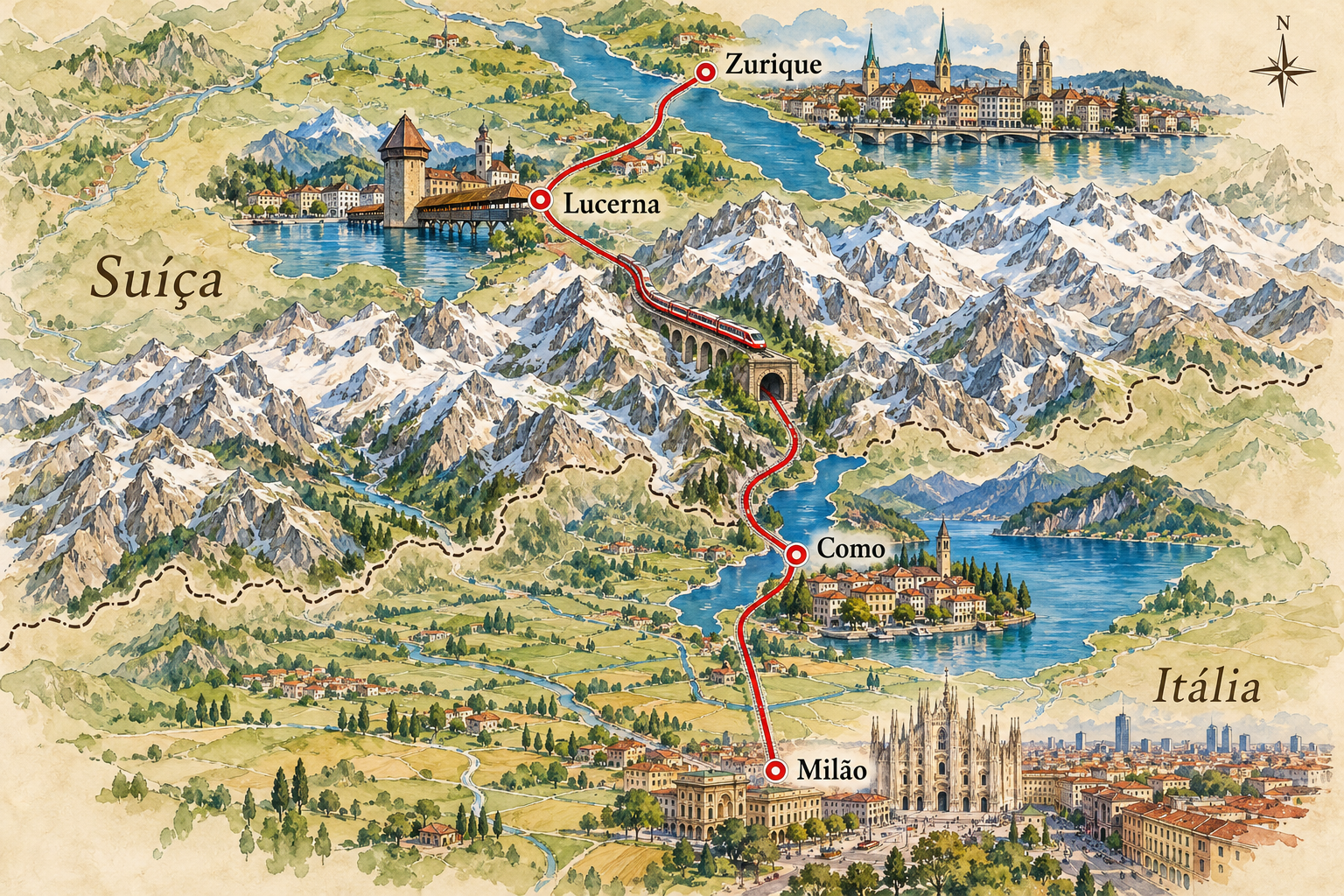
Lucerne and the Mountains is on the Zurich–Milan via the Gotthard

By train from Switzerland to Italy through the Alps: from Zurich to Milan via the Gotthard base tunnel, with Lucerne, Lake Como and, if you have time, the old panoramic mountain line.

Illustrative map, not to scale. Tap a city to open its page.
Illustrated map of Zurich–Milan via the Gotthard
Explore other destinations Search by state and city