

 Brazil
 Antarctica
 Argentina
 Bolivia
 Chile
 Colombia
 Ecuador
 Falkland Islands (Malvinas)
 French Guiana
 Guyana
 Paraguay
 Peru
 Suriname
 Uruguay
 Venezuela
 Albania
 Austria
 Belgium
 Croatia
 Denmark
 Finland
 France
 Germany
 Greece
 Hungary
 Iceland
 Ireland
 Italy
 Luxembourg
 Norway
 Poland
 Portugal
 Slovakia
 Slovenia
 Spain
 Sweden
 Switzerland
 the Czech Republic
 the Netherlands
 the United Kingdom
 Turkey
 Bermuda
 Canada
 Greenland
 Mexico
 Saint Pierre and Miquelon
 the United States
 the Dominican Republic
 Japan
 Egypt
 South Africa
 Australia
 Fiji
 Papua New Guinea
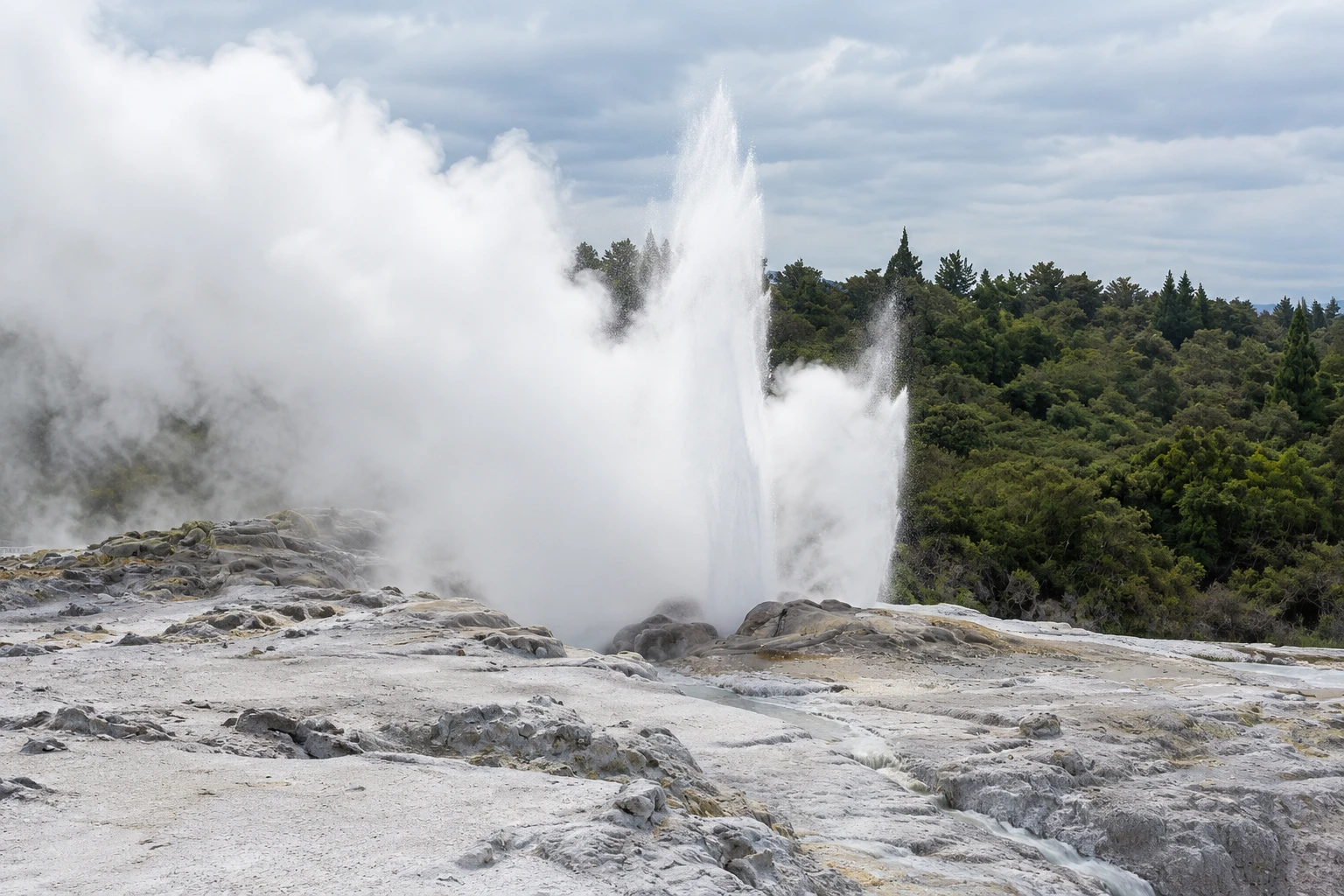
Geothermal area · Rotorua, New Zealand
Te Puia
Park in the Te Whakarewarewa geothermal valley, with the Pōhutu geyser, boiling mud lakes, the national school of Māori carving and weaving, a kiwi house and cultural performances.
Illustrative images. The pictures in this guide are illustrations based on the real place, not photographs, and may differ from it.

Discover
About Te Puia
Te Puia occupies part of the Te Whakarewarewa geothermal valley at Rotorua’s southern edge, about 3 km from the city center. The valley has hundreds of springs, boiling mud pools, silica terraces and geysers. The main one is Pōhutu, whose name means "great spout": it erupts several times a day and sends water and steam up to about 30 meters high.
The park houses the National Institute of Māori Arts and Crafts, established by law to preserve wood carving, weaving and other traditional arts. In workshops open to visitors, students and masters work in front of the public, and a gallery displays finished pieces.
A night house with controlled lighting allows viewing of the kiwi, the country’s emblematic bird, which is nocturnal and hard to find in the wild. During the day there are Māori singing and dance performances in a meeting house (marae), and at night there are programs with a hāngī dinner and a visit to the illuminated valley.
Visits can be with a guide or self-guided, along boardwalks and marked trails. Admission is paid; check the current price list and combinations that include performances and dinner.
Before you go
Practical information
Cidade Turismo reviews its information regularly, but something may have changed. Check with the place before planning your trip.
How much time to set aside
About 2–3 hours for the valley, workshops, kiwi house and a performance; 3–4 hours for the evening programs with dinner.
Best time
In the morning, when the steam is more visible in the cool air. Pōhutu has no fixed schedule; it typically erupts several times a day, so allow time to wait. Evening programs show the illuminated valley.
How to get there
By car or taxi, about 5 minutes from Rotorua center via Fenton Street and Hemo Road, with parking. City buses stop near the entrance. On foot, about 40 minutes from the center.
Tip
Stay near the Pōhutu viewpoints and be patient: the eruption may take time. Do not leave the boardwalks, because the ground around the springs is thin and very hot.
Official website
Your questions
Frequently asked questions about Te Puia
How often does the Pōhutu geyser erupt?
Pōhutu usually erupts several times a day, at no fixed times. Some eruptions last only a few minutes; others last longer.
Is there kiwi at Te Puia?
Yes, in a dimly lit house where you can see the kiwi, which is nocturnal.
How long does the visit to Te Puia take?
About two to three hours for the valley, the workshops and a cultural performance.
What is the difference between Te Puia and the village of Whakarewarewa?
Both are in the same geothermal valley. Te Puia has the Pōhutu geyser nearby, the Māori arts school and the kiwi house; Whakarewarewa is a lived-in village where residents show everyday life heated by the earth.