Cagliari

Sardinia Capital

Cagliari

In the destination Sardinia.

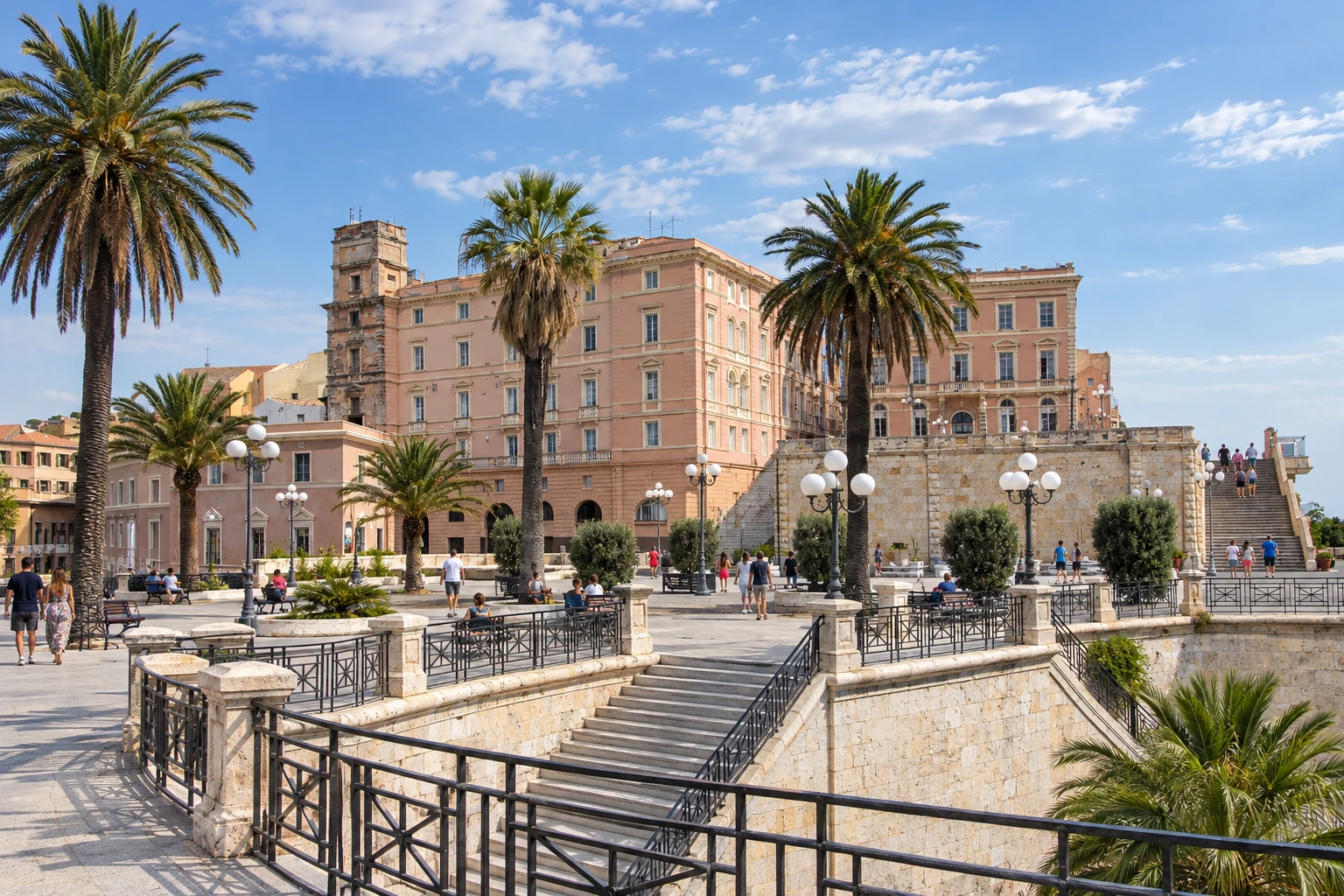
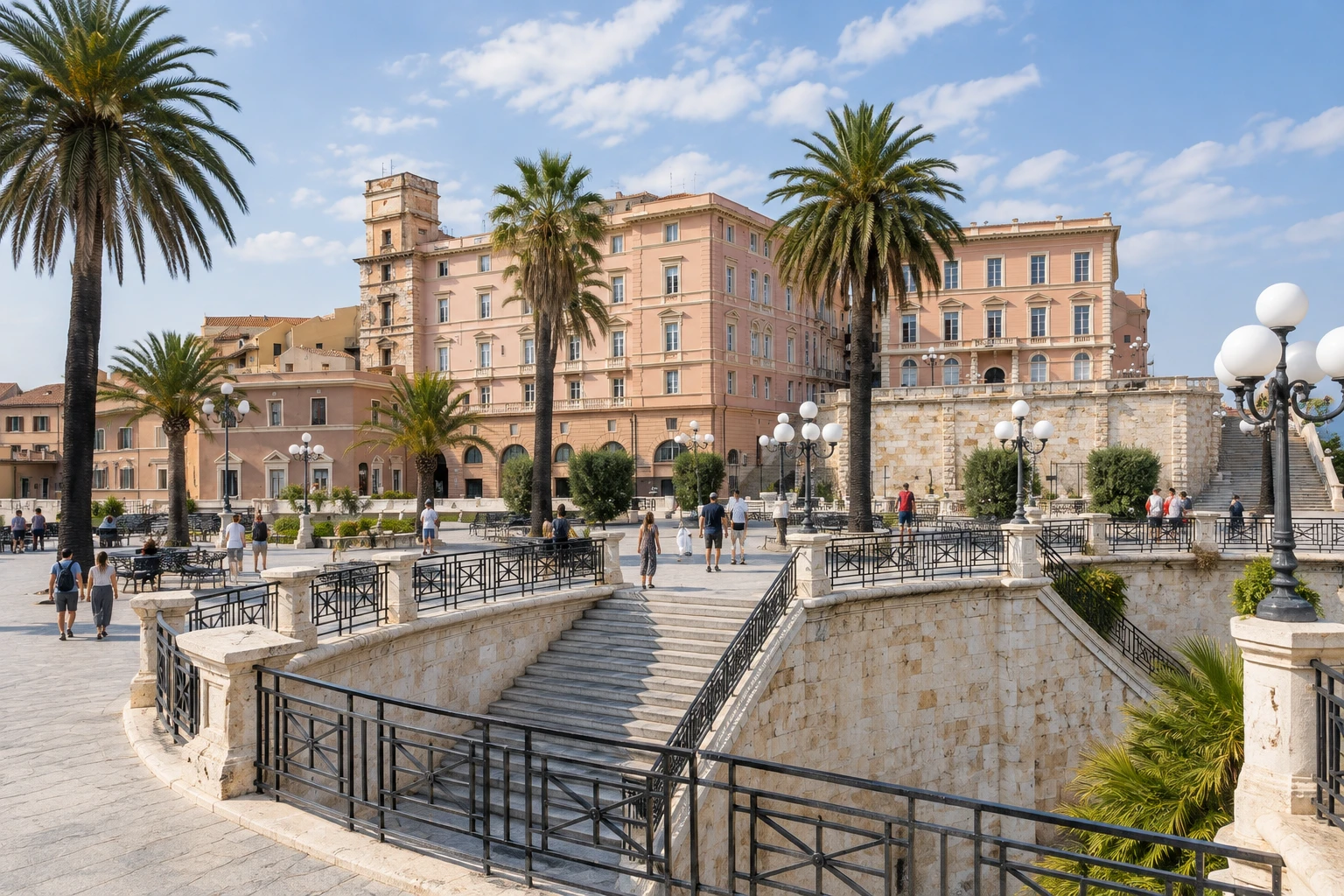
In the photo: Terrazza Umberto I, Bastione Saint Remy, Cagliari

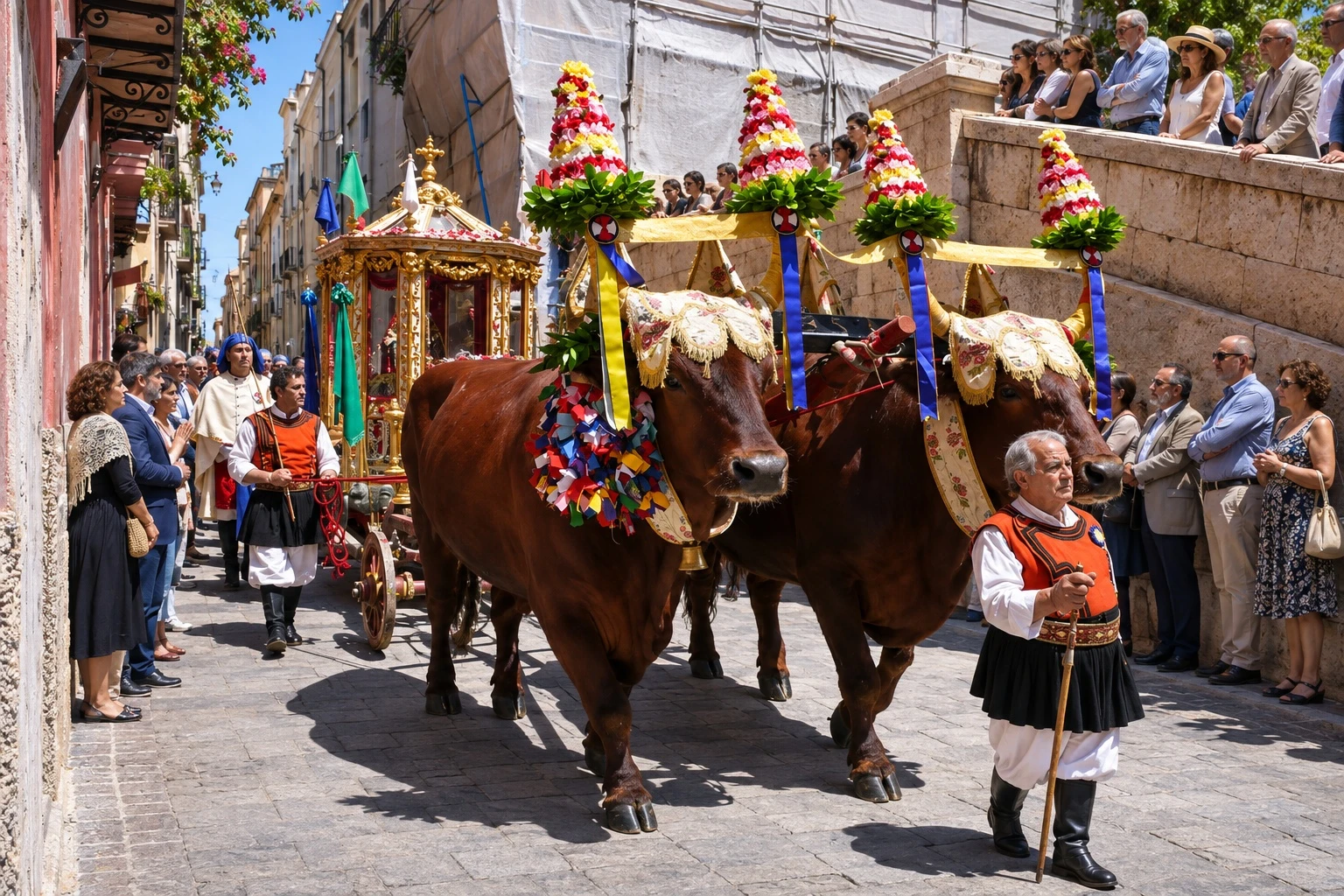
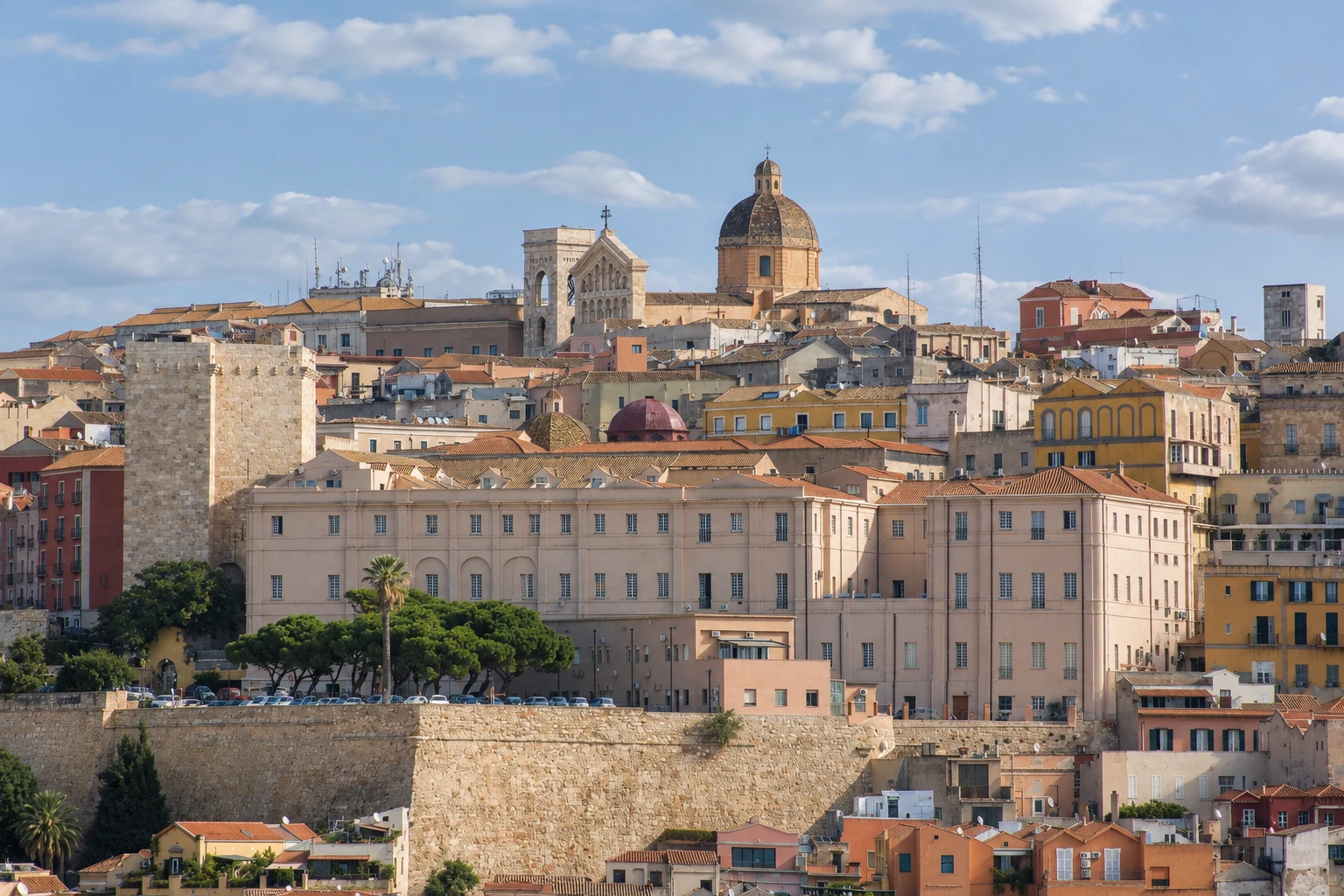
Illustrative images. The pictures in this guide are illustrations based on the real place, not photographs, and may differ from it.

Get it on Google Play

The city

What to expect from Cagliari.

Capital of Sardinia, on the Gulf of Cagliari, in the south of the island. The city climbs limestone hills up to the Castello, a walled district founded by the Pisans in the 13th century, with the Cattedrale di Santa Maria and the Bastione di Saint Remy. Below are the port, the Basilica of Bonaria and the Museo Archeologico Nazionale. To the east lie the Poetto beach and the Molentargius lagoons, with flamingos. It is a base for visiting Nora and Su Nuraxi di Barumini.

Cagliari sits at the head of the Golfo degli Angeli on the southern tip of Sardinia, where the Campidano plain ends. The regional capital and the island’s largest city has around 150,000 residents, a metropolitan population of 430,000 and a port for ferries and cruise ships. The city spreads between the sea, two wetlands, Santa Gilla to the west and Molentargius to the east, and a group of low hills of pale limestone. Like Rome, it counts seven hills: Castello, Tuvixeddu, Monte Claro, Sella del Diavolo, Bonaria, San Michele and Monte Urpinu.

Its history unfolds in layers. Phoenicians and Carthaginians established a city here and left the Tuvixeddu necropolis. The Romans called it Karales and left the amphitheater. The basilica of San Saturnino dates to early Christianity. The Pisans fortified the highest hill in the 13th century, Catalan and Aragonese rulers held sway for four centuries, and from the 18th century the House of Savoy opened the city beyond its walls.

The historic center has four neighborhoods. Castello, on the hilltop, is the walled citadel with its Pisan towers, cathedral, Palazzo Regio and Cittadella dei Musei. Below, the Marina began as a fishermen’s and merchants’ quarter beside the port and the arcades of Via Roma. To the west, Stampace is the neighborhood of Sant’Efisio and the starting point for the May 1 procession, near the amphitheater and the Orto Botanico. Villanova, to the east, has shopping streets, the cloister of San Domenico and Holy Week processions. The stairway of the Bastione di Saint Remy connects it to Castello. Farther on are San Saturnino and the Basilica of Bonaria.

The sea is part of city life. Poetto, the city beach, has about 8 kilometers of sand shared by Cagliari and neighboring Quartu Sant’Elena. It begins below the Sella del Diavolo, a headland you can explore on foot. Behind the beach, Molentargius-Saline Park occupies former salt pans where flamingos nest.

The climate is dry and Mediterranean. In July and August, highs reach around 31°C and there is very little rain. The mistral, a northwesterly wind, often tempers the heat. Winters are mild, with averages near 10°C in January. November is the wettest month. May, June and September combine beach days with comfortable temperatures for walking the hills.

This is a city of slopes, stairways and ramps between neighborhoods, with public elevators up to Castello. Cagliari is a base for visiting Nora in Pula, 40 kilometers away, and Su Nuraxi in Barumini, 60 kilometers away.

Share: WhatsApp

Where to stay

30 places to stay in Cagliari.

Where to eat

27 places to eat in Cagliari.

Map of Cagliari

The city's hotels and restaurants on the map.

Festivals and events

Festivals Cagliari

Dates change every year: check this year's date before you travel.

Festival calendar in Italy

The local experience

Things to do in Cagliari

Cagliari · Italy · Historic neighborhood

Castello

Walled neighborhood atop a hill, founded by the Pisans in the 13th century, with medieval gates, towers, the cathedral, the Palazzo Regio and viewpoints over the port and the lagoons.

Explore Castello

Cagliari · Italy · Viewpoint

Saint Remy Bastion

Neoclassical bastion with stairways and a monumental arch that link Villanova to the Castello; at the top, the Terrazzo Umberto I has views over the port, the Marina and the lagoons.

Explore Saint Remy Bastion

Cagliari · Italy · Cathedral

Cagliari Cathedral

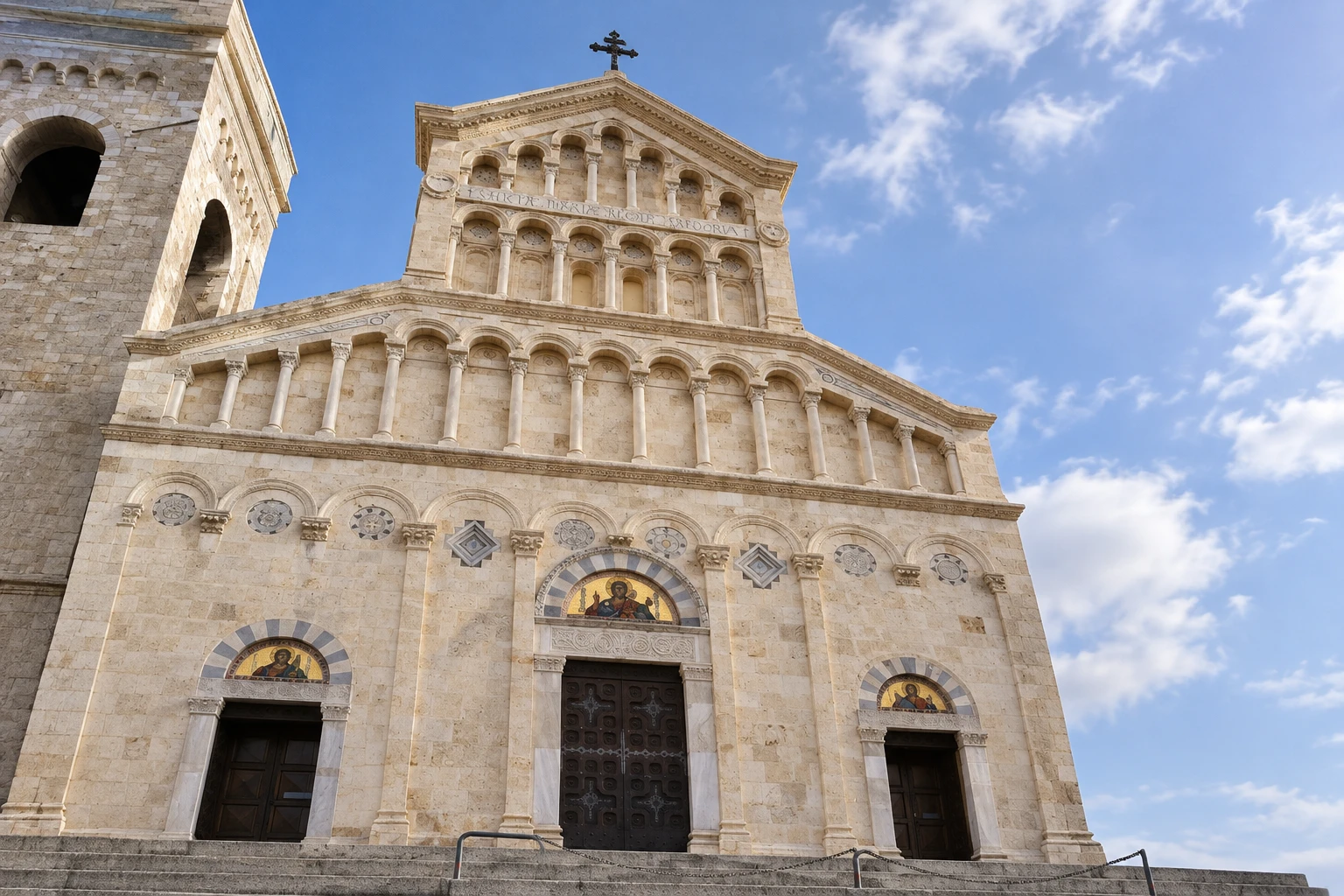
Cathedral of the Castello, of Pisan origin from the 13th century, with a Baroque interior, the Aragonese chapel and a crypt of sculpted chapels; the current façade imitates that of the duomo of Pisa.

Explore Cagliari Cathedral

See 5 more places in Cagliari

To choose before you go

Tours in Cagliari

Where each tour starts, how long it takes, how it is done, what is included and the price range.

Along the walls of Castello: Pisan towers, bastions, and the cathedral

From Piazza Costituzione, at the foot of the Bastione di Saint Remy On foot, using stairs or a public elevator About 3 hours Morning or late afternoon Moderate, with slopes and stairs

Castello occupies Cagliari’s highest hill and was the seat of power for centuries. The Pisans began fortifying it in the 13th century. Catalan, Aragonese and Piedmontese rulers updated the defenses using the techniques of their times. Parts of the walls came down in the late 19th century, but towers, gates and bastions survive as lookouts. The most dramatic approach is through the Bastione di Saint Remy, built in the early 20th century over two older bastions. The stairway ramps lead to Terrazza Umberto I for views over the port, Marina and lagoons. Continue to the Torre dell’Elefante, built in 1307 by architect Giovanni Capula. Its name comes from a small carved elephant on a bracket facing the sea. The passage beneath the tower still has its portcullises. Nearby, the Bastione di Santa Croce is a terrace overlooking Stampace and the sunset. In the middle of the district, Palazzo Regio and the Cattedrale di Santa Maria stand on Piazza Palazzo. Documented in 1255 and enlarged by the Pisans, the cathedral was remodeled in the Baroque style between 1669 and 1674 and received its neo-Romanesque facade in 1931. Inside is Guglielmo’s pulpit, carved for Pisa Cathedral and brought here in 1312. Beneath the altar, the Sanctuary of the Martyrs is a crypt cut into the rock in 1618 with 192 niches for relics. At the northern end, the Torre di San Pancrazio, built in 1305 and twin to the Torre dell’Elefante, guards Porta Cristina, the way out to the Cittadella dei Musei.

Stops: Bastione di Saint Remy, Torre dell'Elefante, Bastione di Santa Croce, Cattedrale di Santa Maria, Palazzo Regio, Torre di San Pancrazio.

Includes: The streets, bastions, terraces, cathedral, and crypt are free. The bell tower and other towers charge for climbs when open. Check current prices.

Tip: Restoration work sometimes closes the Pisan towers, so check before visiting. To skip the climb, use the public elevators, including one by the Bastione di Saint Remy. The pale limestone reflects the sun. In summer, visit early in the morning or late in the afternoon.

Best time: Year-round. On days with a mistral, the wind is strong on the terraces.

Cittadella dei Musei and Galleria Comunale d'Arte

From Piazza Arsenale, beyond Porta Cristina On foot, with stops to see the interiors 3 to 4 hours Morning or afternoon Easy

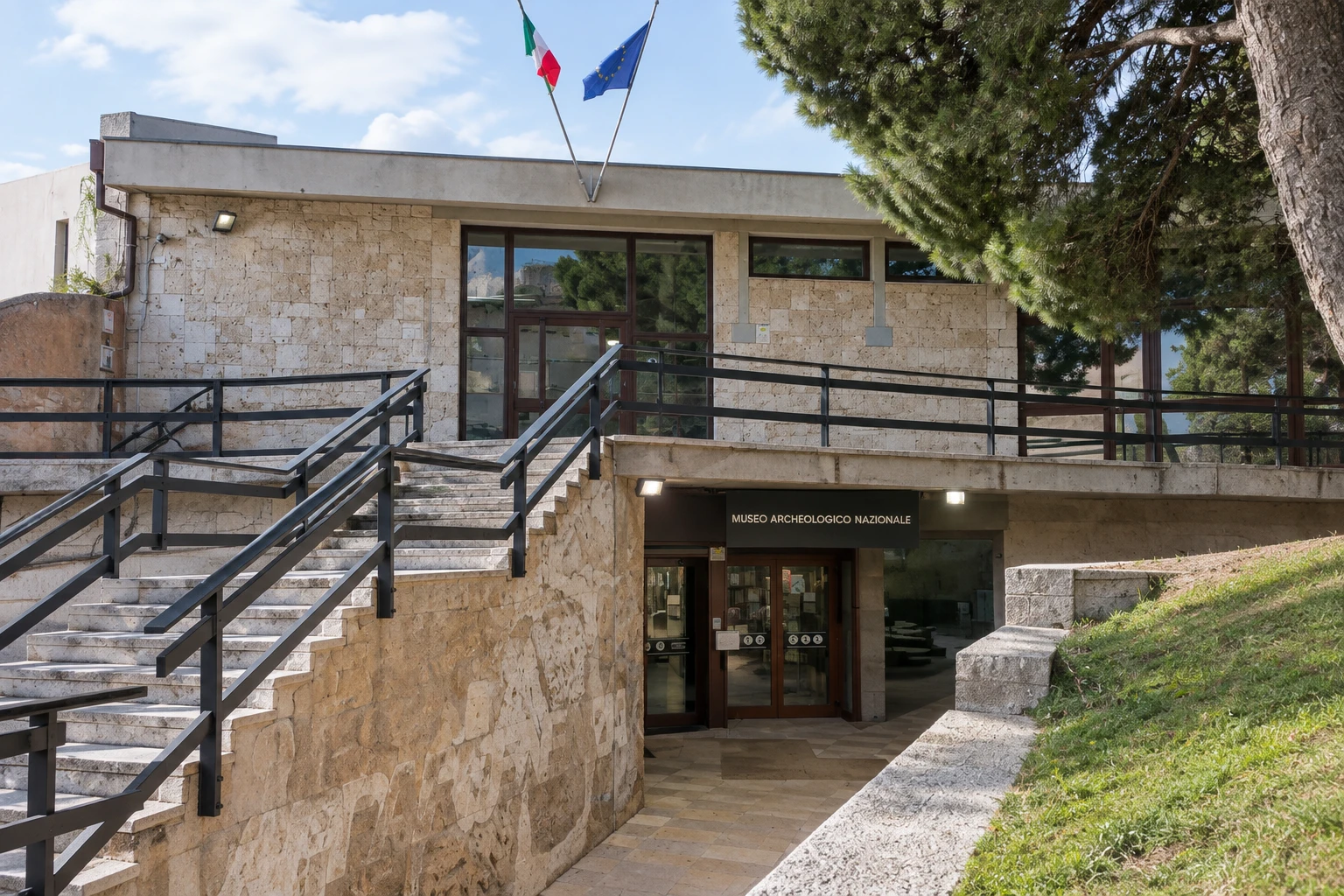
At the northern end of Castello, the former royal arsenal of the House of Savoy, dating to 1727, was restored between 1965 and 1979 to create the Cittadella dei Musei, Sardinia’s largest museum complex. A neoclassical gateway leads into a grassy courtyard overlooking the city. Roman cisterns, Spanish walls and Piedmontese prison cells have become part of the exhibition spaces. The Museo Archeologico Nazionale fills four floors with Neolithic mother goddesses, Nuragic vessels and bronzes, Phoenician jewelry, a reconstruction of the tophet at Tharros and, on the top floor, statues of the Giants of Mont’e Prama. The Pinacoteca Nazionale occupies three levels around the walls and displays Iberian-tradition altarpieces by the Master of Castelsardo and the workshop of Pietro Cavaro, alongside paintings from the 14th through 20th centuries. The Museo d’Arte Siamese Stefano Cardu holds the collection donated to the city in 1914, including Buddhist sculptures, manuscripts, silverware, weapons and porcelain from Thailand and the Far East. In the former prison, a pentagonal room displays anatomical wax models made by Clemente Susini in the early 19th century. A few steps away, the Giardini Pubblici form a terraced garden with a long avenue. At the end, the old royal powder magazine, rebuilt in 1828, houses the Galleria Comunale d’Arte. It displays the Ingrao collection, with works by Boccioni and Morandi, and 20th-century Sardinian artists such as Francesco Ciusa, Costantino Nivola and Maria Lai.

Stops: Museo Archeologico Nazionale, Pinacoteca Nazionale, Museo d'Arte Siamese Stefano Cardu, Museo delle Cere Anatomiche, Giardini Pubblici, Galleria Comunale d'Arte.

Includes: Each museum has its own ticket. The Giardini Pubblici are free. Check current prices.

Tip: If short on time, choose the archaeological museum and see at least the floor with the Giants of Mont'e Prama. Check weekly closing days. State museums are free on the first Sunday of the month.

Best time: Year-round. A good option on rainy or very hot days.

Marina on foot: Via Roma, Palazzo Civico, and Sant'Eulalia

From Via Roma, across from the port Self-guided walk About 2 hours Morning or late afternoon Easy

The Marina is the lower neighborhood between the port and Castello, originally home to fishermen and merchants. This is where you arrive by ship, train or transport from the airport. Via Roma faces the quay with a row of arcaded buildings. On the corner of Largo Carlo Felice stands the white limestone Palazzo Civico, City Hall. In 1896 the city decided to move its municipal seat outside the walls of Castello and closer to the sea. The Catalan Gothic building with Liberty decoration was completed in 1907 and rebuilt after World War II bombing. It has two 38-meter octagonal towers and corner obelisks displaying the heads of the Four Moors. You can tour the interior as a museum to see paintings by Filippo Figari, the 16th-century Councilors’ Altarpiece and a Flemish tapestry from 1620. Behind Via Roma, narrow parallel streets lined with restaurants lead uphill. In their midst is the church of Sant’Eulalia, dedicated to Barcelona’s patron saint. The complex includes a treasury museum with silverware and vestments. Beneath the church an archaeological area of around 900 square meters preserves a late Punic sanctuary and 13 meters of paved Roman street associated with the ancient port. Follow Largo Carlo Felice uphill to Piazza Yenne, where the Marina, Stampace and Castello meet.

Stops: Via Roma arcades, Palazzo Civico, Chiesa di Sant'Eulalia, Museo del Tesoro e Area Archeologica di Sant'Eulalia, Piazza Yenne.

Includes: The streets are free to explore. Palazzo Civico has specific visiting days and hours. The museum and archaeological area of Sant'Eulalia charge admission. Check current prices.

Tip: Explore on foot in two visits: morning for Sant'Eulalia and Palazzo Civico, evening for dinner. The porticoes on Via Roma offer summer shade and shelter on rainy days.

Best time: Year-round.

Stampace and Roman Cagliari: Sant’Efisio, the amphitheater and botanical garden

From Piazza Yenne On foot, with an uphill section 3 to 4 hours Morning Moderate, with hills

Stampace is the medieval quarter west of Castello. From Piazza Yenne, Via Azuni passes the Baroque church of Sant’Anna and leads to the small church of Sant’Efisio, where the saint’s procession begins every May 1. The present building dates to the 18th century and stands over a cave about 9 meters deep. Local tradition identifies it as the prison where Ephysius was held before his martyrdom on Nora beach in 303. Steps cut into the rock lead to the crypt. A few meters away is the crypt of Santa Restituta with its ancient cisterns. Climb the Buoncammino slope to the Roman amphitheater, the largest public building in Roman Sardinia, constructed between the late first and early second centuries. Part of the seating, the arena and the corridors were carved into the rock. It held around 10,000 spectators. After the gladiatorial games ended, it served as a quarry until the 19th century. Just below, the university’s Orto Botanico occupies about five hectares of the Palabanda valley. Work began in 1864. There is a succulent section, a palm grove, Mediterranean woodland and a medicinal plant bed, with a Roman quarry and cisterns among the greenery. About 600 meters from the amphitheater, the site known as Villa di Tigellio preserves parts of three Roman houses with stucco and mosaic decoration and the remains of baths.

Stops: Chiesa di Sant'Anna, Chiesa di Sant'Efisio, Cripta di Santa Restituta, Roman amphitheater, Orto Botanico, Villa di Tigellio.

Includes: The churches are free to enter. The crypt of Sant’Efisio has limited hours. The amphitheater, botanical garden and Villa di Tigellio charge separate admission. Check current prices and opening days.

Tip: The amphitheater interior isn’t always open. You can see the whole site from above at the Buoncammino lookout. Check ahead. The botanical garden provides a shady break on the route. Bring water for the climb.

Best time: Spring and fall. On May 1, the feast of Sant’Efisio fills the neighborhood.

Villanova, San Saturnino and Bonaria Hill

From Piazza Costituzione Self-guided walk About 3 hours Morning or afternoon Easy, with a climb at the end

Villanova lies east of Castello, connected to it by the staircase of the Bastione di Saint Remy. It has shopping streets, the cloister of San Domenico and Holy Week processions that bring the whole neighborhood together. Head south to the Basilica of San Saturnino, Cagliari’s oldest church and Sardinia’s oldest early Christian monument. Built in the fifth and sixth centuries over the grave of Saturninus, the city’s patron saint, beheaded in 304, it stands amid a Roman and Byzantine necropolis exposed by excavations. The dome and part of the apse survive from the Greek-cross building. In 1089 it was given to the monks of Saint-Victor of Marseille, who rebuilt it in the Provençal Romanesque style. A few hundred meters away, Bonaria hill brings together three sights. The Cimitero Monumentale is an open-air sculpture gallery. The small sanctuary of 1324 is the island’s first example of Catalan Gothic architecture. It holds the wooden statue of the Virgin that, according to tradition, washed ashore in a crate in 1370 and gave Buenos Aires its name. Next door, the basilica, begun in 1704 and consecrated in 1926, has a bright nave and a long staircase descending from its square toward the sea. The convent museum displays sailors’ votive offerings, including model ships.

Stops: Villanova, Chiostro di San Domenico, Basilica di San Saturnino, Cimitero Monumentale di Bonaria, Santuario e Basilica di Nostra Signora di Bonaria.

Includes: The churches and cemetery are free to enter. The sanctuary museum may request a donation. San Saturnino has limited opening days and hours. Check before you go.

Tip: San Saturnino has short opening hours, so visit it first. The Bonaria steps catch the late-afternoon light and face Su Siccu marina.

Best time: Year-round. Processions take place in Villanova during Holy Week. On the first Sunday in July, the Bonaria feast includes a boat procession.

Poetto beach stop by stop: from Marina Piccola to the Spanish tower

From Via Roma, by city bus City bus (routes PF and PQ) or bike 4 to 6 hours Full day Easy

Poetto is Cagliari’s beach and one of the largest urban beaches in Europe. Some 8 kilometers of sand stretch from Sella del Diavolo to Margine Rosso, half in the city and half in Quartu Sant’Elena. Until the early 20th century residents favored the western side of the gulf. Then came the first bathing establishments, kiosks and colorful wooden huts, which were removed in 1986. The Cagliari stretch is divided into fermate, the stops of the old tram and today’s buses. The first stop, beside Marina Piccola harbor at the foot of the headland, has the shallowest water. The historic D’Aquila and Lido beach clubs are at the second and third stops. From the fifth stop, marked by a Spanish tower, to the terminus, the sand is open to everyone. Beyond the Quartu boundary, public stretches alternate with beach clubs. The water is clean and the sandy bottom stays shallow for dozens of meters, making it good for children. A wide promenade and bike path behind the beach draw walkers, runners and cyclists. Locals call the kiosks chioschetti. They serve coffee, aperitifs and meals and stay open at night in summer with music. There are sailing schools, small-boat rentals, volleyball and beach tennis courts, and the beach hosts kitesurfing competitions. An entrance to Molentargius-Saline Park opens off the promenade.

Stops: Marina Piccola, Poetto Beach, Spanish tower, Poetto promenade and bike path.

Includes: Bus fare and beach club facilities such as umbrellas and loungers cost extra. The free sections have toilets and showers. Check current prices.

Tip: In July and August the sand near Marina Piccola fills early. More distant stops have more space. In strong winds, Calamosca on the other side of the headland offers a more sheltered cove.

Best time: May to October for sea swimming. Water temperatures reach about 22°C in June. During the rest of the year, walk and have lunch at the kiosks on sunny days.


See 3 more tours

Sella del Diavolo and Calamosca: the headland trail

From Calamosca or Marina Piccola On foot along a trail 2 to 3 hours round trip Morning or late afternoon Moderate, on a rocky trail

The Sella del Diavolo is the limestone headland that bounds Poetto and marks the center of the Golfo degli Angeli. Its saddle-shaped profile is visible from almost anywhere in the city. According to legend, angels and demons fought over the gulf. Defeated by the archangel Michael, Lucifer lost his saddle, which fell and turned to stone, and the gulf took the victors’ name. Trails start at the parking lot beside Calamosca beach or at the little harbor of Marina Piccola. The climb takes about an hour through dwarf palms, junipers, wild olives and mastic shrubs. From the top you can see all of Poetto, the Molentargius lagoons behind it and, on clear days, Capo Carbonara. Along the way are traces of a Punic temple dedicated to Astarte, two cisterns, one Punic and one Roman, the foundations of a medieval church, a Spanish-period watchtower and a World War II fort. Peregrine falcons and kestrels are among the birds that live on the headland. Calamosca, about 4 kilometers from the center, is a small sandy and pebbly cove between the Sella and Capo Sant’Elia, with green water and a gently sloping bottom. Above it stands a watchtower built by the Spanish in the 17th century. With suitable footwear you can follow the slope to rocky-bottomed Cala Fighera.

Stops: Calamosca, Calamosca Tower, Sella del Diavolo, Cala Fighera, Marina Piccola.

Includes: The trail and beach are free. Guided walks, including sunset outings, cost extra.

Tip: Wear sneakers or boots. The ground is loose rock, and there's no shade or water on the route. In summer go early or late, and descend before dark if you're without a guide.

Best time: October through May for comfortable walking. In summer, go early or late in the day.

Molentargius-Saline: flamingos and the salt town

From Park entrance, between downtown and Poetto On foot, by bike, by boat, or on the park's electric bus 2 to 3 hours Morning or late afternoon Easy, flat

Between Cagliari, Quartu Sant’Elena and Poetto, Molentargius-Saline Park covers about 1,600 hectares of lagoons and former salt pans. For two and a half centuries this was Sardinia’s richest salt-producing area. Its name comes from molenti, the donkey that carried the loads. Production ended in 1985. The area joined the Ramsar Convention’s list of internationally important wetlands in 1977 and became a regional park in 1999. The park has two adjacent systems. Freshwater lagoons such as Bellarosa Minore and Perdalonga are fringed with reeds and shelter herons, stilts and several duck species. The saltwater areas, Bellarosa Maggiore and the former evaporation basins, attract flamingos year-round. They nest on the Bellarosa Maggiore embankment. With luck, you may see a swamphen with blue plumage and a red bill. You can explore the green areas independently on foot or by bicycle. The park’s environmental education center leads tours on foot, by bicycle, by boat along the canals or by electric bus, stopping at a bird hide. Bike rentals are available. Structures from the salt industry also survive, including 19th-century channels and tanks, iron bridges, the workers’ village and the “salt city” of the 1920s and 1930s. The latter includes the management building, the Sali Scelti building now used as park headquarters and the old workers’ club, now a theater.

Stops: Parco Naturale Regionale Molentargius-Saline, Bellarosa Maggiore, Bellarosa Minore, Edificio Sali Scelti, Canals of the former saltworks.

Includes: The open-access paths are free. Guided visits, boat and electric bus rides, and bike rentals cost extra. Check current prices.

Tip: Bring binoculars. The flamingos stay away from shore and should be left undisturbed. Early and late in the day offer more birds and softer light. There's little shade, so avoid midday in summer.

Best time: Flamingos are present year-round. Spring and fall offer comfortable temperatures for cycling.

The hills of Cagliari: Tuvixeddu, Castello di San Michele, and Monte Urpinu

From Downtown Cagliari City bus or taxi between hills, then on foot on each hill 4 to 5 hours for all three, about 1 hour 30 minutes each Morning or afternoon Easy to moderate

Three of the seven hills stand outside the historic center and show another side of Cagliari. Visit one in half a day or combine all three in a day. Tuvixeddu, whose name means “small hole,” is an 18-hectare limestone hill riddled with cavities. It is the largest known Punic necropolis, with around a thousand shaft tombs used from the sixth through the third centuries BC and reused by the Romans. Walkways let you see chambers at the bottom of shafts 3 to 11 meters deep. Some have paintings, including the Tomb of the Uraeus and the Warrior’s Tomb. Finds are in the archaeological museum. On the slope facing Viale Sant’Avendrace is the Grotta della Vipera, a Roman tomb built by Lucius Cassius Philippus for his wife Atilia Pomptilla, with serpents carved on the pediment. Castello di San Michele stands in a park on its namesake hill in the Is Mirrionis neighborhood. A square limestone fortress with three corner towers and a moat, it was probably founded in the 12th century, enlarged in the 13th and converted into a fortified residence by the Aragonese Carroz family from 1325 onward. The 360-degree view takes in Castello, the port, Poetto, Sella del Diavolo and the Santa Gilla lagoon. The 22-hectare Monte Urpinu park between Molentargius and Bonaria has pines, ponds with swans, ducks and turtles, free-roaming peacocks and lookouts over the salt pans and old city.

Stops: Necropoli di Tuvixeddu, Grotta della Vipera, Castello di San Michele, Parco di Monte Urpinu.

Includes: The San Michele and Monte Urpinu parks are free. Tuvixeddu, Grotta della Vipera, and the castle interior have specific visiting days and hours. Check ahead.

Tip: Tuvixeddu and the castle have limited opening hours. Check both and plan the day around them. Monte Urpinu is good for children and for viewing flamingos at a distance from above.

Best time: Spring and fall. In summer, go early in the morning.

Day by day

1, 2 and 3-day itinerary in Cagliari

Suggestions to plan the trip. Change the order of the days according to the weather and tour availability.

1 day · One day in Cagliari: Castello, the museum, Marina and late afternoon at Poetto

For Travelers on a cruise stop, arriving by ferry or passing through the south of the island · Based in Cagliari
  1. Day 1 · From the citadel to the sea

    Start early at the Bastione di Saint Remy, taking the stairs or elevator to Terrazza Umberto I for views of the port and lagoons. Follow the streets of Castello to the Torre dell’Elefante and Bastione di Santa Croce, then enter the Cattedrale di Santa Maria and descend to the crypt of the Martyrs. Continue to the northern end of the neighborhood and spend the late morning in the Museo Archeologico Nazionale at the Cittadella dei Musei. Go up to the floor with the Giants of Mont’e Prama. Head downhill for lunch in the Marina, in the streets behind Via Roma. After lunch, walk under the arcades, view the exterior of Palazzo Civico and, if open, visit the archaeological site beneath the church of Sant’Eulalia. In midafternoon, catch a bus on Via Roma to Poetto. Walk the promenade from Marina Piccola with Sella del Diavolo on one side and stop at a kiosk. From May through October you can go for a swim. Return downtown for dinner in the Marina or Stampace. Save Bonaria, Molentargius and the Sella trail for a longer visit.

2 days · Two days in Cagliari: the four districts, flamingos and the beach
For First visits and weekend trips · Based in Cagliari
  1. Day 1 · Castello, museums and Stampace

    Spend the morning in Castello at the Bastione di Saint Remy, Torre dell’Elefante, cathedral and Piazza Palazzo. Continue to the Cittadella dei Musei for the archaeological museum. If you enjoy painting, add the picture gallery. Have lunch in Castello or head down to Stampace. In the afternoon see the church of Sant’Efisio, the Roman amphitheater from the lookout or inside if open, and the Orto Botanico. Return to the Bastione di Santa Croce late in the afternoon for sunset over Stampace and have dinner in the Marina.

  2. Day 2 · Villanova, Bonaria, Molentargius and Poetto

    Start in Villanova and at the Basilica of San Saturnino, then climb Bonaria hill for the sanctuary, basilica and staircase facing the sea. Before lunch, head to Molentargius-Saline Park. Walk or cycle the paths with binoculars to spot flamingos, or reserve a guided boat or electric bus tour. Spend the afternoon at Poetto, with lunch at a kiosk and a swim in season. If you prefer hiking, take the Sella del Diavolo trail from Marina Piccola in the late afternoon. On your return, walk through the arcades of Via Roma in front of Palazzo Civico.

3 days · Three days in Cagliari: the city, sea and a trip to Nora or Su Nuraxi
For Travelers who want time to explore the city and take a day trip from the same hotel · Based in Cagliari
  1. Day 1 · Castello and the Cittadella dei Musei

    Devote the morning to Castello’s bastions, Pisan towers, cathedral and crypt, and Palazzo Regio. After lunch, spend the afternoon in the Cittadella dei Musei at the archaeological museum and one other museum of your choice. Finish at the Galleria Comunale d’Arte in the Giardini Pubblici. Spend the late afternoon on Terrazza Umberto I, then stroll along Via Roma before dinner in the Marina.

  2. Day 2 · Stampace, Villanova, Bonaria and the sea

    Explore Stampace in the morning, visiting Sant’Efisio, the Roman amphitheater and the Orto Botanico. Cross the center to Villanova, visit San Saturnino and climb to Bonaria. In the afternoon, go to Molentargius-Saline for the flamingos and then to Poetto. On a cool day, hike the Sella del Diavolo trail from Calamosca and descend for a swim in the cove. In summer the Poetto kiosks stay open late. Outside the season, have dinner downtown.

  3. Day 3 · Nora or Su Nuraxi, with a hilltop stop on the way back

    Allow a full day for one of two archaeological sites in neighboring municipalities. Nora in Pula, 40 kilometers away, is a Phoenician and Roman seaside town that pairs well with a beach visit. Drive or take a regional bus to Pula and a local connection. Su Nuraxi in Barumini, 60 kilometers or about an hour away by car, is a UNESCO-listed Nuragic complex visited on guided tours. The trip is long without a car, and organized excursions are available. Back in Cagliari, if there is still daylight, climb to Monte Urpinu park or Castello di San Michele for views over the city. To stay in town, spend the morning at Tuvixeddu and the Grotta della Vipera and enjoy another afternoon at the beach.

Best time to go

When to go: Cagliari month by month

The seasons shown are the most usual ones; nature doesn't always follow the calendar.

January Low rain

Mild winter · Quiet town

Winter. Temperatures average 10°C, with highs near 14°C and about 37 mm of rain. Expect sunny, windy days with a strong mistral at times. The sea is cold. The city goes about its business with few visitors, leaving museums and Castello quiet. On sunny days, walk Poetto and have lunch at the kiosks.

February Low rain

Winter · Museums and walks

Winter. Temperatures average 10°C, with about 34 mm of rain. Temperatures resemble January’s, but days are a little longer. Visitor numbers are low. Explore the Cittadella museums, visit churches and walk the bastions. The Sella del Diavolo trail is comfortable on days without strong winds.

March Low rain

Early spring

Spring begins. Temperatures average 12.4°C, with about 32 mm of rain. Parks and the Orto Botanico turn green and blossom. Days suit visits to the hills of Tuvixeddu, San Michele and Monte Urpinu. The sea is still cold. European daylight saving time begins on the last Sunday.

April Some rain

Spring · Holy Week in Villanova

Spring. Temperatures average 14.8°C, with about 46 mm of rain, the season’s wettest month. During Holy Week, processions pass through Villanova. On the Monday after Easter, a statue of Sant’Efisio is carried from Stampace to the cathedral. The island’s beach hotels reopen around the April 25 holiday.

May Low rain

Feast of Sant’Efisio (May 1–4)

Spring is in full swing. Temperatures average 18.7°C, with about 26 mm of rain. On May 1 the procession of Sant’Efisio leaves the saint’s church in Stampace. Groups from all over the island in traditional dress, riders and decorated oxcarts accompany it to Nora, returning on the 4th. Accommodations usually fill up, so reserve ahead. Beaches are quiet, the water is still cool and flamingos are at Molentargius.

June Low rain

Early summer · Pleasant sea temperatures

Summer. Temperatures average 23°C, with around 12 mm of rain. The sea reaches about 22°C and Poetto has yet to see July’s crowds. Long, dry days suit Castello and museums in the morning, the beach in the afternoon and kiosks at night. This is one of the best-balanced months for combining city and sea.

July Low rain

Midsummer · Feast of Bonaria

Summer. Temperatures average 25.7°C, with highs near 31°C and almost no rain. The beach fills up, especially on weekends. Walk early or late in the afternoon and visit museums and churches at midday. On the first Sunday of the month, the feast of Our Lady of Bonaria includes a boat procession.

August Low rain

High summer · Ferragosto

The hottest and busiest month averages 26.2°C, with about 11 mm of rain. Around Ferragosto on August 15, a holiday throughout Italy, ferries and flights fill up and Poetto’s popular stretches get crowded early. The sea reaches its warmest temperature of the year. Book accommodations and transportation ahead.

September Some rain

Late summer · warm sea

Late summer. Temperatures average 22.7°C, with about 39 mm of rain in brief storms. The sea stays warm and the beach grows quieter after the first week. Afternoons are comfortable again for walking through Castello or hiking the Sella del Diavolo. This is a popular month for combining city and beach without August’s crowds.

October Some rain

Fall · Last beach days

Fall. Temperatures average 18.8°C, with about 44 mm of rain. Sunny days reach around 24°C, and swimming is generally possible until midmonth, after which beach clubs close. It is a good time for the hills, parks and day trips to Nora and Su Nuraxi. European daylight saving time ends on the last Sunday.

November High rain

Fall · Wettest month

Late fall. Temperatures average 14.5°C, with about 74 mm of rain, making this Cagliari’s wettest month. The mistral can blow hard. The city is quiet, a good time for the Cittadella dei Musei, Galleria Comunale, Sant’Eulalia archaeological site and churches. Between weather fronts, the air on Castello’s terraces is clear and the views extend far.

December Some rain

Winter · Christmas in the city

Winter. Temperatures average 11.2°C, with around 55 mm of rain and sunny days near 16°C between weather fronts. Look for Christmas markets and Nativity scenes in churches. Many Sardinians return home between Christmas and New Year, so flights fill up. Buy tickets ahead.

Plan the journey

How to get there: Cagliari

By air: Cagliari Elmas Airport (CAG)

Cagliari’s Mario Mameli Airport is in Elmas, about 7 kilometers from the center, beside the Santa Gilla lagoon. It receives flights from several Italian and European cities. Domestic flights from Rome or Milan take about an hour. Travelers from other continents usually connect in a European city. Check before purchasing.

A walkway links the terminal to Elmas Aeroporto station. Trains take a few minutes to reach Cagliari’s central station on Piazza Matteotti, beside the port and Via Roma. Validate paper tickets before boarding. Taxis and buses are also available.

Flights to Sardinia fill up in high season, so buy ahead. The island’s other two airports, Olbia and Alghero in the north, are about three hours or more away by road.

By ship and ferry

Cagliari’s port faces Via Roma beside the Marina, so you can walk straight into town. Car ferries arrive from Civitavecchia, Rome’s port, in around 13 to 14 hours, from Naples in around 13 hours and from Palermo in around 12 hours. Crossings generally run overnight with cabins and do not operate daily.

In summer, cabins and vehicle spaces sell out. Book ahead and confirm departure days.

Cruise ships also call at Cagliari. From the quay you can walk to the Marina and reach Castello by stairs or elevator. Poetto is about 15 minutes away by bus.

Around the island by train and bus

The central station is on Piazza Matteotti beside the port. Trains connect Cagliari to Oristano in about one hour, Sassari in about three hours and Olbia in about four hours.

Regional buses cover the rest of the island, with limited schedules outside cities. Pula, where you connect for Nora, is about an hour away. Barumini, home to Su Nuraxi, takes about an hour and a half, with few departures. Check the timetable for your travel day. Service is much more limited on Sundays.

For Alghero in the northwest, take the train to Sassari and change to a local train.

By car

The island’s main road, the SS131 Carlo Felice, connects Cagliari with Sassari and Porto Torres in about 2½ to 3 hours. Olbia is about 3½ hours away. Sardinia has no road tolls.

Nora in Pula is 40 kilometers away along the southwest coast. Su Nuraxi in Barumini is 60 kilometers away, about an hour’s drive.

You can do without a car in town. The center is walkable and buses serve Poetto. Castello has a camera-monitored limited-traffic zone, or ZTL, closed to outside vehicles. Park in the lower town and walk or take an elevator up. If renting a car to tour the island, you can pick it up at the airport as you leave Cagliari.

Getting around the city

You can explore the four historic neighborhoods on foot, but Cagliari is hilly. Slopes and stairs connect the Marina to upper Castello. Three public elevators save the climb, at Santa Chiara near the Torre dell’Elefante, the Bastione di Saint Remy and Piazza Indipendenza. Check that they are running.

City buses leave from around Via Roma and Piazza Matteotti. Routes PF and PQ reach Poetto in about 15 minutes. City buses or taxis also serve Bonaria, Monte Urpinu, Castello di San Michele and Tuvixeddu. Confirm the route.

Calamosca and the start of the Sella del Diavolo trail, about 4 kilometers from downtown, are accessible by city bus or taxi. The Poetto promenade and Molentargius park have bike paths and bicycle rental.

Buy bus tickets at tobacco shops and newsstands and validate them on board. Check routes and schedules before heading out.

Your questions

Frequently asked questions about Cagliari

How to get from Cagliari airport to the center?

By train in a few minutes to the central station at Piazza Matteotti, next to the port and Via Roma. There are also taxis and buses. If the train ticket is paper, validate it before boarding.

Where to stay in Cagliari?

In the Marina or in Stampace, near the station, the port and restaurants. The Castello offers views and quiet, but it's up high and has a ZTL. Those seeking the beach can stay near the Poetto and go to the center by bus.

Can you get to Su Nuraxi without a car?

It is possible with regional buses and connections, but the journey is long and services are limited. By car it's about 60 km and 1 hour. There are also organized tours departing from Cagliari.

What is the feast of Sant'Efisio?

It is Cagliari's big procession, every May 1st, in honor of the patron saint. Groups from across the island parade in traditional dress, with horsemen and decorated ox carts, and the procession continues to Nora. Accommodation usually sells out on that date.

Does Cagliari have a beach in the city?

Yes. The Poetto, east of the center, has about 8 km of sand and is reached by urban bus. There are sections with facilities and free stretches.

How many days should I spend in Cagliari?

Two days cover Castello, the archaeological museum, Marina, Bonaria and an afternoon at Poetto Beach. With three or four days, add Molentargius, the Sella del Diavolo trail, the hills and a day trip to Nora or Su Nuraxi di Barumini.

Can I explore Cagliari on foot?

Yes, in the historic center. Castello, Marina, Stampace and Villanova are right next to each other. Expect hills and stairways, with public elevators to help you get up to Castello. Take a city bus, bike or taxi to Poetto, Molentargius, Calamosca and the hills outside downtown.

How do I get up to Castello without climbing the stairs?

There are three public elevators: Santa Chiara, which brings you close to Torre dell’Elefante, the Bastione di Saint Remy elevator and the one at Piazza Indipendenza. They sometimes close for maintenance, so check that they’re running. The district has a restricted traffic zone that rules out driving there as a visitor.

How do I get from downtown Cagliari to Poetto Beach?

Take city bus PF or PQ from Via Roma. The trip takes about 15 minutes. Stops along the beach are numbered. The first is beside Marina Piccola and Sella del Diavolo. There’s also a bike path. Check routes and schedules before setting off.

Where can I see flamingos in Cagliari?

At Molentargius-Saline Park between town and Poetto, where flamingos can be seen year-round and also nest. Bring binoculars for the free trails, or take a guided tour on foot, by bike, by boat or by electric bus. Flamingos also visit Santa Gilla Lagoon near the airport. For a view over the salt ponds, head up Monte Urpinu.

What is the Sella del Diavolo trail like?

It’s about an hour’s walk from Calamosca or Marina Piccola to the top of the headland, on rocky ground with no shade. Along the way are the remains of a Punic temple, cisterns, a Spanish tower and a small fort. Bring water and closed-toe shoes. In summer, go early or late in the afternoon.

How do I get from Cagliari to Nora?

Nora is in the municipality of Pula, 40 km from Cagliari. By car, follow the southwest coast. By regional bus, the trip to Pula takes about an hour, and a local bus continues to the archaeological site. The site charges separate admission. Check bus schedules and opening hours before you go.

When should I visit Cagliari?

May through October is good for Poetto Beach, with June and September quieter than July and August. April, May and October offer comfortable walking temperatures. On May 1, the city comes to a standstill for the feast of Sant’Efisio. Winter is mild, averaging around 10 °C in January. November is the wettest month.

What can I do in Cagliari on a rainy day?

Visit the Cittadella dei Musei, with its archaeological museum, picture gallery and museum of Siamese art, or the Galleria Comunale d’Arte. Other options include the cathedral and its Crypt of the Martyrs, the archaeological area beneath Sant’Eulalia Church and Palazzo Civico when open to visitors. The arcades along Via Roma offer a sheltered walk.

What can I do in Cagliari with children?

The water stays shallow for dozens of meters at Poetto Beach. Monte Urpinu Park has peacocks, ducks and turtles, and at Molentargius you can spot flamingos by boat or electric bus. Try the botanical garden and the Giants of Mont’e Prama at the archaeological museum, too. The amusement park at the beach opens year-round.

What should I eat in Cagliari?

Seafood defines the local cooking. Try spaghetti with bottarga, cured mullet roe, and artichoke, or burrida, made with dogfish and walnuts. Fregula con cocciula pairs small pasta pearls with clams. Bottarga is also the city’s most popular souvenir. Lunch usually runs from around 12:30 into the early afternoon, and dinner starts around 8 p.m.

Can I reach Cagliari by ship?

Yes. The port faces Via Roma downtown and receives car ferries from Civitavecchia, Naples and Palermo. Crossings take about 12 to 14 hours and do not run every day. Cagliari is also a cruise stop. In summer, book cabins and vehicle spaces well ahead.

What are Cagliari’s historic districts?

There are four. Castello, on the hilltop, is the walled citadel with the cathedral and museums. Marina, next to the port, has restaurants and the arcades of Via Roma. Stampace, to the west, is home to Sant’Efisio and the Roman amphitheater. Villanova, to the east, has shopping streets, the cloister of San Domenico and Holy Week processions.

Can I climb Cagliari’s Pisan towers?

Torre dell’Elefante, built in 1307, and Torre di San Pancrazio, built in 1305, open to visitors at certain times and close for restoration work. Check before going. Free alternatives with similar views include Terrazza Umberto I, Bastione di Santa Croce and the Buoncammino lookout. The cathedral bell tower charges a separate fee to climb.

What remains of Roman Cagliari?

The amphitheater, carved into the Buoncammino hillside, held around 10,000 people. Villa di Tigellio preserves parts of three houses, and the Grotta della Vipera is a first- or second-century tomb. Beneath Sant’Eulalia Church lies a stretch of paved street, and cisterns survive in the botanical garden and on Sella del Diavolo. The city was called Karales.

Traveler, share your experiences through photos Up to 5 photos of each place you visited.
See the destination Sardinia Find another city